Page 46 of 106
3-13
E
EJU01283
Operation
WARNING@ Before operating your watercraft,
become familiar with all controls. Con-
sult your Yamaha dealer about any con-
trols or functions you do not fully
understand. Failure to understand how
controls work could cause an accident or
prevent you from avoiding an accident.
@
EJU01284
Engine break-in
The engine break-in period is essential to
allow the various components of the engine
to wear and polish themselves to the correct
operating clearances. This ensures proper
performance and promotes longer compo-
nent life.
CAUTION:@ �For the first 5 hours or 2 tankfuls of
operation, premix fuel and oil in a 25:1
ratio.
�After break-in, premix fuel and oil in a
50:1 ratio for normal operation.
@
1. Launch the watercraft and start the
engine, and then board the watercraft.
2. Run the engine at the lowest possible
speed for 5 minutes.
UF1N73.book Page 13 Monday, May 10, 2004 10:37 AM
Page 47 of 106
3-14
E
3. Gradually open the throttle lever to 3/4 or
less.
4. Continue operation at 3/4 throttle or less
until the first tankful of fuel has been
used.
5. Fill the tank once more with a fuel-to-oil
ratio of 25:1, and proceed with normal
operation.
CAUTION:@ Failure to follow the engine break-in pro-
cedure properly can result in severe
damage to the engine.
@
UF1N73.book Page 14 Monday, May 10, 2004 10:37 AM
Page 48 of 106
3-15
E
EJU01137
Starting the engine
WARNING@ Never start the engine or let it run for any
length of time in an enclosed area.
Exhaust fumes contain carbon monox-
ide, a colorless, odorless gas that may
cause loss of consciousness and death
within a short time. Always operate the
watercraft in an open area.
@
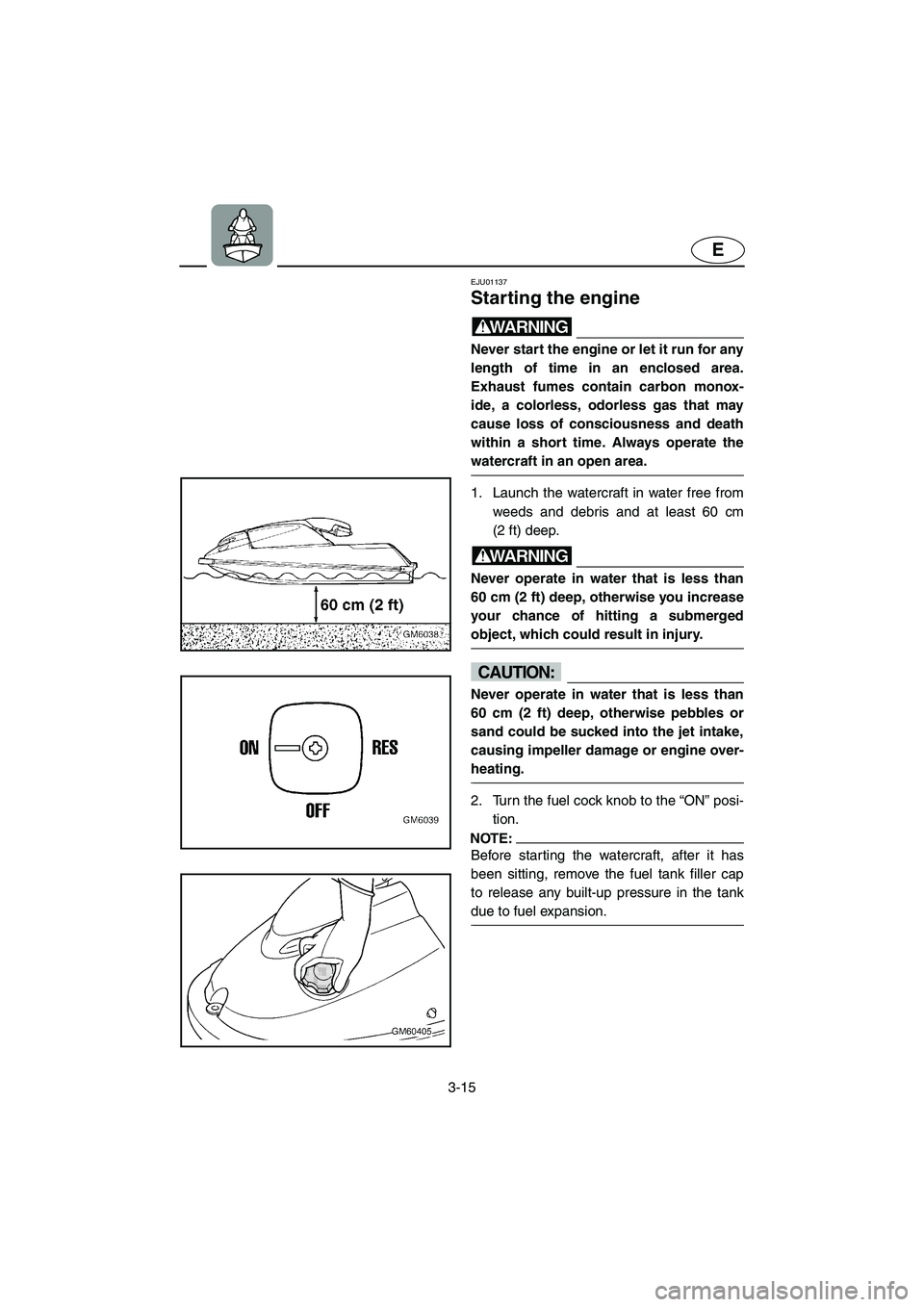
1. Launch the watercraft in water free from
weeds and debris and at least 60 cm
(2 ft) deep.
WARNING@ Never operate in water that is less than
60 cm (2 ft) deep, otherwise you increase
your chance of hitting a submerged
object, which could result in injury.
@
CAUTION:@ Never operate in water that is less than
60 cm (2 ft) deep, otherwise pebbles or
sand could be sucked into the jet intake,
causing impeller damage or engine over-
heating.
@
2. Turn the fuel cock knob to the “ON” posi-
tion.
NOTE:@ Before starting the watercraft, after it has
been sitting, remove the fuel tank filler cap
to release any built-up pressure in the tank
due to fuel expansion.
@
UF1N73.book Page 15 Monday, May 10, 2004 10:37 AM
Page 67 of 106
3-34
E
EJU01956
Transporting
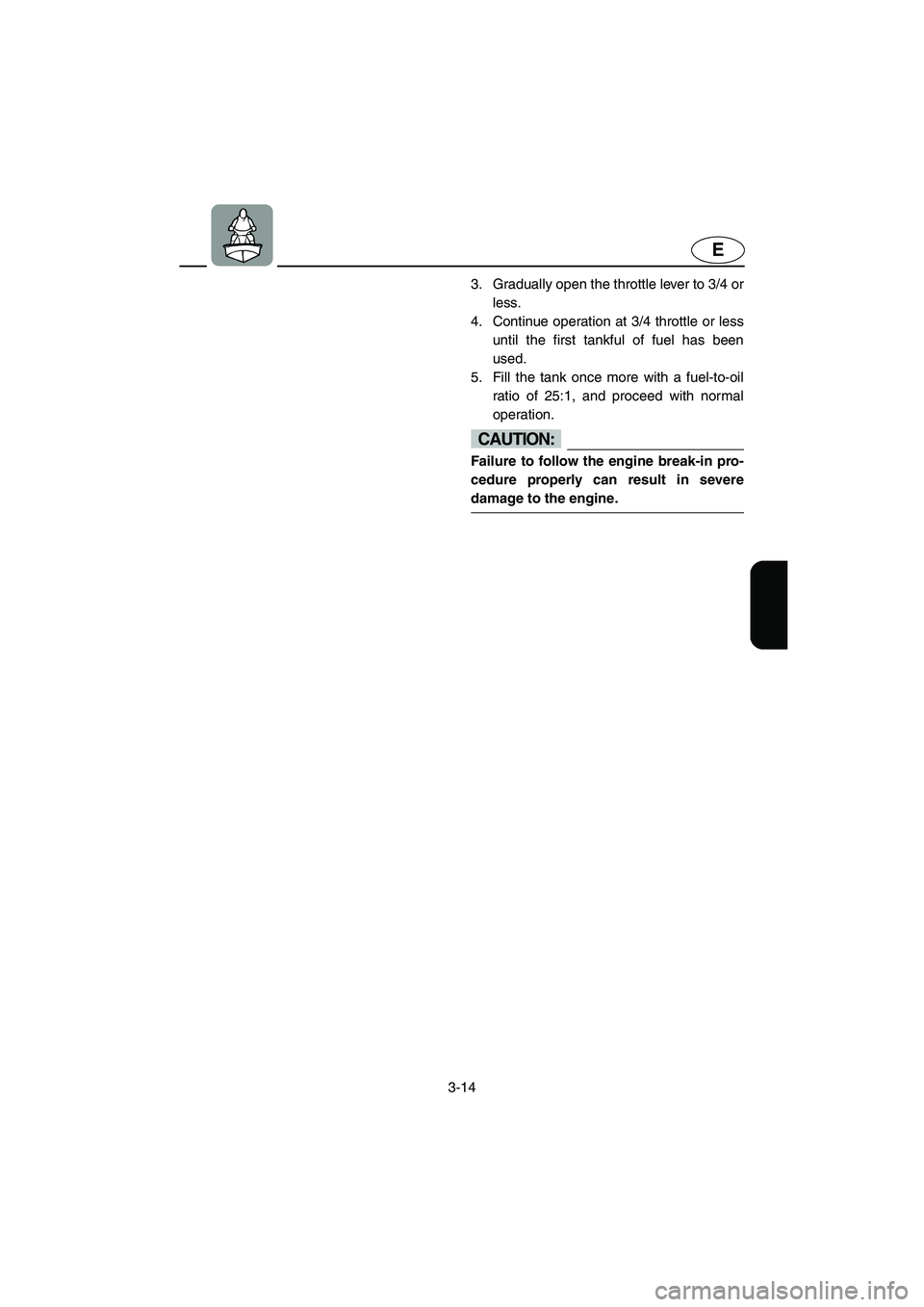
WARNING@ Always place the fuel cock knob in the
“OFF” position when transporting the
watercraft, otherwise fuel could leak out
into the engine or engine compartment,
which would create a fire hazard.
@
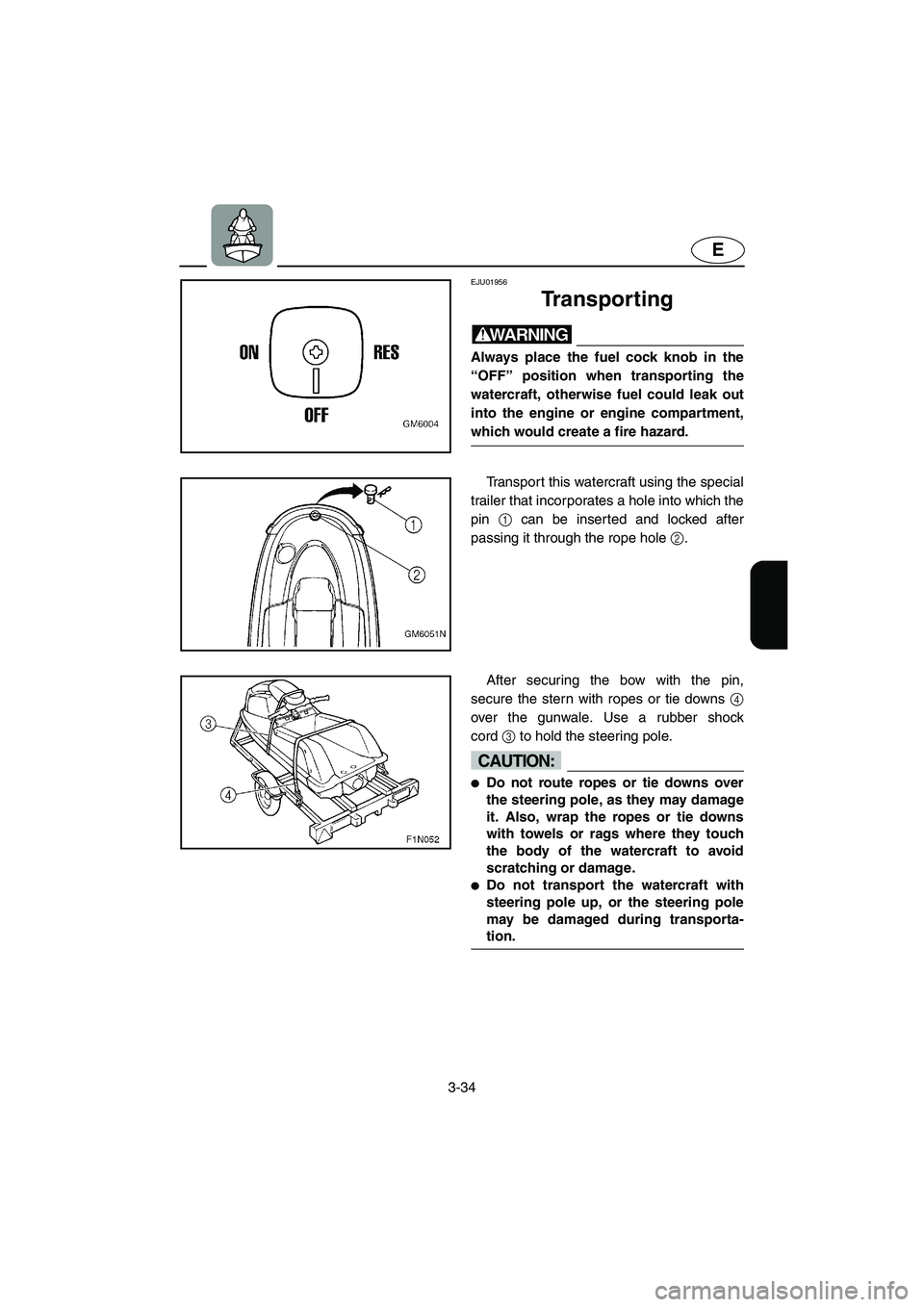
Transport this watercraft using the special
trailer that incorporates a hole into which the
pin 1 can be inserted and locked after
passing it through the rope hole 2.
After securing the bow with the pin,
secure the stern with ropes or tie downs 4
over the gunwale. Use a rubber shock
cord3 to hold the steering pole.
CAUTION:@ �Do not route ropes or tie downs over
the steering pole, as they may damage
it. Also, wrap the ropes or tie downs
with towels or rags where they touch
the body of the watercraft to avoid
scratching or damage.
�Do not transport the watercraft with
steering pole up, or the steering pole
may be damaged during transporta-
tion.
@
UF1N73.book Page 34 Monday, May 10, 2004 10:37 AM
Page 69 of 106
E
4
EJU01086
MAINTENANCE AND
CARE
Storage ...................................................... 4-1
Flushing the cooling system .................. 4-1
Lubrication .............................................. 4-3
Fuel system ............................................ 4-4
Battery .................................................... 4-5
Cleaning the watercraft .......................... 4-6
Maintenance and adjustments .............. 4-7
Owner’s/Operator’s Manual and
tool kit ..................................................... 4-8
Periodic maintenance chart ................... 4-9
Inspecting the fuel system ................... 4-10
Inspecting the jet thrust nozzle
angle ..................................................... 4-12
Inspecting and adjusting the throttle
cable ..................................................... 4-12
Cleaning and adjusting the spark
plugs ..................................................... 4-13
Lubrication points ................................. 4-14
Adjusting the choke cable .................... 4-16
Inspecting the battery .......................... 4-17
Adjusting the carburetor ...................... 4-19
Replacing the fuse ............................... 4-20
Adjusting the steering friction .............. 4-20
Adjusting the jet thrust nozzle angle ... 4-21
Specifications ........................................ 4-23
UF1N73.book Page 1 Monday, May 10, 2004 10:37 AM
Page 70 of 106
4-1
E
EJU01087
Storage
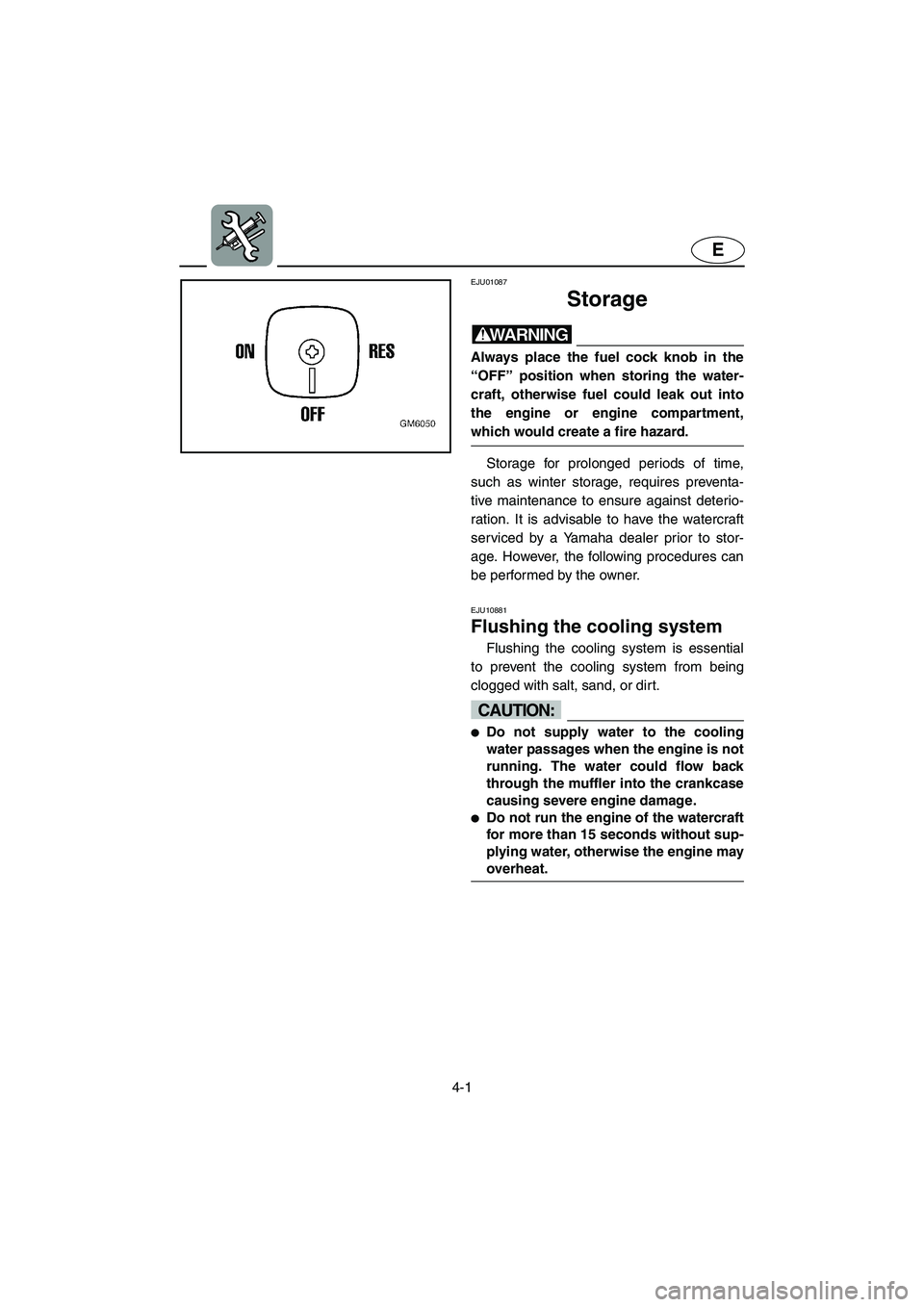
WARNING@ Always place the fuel cock knob in the
“OFF” position when storing the water-
craft, otherwise fuel could leak out into
the engine or engine compartment,
which would create a fire hazard.
@
Storage for prolonged periods of time,
such as winter storage, requires preventa-
tive maintenance to ensure against deterio-
ration. It is advisable to have the watercraft
serviced by a Yamaha dealer prior to stor-
age. However, the following procedures can
be performed by the owner.
EJU10881
Flushing the cooling system
Flushing the cooling system is essential
to prevent the cooling system from being
clogged with salt, sand, or dirt.
CAUTION:@ �Do not supply water to the cooling
water passages when the engine is not
running. The water could flow back
through the muffler into the crankcase
causing severe engine damage.
�Do not run the engine of the watercraft
for more than 15 seconds without sup-
plying water, otherwise the engine may
overheat.
@
UF1N73.book Page 1 Monday, May 10, 2004 10:37 AM
Page 73 of 106
4-4
E
EJU19640
Fuel system
Draining the fuel system prevents buildup
of varnishes and other harmful deposits that
result when gasoline sits for a prolonged
period of time.
WARNING@ GASOLINE AND ITS VAPORS ARE
HIGHLY FLAMMABLE AND EXPLOSIVE!
�Do not smoke when refueling, and
keep away from sparks, flames, or
other sources of ignition.
�Stop engine before refueling.
�Refuel in a well-ventilated area with
the watercraft in a horizontal position.
�Do not stand or sit on the watercraft
while refueling in case of fire.
�Take care not to spill gasoline. If gaso-
line spills, wipe it up immediately with
dry rags. Always properly dispose of
gasoline-soaked rags.
�Avoid overfilling the fuel tank. Stop fill-
ing when the fuel level just reaches the
bottom of the filler tube. Do not fill up
the filler tube because fuel expands as
it warms up and could overflow. If tem-
porarily leaving the watercraft with a
full fuel tank, do not leave it in direct
sunlight. Leave it in a well-ventilated
area with the watercraft in a horizontal
position.
�Tighten the filler cap securely after
refueling.
�If you should swallow some gasoline,
inhale a lot of gasoline vapor, or get
gasoline in your eyes, get immediate
medical attention.
�If any gasoline spills onto your skin,
immediately wash with soap and
water. Change clothing if gasoline
spills on it.
@
UF1N73.book Page 4 Monday, May 10, 2004 10:37 AM
Page 74 of 106
4-5
E
To drain the fuel system:
1. Place the fuel cock knob in the “OFF”
position.
2. Drain the fuel tank using a siphon.
EJU19700
Battery
If the watercraft will not be used for more
than a month, disconnect the negative (–)
lead first, then the positive (+) lead and
breather hose, and then remove the battery
from the watercraft.
Clean the battery casing using fresh
water.
If the battery terminals are dirty or cor-
roded, clean them with a wire brush.
Fully charge the battery, and then store it
in a cool, dark place.
Apply Yamaha marine grease or Yamaha
grease A to the battery terminals.
Check the battery at least every 2 months
and fully charge it if necessary.
WARNING@ Be sure to connect the breather hose to
the battery. Fire or explosion could result
if the breather hose is damaged,
obstructed, or not connected properly.
@
CAUTION:@ The battery may not be usable again if
you store it for a long period without
charging it. Charge the battery periodi-
cally.
@
UF1N73.book Page 5 Monday, May 10, 2004 10:37 AM