Page 100 of 400
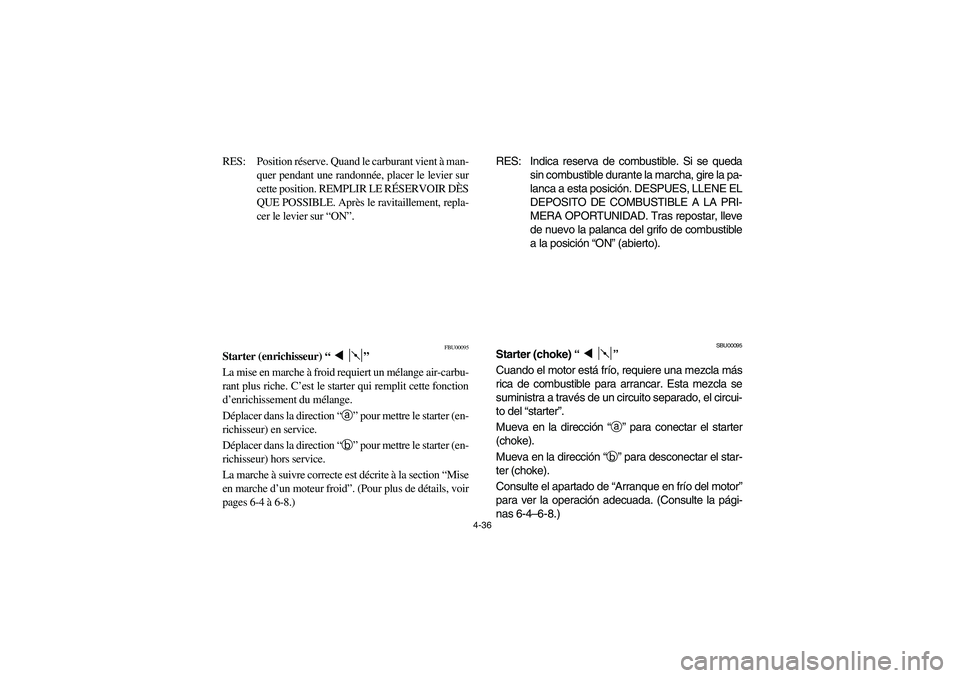
4-35 1. Arrow mark pointing to “RES”
1. Flèche dirigée vers “RES”
1. Marca de la flecha señalando a “RES”
RES position
Réserve
Posición RES1. Starter (choke) “”
1. Starter (enrichisseur) “”
1. Starter (choke) “”
RES: This indicates reserve. If you run out of fuel
while riding, turn the lever to this position.
THEN FILL THE FUEL TANK AT THE
FIRST OPPORTUNITY. After refuelling, re-
turn the fuel cock lever to the “ON” position.
EBU00095
Starter (choke) “”
Starting a cold engine requires a richer air-fuel
mixture. A separate starter circuit supplies this
mixture.
Move in direction
a to turn on the starter (choke).
Move in direction
b to turn off the starter (choke).
Refer to “Starting a cold engine” for proper opera-
tion. (See pages 6-3–6-7.)
U5UH61.book Page 35 Tuesday, April 20, 2004 10:10 AM
Page 101 of 400
4-36
RES: Position réserve. Quand le carburant vient à man-
quer pendant une randonnée, placer le levier sur
cette position. REMPLIR LE RÉSERVOIR DÈS
QUE POSSIBLE. Après le ravitaillement, repla-
cer le levier sur “ON”.
FBU00095
Starter (enrichisseur) “”
La mise en marche à froid requiert un mélange air-carbu-
rant plus riche. C’est le starter qui remplit cette fonction
d’enrichissement du mélange.
Déplacer dans la direction “a” pour mettre le starter (en-
richisseur) en service.
Déplacer dans la direction “b” pour mettre le starter (en-
richisseur) hors service.
La marche à suivre correcte est décrite à la section “Mise
en marche d’un moteur froid”. (Pour plus de détails, voir
pages 6-4 à 6-8.)
RES: Indica reserva de combustible. Si se queda
sin combustible durante la marcha, gire la pa-
lanca a esta posición. DESPUES, LLENE EL
DEPOSITO DE COMBUSTIBLE A LA PRI-
MERA OPORTUNIDAD. Tras repostar, lleve
de nuevo la palanca del grifo de combustible
a la posición “ON” (abierto).
SBU00095
Starter (choke) “”
Cuando el motor está frío, requiere una mezcla más
rica de combustible para arrancar. Esta mezcla se
suministra a través de un circuito separado, el circui-
to del “starter”.
Mueva en la dirección “
a” para conectar el starter
(choke).
Mueva en la dirección “
b” para desconectar el star-
ter (choke).
Consulte el apartado de “Arranque en frío del motor”
para ver la operación adecuada. (Consulte la pági-
nas 6-4–6-8.)
U5UH61.book Page 36 Tuesday, April 20, 2004 10:10 AM
Page 144 of 400

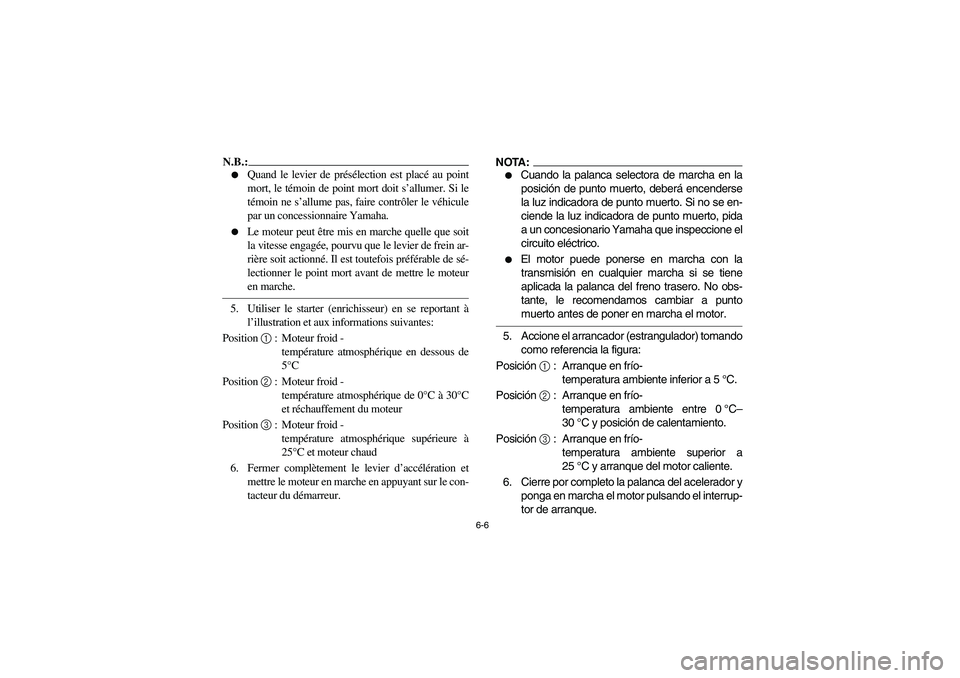
6-5 a. Starter (choke)
1. Fully open
2. Half open
3. Closed
a. Starter (enrichisseur)
1. Complètement ouvert
2. Mi-ouvert
3. Fermé
a. Arrancador (estrangulador)
1. Abre completamente
2. Semiabierto
3. Cerrado
NOTE:_ �
When the drive select lever is in the neutral
position, the neutral indicator light should
come on. If the neutral indicator light does not
come on, ask a Yamaha dealer to inspect the
electric circuit.
�
The engine can be started in any gear if the
rear brake lever is applied. However, it is rec-
ommended to shift into neutral before starting
the engine.
_5. Use the starter (choke) in reference to the fig-
ure:
Position
1: Cold engine start-
ambient temperature below 5°C.
Position
2: Cold engine start-
ambient temperature at 0°C–30°C
and warming up position.
Position
3: Cold engine start-
ambient temperature above 25°C
and warm engine start position.
6. Completely close the throttle lever and start
the engine by pushing the start switch.
U5UH61.book Page 5 Tuesday, July 6, 2004 2:50 PM
Page 145 of 400
6-6
N.B.:_ �
Quand le levier de présélection est placé au point
mort, le témoin de point mort doit s’allumer. Si le
témoin ne s’allume pas, faire contrôler le véhicule
par un concessionnaire Yamaha.
�
Le moteur peut être mis en marche quelle que soit
la vitesse engagée, pourvu que le levier de frein ar-
rière soit actionné. Il est toutefois préférable de sé-
lectionner le point mort avant de mettre le moteur
en marche.
_5. Utiliser le starter (enrichisseur) en se reportant à
l’illustration et aux informations suivantes:
Position 1
: Moteur froid -
température atmosphérique en dessous de
5°C
Position 2
: Moteur froid -
température atmosphérique de 0°C à 30°C
et réchauffement du moteur
Position 3
: Moteur froid -
température atmosphérique supérieure à
25°C et moteur chaud
6. Fermer complètement le levier d’accélération et
mettre le moteur en marche en appuyant sur le con-
tacteur du démarreur.
NOTA:_ �
Cuando la palanca selectora de marcha en la
posición de punto muerto, deberá encenderse
la luz indicadora de punto muerto. Si no se en-
ciende la luz indicadora de punto muerto, pida
a un concesionario Yamaha que inspeccione el
circuito eléctrico.
�
El motor puede ponerse en marcha con la
transmisión en cualquier marcha si se tiene
aplicada la palanca del freno trasero. No obs-
tante, le recomendamos cambiar a punto
muerto antes de poner en marcha el motor.
_5. Accione el arrancador (estrangulador) tomando
como referencia la figura:
Posición
1 : Arranque en frío-
temperatura ambiente inferior a 5°C.
Posición
2 : Arranque en frío-
temperatura ambiente entre 0°C–
30°C y posición de calentamiento.
Posición
3 : Arranque en frío-
temperatura ambiente superior a
25°C y arranque del motor caliente.
6. Cierre por completo la palanca del acelerador y
ponga en marcha el motor pulsando el interrup-
tor de arranque.
U5UH61.book Page 6 Tuesday, July 6, 2004 2:50 PM
Page 146 of 400

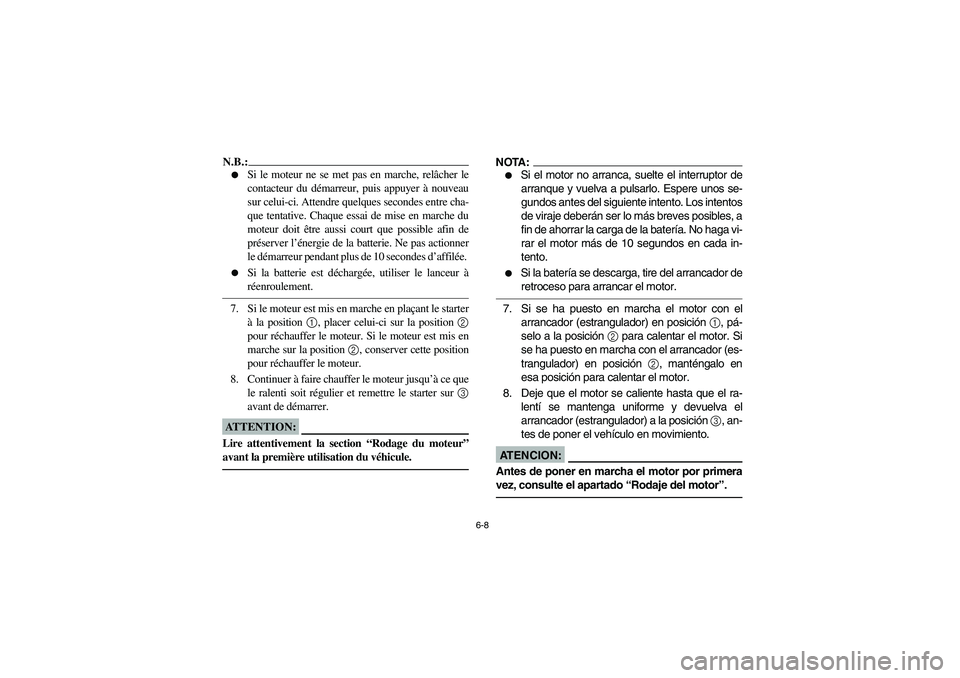
6-7 a. Starter (choke)
1. Fully open
2. Half open
3. Closed
a. Starter (enrichisseur)
1. Complètement ouvert
2. Mi-ouvert
3. Fermé
a. Arrancador (choke)
1. Abre completamente
2. Semiabierto
3. Cerrado
NOTE:_ �
If the engine fails to start, release the start
switch, and then push the start switch again.
Pause a few seconds before the next at-
tempt. Each cranking should be as short as
possible to preserve battery energy. Do not
crank the engine more than 10 seconds on
each attempt.
�
If the battery is discharged, pull the recoil
starter to start the engine.
_7. If the engine is started with the starter (choke)
in position
1, the starter (choke) should be
returned to position
2 to warm up the en-
gine. If the engine is started with the starter
(choke) in position
2, keep the starter
(choke) in this position to warm up the en-
gine.
8. Continue warming up the engine until it idles
smoothly and return the starter (choke) to po-
sition
3 before riding.CAUTION:_ See the “Engine break-in” section prior to op-
erating the engine for the first time. _
U5UH61.book Page 7 Tuesday, April 20, 2004 10:10 AM
Page 147 of 400
6-8
N.B.:_ �
Si le moteur ne se met pas en marche, relâcher le
contacteur du démarreur, puis appuyer à nouveau
sur celui-ci. Attendre quelques secondes entre cha-
que tentative. Chaque essai de mise en marche du
moteur doit être aussi court que possible afin de
préserver l’énergie de la batterie. Ne pas actionner
le démarreur pendant plus de 10 secondes d’affilée.
�
Si la batterie est déchargée, utiliser le lanceur à
réenroulement.
_7. Si le moteur est mis en marche en plaçant le starter
à la position 1
, placer celui-ci sur la position 2
pour réchauffer le moteur. Si le moteur est mis en
marche sur la position 2
, conserver cette position
pour réchauffer le moteur.
8. Continuer à faire chauffer le moteur jusqu’à ce que
le ralenti soit régulier et remettre le starter sur 3
avant de démarrer.ATTENTION:_ Lire attentivement la section “Rodage du moteur”
avant la première utilisation du véhicule. _
NOTA:_ �
Si el motor no arranca, suelte el interruptor de
arranque y vuelva a pulsarlo. Espere unos se-
gundos antes del siguiente intento. Los intentos
de viraje deberán ser lo más breves posibles, a
fin de ahorrar la carga de la batería. No haga vi-
rar el motor más de 10 segundos en cada in-
tento.
�
Si la batería se descarga, tire del arrancador de
retroceso para arrancar el motor.
_7. Si se ha puesto en marcha el motor con el
arrancador (estrangulador) en posición
1, pá-
selo a la posición
2 para calentar el motor. Si
se ha puesto en marcha con el arrancador (es-
trangulador) en posición
2, manténgalo en
esa posición para calentar el motor.
8. Deje que el motor se caliente hasta que el ra-
lentí se mantenga uniforme y devuelva el
arrancador (estrangulador) a la posición
3, an-
tes de poner el vehículo en movimiento.AT E N C I O N :_ Antes de poner en marcha el motor por primera
vez, consulte el apartado “Rodaje del motor”. _
U5UH61.book Page 8 Tuesday, April 20, 2004 10:10 AM
Page 148 of 400
6-9
EBU00180
Starting a warm engine
To start a warm engine, refer to the “Starting a cold
engine” section. The starter (choke) should not be
used. The throttle should be opened slightly.
EBU00182
Warming up
To get maximum engine life, always warm up the
engine before starting off. Never accelerate hard
with a cold engine! To see whether or not the en-
gine is warm, check if it responds to the throttle
normally with the starter (choke) turned off.
U5UH61.book Page 9 Tuesday, April 20, 2004 10:10 AM
Page 149 of 400
6-10
FBU00180
Mise en marche d’un moteur chaud
Se reporter à la section “Mise en marche d’un moteur
froid”. Ne pas utiliser le starter (enrichisseur). Ne pas ac-
célérer brutalement.
FBU00182
Réchauffement du moteur
Afin de garantir la longévité du moteur, il est indispensa-
ble de chauffer le moteur avant de démarrer. Ne jamais
accélérer brusquement quand le moteur est froid! Le mo-
teur a atteint sa température normale de fonctionnement
dès qu’il répond immédiatement aux accélérations avec
le starter (enrichisseur) en position fermée.
SBU00180
Arranque del motor en caliente
Para arrancar un motor caliente, consulte el aparta-
do de “Arranque del motor en frío”. El starter (choke)
no deberá utilizarse. El acelerador deberá abrirse un
poco.
SBU00182
Calentamiento
Para que el motor alcance su máxima duración, per-
mita siempre que se caliente antes de iniciar la mar-
cha. ¡No acelere nunca violentamente con el motor
frío! Para ver si el motor está lo bastante caliente,
compruebe si responde normalmente al acelerador
con el starter (choke) cerrado.
U5UH61.book Page 10 Tuesday, April 20, 2004 10:10 AM

