2005 VOLVO XC90 key
[x] Cancel search: keyPage 110 of 263

2005 VOLVO XC90
Child safety locks
Manual child safety locks - rear doors/tailgate
The controls are located on the rear door jambs and at the lower edge of\
the tailgate. Use a key to adjust
these controls.
A The door/tailgate locks function normally.
B The door/tailgate cannot be opened from the inside. Normal operation fr\
om the outside.
WARNING!
Remember, in the event of an accident, the rear seat passengers cannot o\
pen the doors from the inside
with the buttons in position A.
file:///K|/ownersdocs/2005/2005_XC90/05xc90_05.htm (9 of 13)12/30/2006\
4:42:32 PM
Page 111 of 263

2005 VOLVO XC90
Power child locks (option)
To prevent the rear doors from being opened from the inside:
1. Turn the vehicle's ignition key to at least position 1.
2. Press the button shown above.
Indicator light in the button ON: the doors cannot be opened from the inside. Normal operation from
the outside.
Indicator light in the button OFF: the doors can be opened from the inside.
pg. 82 Locks and Alarms
Alarm
Alarm
The alarm is automatically armed whenever you lock your vehicle.
When armed, the alarm continuously monitors a number of points on the ve\
hicle. The following
conditions will set off the alarm:
l The hood is forced open.
l The tailgate is forced open.
l A door is forced open.
l The ignition switch is tampered with.
l If there is movement in the passenger compartment (if the vehicle is eq\
uipped with the optional
movement sensor).
l The vehicle is lifted or towed (if the vehicle is equipped with the opt\
ional inclination sensor).
l The battery is disconnected (while the alarm is armed).
l The siren is disconnected when the alarm is disarmed.
Arming the alarm
Press the LOCK button on the remote control, lock the vehicle using the \
key in the driver's door or press
the central lock button on one of the front doors with the door open. On\
e long flash of the turn signals
will confirm that the alarm is armed.
Disarming the alarm
Press the UNLOCK button on the remote control or unlock the doors with t\
he key.
Turning off (stopping) the alarm
If the alarm is sounding, it can be stopped by pressing the UNLOCK butto\
n on the remote control or by
unlocking the driver's door with the key.
file:///K|/ownersdocs/2005/2005_XC90/05xc90_05.htm (10 of 13)12/30/200\
6 4:42:32 PM
Page 113 of 263

This device may not cause harmful interference, and (2)")
2005 VOLVO XC90
FCC ID: MAYDA5823
This device complies with part 15 of the FCC rules. Operation is subject\
to the following conditions: (1)
This device may not cause harmful interference, and (2) this device mu\
st accept any interference
received, including interference that may cause undesired operation.
Canadian IC: 4405A-DA5823
Movement sensor DA5823 by Dynex
Operation is subject to the following conditions: (1) this device may \
not cause interference, and (2) this
device must accept any interference, including interference that may cau\
se undesired operation of the
device.
In certain situations it may be desirable to turn off the accessory incl\
ination and movement alarm
sensors if, for example, you drive your vehicle onto a ferry where the r\
ocking of the boat could trigger
the alarm or if a pet is left in the vehicle with the doors locked.
To temporarily turn off the inclination and movement alarm sensors from \
the alarm system:
From the time the ignition key is turned from the Drive position (posit\
ion II) until you lock the vehicle,
you can press the button in the center console. The LED in the switch wi\
ll light up and a message will be
displayed in the text window to indicate that the sensors are disconnect\
ed.
The vehicle can then be locked in the usual way to set the alarm.
NOTE:
l This function will not turn off the vehicle's standard alarm.
l The optional sensors are automatically reconnected to the alarm system t\
he next time the vehicle is
unlocked and then locked again.
LED alarm status signals
The status of the alarm system is indicated by the red LED at the top of\
the dash:
l LED off - the alarm is not armed
l LED flashes once per second - the alarm is armed
l LED flashes rapidly before the ignition is switched on - the alarm has b\
een triggered
l Fault in the alarm system: If a fault has been detected in the alarm system, a message will be
displayed in the text window. Contact your Volvo retailer.
Automatic re-lock/re-arm system
If the vehicle is unlocked with the remote, the vehicle will re-lock and\
the alarm will re-arm after 2
minutes unless a door or the tailgate has been opened.
pg. 84 Locks and Alarms
file:///K|/ownersdocs/2005/2005_XC90/05xc90_05.htm (12 of 13)12/30/200\
6 4:42:32 PM
Page 120 of 263

2005 VOLVO XC90
3. Without touching the accelerator pedal, turn the ignition key* to the\
starting position. Allow the
starter to operate for up to 10 seconds. Release the key as soon as the \
engine starts. If the engine fails to
start, repeat this step.
NOTE:
- On certain models, when the vehicle is started, idle speed may be noti\
ceably higher than normal for a
short period, depending on the temperature of the engine.
This has been done to help bring components in the emission control syst\
em to their normal operating
temperature as quickly as possible, which enables them to function norma\
lly.
- For cold starts at altitudes above 6000 ft (1800 meters), depress th\
e accelerator pedal halfway and turn
the key to the starting position. Release the pedal slowly when the engi\
ne starts.
4. To release the gear selector from the (P)ark position, the engine must be running (or the ignition key
must be in position II) and the brake pedal must be depressed.
5. Select the desired gear. The gear engages after a very slight delay w\
hich is especially noticeable when
selecting R.
NOTE: Your vehicle is equipped with a Keylock system. When the engine is switc\
hed off, the gear
selector must be in the (P)ark position before the key can be removed from the ignition switch.
When starting in cold weather, the transmission may shift up at slightly\
higher engine speeds than
normal until the automatic transmission fluid reaches normal operating t\
emperature.
Do not race a cold engine immediately after starting. Oil flow may not r\
each some lubrication points fast
enough to prevent engine damage.
* If two of the keys to your vehicle are close together, e.g., on the sa\
me key ring, when you try to start
the vehicle, this could cause interference in the immobilizer system and\
result in the vehicle not starting.
If this should occur, remove one of the keys from the key ring before tr\
ying to start the vehicle again.
file:///K|/ownersdocs/2005/2005_XC90/05xc90_06a.htm (6 of 16)12/30/200\
6 4:42:33 PM
Page 122 of 263

2005 VOLVO XC90
Steering wheel lock
The steering wheel lock might be under tension when the vehicle is parke\
d.
Turn the steering wheel slightly to free the ignition key.
In order to help reduce vehicle theft, make sure the steering wheel lock\
is engaged before leaving
the vehicle.
WARNING!
Never switch off the ignition (turn the ignition key to position 0) or\
remove the key from the ignition
switch while the vehicle is in motion. This could cause the steering whe\
el to lock, which would make
the vehicle impossible to steer.
file:///K|/ownersdocs/2005/2005_XC90/05xc90_06a.htm (8 of 16)12/30/200\
6 4:42:33 PM
Page 123 of 263
ark position (automatic transmission).
** Please be aware that leaving the key in this position will increase b\
attery drain.
pg. 91 Starting")
2005 VOLVO XC90
* The gear selector must be in the (P)ark position (automatic transmission).
** Please be aware that leaving the key in this position will increase b\
attery drain.
pg. 91 Starting and driving
General information
Economical driving conserves natural resources
Better driving economy may be obtained by thinking ahead, avoiding rapid\
starts and stops and
adjusting the speed of your vehicle to immediate traffic conditions. Obs\
erve the following rules:
l Bring the engine to normal operating temperature as soon as possible by \
driving with a light foot on
the accelerator pedal for the first few minutes of operation. A cold eng\
ine uses more fuel and is subject
to increased wear.
l Whenever possible, avoid using the vehicle for driving short distances. \
This does not allow the engine
to reach normal operating temperature.
l Drive carefully and avoid rapid acceleration and hard braking.
l Use the transmission's (D)rive position as often as possible and avoid using "kickdown" to help
improve fuel economy.
l Do not exceed posted speed limits.
l Avoid carrying unnecessary items (extra load) in the vehicle.
l Maintain correct tire pressure. Check tire pressure regularly (when tir\
es are cold).
l Remove snow tires when threat of snow or ice has ended.
l Note that roof racks, ski racks, etc, increase air resistance and also f\
uel consumption.
l At highway driving speeds, fuel consumption will be lower with the air c\
onditioning on and the
windows closed than with the air conditioning off and the windows open. \
l Using the onboard trip computer's fuel consumption modes can help you le\
arn how to drive more
economically.
Other factors that decrease gas mileage are:
l Dirty air cleaner
l Dirty engine oil and clogged oil filter
l Dragging brakes
l Incorrect front end alignment
Some of the above mentioned items and others are checked at the standard\
Maintenance intervals.
Weight distribution affects handling
At the specified curb weight your vehicle has a tendency to understeer, \
which means that the steering
wheel has to be turned more than might seem appropriate for the curvatur\
e of a bend. This ensures good
stability and reduces the risk of rear wheel skid. Remember that these p\
roperties can alter with the
vehicle load. The heavier the load in the cargo area, the less the tende\
ncy to understeer.
file:///K|/ownersdocs/2005/2005_XC90/05xc90_06a.htm (9 of 16)12/30/200\
6 4:42:33 PM
Page 125 of 263

2005 VOLVO XC90
NOTE: Avoid driving on steep inclines if the fuel tank is nearly empty. If the\
flow of fuel to the engine
is interrupted due to the vehicle's angle of inclination, this could res\
ult in damage to the three-way
catalytic converter. We recommend keeping the fuel tank at least half fu\
ll when driving on steep inclines.
Driving through water
l The vehicle should not be driven through water that is deeper than 18 in\
ches (48 cm). Driving through
deeper water could result in damage to transmission components or the di\
fferential, or to the engine if
excess water is drawn in through the air intake system.
l Drive slowly and avoid stopping when driving through water.
l After having driven through water, apply the brakes lightly several time\
s to remove water, mud, etc
from the brake discs.
l Never allow the vehicle to stand in water above the door sills. This cou\
ld result in damage to the
electrical system.
Conserving electrical current
Keep the following in mind to help minimize battery drain:
l When the engine is not running, avoid turning the ignition key to positi\
on II (see page 90). Many
electrical systems (the audio system, the optional infotainment/navigat\
ion systems, power windows, etc)
will function with the ignition key in position I. This position reduces\
drain on the battery.
l Please keep in mind that using systems, accessories, etc that consume a \
great deal of current when the
engine is not running could result in the battery being completely drain\
ed.
NOTE: A warning message will be displayed in the text window in the instrument\
panel when the
battery charge is low.
pg. 93 Starting and driving
Automatic transmission with Geartronic
5-cylinder turbo models
file:///K|/ownersdocs/2005/2005_XC90/05xc90_06a.htm (11 of 16)12/30/20\
06 4:42:33 PM
Page 126 of 263
2005 VOLVO XC90
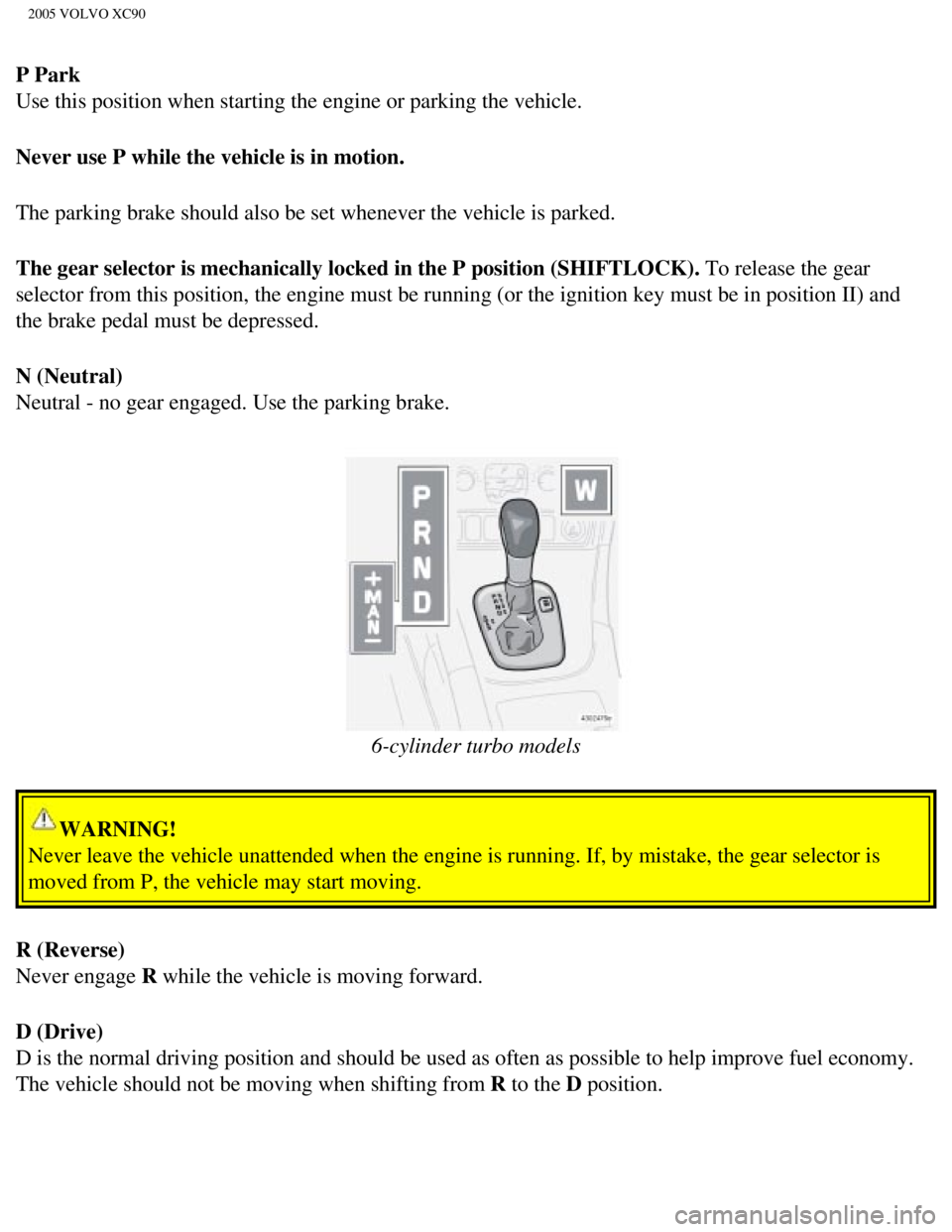
P Park
Use this position when starting the engine or parking the vehicle.
Never use P while the vehicle is in motion.
The parking brake should also be set whenever the vehicle is parked.
The gear selector is mechanically locked in the P position (SHIFTLOCK)\
. To release the gear
selector from this position, the engine must be running (or the ignitio\
n key must be in position II) and
the brake pedal must be depressed.
N (Neutral)
Neutral - no gear engaged. Use the parking brake.
6-cylinder turbo models
WARNING!
Never leave the vehicle unattended when the engine is running. If, by mi\
stake, the gear selector is
moved from P, the vehicle may start moving.
R (Reverse)
Never engage R while the vehicle is moving forward.
D (Drive)
D is the normal driving position and should be used as often as possible\
to help improve fuel economy.
The vehicle should not be moving when shifting from R to the D position.
file:///K|/ownersdocs/2005/2005_XC90/05xc90_06a.htm (12 of 16)12/30/20\
06 4:42:33 PM