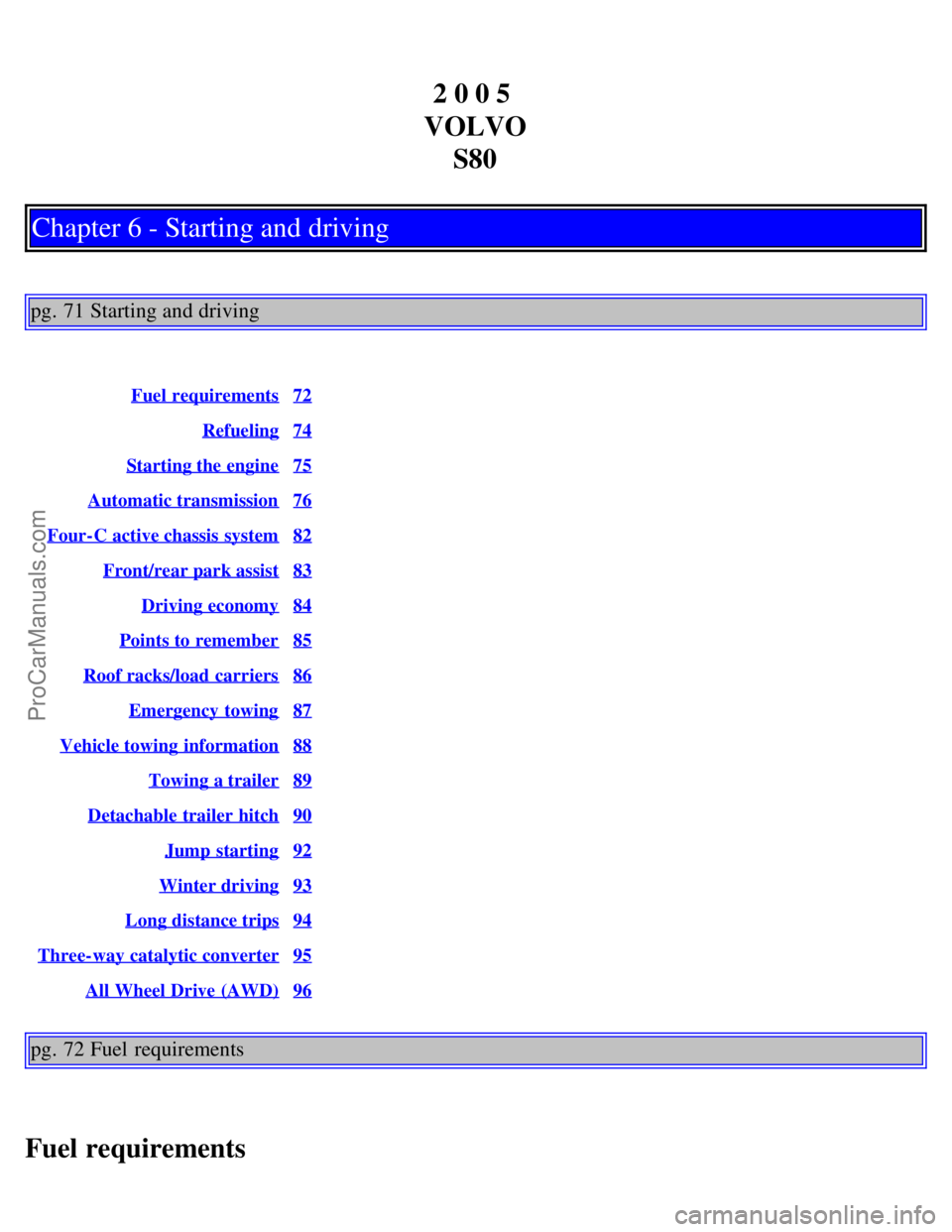
2 0 0 5
VOLVO S80
Chapter 6 - Starting and driving
pg. 71 Starting and driving
Fuel requirements72
Refueling74
Starting the engine75
Automatic transmission76
Four-C active chassis system82
Front/rear park assist83
Driving economy84
Points to remember85
Roof racks/load carriers86
Emergency towing87
Vehicle towing information88
Towing a trailer89
Detachable trailer hitch90
Jump starting92
Winter driving93
Long distance trips94
Three-way catalytic converter95
All Wheel Drive (AWD)96
pg. 72 Fuel requirements
Fuel requirements
ProCarManuals.com
· Press the Park assist button on the center console (see page 31) to temporarily deactivate the system(s).
· The indicator light in the button will go out when the system(s) have been deactivated.
· If the vehicle is equipped with front and rear park assist, both systems will be deactivated by pressing the button.
NOTE:
It may be necessary to deactivate one or both of the park assist systems in certain cases.
· Rear park assist: towing a trailer, carrying bicycles in a rear-mounted carrier, etc, could trigger the rear park assist
system's sensors.
· Front park assist: it may not be possible to combine auxiliary headlights and front park assist since these lights
could trigger the system's sensors.
Faults in the system
If a fault should occur in the system, the LED in the button will be switched off and a message will be displayed in the
text window.
Cleaning the sensors
For the system to function properly, the sensors in the front and/or rear bumpers should be kept clean. They can be
cleaned with car washing detergent and a sponge.
WARNING!
These systems are designed to be a supplementary aid when parking the vehicle. They are not, however, intended to
replace the driver's attention and judgement.
pg. 84 Driving economy
Economical driving conserves natural resources
Better driving economy may be obtained by thinking ahead, avoiding rapid starts and stops and adjusting the speed of
your vehicle to immediate traffic conditions. Observe the following rules:
Bring the engine to normal operating temperature as soon as possible by driving with a light foot on the accelerator
pedal for the first few minutes of operation. A cold engine uses more fuel and is subject to increased wear.
Whenever possible, avoid using the car for driving short distances. This does not allow the engine to reach normal
operating temperature.
Drive carefully and avoid rapid acceleration and hard braking.
Do not exceed posted speed limits.
Avoid carrying unnecessary items (extra load) in the car.
Maintain correct tire pressure. Check tire pressure regularly (when tires are cold).
Remove snow tires when threat of snow or ice has ended.
Note that roof racks, ski racks, etc., increase air resistance and also fuel consumption.
Avoid using automatic transmission kickdown feature unless necessary.
Avoid using the air conditioning when it is not required. When engaged, the A/C compressor places an additional
load on the engine. However, at higher driving speeds, fuel consumption will be lower with the air conditioning on and
the windows closed than with the air conditioning off and the windows open.
Using the onboard trip computer's fuel consumption modes can help you learn how to drive more economically.
Other factors that decrease gas mileage are:
Dirty air cleaner
Dirty engine oil and clogged oil filter
Dragging brakes
Incorrect front end alignment
Some of the above mentioned items and others are checked at the standard Maintenance Service intervals.
ProCarManuals.com
Parking brake reminder light..........28
Parking lights..........34
Passenger's seat backrest - folding..........55
PCV system..........133
PI (Program Information) Seek..........159
Polishing..........128
Power moonroof..........43
Power seats..........54
Power steering - speed-sensitive..........85
Power steering fluid ........ 138, 147
Power windows..........41
R
Radio..........153, 154
Radio Broadcast Data System - RBDS..........159
Rain sensor - windshield wipers..........37
Reading lights - front/rear ........ 56
Rear door step lights - replacing..........123
Rear fog light..........29, 35
Rear reading lights..........56
Rear seat backrests - folding..........60
Rear suspension..........148
Rear window - heated..........39
Rearview mirror..........42
Refrigerant..........50, 147
Refueling..........74
Remote control - keyless entry system and sideview mirrors..........42
Remote keyless entry system..........63
Remote keyless entry system - replacing batteries..........64
Remote keyless entry system and the driver's seat..........55
Replacing bulbs..........119-125
Replacing fuses..........114
Replacing the battery..........139
Replacing wiper blades..........141
Reporting safety defects..........13
Road assistance..........150
Roadholding..........85
Roof load - maximum..........145
Roof racks..........86
Run flat tires..........103
S
Safety defects - reporting..........13
Safety locks - child..........69
Seat belt maintenance..........13
Seat belts..........2, 3, 16
ProCarManuals.com