2005 VOLVO S80 engine oil
[x] Cancel search: engine oilPage 86 of 123
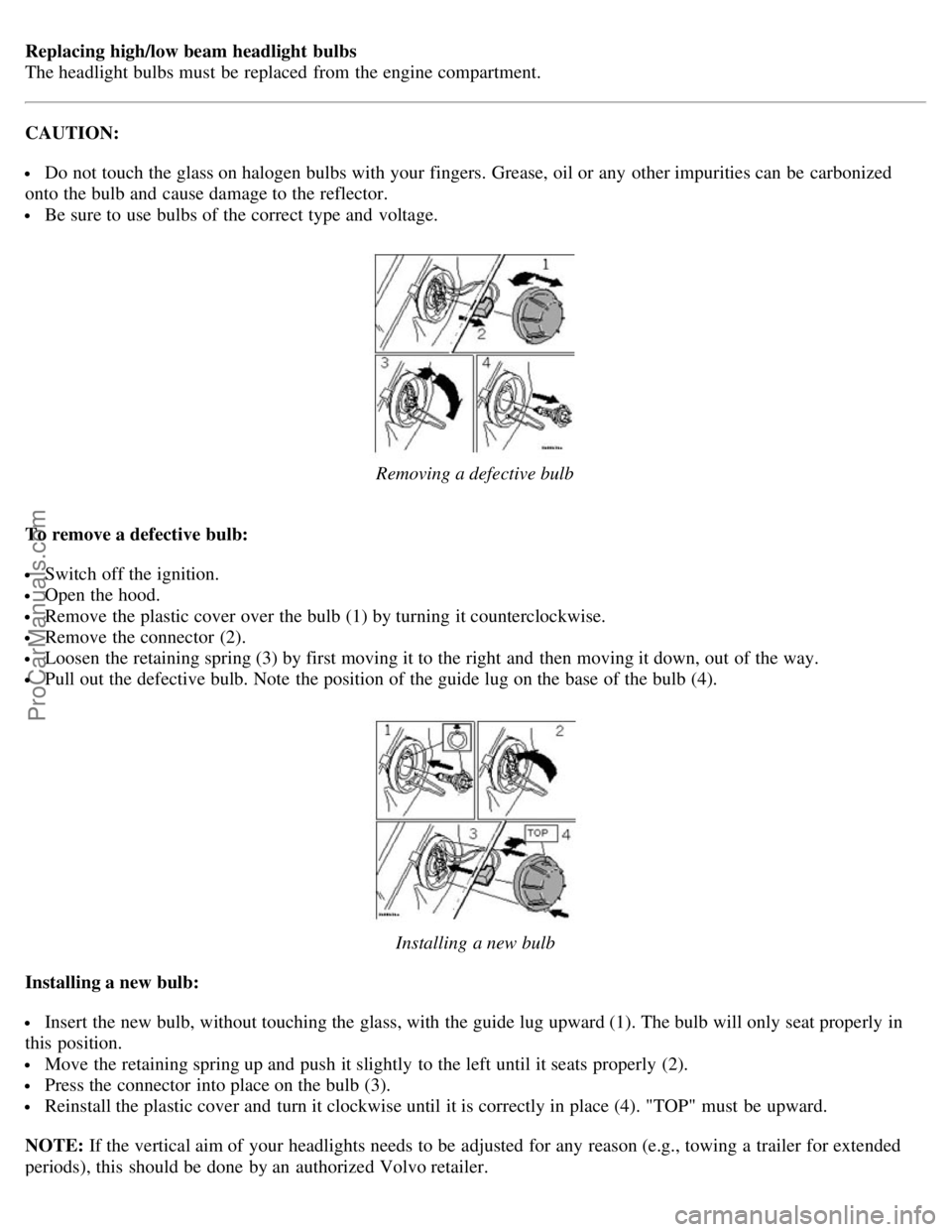
Replacing high/low beam headlight bulbs
The headlight bulbs must be replaced from the engine compartment.
CAUTION:
Do not touch the glass on halogen bulbs with your fingers. Grease, oil or any other impurities can be carbonized
onto the bulb and cause damage to the reflector.
Be sure to use bulbs of the correct type and voltage.
Removing a defective bulb
To remove a defective bulb:
Switch off the ignition.
Open the hood.
Remove the plastic cover over the bulb (1) by turning it counterclockwise.
Remove the connector (2).
Loosen the retaining spring (3) by first moving it to the right and then moving it down, out of the way.
Pull out the defective bulb. Note the position of the guide lug on the base of the bulb (4).
Installing a new bulb
Installing a new bulb:
Insert the new bulb, without touching the glass, with the guide lug upward (1). The bulb will only seat properly in
this position.
Move the retaining spring up and push it slightly to the left until it seats properly (2).
Press the connector into place on the bulb (3).
Reinstall the plastic cover and turn it clockwise until it is correctly in place (4). "TOP" must be upward.
NOTE: If the vertical aim of your headlights needs to be adjusted for any reason (e.g., towing a trailer for extended
periods), this should be done by an authorized Volvo retailer.
ProCarManuals.com
Page 92 of 123
2 0 0 5
VOLVO S80
Chapter 9 - Specifications
pg. 143 Specifications
Label information144
Dimensions and weights145
Engine specifications146
Oil/fluid specifications and volumes147
Fuel system, distributor ignition system, suspension148
Electrical system149
On Call Roadside Assistance150
pg. 144 Label information
1 Vehicle Emission Control Information
Your Volvo is designed to meet all applicable emission standards, as evidenced by the certification label on the
underside of the hood. For further information regarding these regulations, please consult your Volvo retailer.
2 Vacuum hose routing
(underside of hood)
3 Loads and Tire Pressures
(on inside of fuel filler door): Canadian models only.
4 Model plate
Vehicle Identification Number (VIN). Codes for color and upholstery, etc. The plate is located in the engine
compartment, on the inside of the left front fender.
5 Vehicle Identification Number (VIN) *
The VIN plate is located on the top left surface of the dashboard. The VIN is also stamped on the right hand door
pillar.
6 Federal Motor Vehicle Safety Standards (FMVSS) specifications (USA) and Ministry of Transport (CMVSS)
standards (Canada )
Your Volvo is designed to meet all applicable safety standards, as evidenced by the certification label on the facing
side of the driver's door. For further information regarding these regulations, please consult your Volvo retailer.
ProCarManuals.com
Page 95 of 123

Number of valves24
Charge air cooler (Intercooler)
Turbocharged engines employ a turbo-compressor to force air into the engine inlet manifold and a charge air cooler to
cool the compressed inlet air. The resulting increase in air flow raises pressure in the intake manifold and increases
engine power over that developed by the normally-aspirated engine. The charge air cooler (which resembles a radiator)
is located between the turbo-compressor and inlet manifold.
Designation: Volvo B 5254 T2
Output 208 hp at 5000 rpm (154 kW/83 rps)
Max. torque 236 ft. lbs. at 1500-4500 rpm (320 Nm/25-75 rps)
Number of cylinders 5
Bore 3.27" (83 mm)
Stroke 3.67" (93.2 mm)
Displacement 2.5 liters
Compression ratio 9.0:1
Number of valves 20
All specifications are subject to change without prior notice.
pg. 147 Oil/fluid specifications and volumes
Engine oil
Meeting minimum ILSAC specification GF-2, including ACEA A1, API SJ, SJ/CF and SJ/Energy Conserving.
Extra oil additives must not be used.
Volume: (including filter):
5-cylinder turbo engine - 6.1 US qts (5.8 liters).
6-cylinder engines - 6.9 US qts (6.6 liters).
Automatic transmission fluid
Total volume: 7.6 US qts (7.2 liters).
Type: JWS 3309
Different types of oil should never be mixed.
Cooling system
Type: Positive pressure, closed system. The thermostat begins to open at 194 °F (90 °C).
Coolant: Volvo original coolant/antifreeze.
Volume: 9.5 US qts (9.0 liters)
Power steering fluid
Volvo synthetic power steering fluid (Pentosin CHF 11S) P/N 1161529 or equivalent.
Volume: 0.95 US qt (0.9 liter).
Brake fluid
DOT 4+ boiling point > 536°F (280° C) P/N 9437433
Volume: 0.6 US qt (0.6 liter)
Climate control system - refrigerant (R 134a)
Oil: PAG
Volume: 2.2 lbs (1000 g) R134a.
ProCarManuals.com
Page 96 of 123

Fuel
Minimum octane requirement - AKI 87 (RON 91)
Volume (fuel tank): 21.1 US gals (80 liters) on T6 models, or 18 US gal. (68 liters) on the S80 All Wheel Drive and
the S80 2.5T Front Wheel Drive.
Washer fluid reservoir
Volume: 6 cyl: 4.7 US qts. (4.5 liters)
All specifications are subject to change without prior notice.
pg. 148 Fuel system, Distributor ignition system, Suspension
Fuel system
The engine is equipped with a multiport fuel injection system.
Distributor ignition system
Firing order: 15-3-6-2-4
Distributor ignition setting: Not adjustable
Spark plugs: B 6284 T: P/N 271367-4 (or equivalent)
B 5254 T2: Champion RC8PYP 8 (or equivalent)
Spark plug gap: 0.028-0.032" (0.7-0.8 mm)
Tightening torque: 18.4 ft. lbs. (25 Nm)
WARNING!
The distributor ignition system operates at very high voltages. Special safety precautions must be followed to
prevent injury. Always turn the ignition off when:
Replacing distributor ignition components e.g. plugs, coil, etc.
Do not touch any part of the distributor ignition system while the engine is running. This may result in unintended
movements and body injury.
Front suspension
Spring strut suspension with integrated shock absorbers and control arms linked to the support frame. Power-assisted
rack and pinion steering. Safety type steering column.
The alignment specifications apply to an unladen car but include fuel, coolant and spare wheel.
Rear suspension
Individual rear wheel suspension with longitudinal support arms, double link arms and track rods.
Vehicle loading
The tires on your Volvo should perform to specifications at all normal loads when inflated as recommended on the tire
information label. The label is located on the inside of the fuel filler door and lists vehicle design limits. Do not load
your car beyond the load limits indicated.
WARNING!
Improperly inflated tires will reduce tire life, adversely affect vehicle handling and can possibly lead to failure
resulting in loss of vehicle control without prior warning.
All specifications are subject to change without prior notice.
ProCarManuals.com
Page 114 of 123
Door step courtesy lights - replacing..........123
Doors and locks..........62
Drive belt..........132
Driving economy..........84
Driving mode indicator..........27
Driving mode W..........77, 79, 81
Driving with trunk open..........85
E
Economical driving..........84
Electrical system..........149
Electrical system - general information..........85
Electrically operated front seats..........54
Electrically operated moonroof..........43
Electrically operated sideview mirrors..........42
Electrically operated windows..........41
Electronic Brake Force Distribution..........19
Electronic Climate Control(ECC)..........47 - 49, 51
Emergency Locking Retractor (ELR)..........16
Emergency towing..........87, 88
Emergency warning flashers..........39
Emissions systems..........131
Engine - specifications..........146
Engine - starting..........75
Engine air filter..........133
Engine compartment..........135
Engine oil..........93, 136, 137, 147
Exterior courtesy lights..........62
Exterior features - overview..........25
F
Fog light - rear..........29
, 35
Fog lights - front..........34
Folding passenger's seat backrest..........55
Folding rear seat backrests ........60
Four-C (active chassis system).........82
Front airbags - SRS..........4-9
Front airbags - SRS - warning light..........28
Front courtesy lights - replacing..........125
Front fog lights..........34
Front fog lights - replacing ........122
Front reading lights..........56
Front seats - adjusting..........54
Front seats - heated..........39
Front suspension..........148
Fuel..........72, 147
ProCarManuals.com
Page 116 of 123
Interior features - overview..........24
Interior lighting..........56
ISOFIX Child seat anchors........ 14
J
Jack..........59
, 110, 111
Jump starting..........92
K
Key - removing from ignition switch..........75
Keyless entry system..........63, 64
Keyless entry system - replacing batteries..........64
Keylock..........75
Keys..........62
Kickdown..........79, 80
L
Label information..........144
Laminated side windows..........128
LATCH/ISOFIX anchors........ 14
License plate lights - replacing..........123
Lifting the car..........134
Load carriers..........86
Locking and unlocking the car..........62
Locking steering wheel..........38
Long distance trip..........94
Long loads..........55
M
Maintenance service..........130
Malfunction indicator lamp..........29
Manually unlocking the fuel filler door..........35
Mirrors..........42
Mirrors, sideview - memory function..........42
Moonroof..........43
O
Occupant safety..........13
Octane rating..........72
Odometer..........27
Oil - engine..........93, 136, 137, 147
Oil pressure warning light ........ 28
Opening the hood..........135
Opening the trunk from the inside..........65
P
Paint touch-up..........126
Panic function (alarm)..........67
Park Assist..........83
Parking brake..........40
ProCarManuals.com
Page 122 of 123

the vehicle and others sharing the roadway. Avoiding distractions is part of that responsibility.
The following should be checked regularly: *
1 Washer fluid reservoir should be filled with water and solvent (wintertime: windshield washer anti-freeze). See
page 93.
2 Power steering - When cold, the level must not be above the COLD mark and when hot it must not be above the
HOT mark. Top up if the level drops to the ADD mark with ATF fluid. See page 138.
3 Coolant level should be between the expansion tank marks. Mixture: 50% anti-freeze and 50% water. See page 132.
4 Engine oil level should be between the dipstick marks. The distance between the marks represents approx.
1.6 US qts (1.5 liters). See page 136.
5 Brake fluid - check, without removing the cap, that the level is above the MIN mark. Use brake fluid DOT 4+. See
page 138.
* Engine oil should be checked each time the car is refuelled.
Octane rating, see page 72.
Tire pressure, see label located on the rear edge of the right front door.
ProCarManuals.com