2005 VOLVO S80 belt
[x] Cancel search: beltPage 12 of 123
bush), or a rigid, fixed object at a low speed, the SRS system will not necessarily deploy. Front airbags do not
normally deploy in a side impact collision, in a collision from the rear or in a rollover situation. The amount of
damage to the bodywork does not reliably indicate if the airbags should have deployed or not.
Seat belts - the heart of the Volvo safety system
The heart of the Volvo safety system is the three-point seat belt (a Volvo invention)! In order for the SRS system to
provide the protection intended, seat belts must be worn at all times by everyone in the car. The SRS system is a
supplement to the seat belts.
pg. 9 Front airbags - SRS
WARNING!
If your car has been subjected to flood conditions (e.g. soaked carpeting/standing water on the floor of the vehicle)
or if your car has become flood-damaged in any way, do not attempt to start the vehicle or put the key in the ignition
before disconnecting the battery (see below). This may cause airbag deployment which could result in personal
injury. Have the car towed to an authorized Volvo retailer for repairs.
Automatic transmission:
Before attempting to tow the car, use the following procedure to override the shiftlock system to move the gear
selector to the neutral position.
Switch off the ignition for at least 10 minutes and disconnect the battery
Wait at least one minute
Insert the key in the ignition and turn it to position II
Press firmly on the brake pedal.
Move the gear selector from (P)ark to the (N)eutral position.
WARNING!
Never drive with the airbags deployed. The fact that they hang out can impair the steering of your car. Other safety
systems can also be damaged. The smoke and dust formed when the airbags are deployed can cause skin and eye
irritation in the event of prolonged exposure.
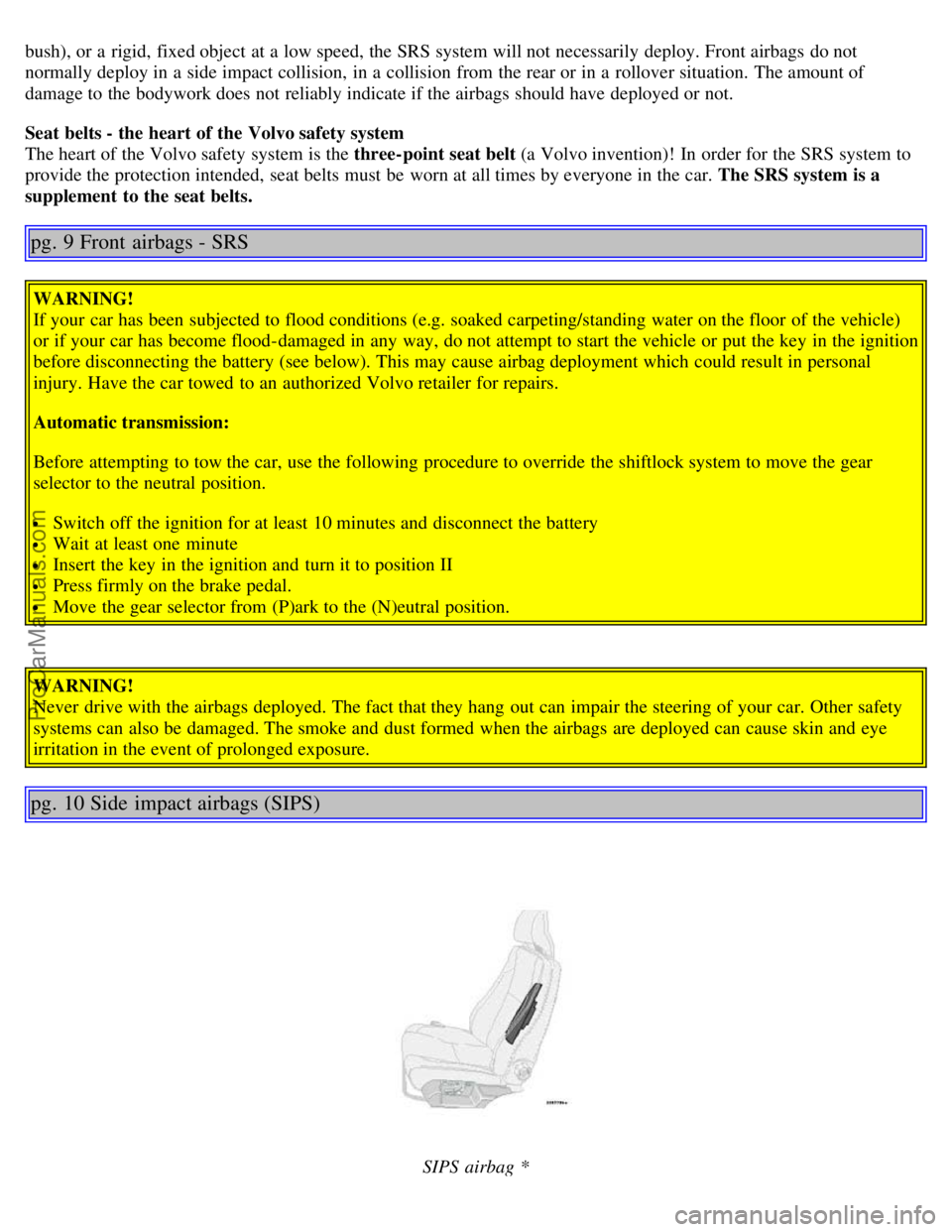
pg. 10 Side impact airbags (SIPS)
SIPS airbag *
ProCarManuals.com
Page 13 of 123

SIPS airbag (front seats only)
As an enhancement to the structural Side Impact Protection System built into your car, the car is also equipped with
Side Impact Protection System (SIPS) airbags. The SIPS airbag system consists of airbag modules built into the sides
of both front seat backrests (1), wires (2) and gas generators/sensor units (3).
The SIPS airbag system is designed to help increase occupant protection in the event of certain side impact collisions.
The SIPS airbags are designed to deploy only during certain side-impact collisions, depending on the crash severity,
angle, speed and point of impact. The airbags are not designed to deploy in all side impact situations.
NOTE: SIPS airbag deployment (one airbag) occurs only on the side of the vehicle affected by the impact.
WARNING!
The SIPS airbag system is a supplement to the Side Impact Protection System and the three-point seat belt system.
It is not designed to deploy during collisions from the front or rear of the car or in rollover situations.
The use of seat covers on the front seats may impede SIPS airbag deployment.
No objects, accessory equipment or stickers may be placed on, attached to or installed near, the SIPS airbag
system or in the area affected by SIPS airbag deployment (see illustration below).
Never try to open or repair any components of the SIPS airbag system. This should only be done by an authorized
Volvo service technician.
In order for the SIPS airbag to provide its best protection, both front seat occupants should sit in an upright
position with the seat belt properly fastened.
1 - Airbag, 2 - wire, 3 - gas generator/sensor unit
WARNING!
Never drive with the airbags deployed. The fact that they hang out can impair the steering of your car. Other
safety systems can also be damaged. The smoke and dust formed when the airbags are deployed can cause skin and
eye irritation in the event of prolonged exposure.
If your car has been subjected to flood conditions (e.g. soaked carpeting/standing water on the floor of the
vehicle) or if your car has become flood-damaged in any way, do not attempt to start the vehicle or put the key in
the ignition before disconnecting the battery. This may cause airbag deployment which could result in personal
injury. Have the car towed to an authorized Volvo retailer for repairs.
*A SIPS airbag warning decal is also located at the end of the instrument panel on the driver's side of the car.
pg. 11 Volvo Inflatable curtain (VIC)
ProCarManuals.com
Page 14 of 123
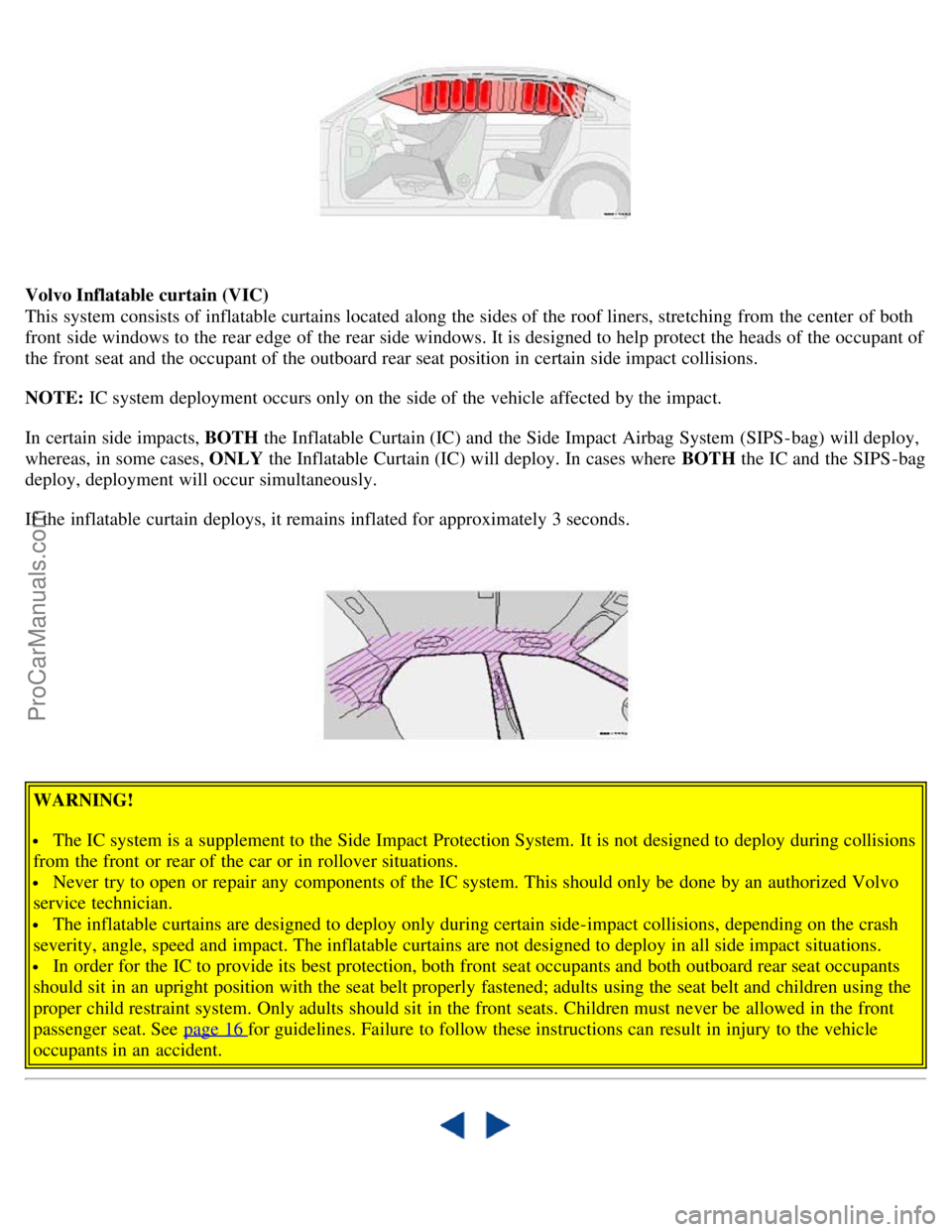
Volvo Inflatable curtain (VIC)
This system consists of inflatable curtains located along the sides of the roof liners, stretching from the center of both
front side windows to the rear edge of the rear side windows. It is designed to help protect the heads of the occupant of
the front seat and the occupant of the outboard rear seat position in certain side impact collisions.
NOTE: IC system deployment occurs only on the side of the vehicle affected by the impact.
In certain side impacts, BOTH the Inflatable Curtain (IC) and the Side Impact Airbag System (SIPS-bag) will deploy,
whereas, in some cases, ONLY the Inflatable Curtain (IC) will deploy. In cases where BOTH the IC and the SIPS -bag
deploy, deployment will occur simultaneously.
If the inflatable curtain deploys, it remains inflated for approximately 3 seconds.
WARNING!
The IC system is a supplement to the Side Impact Protection System. It is not designed to deploy during collisions
from the front or rear of the car or in rollover situations.
Never try to open or repair any components of the IC system. This should only be done by an authorized Volvo
service technician.
The inflatable curtains are designed to deploy only during certain side-impact collisions, depending on the crash
severity, angle, speed and impact. The inflatable curtains are not designed to deploy in all side impact situations.
In order for the IC to provide its best protection, both front seat occupants and both outboard rear seat occupants
should sit in an upright position with the seat belt properly fastened; adults using the seat belt and children using the
proper child restraint system. Only adults should sit in the front seats. Children must never be allowed in the front
passenger seat. See page 16
for guidelines. Failure to follow these instructions can result in injury to the vehicle
occupants in an accident.
ProCarManuals.com
Page 23 of 123
Turn signal indicator - trailer (certain models)
If you are towing a trailer, this light will flash simultaneously with the turn signals on the trailer. If the light does not
flash when signaling, neither the trailer's turn signals nor the car's turn signals are functioning.
Seat belt reminder
This symbol lights up to indicate that the driver has not fastened his/her seat belt.
Tire pressure warning light
See page 102
for more information on this function.
Contents | Top of Page
ProCarManuals.com
Page 37 of 123

Press button B to open the storage space in the center console for cassettes, accessory coin holder, etc.
Secure long loads with the seat belt
Carry long loads
The center backrest cushion folds forward, allowing you to transport long, light cargo such as skis in the trunk of your
car. To lower the backrest:
Pull the right release control handle in the trunk to release the backrest (see page 58).
From the rear seat, fold down the right section of the backrest slightly*.
Release the flap by pushing the catch (located on the rear side of the backrest) upward and pulling the flap forward.
Return the backrest to the upright position.
* If your car is equipped with the optional integrated child booster cushion, this cushion must be folded down before
you fold down the backrest (see page 15
).
pg. 59 Spare tire, Cargo net in trunk
Spare tire
The spare tire, jack and tool bag are located under the floor of the trunk. To access the spare tire:
· Raise the rear edge of the trunk floor and fold it back toward the rear seat backrest.
· Lift out the trunk floor support (certain models) from the spare tire securing bracket.
· Release the strap to lift out the jack and tool bag.
· Unscrew the securing bracket and lift out the spare tire.
ProCarManuals.com
Page 53 of 123

CAUTION:
Do not refuel with the engine running *. Turn the ignition off or to position I. If the ignition is on, an incorrect
reading could occur in the fuel gauge.
After refueling, close the fuel filler cap by turning it clockwise until it clicks into place *.
Allow for fuel expansion by not overfilling the tank. Overfilling could also cause damage to the emission control
systems.
Avoid spilling gasoline during refueling. In addition to causing damage to the environment, gasolines containing
alcohol can cause damage to painted surfaces, which may not be covered under the New Vehicle Limited Warranty.
Do not use gasolines containing methanol (methyl alcohol, wood alcohol). This practice can result in vehicle
performance deterioration and can damage critical parts in the fuel system. Such damage may not be covered under the
New Vehicle Limited Warranty.
* If the fuel filler cap is not closed tightly or if the engine is running when the car is refueled, the Check Engine
Light (malfunction indicator lamp) may indicate a fault.
However, your vehicle's performance will not be affected. Use only Volvo original or approved fuel filler caps.
pg. 75 Starting the engine
Starting the engine
1. Fasten the seat belt.
WARNING!
Before starting, check that the seat, steering wheel and mirrors are adjusted properly. Make sure the brake pedal can
be depressed completely. Adjust the seat if necessary. See page 54
.
2. Apply the parking brake, if not already set. The gear selector is locked in the (P)ark position (SHIFTLOCK).
3. Without touching the accelerator pedal, turn the ignition key* to the starting position. Allow the starter to operate
for up to 5 seconds (turbo: 10 seconds). Release the key as soon as the engine starts. If the engine fails to start, repeat
this step.
NOTE: On certain models, when the car is started, idle speed may be noticeably higher than normal for a short period,
depending on the temperature of the engine.
This has been done to help bring components in the emission control system to their normal operating temperature as
quickly as possible, which enables them to function normally.
For cold starts at altitudes above 6000 ft (1800 meters), depress the accelerator pedal halfway and turn the key to the
starting position. Release the pedal slowly when the engine starts.
4. To release the gear selector from the (P)ark position, the engine must be running (or the ignition key must be in
position II) and the brake pedal must be depressed. While keeping firm pressure on the brake pedal, release the parking
brake.
5. Select the desired gear. The gear engages after a very slight delay which is especially noticeable when selecting R.
NOTE:
Your car is equipped with a KEYLOCK system. When the engine is switched off, the gear selector must be in the
( P )ark position before the key can be removed from the ignition switch.
When starting in cold weather, the transmission may shift up at slightly higher engine speeds than normal until the
automatic transmission fluid reaches normal operating temperature.
ProCarManuals.com
Page 79 of 123

2 0 0 5
VOLVO S80
Chapter 8 - Maintenance/Servicing
pg. 113 Maintenance/Servicing
Fuses114
Replacing bulbs119
Paint touch up126
Washing the car127
Cleaning the upholstery129
Maintenance service, Warranty130
Fuel/emissions systems131
Drive belt, Coolant132
Emissions maintenance133
Washer fluid, Hoisting the car134
Opening the hood, Engine compartment135
Engine oil136
Power steering/Brake fluid reservoirs138
Replacing the battery139
Battery maintenance140
Replacing wiper blades141
pg. 114 Fuses
ProCarManuals.com
Page 114 of 123
Door step courtesy lights - replacing..........123
Doors and locks..........62
Drive belt..........132
Driving economy..........84
Driving mode indicator..........27
Driving mode W..........77, 79, 81
Driving with trunk open..........85
E
Economical driving..........84
Electrical system..........149
Electrical system - general information..........85
Electrically operated front seats..........54
Electrically operated moonroof..........43
Electrically operated sideview mirrors..........42
Electrically operated windows..........41
Electronic Brake Force Distribution..........19
Electronic Climate Control(ECC)..........47 - 49, 51
Emergency Locking Retractor (ELR)..........16
Emergency towing..........87, 88
Emergency warning flashers..........39
Emissions systems..........131
Engine - specifications..........146
Engine - starting..........75
Engine air filter..........133
Engine compartment..........135
Engine oil..........93, 136, 137, 147
Exterior courtesy lights..........62
Exterior features - overview..........25
F
Fog light - rear..........29
, 35
Fog lights - front..........34
Folding passenger's seat backrest..........55
Folding rear seat backrests ........60
Four-C (active chassis system).........82
Front airbags - SRS..........4-9
Front airbags - SRS - warning light..........28
Front courtesy lights - replacing..........125
Front fog lights..........34
Front fog lights - replacing ........122
Front reading lights..........56
Front seats - adjusting..........54
Front seats - heated..........39
Front suspension..........148
Fuel..........72, 147
ProCarManuals.com