2005 VOLVO S40 oil
[x] Cancel search: oilPage 93 of 127
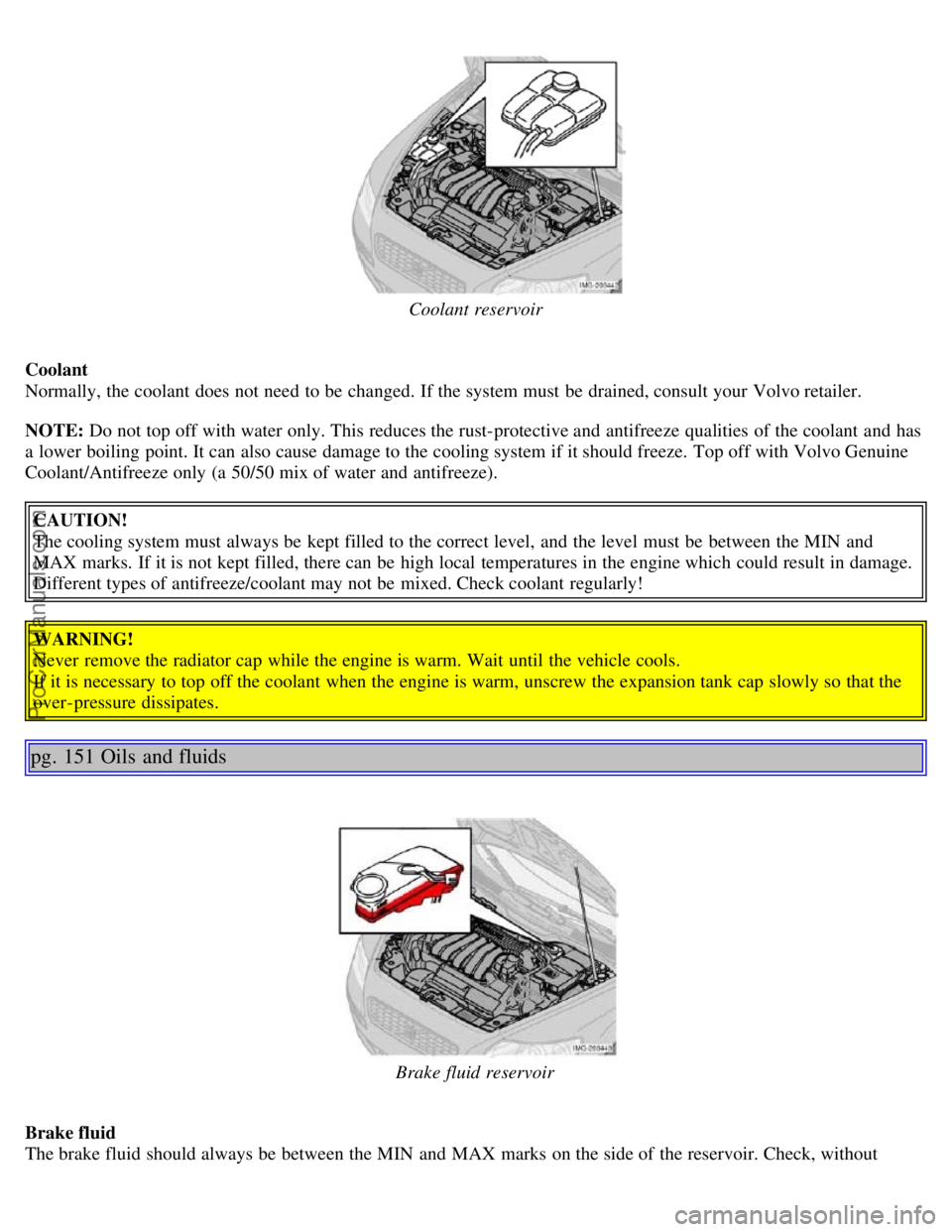
Coolant reservoir
Coolant
Normally, the coolant does not need to be changed. If the system must be drained, consult your Volvo retailer.
NOTE: Do not top off with water only. This reduces the rust-protective and antifreeze qualities of the coolant and has
a lower boiling point. It can also cause damage to the cooling system if it should freeze. Top off with Volvo Genuine
Coolant/Antifreeze only (a 50/50 mix of water and antifreeze). CAUTION!
The cooling system must always be kept filled to the correct level, and the level must be between the MIN and
MAX marks. If it is not kept filled, there can be high local temperatures in the engine which could result in damage.
Different types of antifreeze/coolant may not be mixed. Check coolant regularly!
WARNING!
Never remove the radiator cap while the engine is warm. Wait until the vehicle cools.
If it is necessary to top off the coolant when the engine is warm, unscrew the expansion tank cap slowly so that the
over-pressure dissipates.
pg. 151 Oils and fluids
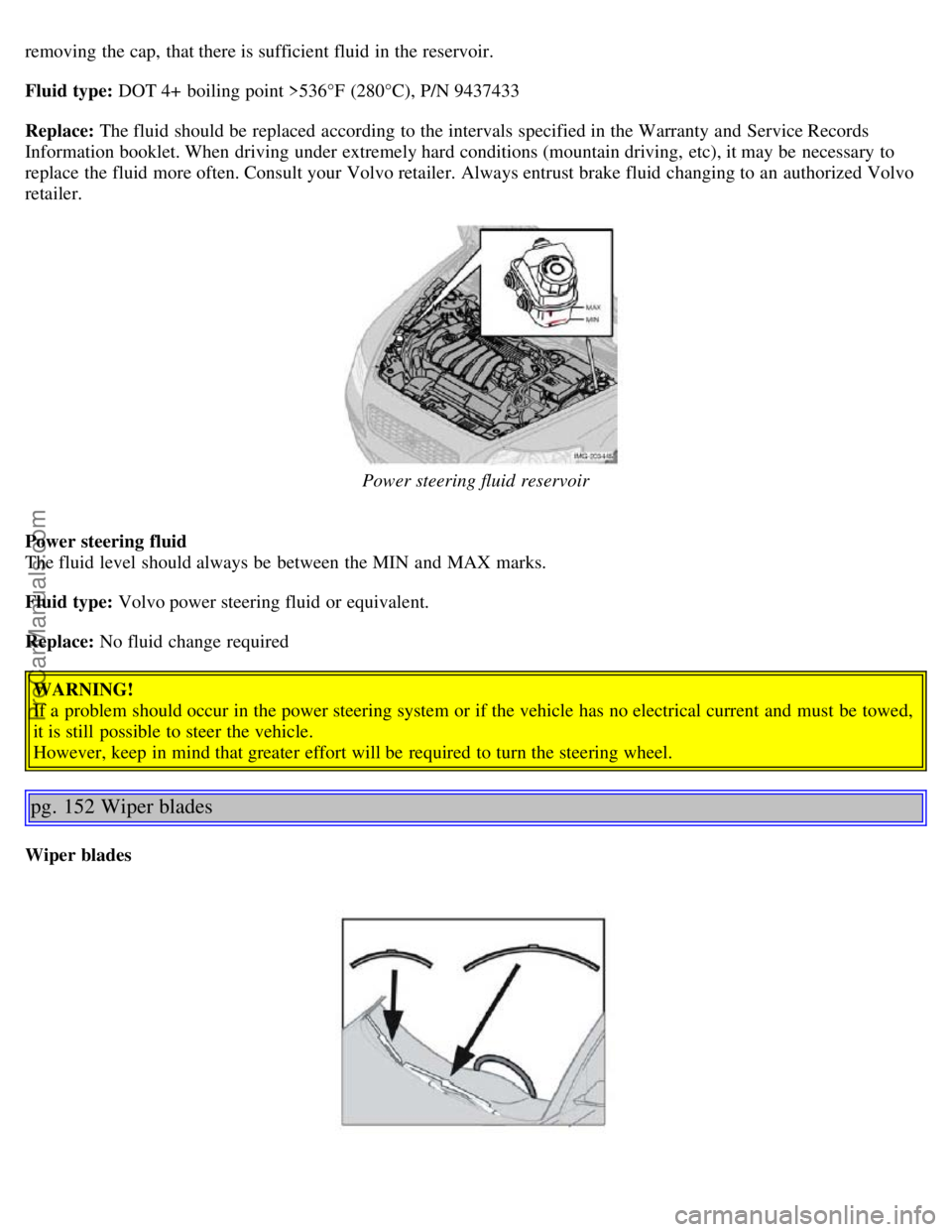
Brake fluid reservoir
Brake fluid
The brake fluid should always be between the MIN and MAX marks on the side of the reservoir. Check, without
ProCarManuals.com
Page 94 of 127
removing the cap, that there is sufficient fluid in the reservoir.
Fluid type: DOT 4+ boiling point >536°F (280°C), P/N 9437433
Replace: The fluid should be replaced according to the intervals specified in the Warranty and Service Records
Information booklet. When driving under extremely hard conditions (mountain driving, etc), it may be necessary to
replace the fluid more often. Consult your Volvo retailer. Always entrust brake fluid changing to an authorized Volvo
retailer.
Power steering fluid reservoir
Power steering fluid
The fluid level should always be between the MIN and MAX marks.
Fluid type: Volvo power steering fluid or equivalent.
Replace: No fluid change required WARNING!
If a problem should occur in the power steering system or if the vehicle has no electrical current and must be towed,
it is still possible to steer the vehicle.
However, keep in mind that greater effort will be required to turn the steering wheel.
pg. 152 Wiper blades
Wiper blades
ProCarManuals.com
Page 112 of 127
2 0 0 5
VOLVO S40
Chapter 12 - Specifications
pg. 183 Specifications
Label information184
Dimensions and weights185
Fuel, oils, and fluids186
Engine oil187
Engine specifications188
Electrical system189
Three-way catalytic converter190
Volvo programs191
pg. 184 Label information
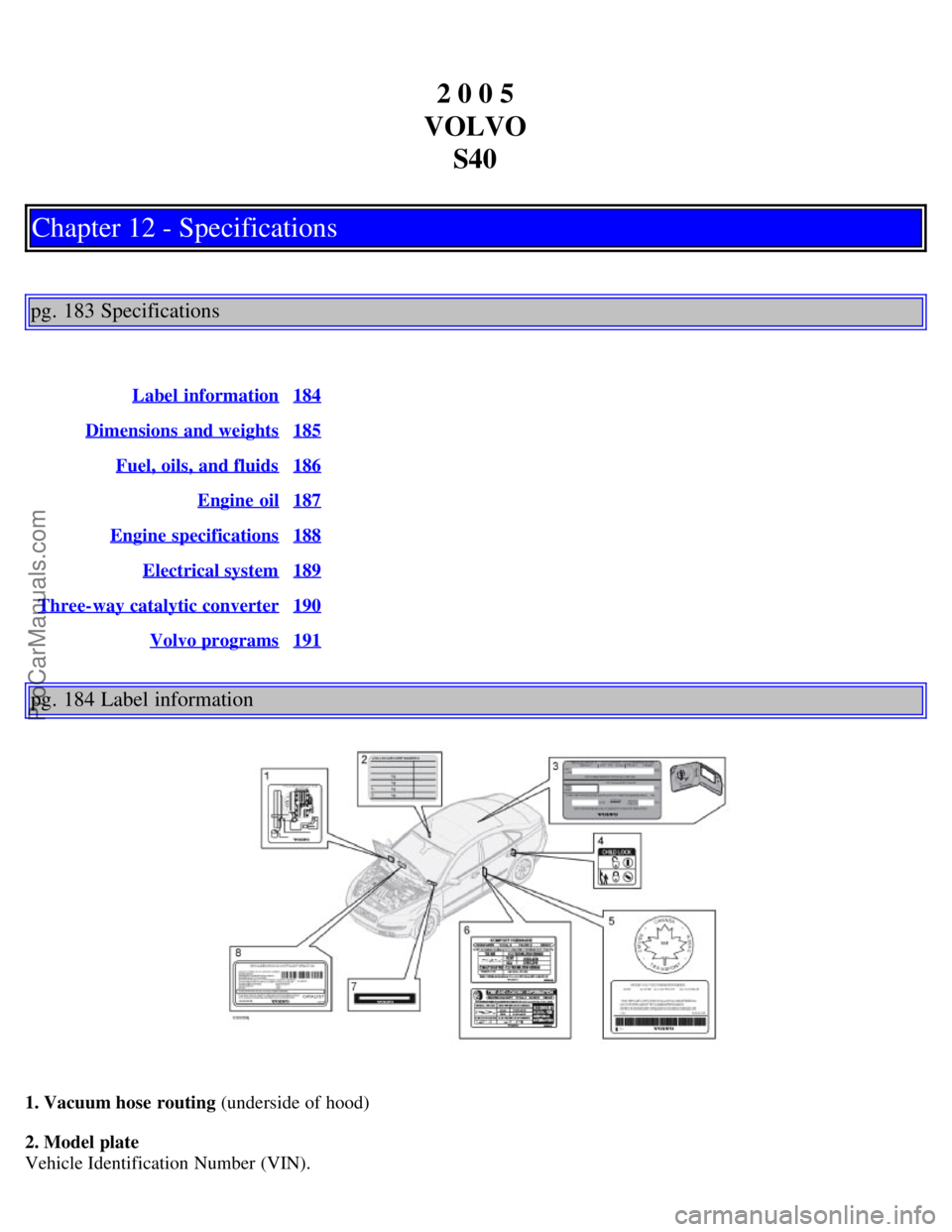
1. Vacuum hose routing (underside of hood)
2. Model plate
Vehicle Identification Number (VIN).
ProCarManuals.com
Page 114 of 127
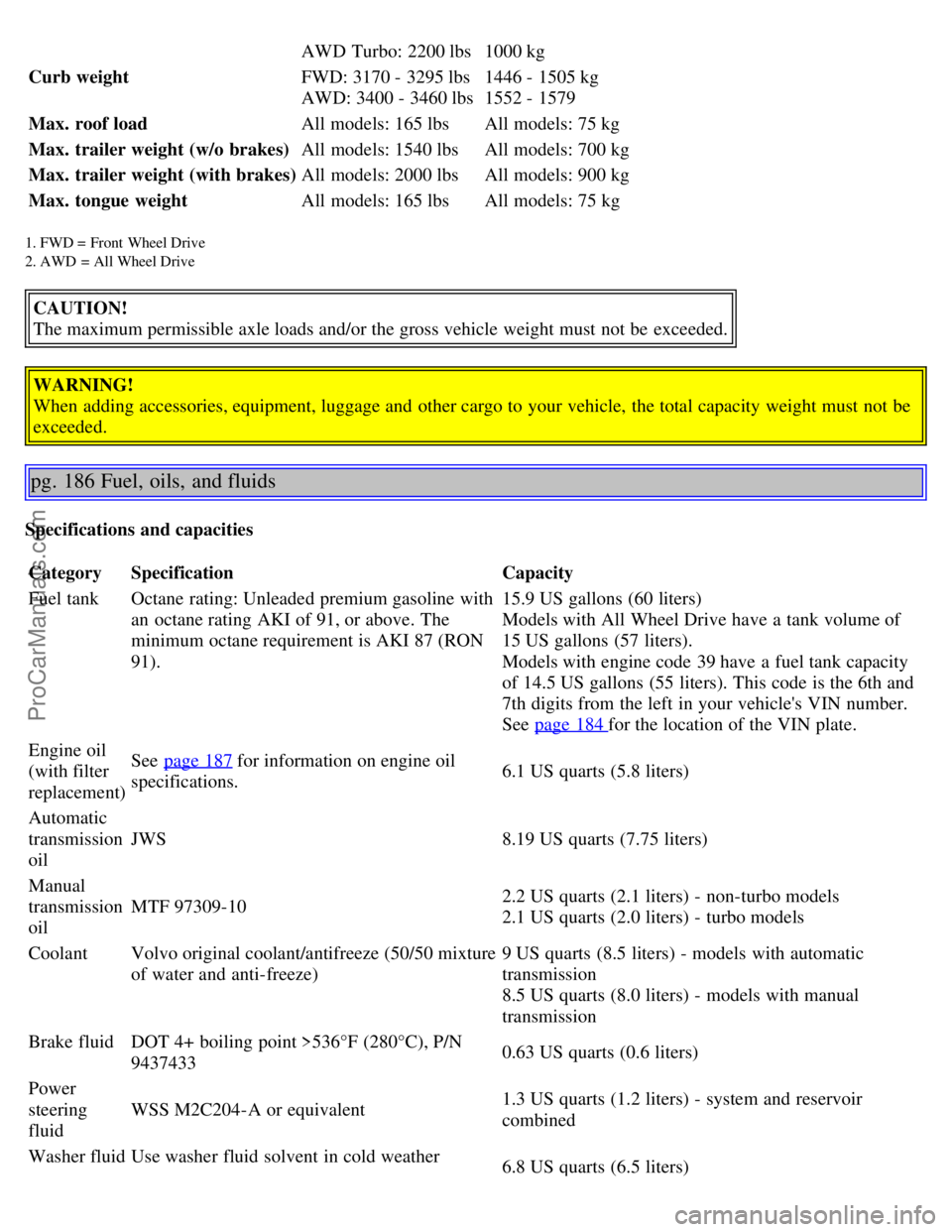
AWD Turbo: 2200 lbs1000 kg
Curb weight FWD: 3170 - 3295 lbs
AWD: 3400 - 3460 lbs1446 - 1505 kg
1552 - 1579
Max. roof load All models: 165 lbsAll models: 75 kg
Max. trailer weight (w/o brakes) All models: 1540 lbsAll models: 700 kg
Max. trailer weight (with brakes) All models: 2000 lbsAll models: 900 kg
Max. tongue weight All models: 165 lbsAll models: 75 kg
1. FWD = Front Wheel Drive
2. AWD = All Wheel Drive
CAUTION!
The maximum permissible axle loads and/or the gross vehicle weight must not be exceeded.
WARNING!
When adding accessories, equipment, luggage and other cargo to your vehicle, the total capacity weight must not be
exceeded.
pg. 186 Fuel, oils, and fluids
Specifications and capacities
Category Specification Capacity
Fuel tank Octane rating: Unleaded premium gasoline with
an octane rating AKI of 91, or above. The
minimum octane requirement is AKI 87 (RON
91). 15.9 US gallons (60 liters)
Models with All Wheel Drive have a tank volume of
15 US gallons (57 liters).
Models with engine code 39 have a fuel tank capacity
of 14.5 US gallons (55 liters). This code is the 6th and
7th digits from the left in your vehicle's VIN number.
See page 184
for the location of the VIN plate.
Engine oil
(with filter
replacement) See page 187
for information on engine oil
specifications. 6.1 US quarts (5.8 liters)
Automatic
transmission
oil JWS
8.19 US quarts (7.75 liters)
Manual
transmission
oil MTF 97309-10
2.2 US quarts (2.1 liters) - non-turbo models
2.1 US quarts (2.0 liters) - turbo models
Coolant Volvo original coolant/antifreeze (50/50 mixture
of water and anti-freeze) 9 US quarts (8.5 liters) - models with automatic
transmission
8.5 US quarts (8.0 liters) - models with manual
transmission
Brake fluid DOT 4+ boiling point >536°F (280°C), P/N
9437433 0.63 US quarts (0.6 liters)
Power
steering
fluid WSS M2C204-A or equivalent
1.3 US quarts (1.2 liters) - system and reservoir
combined
Washer fluid Use washer fluid solvent in cold weather
6.8 US quarts (6.5 liters)
ProCarManuals.com
Page 115 of 127
reservoirconditions.
Air
conditioning
systemRefrigerant - R134a
1.2 lbs. (530 grams)
pg. 187 Engine oil
Oil specifications
Engine oil must meet the minimum ILSAC specification GF-2, including ACEA A1, API SJ, SJ/CF and SJ/Energy
Conserving. Your Volvo has been certified to standards using ILSAC oil specification GF-2 5W -30. Volvo
recommends use of oil with a quality rating equal to or higher than ILSAC GF-2. Equivalent and better oils include
ACEA A1, API SJ, SJ/CF, and SJ/Energy conserving. Lower quality oils may not offer the same fuel economy, engine
performance, or engine protection.
Volvo Cars recommends Castrol.
Depending on your driving habits, premium or synthetic oils may provide superior fuel economy and engine
protection. Consult your Volvo retailer for recommendations on premium or synthetic oils.
Oil additives must not be used.
NOTE: Synthetic oil is not used when the oil is changed at the normal service intervals. This oil is only used at
customer request, at additional charge. Please consult your Volvo retailer.
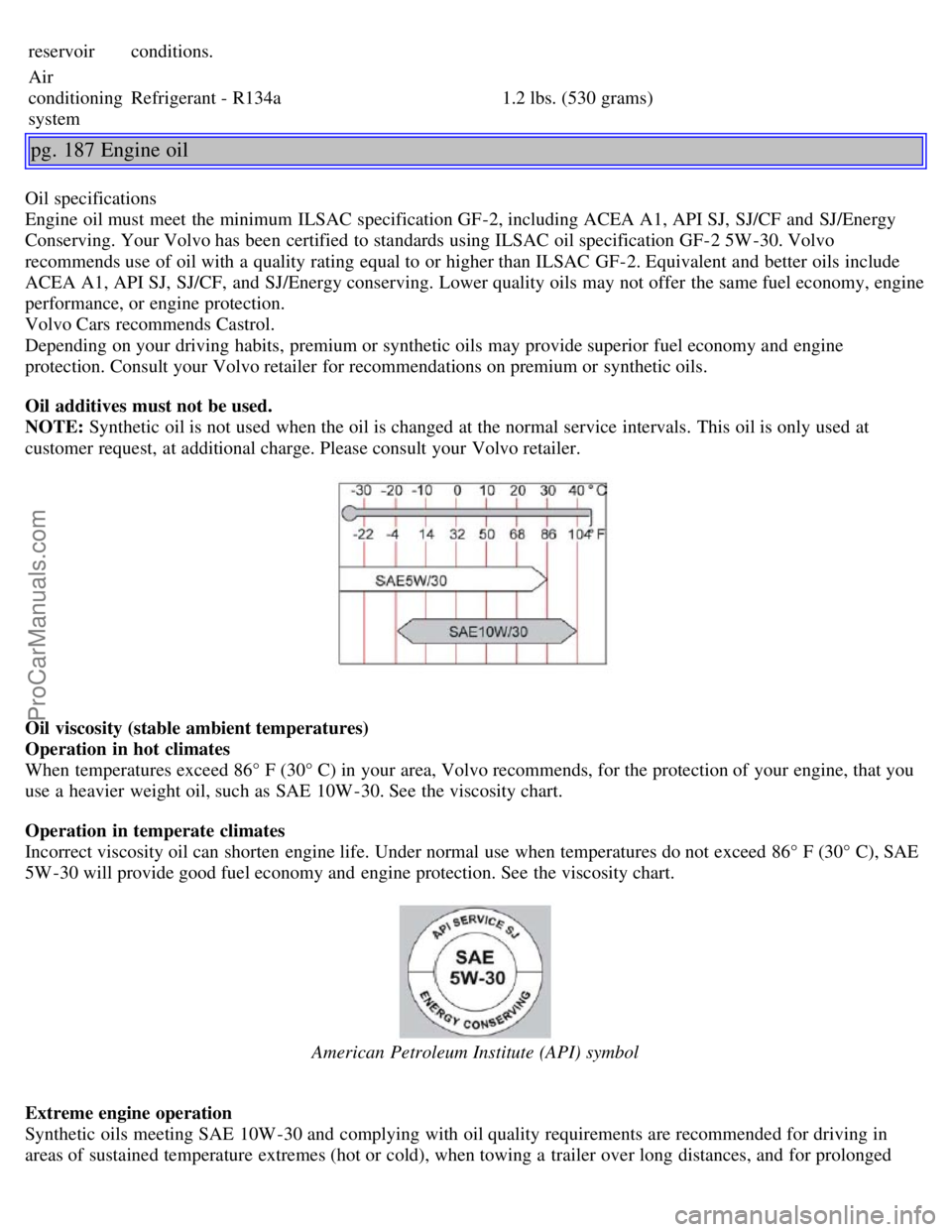
Oil viscosity (stable ambient temperatures)
Operation in hot climates
When temperatures exceed 86° F (30° C) in your area, Volvo recommends, for the protection of your engine, that you
use a heavier weight oil, such as SAE 10W -30. See the viscosity chart.
Operation in temperate climates
Incorrect viscosity oil can shorten engine life. Under normal use when temperatures do not exceed 86° F (30° C), SAE
5W -30 will provide good fuel economy and engine protection. See the viscosity chart.
American Petroleum Institute (API) symbol
Extreme engine operation
Synthetic oils meeting SAE 10W -30 and complying with oil quality requirements are recommended for driving in
areas of sustained temperature extremes (hot or cold), when towing a trailer over long distances, and for prolonged
ProCarManuals.com
Page 116 of 127

driving in mountainous areas.
American Petroleum Institute (API) symbol
The API Service Symbol "donut" is divided into three parts:
The upper section describes the oil's performance level.
The center identifies the oil's viscosity.
The lower section indicates whether the oil has demonstrated energy-conserving properties in a standard test in
comparison to a reference oil.
pg. 188 Engine specifications
Engine designation B5244S4 B5244S7B5254T3
Output
kW/rps 125/100 125/100162/83
hp/rpm 168/6000 168/6000218/5000
Torque
Nm/rps 230/73 230/73320/25-80
ft. lbs./rpm 166/4400 166/4400236/1500-4800
No. of cylinders 5 55
Displacement (liters/cubic
inches) 2.44/148.6
2.44/148.62.52/153.8
Bore (mm/in.) 83/3.27 83/3.2783/3.27
Stroke (mm/in.) 90/3.54 90/3.5493.2/3.67
Compression ratio 10.3:1 10.3:19.0:1
Spark plugs
type Volvo kit no. 30650843 Volvo kit no. 30650843Volvo kit no.
30650379
gap inches/mm (3x) 0.024 ± 0.004 in./0.6 ±
0.1mm (3x) 0.024 ± 0.004 in./0.6 ±
0.1mm
0.027in./0.7mm
tightening torque ft. lbs./Nm 22.5 ft. lbs./30 Nm 22.5 ft. lbs./30 Nm22.5 ft. lbs./30 Nm
Charge air cooler (Intercooler)
Turbocharged engines employ a turbocompressor to force air into the engine inlet manifold and a charge air cooler to
cool the compressed inlet air. The resulting increase in air flow raises pressure in the intake manifold and increases
engine power over that developed by the normally-aspirated engine. The charge air cooler (which resembles a radiator)
is located between the turbo-compressor and inlet manifold.
Fuel system
The engine is equipped with a multiport fuel injection system.
pg. 189 Electrical system
General information
12-volt system with voltage controlled generator. Single wire system in which the chassis and engine block are used as
conductors, grounded on the chassis.
Bulbs
Please refer to page 155
for a list of the bulbs used in your car.
ProCarManuals.com
Page 120 of 127
Brake fluid151
Bulbs155
C
Capacities, fluids186
Catalytic converter, three-way190
CD changer179
CD player177
Central locking system, remote controls88
Changing a tire135
Changing oil149
Charge air cooler188
Child restraint anchorages35
Child safety32
Clock setting button38
Cold weather precautions99
Collision status30
Collisions, driving after30
Compact disc care177
Compass in rearview mirror57
Coolant150
Courtesy lighting81
Cruise control49
D
Dimensions185
Disabling the passenger's side front airbag19
Display, instrument panel38
Dolby Surround Pro Logic II172
Door mirrors58
Door open warning42
Driving after a collision30
DSTC44
E
Economical driving98
Electrical current - conserving99
Electrical system189
Electronic Brake Force Distribution (EBD)112
Emergency Brake Assistance - EBA113
Engine compartment148
Engine oil, changing149
Engine specifications188
Environment3
Equalizer, audio system172
F
Federal Clean Air Act146
ProCarManuals.com
Page 122 of 127

Inflation pressure tables127
Information display38
Information display, messages in43
Information symbol38, 39
Instrument overview8
Instrument panel38
Instrument panel lighting45
Interior lighting81
ISOFIX/LATCH anchors32
J
Jack, positioning correctly136
Jump starting118
K
Key blade90
Key blade, locking and unlocking the car90
Keylock2, 104
Kickdown109
L
Label information184
LATCH anchors33
License plate lighting, replacing159
Lighting panel45
Loading the vehicle130
Long distance trips100
Low beam bulb, replacing156
M
Maintenance146
Malfunction indicator light40
Manual front seat adjustment78
Manual shifting (Geartronic)108
Manual transmission107
Mirror, rearview57
Mirrors, door-mounted58
Moonroof59
O
Occupant safety12
Occupant Weight Sensor (OWS), disabling front passenger's side airbag19
Octane rating101
Oil pressure warning light41
Oil, changing149
On Call Roadside Assistance191
Opening the hood148
P
Paint touch up143
ProCarManuals.com