2005 VOLKSWAGEN GOLF seats
[x] Cancel search: seatsPage 145 of 444
page
There are also additi ona l a dju stment s tha t mus t
b e m ad e in order to be a ble to properl y install a
c hild res trained on th e f ro m seat:
Set th e safe ty bell upper a nch orage for th e
front passenger seat to the hi ghest adju stment po sition if th e available safety belt l eng th is sufficient to prope rly install the child res traim
Move the fr ont passe nge r scat to the highes t
pos ition in the seat's up and do wn adju stment
range.
Mo ve the front passe nge r seat to the rea rmos t positio n in the seat's fore an d aft adjustment range, as far away from the airbag as pos
sib le before insta llin g th e forw ard-fa cin g c hild
If a strap ortether is bein g used to tic th e child seat to th e fro nt passe nge r seat, make sure
t h a t it is not so tight that it causes the w eig ht sensing m at to m ea sur e mo re we ight than is acon the seat.
Always r
emember: Even though your vehicl e is equipped w ith an Adva nce d Air b ag all childr en. espec ially those 12 years and you nger,
s h ou ld always ride in the back scat properly re
strai ned for th eir and size.
Not u sin g a child seat, using the wrong child seat or improperly ins taUing a c hild res traint
in creases the risk of seriou s personal injury and death.
All vehicle occu pants and especially children must a lways be res train ed properl y
w heneve r riding in a ve hicle .
- An
unrestrained or improp erl y re
s trained child can be injur ed or killed by
ava ilabl e c hild seats are re
quired to comply with hicle Safety Standard
use child restraint sys te m s that fully contact the flat portion of th e seat
c u shi on. Th e child restraint must not tip or lean to either si de. Volkswagen does not recommend using child seats that rest on legs or tube- like frames. They do not pro
vide adequate cont act with the se at.
- Always h
eed all legal requirem ents per
taining to th e in stallation and u se of c hild seats and carefully follow the in struction s provided by the manufacturer of th e scat
yo u are usin g.
Neve r allow children unde r 4 ft 9 in (57 in ch es /1.45 meters) to wear a normal safe ty belt . T hey must alway s be re strai ned by
a prope r child restraint syste m. they could su sta in injuries to th e abdomen and n ec k areas during sudden braklng ma
neuv ers or acci de nt s.
Never let more than one child occupy a
c hil d scat.
Neve r let babies or older child ren ride in a vehicl e w hil e sittin g on tlt e lap of ano ther pas
senge r.
- Holdin g a child in yo
ur arms is neve r a
subs titute for a child restraint syste m .
-
The s trongest person co uld not hold the
c hild with the forc es that exist in an acci
d e nt . Th e child will strike the int erior of the vehicl e and can al so be struck b y the pas
senge r.
-
The c hild and th e passe nger can also injure each another in an acci dent .
Neve r in stall rcanvard-faci ngchild seats or infant carriers on the front passenger seat. A
c hild w ill be se riou sly inju red and ca n be
safety 57
Page 146 of 444
Booklet 2.1 Safety first
(continued)
even with an Adva nced Air bag Sys tem.
The infl ating airbag will hit the child seat or infant carrier w ith great force and will
smas h the c hild seat and child against the
backre st, center armrest, door o r roof.
Always in stall r eanva rd-facing child seats or infant carri ers on the rear scat.
Fonvard -facing child seats in stall ed on th e
front passe nger's sea t can interfere
th e c hild's safety and well-being require that the fo llowing special precautions be taken:
- Make s
ure the fo nvard -facing seat has been designed and certifi ed b y its manufacturer for use on a front scat with
as po ssib le before
installin g the child res traint .
58 safety
the front passenger's seat from being moved to the rca rmost position in its for e and aft adjustment range.
-
Always make s ure that th e ba ckrest is in the upright position.
Always buckle the child seat finnl y in pla ce
eve n if a child is not sitting in it. A loo se child
seat
can fly around durin g a sudden stop or in
a collisio n.
Alway s read and hee d all WAHNINGS whenever usi ng a child restrain ed in a ve hicle
i s being page page and
To reduce the risk of serio us injury, make sure th at the PASSENGER BAG light comes o n and stays on whenever a child restraint is
installed on the front p asse nger seat and the ignition is sw itch ed on.
Tak e th e c hild restra int the front senger seat and in stall it properly at one of th e
rear seat posi tio ns if PASSENGER light does not sta y on.
Have the airbag sys te m inspec ted by your au thori ze d Volkswagen dealer or qualified
worksho p immediat ely .
Page 147 of 444
seats
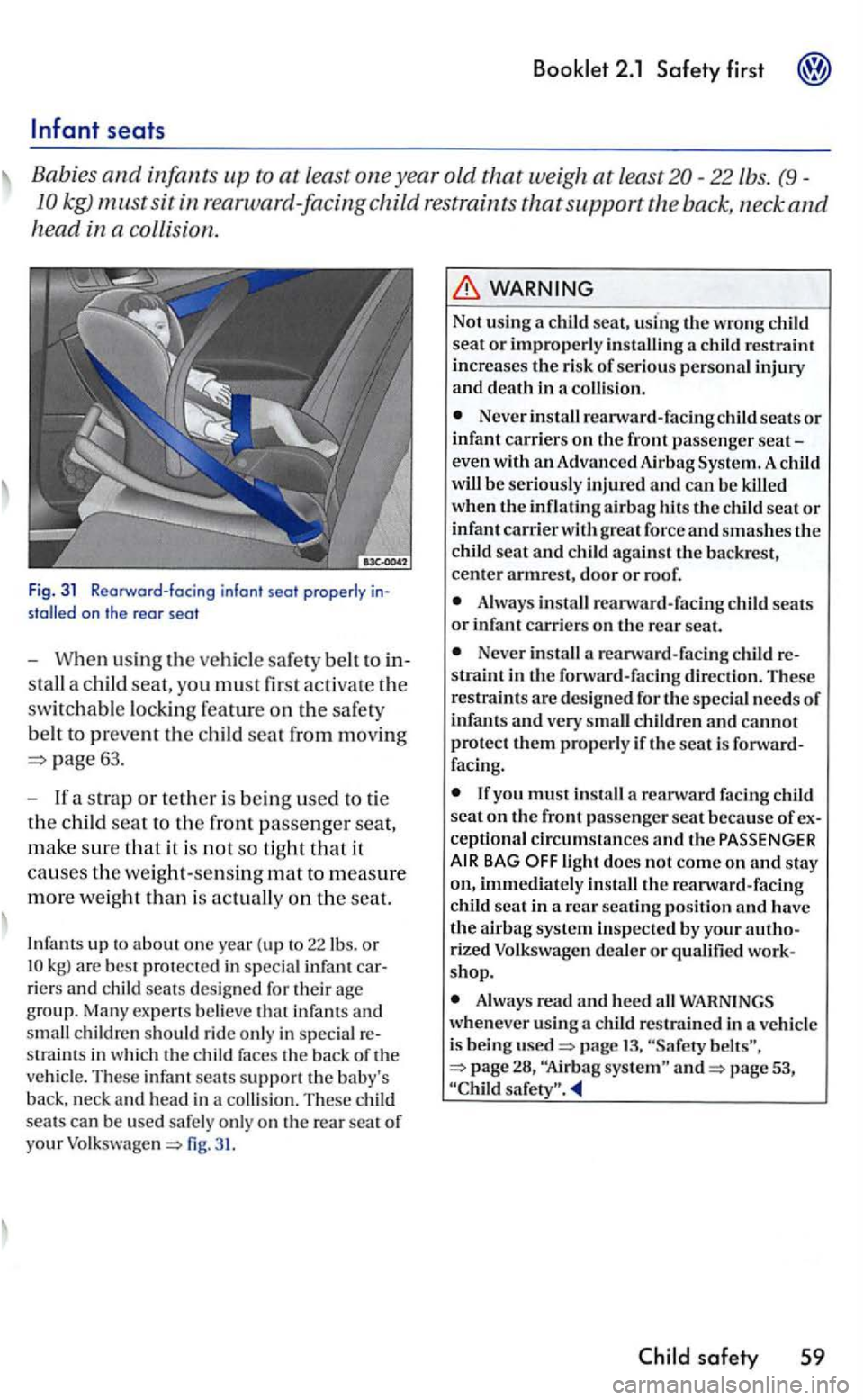
Babies and infants up to at least one year old that weigh at least20-22lbs. (9-
kg) must sit
on the re ar seat
- When using the ve hicl e sa fet y bell to
stall a child seat, yo u m ust activate the
sw itchab le lock in g
feature on the safety
to prevent th e child seat from moving
63.
-If a s trap or tet her is bein g use d to tie
t h e chil d se
at to th e front passenger seat,
make s
ure that it is not so tight that it
causes d1e we ight-s en sin g mat to m easure
more weig ht than is actually on t h e sea t.
I nfant s up to about one year (up to 22lbs. or
riers an d child seats des ign ed for their ag e
gro up. M any experts believe that i nfan ts an d
s ma
ll children should ride on ly in specia l stra int s in whic h the ch ild faces th e ba ck of the vehicle. These infant sca ts s uppo rt th e baby 's
ba ck, neck and he ad in a collisio n. These child
sea ts can b e used safe ly only on the rear seat of your Jig.
WARNING
N ot using a chil d sca t, th e wro ng c hild seat o r im prope rly a c hild restraint increases th e r isk of serio us pers onal injury a nd death in a
Neve r install reanvard-fac ing child seats or
i n fa n t carri ers o n th e fro nt passenger sea t
e v en w ith an Adva nced Airb ag System. A child
Always install reanva rd-faci ng c hil d seats or in fant carriers on the rear seat.
Never install a reanva rd -faci ng c hild
faci ng.
rize d Volkswage n deale r or q u al ified
A lways read an d heed all WARNINGS whenever using a c hild re strained in a v ehicle
is being
page 53,
safety 59
Page 148 of 444
2.1
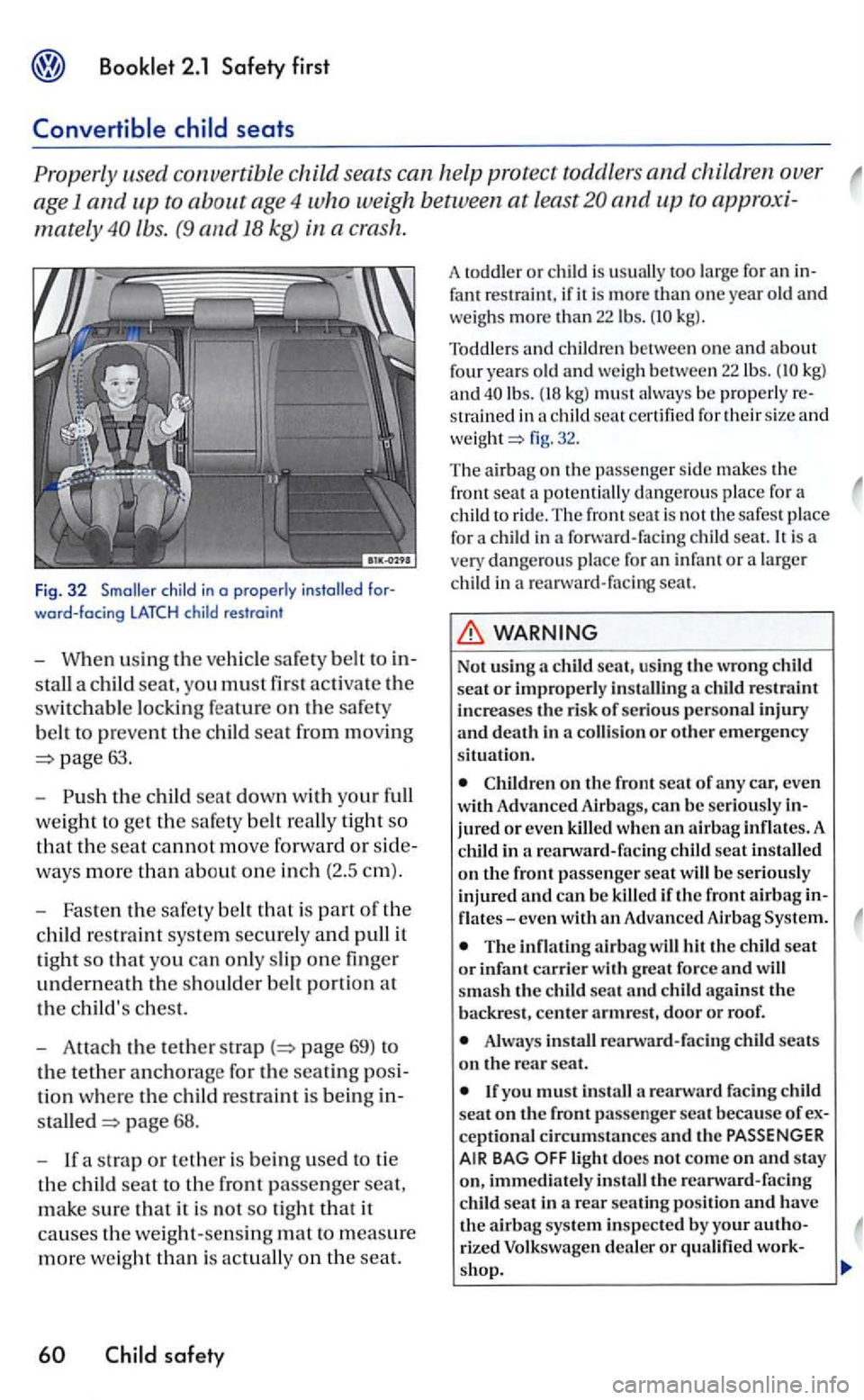
seats can help protect toddlers and children ove r
age 1 and and up to
mately lbs. (9 and 18 kg) in a cra sh.
Fig . 32
stall a child seat, yo u must first activ ate the
switchable locki ng feature on the safet y
belt to pre vent the child seat from moving
63.
-the child seat down with your full
weight to get the safety belt re ally tight so
that the seat cannot move fo rw ard or
page 69) to
the tether anchorage for th e seating
tion w here the c hild restra int is being
sta lled page 68.
-
safety
A toddle r or is usuall y too large for fant restraint, if it is m ore than one year and weighs more than 221b s.
and weig h be tween 221bs.
s train ed in seat certified for the ir size and fig. 32.
The airbag on the passenger side m akes the front seat a pot entially dang erous place fo r a to ride. Th e front seat is not the safest place
for a child in a forward-fac ing child seat.
in a re arw ard-facing seat.
WARNING
Not using us ing the wrong seat or improperly installing child restra int
increases the risk of serious personal injury and death in a or other emergency
si tuation.
Children on th e front seat of any car, even
with Advanced Airbags, can be seriously jured or even
be seriousl y
in jured and be if th e front airbag flates-even with an Advanced 1\irbag System .
The inflating airbag will th e child seat or infant carrier with gr eat force and
Always install rearward -facing child seats on the rear seat.
yo u must i.nstall a rearward faci ng sea t on the front passeng er sea t because of ceptional circumstances and th e PASSENGER
immediatel y in stall the r earward-facing
child sea ting position and have
th e airbag system inspected by your rized Volkswagen dealer or qualified work-
shop.
Page 150 of 444
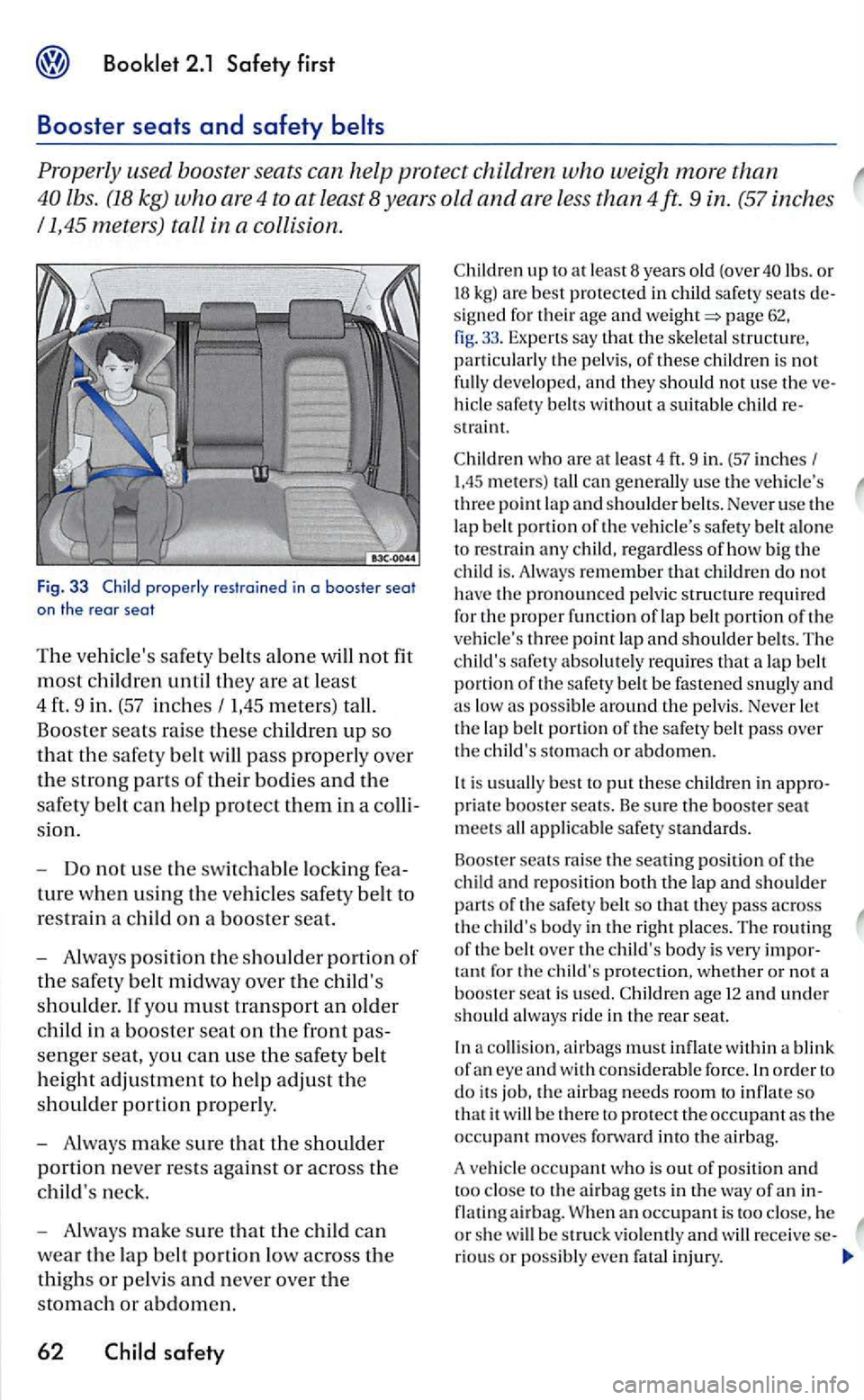
Properly used booster seats can help protect children who weigh more than
lbs. (18 kg) who are 4 to at least 8 years old and are less than 4ft. 9 in. (57 inches
1,45 meters) tall in a collision.
Fig. 33 Child
s igne d for th e ir age and page 62, fig. 33. Experts say that the skeletal structu re, particularl y the pelvis, of these child ren is not fully developed, and
1,45meters) tall can generally use the vehicle's three point lap and shoulder belts. Never use the lap be lt portion of the vehicle's safety belt alone to res train any child, regardless of how b ig the child is. Always remember that children do not have the pronounced pelvic structure requ ired for the proper fun ction of lap belt portion of the veh icle 's three point la p and shoulder belt s. The child's safety absolutely require s that a lap belt portion of the safety belt be fas tened snugl y and as low as possible around the pelvis. Never le t the lap b e lt portion of the safety belt pass over
the ch ild's stomach or abdomen.
age 12 and under should always ride in th e rear seat.
a c ollisio n, airba gs must inflate w ith in a blink
o f an eye and w ith considerable force. ord er to
d o its job , the airbag needs room to infla te so tha t it will be there to pro tect the occupant as the occupant moves forward into the airbag.
A vehicle
occupant who is out of posit ion and too close to th e airbag gets in the way of an infla tin g airbag. When an occupant is too close, he
o r she will be stru ck vio lently and wiLl receive se-rious o r poss ibly even fatal injury.
Page 152 of 444
child restrain! is in stalled with a
sa fety belt , th e safety belt must be locke d so
strained for th eir age and size.
colli sio n.
Always make sure th at the safety b elt tracto r is locke d w hen in stallin g
Always buckle the seat firml y in plac e
eve n if
can fly around during a sudden sto p or in
Always rest to whi ch the ce nter rear safety belt is tach ed i s sec ure ly la tc h ed wh eneve r th e rea r
cente r sa fety belt is being use d to secure a
c hild booklet 3.1 and
ward together with the backrest and w ill strik e
part s of th e ve hicl e int eri or. T he c hild can be seriou sly injure d or kill ed .
Never ins tall rearw ard -faci ng c hild scats or infant carri ers on the f ront passe nge r sc at. A
kill ed w hen the passe nge r airb ag inflates.
The inflatin g air bag will hit the child scat or infa nt carrier with great force and w ill
smas h th e child seat and child against the
b ackrest, ce nter armrest , d oo r or roof.
Always instal l rearward -faci ng c hild seats or infant carri ers on th e rear scat.
64 safety
Forward -facin g c hild seats o r infant ri ers insta ll ed on the fr ont passe nger' s sca t
m ay interfere with the de plo ym ent of the
a irba g cause seriou s injury to the c hild.
Alw ays read and hee d all whenever u sin g a c hild restrain ed in a vehicle
i s be in g page 53.
page
Rearward -fa cin g restrai nts:
child in a reanva rd-facin g c hild seat sta ll ed on the front p asse nger sea t will b e ously inju red and ca n be killed if the fro nt
a irbag infl ates eve n with an Advan ce d Airb a g
Syste m.
The inflatin g airbagwill hit the child seat or infant carrier with great force and w ill
smas h the c hild seat a nd child against the
b ackrest, ce nter armres t, d oor o r r oof.
Always be es peci all y care ful if yo u must s tall a reanvard faci ng seat on the front pa sse nge r seat in ex ce ptional circumsta nces.
A tight te th er strap on a rearward- fac ing
c hild restraint attache d to the front p asse nger
sca t can put too muc h pressure o n the mat in the seat and reg is ter a heav ie r weight in the A dva nce d Airb ag Sys te m. The hea vie r
w eig ht reg is te re d ca n mak e th e sys te m work
as
thoug h an adult were o n the scat and ploy the A dva nced Airba g wh en it must be suppresse d causing serio us or eve n fa ta l ju ry to the child .
Make sure that th e PASSENGER AIR BAG Light comes o n and s tays on all the tim e
wh en ever th e ig niti on is s wit ch ed on.
dealer o r
Page 155 of 444
2.1 Safety first
cally when the belt is wound all the way back into the retractor.
-the red button on the safety belt
buckle.
The belt tongue will pop out of the
-Guide the safety belt back by ha nd so
that it rolls easily onto the retractor and the
trim around the retractor will not be
aged.
Always let th e sa fe ty belt retract completely into its s towed position. The sa fety belt can now be used as an ordinary safety belt withou t th e
vated inadvertently, the safety belt must be
WARNING
Improperly installed child seats increase the risk of serious personal injury and death in a
collision .
Never unfasten the safety belt to deactivate the switchable locking feature for child
ously injured in an accident.
WARNINGS whenever using a child restrained in a vehicle
i s being page 53. Special precautions apply when installing a child seat on the front passe ng er page
safety 67
Page 161 of 444
-both straps wit h hook-on con
n
ect ors on the secu re ly to the lower
a n ch orages.
- P ull str ap s tig
ht foll ow ing th e man
ufacturer's instr uctio ns.
-Release or deploy th e ch ild rest ra in t
tether strap.
- Guide th e
upper tether strap under th e
rea r
head restraint (ra ise the head restra int
if n ecessary).
- Att
ach th e te ther s trap anch orage hook
int o th e o pe
ning of th e te ther a n ch o rage.
- Pull on
both of the adjustable straps on
th e
to make cer
t ain it's secure a
nd properl y attached .
Relea sing
- Loose n th e te nsio n on the stra p f ol
l
owing t h e manufacturer's in stru c
t i
ons.
- Dep ress the sprin g catch on th e hoo k.
- Hold th e s prin g
catch in th e dep ressed
p os ition .
- Move th e h
ook in direct ion of th e ve
hicle floo r so that the re is en o ug h space to
r e lease th e co
nnecto r f ro m th e lowe r an
c h o rage.
Booklet 2.1 Safety first
-Release the te th er str ap
WARNING
Impro pe r u sc of th e sys te m can in
c re a se the risk of serio us personal inju ry and death in an accid ent.
Th ese anchors were developed sole ly fo r seats usin g the sys te m .
Neve r attac h oth er child seats,
A lways make sure th a t the yo u hear whe n l atc hin g th e seat in place.lfyou d o not
hear f orward and hit th e int erior of the ve hicle, or
b e e jecte d from the ve hicl e.
WARN ING
Im proper in sta ll ati on of restra in ts
A lways manufacturer's
as the
l o w er anch orages or safety belt s in your ve
Always read and heed th e i mportant infor
m ati on an d about safety and the in sta ll ati o n of
se lectio n, in stalla tion and
use:
N
HTSA advises that the best child safety seat is
t h e o ne that fits your c hil d and fits in your veand that you will use correct ly and consis
tent ly.
Try befo re you b uy!
Nat ional High way Traffi c Admini stration
Tel.: (888) www.nhtsa.do t.gov
Nati onal Tel.: (202) 662-0600
www.safekids.o rg
www.ca rseat.o rg
safety 73