Page 14 of 506
’05 TUNDRA_U (L/O 0408)
3
2005 TUNDRA from Aug. ’04 Prod. (OM34427U)
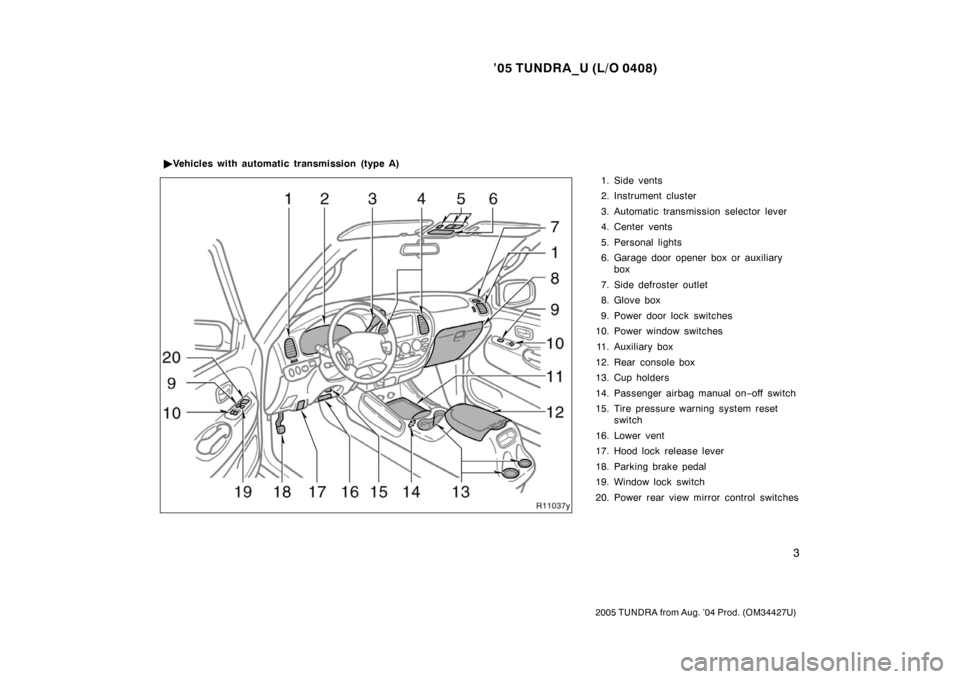
1. Side vents
2. Instrument cluster
3. Automatic transmission selector lever
4. Center vents
5. Personal lights
6. Garage door opener box or auxiliary
box
7. Side defroster outlet
8. Glove box
9. Power door lock switches
10. Power window switches
11. Auxiliary box
12. Rear console box
13. Cup holders
14. Passenger airbag manual on −off switch
15. Tire pressure warning system reset switch
16. Lower vent
17. Hood lock release lever
18. Parking brake pedal
19. Window lock switch
20. Power rear view mirror control switches
�
Vehicles with automatic transmission (type A)
Page 15 of 506
’05 TUNDRA_U (L/O 0408)
4
2005 TUNDRA from Aug. ’04 Prod. (OM34427U)
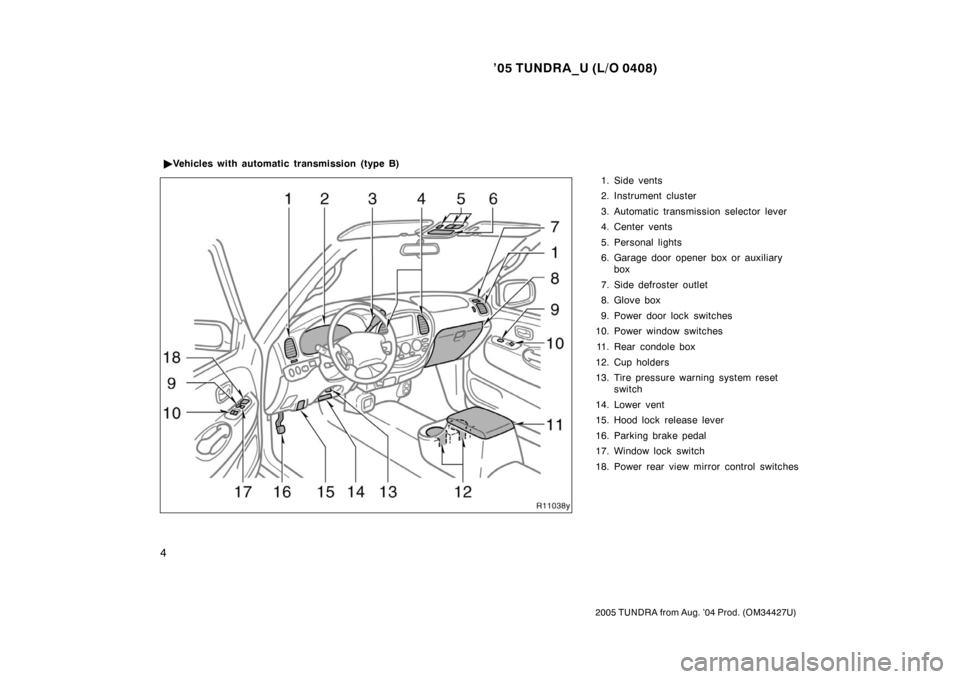
1. Side vents
2. Instrument cluster
3. Automatic transmission selector lever
4. Center vents
5. Personal lights
6. Garage door opener box or auxiliary
box
7. Side defroster outlet
8. Glove box
9. Power door lock switches
10. Power window switches
11. Rear condole box
12. Cup holders
13. Tire pressure warning system reset switch
14. Lower vent
15. Hood lock release lever
16. Parking brake pedal
17. Window lock switch
18. Power rear view mirror control switches
�
Vehicles with automatic transmission (type B)
Page 16 of 506
’05 TUNDRA_U (L/O 0408)
5
2005 TUNDRA from Aug. ’04 Prod. (OM34427U)
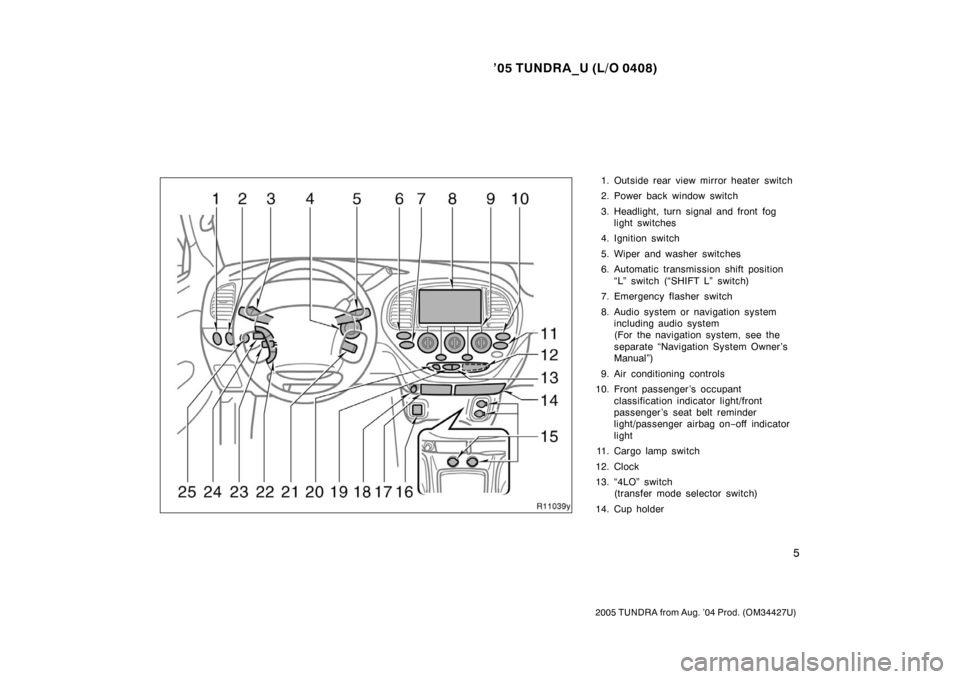
1. Outside rear view mirror heater switch
2. Power back window switch
3. Headlight, turn signal and front fog
light switches
4. Ignition switch
5. Wiper and washer switches
6. Automatic transmission shift position “L” switch (“SHIFT L” switch)
7. Emergency flasher switch
8. Audio system or navigation system including audio system
(For the navigation system, see the
separate “Navigation System Owner ’s
Manual”)
9. Air conditioning controls
10. Front passenger ’s occupant classification indicator light/front
passenger ’s seat belt reminder
light/passenger airbag on −off indicator
light
11. Cargo lamp switch
12. Clock
13. “4LO” switch (transfer mode selector switch)
14. Cup holder
Page 20 of 506
’05 TUNDRA_U (L/O 0408)
9
2005 TUNDRA from Aug. ’04 Prod. (OM34427U)
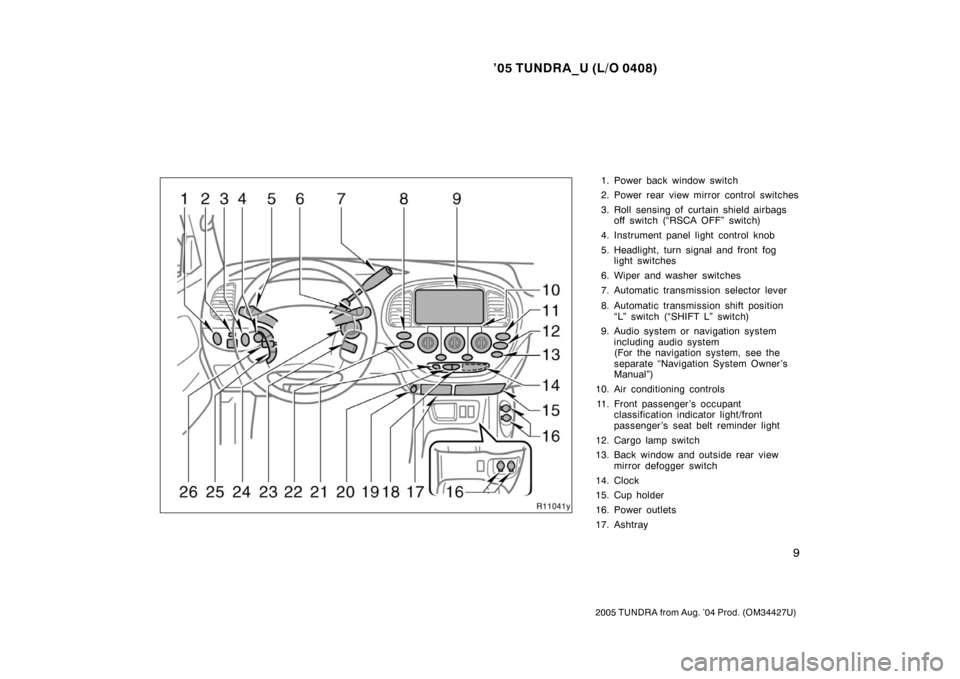
1. Power back window switch
2. Power rear view mirror control switches
3. Roll sensing of curtain shield airbags
off switch (“RSCA OFF” switch)
4. Instrument panel light control knob
5. Headlight, turn signal and front fog light switches
6. Wiper and washer switches
7. Automatic transmission selector lever
8. Automatic transmission shift position “L” switch (“SHIFT L” switch)
9. Audio system or navigation system including audio system
(For the navigation system, see the
separate “Navigation System Owner ’s
Manual”)
10. Air conditioning controls 11. Front passenger ’s occupant classification indicator light/front
passenger ’s seat belt reminder light
12. Cargo lamp switch
13. Back window and outside rear view mirror defogger switch
14. Clock
15. Cup holder
16. Power outlets
17. Ashtray
Page 24 of 506
’05 TUNDRA_U (L/O 0408)
13
2005 TUNDRA from Aug. ’04 Prod. (OM34427U)
Driver ’s seat belt reminder light∗
1
Low engine oil pressure warning light∗1
Low fuel level warning light∗1
Brake system warning light∗1
Discharge warning light∗1
Malfunction indicator lamp∗1
Anti −lock brake system warning light∗
1or
Front passenger ’s seat belt reminder light∗1
�Vehicle stability control system warning
light∗1
�Traction control system warning light∗1
�“AUTO LSD” system warning light∗1
SRS warning light∗1
Automatic transmission fluid temperature
warning light∗1 (four −wheel drive models)
Unengaged “Park” warning light
∗
1
Low windshield washer fluid level warning
light∗1
Open door warning light∗1
Low tire pressure warning light∗1
Engine oil replacement reminder light∗1
(for vehicles sold in U.S.A.)
Indicator symbols on the instrument panel
Page 25 of 506

’05 TUNDRA_U (L/O 0408)
14
2005 TUNDRA from Aug. ’04 Prod. (OM34427U)
∗
1: For details, see “Service reminder indicators and warning
buzzers” in Section 1 −6.
∗
2: For details, see “Roll sensing of curtain shield airbags off
switch” in Section 1 −3.
∗
3: If this light flashes, see “Four −wheel drive system” in Sec-
tion 1 −7.
∗
4: If this light flashes, see “Cruise control” in Section 1− 7.
Cruise control indicator light
∗
4
Low speed four −wheel drive indicator light∗
3
(four −wheel drive models)
High speed four −wheel drive indicator light∗
3
(four −wheel drive models)
Automatic transmission indicator lights
Overdrive −off indicator light
Turn signal indicator lights “AUTO LSD” indicator light
Slip indicator light
Vehicle stability control system off indicator light
Headlight high beam indicator light
�Front passenger occupant classification
indicator light
�Passenger airbag on
−off indicator light
Theft deterrent system indicator light
Roll sensing of curtain shield airbags off
indicator light
∗
2
Page 83 of 506

’05 TUNDRA_U (L/O 0408)
72
2005 TUNDRA from Aug. ’04 Prod. (OM34427U)
Indicator
light
Except for separate seat with automatic
transmission
Indicator
light
For separate seat with automatic trans-
mission
The passenger airbag system is
equipped with a manual on −off switch
and indicator light. Turning the passen-
ger airbag manual on −off switch clock-
wise to the “ON” or “AUTO” position
makes the passenger airbag system op-
erational. To disable the passenger air-
bag system, turn the manual on −off
switch counterclockwise to the “OFF”
position and remove the key. The indi-
cator light on the passenger airbag
manual on− off switch will come on
when the passenger airbag system has
been disabled.
See “Passenger airbag manual on −off
switch” in this Section for detail.
CAUTION
�Do not turn off the passenger air-
bag manual on− off switch except
when a member of a passenger risk
group identified in TABLE 1 is oc-
cupying the right front passenger
seating position.
�When the passenger airbag manual
on− off switch is turned off, the pas-
senger airbag will not inflate in a
collision and turning off the pas-
senger airbag can reduce the occu-
pant protection which your vehicle
safety systems can provide to you
in certain accidents and increase
the likelihood of death or serious
personal injuries.
Page 86 of 506

’05 TUNDRA_U (L/O 0408)
75
2005 TUNDRA from Aug. ’04 Prod. (OM34427U)
7. Driver ’s seat position sensor
8. For separate seat with automatic trans-
mission—Passenger airbag manual on −
off switch
9. Except for separate seat with automatic transmission—Passenger airbag manual
on− off switch
10. Airbag sensor assembly
11. Airbag module for driver (airbag and inflator)
12. SRS warning light The airbag sensor assembly consists of a
safing sensor and airbag sensor.
The front airbag sensors constantly moni-
tor the forward deceleration of the vehicle.
If an impact results in a forward decelera-
tion beyond the designed threshold level,
the system triggers the airbag inflators. At
this time a chemical reaction in the infla-
tors very quickly fills the air bags with
non− toxic gas to help restrain the forward
motion of the occupants. The airbags then
quickly deflate, so that there is no ob-
struction of the driver ’s vision should it be
necessary to continue driving. When the airbags inflate, they produce a
loud noise and release some smoke and
residue along with non
−toxic gas. This
does not indicate a fire. This smoke may
remain inside the vehicle for some time,
and may cause some minor irritation to
the eyes, skin or breathing. Be sure to
wash off any residue as soon as possible
to prevent any potential skin irritation with
soap and water. If you can safely exit
from the vehicle, you should do so imme-
diately. Deployment of the airbags happens in a
fraction of a second, so the airbags must
inflate with considerable force. While the
system is desi
gned to reduce serious inju-
ries, primarily to the head and chest, it
may also cause other, less severe injuries
to the face, chest, arms and hands. These
are usually in the nature of minor burns
or abrasions and swelling, but the force of
a deploying airbag can cause more seri-
ous injuries, especially if an occupant’s
hands, arms, chest or head is in close
proximity to the airbag module at the time
of deployment. This is why it is important
for the occupant to: avoid placing any
object or part of the body between the
occupant and the airbag module; sit
straight and well back into the seat; wear
the available seat belt properly; and sit as
far as possible from the airbag module,
while still maintaining control of the ve-
hicle.
Parts of the airbag module (steering wheel
hub, airbag cover and inflator) may be hot
for several minutes after deployment, so
do not touch! The airbags inflate only
once. The windshield may be damaged by
absorbing some of the force of the inflat-
ing airbag.