Page 230 of 336

2304. The resulting figure equals the
available amount of cargo and lug-
gage load capacity. For example,
if the “XXX” am ount equals 1400
lbs. and there will be five 150 lb.
passengers in your vehicle, the
amount of available cargo and lug-
gage load capacity is 650 lbs.
(1400–750 (5x150)=650 lbs).
5. Determine the combined weight of luggage and cargo being loaded on
the vehicle. That weight may not
safely exceed the available cargo
and luggage load capacity calcu-
lated in Step 4.
6. If your vehicle will be towing a trail- er, load from your trailer will be
transferred to your vehicle. Consult
this manual to determine how this
reduces the available cargo and
luggage load capacity of your ve-
hicle. Toyota does not recommend towing
a trailer with your vehicle. Your ve-
hicle is not designed for trailer towing.
Total load
capacity Cargo
capacity
EXAMPLE ON YOUR VEHICLE
In case that 2 people with the com-
bined weight of 166 kg (366 lb.) are
riding in your vehicle with the total
load capacity of 379 kg (835 lb.), the
available amount of cargo and lug-
gage load capacity will be as follows:
379 kg – 166 kg = 213 kg.
( 835 lb. – 366 lb. = 469 lb. )
From this condition, if 3 more passen-
gers with the combined weight of 176
kg (388 lb.) get on , the av ailable car-
go and luggage load will be reduced
as follows:
Page 233 of 336
233
STARTING AND DRIVING
Before starting the hybrid system234
. . . . . . . . . . . . . . . . . . . . . . . . . . . . .
How to start the hybrid system 234
. . . . . . . . . . . . . . . . . . . . . . . . . . . . . . .
Tips for driving in various conditionss 236
. . . . . . . . . . . . . . . . . . . . . . . . .
Winter driving tips 237
. . . . . . . . . . . . . . . . . . . . . . . . . . . . . . . . . . . . \
. . . . . .
Dinghy towing 238
. . . . . . . . . . . . . . . . . . . . . . . . . . . . . . . . . . . . \
. . . . . . . . . .
Trailer towing 239
. . . . . . . . . . . . . . . . . . . . . . . . . . . . . . . . . . . . \
. . . . . . . . . .
How to save fuel and make your vehicle last longer, too 239
. . . . . . . . .
SECTION 4
Page 238 of 336
238
Check the condition of the auxiliary
battery and cables.
Cold temperatures reduce the capacity of
any auxiliary battery, so it must be in top
shape to provide enough power for winter
starting. Section 8−3 tells you how to
visually inspect the auxiliary battery. Your
Toyota dealer will be pleased to check the
level of charge.
Make sure the engine oil viscosity is
suitable for the cold weather.
See page 287 for recommended viscosity.
Leaving a heavy summer oil in your ve-
hicle during winter months may cause
harder starting. If you are not sure about
which oil to use, call your Toyota deal-
er—they will be pleased to help.
Keep the door locks from freezing.
Squirt lock de −icer or glycerine into the
locks to keep them from freezing.
Use a washer fluid containing an anti
freeze solution.
This product is available at your Toyota
dealer and most auto parts stores. Follow
the manufacturer ’s directions for how
much to mix with water.NOTICE
Do not use engine antifreeze or any
other substitute because it may dam-
age your vehicle’s paint.
Do not use your parking brake when
there is a possibility it could freeze.
When parking, push the “P” position
switch and block the rear wheels. Do not
use the parking brake, for snow or water
accumulated in and around the parking
brake mechanism may freeze, making it
hard to release.
Keep ice and snow from accumulating
under the fenders.
Ice and snow built up under your fenders
can make steering difficult. During extreme
winter driving, stop and check under the
fenders occasionally.
Depending on where you are driving,
we recommend you carry some emer-
gency equipment.
Some of the things you might put in the
vehicle are tire chains, window scraper,
bag of sand or salt, flares, small shovel,
jumper cables, etc.40p050b
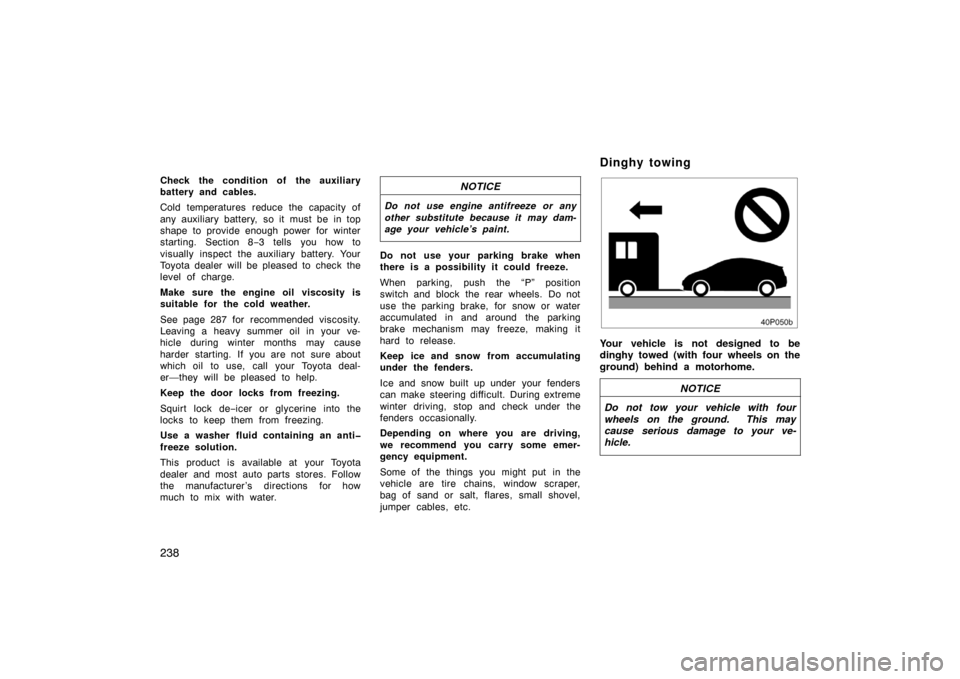
Your vehicle is not designed to be
dinghy towed (with four wheels on the
ground) behind a motorhome.
NOTICE
Do not tow your vehicle with four
wheels on the ground. This may
cause serious damage to your ve-
hicle.
Dinghy towing
Page 239 of 336
239
40p003b
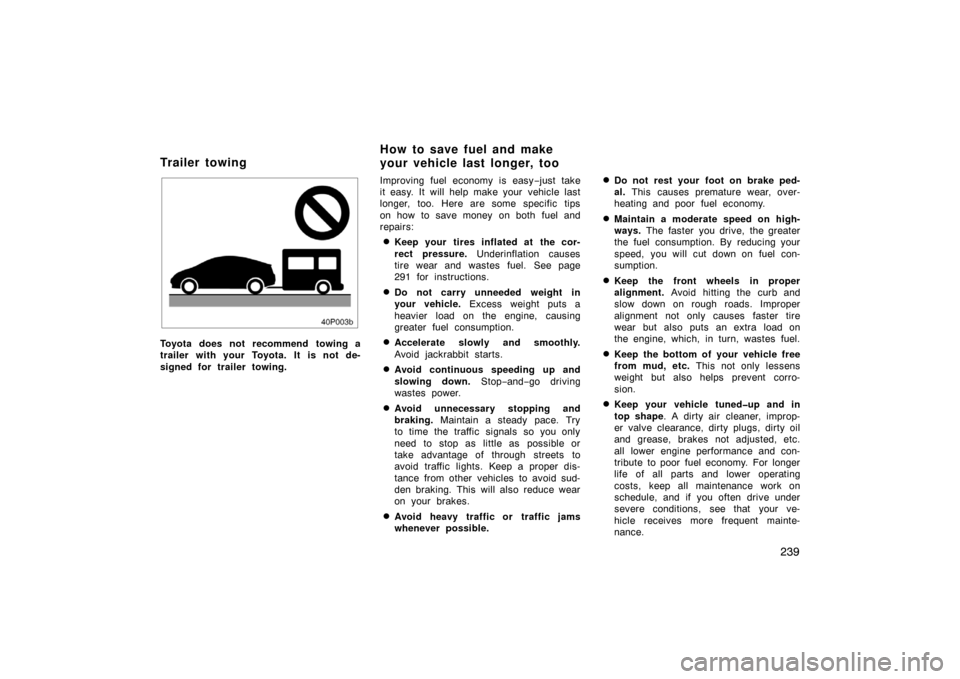
Toyota does not recommend towing a
trailer with your Toyota. It is not de-
signed for trailer towing.Improving fuel economy is easy
−just take
it easy. It will help make your vehicle last
longer, too. Here are some specific tips
on how to save money on both fuel and
repairs:
�Keep your tires inflated at the cor-
rect pressure. Underinflation causes
tire wear and wastes fuel. See page
291 for instructions.
�Do not carry unneeded weight in
your vehicle. Excess weight puts a
heavier load on the engine, causing
greater fuel consumption.
�Accelerate slowly and smoothly.
Avoid jackrabbit starts.
�Avoid continuous speeding up and
slowing down. Stop−and− go driving
wastes power.
�Avoid unnecessary stopping and
braking. Maintain a steady pace. Try
to time the traffic signals so you only
need to stop as little as possible or
take advantage of through streets to
avoid traffic lights. Keep a proper dis-
tance from other vehicles to avoid sud-
den braking. This will also reduce wear
on your brakes.
�Avoid heavy traffic or traffic jams
whenever possible.
�Do not rest your foot on brake ped-
al. This causes premature wear, over-
heating and poor fuel economy.
�Maintain a moderate speed on high-
ways. The faster you drive, the greater
the fuel consumption. By reducing your
speed, you will cut down on fuel con-
sumption.
�Keep the front wheels in proper
alignment. Avoid hitting the curb and
slow down on rough roads. Improper
alignment not only causes faster tire
wear but also puts an extra load on
the engine, which, in turn, wastes fuel.
�Keep the bottom of your vehicle free
from mud, etc. This not only lessens
weight but also helps prevent corro-
sion.
�Keep your vehicle tunedup and in
top shape . A dirty air cleaner, improp-
er valve clearance, dirty plugs, dirty oil
and grease, brakes not adjusted, etc.
all lower engine performance and con-
tribute to poor fuel economy. For longer
life of all parts and lower operating
costs, keep all maintenance work on
schedule, and if you often drive under
severe conditions, see that your ve-
hicle receives more frequent mainte-
nance.
Trailer towing How to save fuel and make
your vehicle last longer, too
Page 241 of 336
241
IN CASE OF AN EMERGENCY
If your vehicle will not start242
. . . . . . . . . . . . . . . . . . . . . . . . . . . . . . . . . . .
If your hybrid system stalls while driving 246
. . . . . . . . . . . . . . . . . . . . . . .
If your vehicle overheatss 246
. . . . . . . . . . . . . . . . . . . . . . . . . . . . . . . . . . .
If you have a flat tire 247
. . . . . . . . . . . . . . . . . . . . . . . . . . . . . . . . . . . . \
. . . . .
If your vehicle needs to be towed 258
. . . . . . . . . . . . . . . . . . . . . . . . . . . . .
If you lose your keys 261
. . . . . . . . . . . . . . . . . . . . . . . . . . . . . . . . . . . . \
. . . .
If you cannot operate back door opener 262
. . . . . . . . . . . . . . . . . . . . . . .
SECTION 5
Page 242 of 336

242
Before making these checks, make sure
you have followed the correct starting
procedure given in “How to start the
hybrid system” on page 234 and that you
have sufficient fuel. Also check whether
the other keys will start the hybrid
system. If they work, your key may be
broken. Have the key checked at your
Toyota dealer. If none of your keys work,
there may be a malfunction in the hybrid
vehicle immobilizer system. Call your
Toyota dealer. (See “Keys” on page 20.)
If the instrument cluster dims or the
instrument cluster display turns off
with the hybrid system on—1. Check that the auxiliary battery termi- nals are tight and clean.
2. If the auxiliary battery terminals are O.K., the auxiliary battery is dis-
charged. You may try jump starting.
See “(b) Jump starting” for further in-
structions.
NOTICE
Hybrid vehicles cannot be push
started.
If the instrument cluster is shown in
appropriate brightness with the hybrid
system is in the “IGON” mode—
The hybrid vehicle system is suspected to
be faulty. Contact your Toyota dealer. If the auxiliary battery is discharged,
the hybrid system can be started by
jump starting. Depending on the vehicle
condition, the engine may not start.
To avoid serious personal injury and
damage to your vehicle which might re-
sult from battery explosion, acid burns,
electrical burns, or damaged electronic
components, these instructions must be
followed precisely.
If the auxiliary battery is discharged, you
cannot access to the auxiliary battery in
the luggage compartment because the
back door cannot be opened. Use the ex-
clusive jump starting terminal in the en-
gine compartment. For details, see “JUMP
STARTING PROCEDURE” on page 243.
NOTICE
If the auxiliary battery is discharged
with the transaxle in “P”, your vehicle
cannot be moved unless the front
wheels are raised. This is because the
front wheels are locked by means of
the parking lock mechanism.
If you are unsure about how to follow this
procedure, we strongly recommend that
you seek the help of a competent qualified
technician or towing service.
If your vehicle will not start—
(a) Simple checks
(b) Jump starting
Page 255 of 336
255
CAUTION
�When lowering the vehicle,
make sure all portions of your
body and all other persons
around will not be injured as
the vehicle is lowered to the
ground.
� Have the wheel nuts tightened
with torque wrench to 103 N·m
(10.5 kgf·m, 76 ft·lbf), as soon
as possible after changing
wheels. Otherwise, the nuts
may loosen and the wheels
may fall off, which could cause
a serious accident.
9. Restow all the tools and jack se-
curely. Then secure the flat tire
in the luggage compartment
with the tire tiedown belts and
tiedown hooks as follows
CAUTION
Before driving, make sure all the
tools and jack are securely in
place in their storage location to
reduce the possibility of person-
al injury during a collision or
sudden braking.
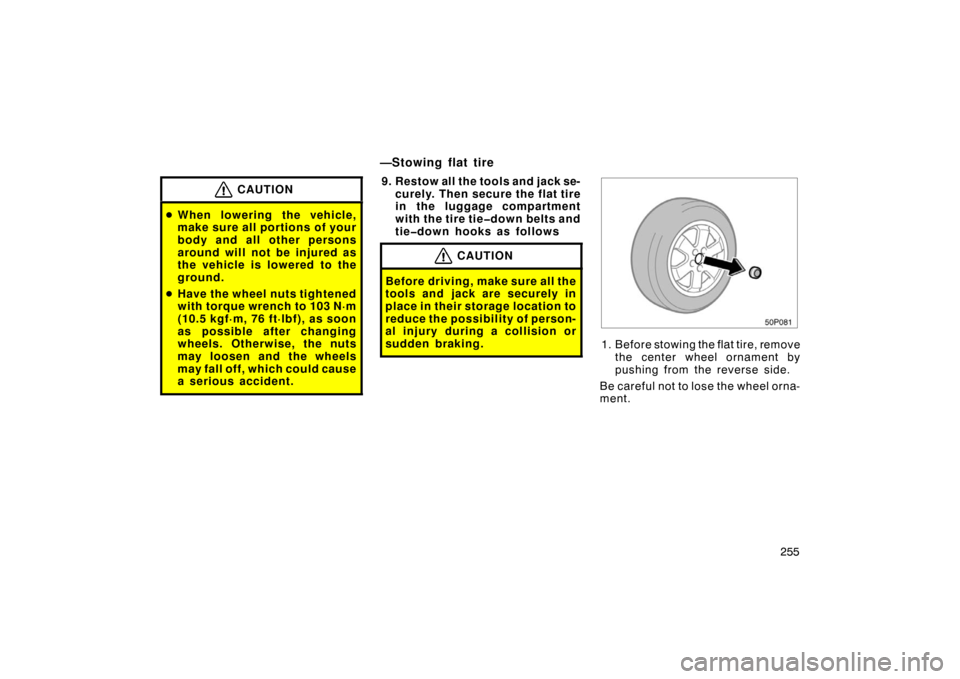
1. Before stowing the flat tire, removethe center wheel ornament by
pushing from the reverse side.
Be careful not to lose the wheel orna-
ment.
—Stowing flat tire
Page 256 of 336
256
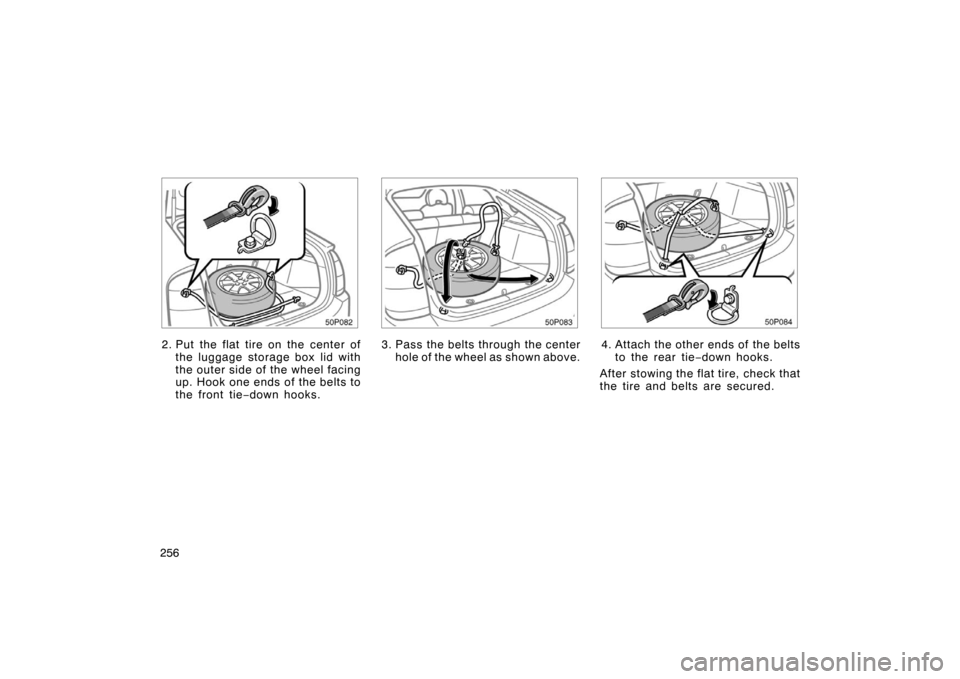
2. Put the flat tire on the center ofthe luggage storage box lid with
the outer side of the wheel facing
up. Hook one ends of the belts to
the front tie −down hooks.3. Pass the belts through the center
hole of the wheel as shown above.4. Attach the other ends of the beltsto the rear tie −down hooks.
After stowing the flat tire, check that
the tire and belts are secured.