Page 111 of 259
1032005 MR2 from Aug. ’04Prod. (OM17527U)
YOUR RADIO ANTENNA
Power antenna—
To lower the power antenna, turn off the
audio system by pushing “PWR·VOL”, or
turn the ignition key to “LOCK”.
The antenna automatically retracts when
the radio mode is switched off to turn on
the cassette tape player or compact disc
player.
NOTICE
To prevent damage to the antenna,
make sure it is retracted before driv-
ing your Toyota through an automatic
car wash.
YOUR COMPACT DISC PLAYER WITH
CHANGER
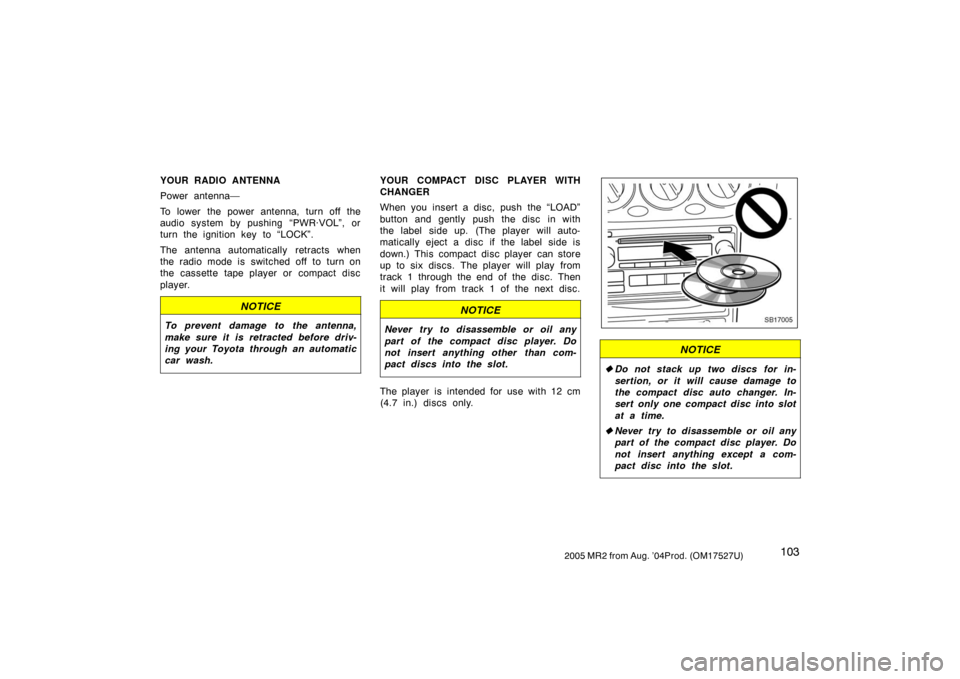
When you insert a disc, push the “LOAD”
button and gently push the disc in with
the label side up. (The player will auto-
matically eject a disc if the label side is
down.) This compact disc player can store
up to six discs. The player will play from
track 1 through the end of the disc. Then
it will play from track 1 of the next disc.
NOTICE
Never try to disassemble or oil any
part of the compact disc player. Do
not insert anything other than com-
pact discs into the slot.
The player is intended for use with 12 cm
(4.7 in.) discs only.
SB17005
NOTICE
�Do not stack up two discs for in-
sertion, or it will cause damage to
the compact disc auto changer. In-
sert only one compact disc into slot
at a time.
�Never try to disassemble or oil any
part of the compact disc player. Do
not insert anything except a com-
pact disc into the slot.
Page 118 of 259
11 02005 MR2 from Aug. ’04Prod. (OM17527U)
Here are some common reception prob-
lems that probably do not indicate a prob-
lem with your radio:
FM
Fading and drifting stations—Generally, the
effective range of FM is about 40 km (25
miles). Once outside this range, you may
notice fading and drifting, which increase
with the distance from the radio transmit-
ter. They are often accompanied by distor-
tion.
Multi−path—FM signals are reflective,
making it possible for two signals to reach
your antenna at the same time. If this
happens, the signals will cancel each oth-
er out, causing a momentary flutter or
loss of reception.
Static and fluttering—These occur when
signals are blocked by buildings, trees, or
other large objects. Increasing the bass
level may reduce static and fluttering.
Station swapping—If the FM signal you
are listening to is interrupted or weak-
ened, and there is another strong station
nearby on the FM band, your radio may
tune in the second station until the origi-
nal signal can be picked up again.AM
Fading—AM broadcasts are reflected by
the upper atmosphere—especially at night.
These reflected signals can interfere with
those received directly from the radio sta-
tion, causing the radio station to sound
alternately strong and weak.
Station interference—When a reflected sig-
nal and a signal received directly from a
radio station are very nearly the same
frequency, they can interfere with each
other, making it difficult to hear the broad-
cast.
Static—AM is easily affected by external
sources of electrical noise, such as high
tension power lines, lightening, or electri-
cal motors. This results in static.CARING FOR YOUR COMPACT DISC
PLAYER AND DISCS
�Your compact disc player is intended
for use with 12 cm (4.7 in.) discs only.
�Extremely high temperatures can keep
your compact disc player from working.
On hot days, use the air conditioning
to cool the vehicle interior before you
listen to a disc.
�Bumpy roads or other vibrations may
cause your compact disc player to
skip.
�If moisture gets into your compact disc
player, you may not hear any sound
even though your compact disc player
appears to be working. Remove the
disc from the player and wait until it
dries.
CAUTION
Compact disc players use an invisible
laser beam which could cause hazard-
ous radiation exposure if directed
outside the unit. Be sure to operate
the player correctly.
Page 253 of 259

2462005 MR2 from Aug. ’04Prod. (OM17527U)
SB73068a
Engine compartment
24. TAIL1 20 A: “TAIL2” “PANEL” fuses
25. D P/W 20 A: Power window system
26. P P/W 20 A: Power window system
27. RADIO1 15 A: Power antenna, audio
28. DOME 10 A: Clock
29. ECUB 10 A: Daytime running light
system, gauges and meters
30. TAIL2 10 A: Taillights, parking lights,
license plate lights, gauges and meters
31. PANEL 7.5 A: Clock, illuminations
32. RADIO2 7.5 A: Gauges and meters,
outside rear view mirror system, clock33. CIG 15 A: Cigarette lighter
34. I/UP 7.5 A: Engine idle up system
35. ALTS 7.5 A: Charging system
36. ECUB1 25 A: “ECU−B” “DOME” fuses
37. SMTB 10A: Sequential manual trans-
mission system
38. HORN 10 A: Horn
39. HAZ 15 A: Turn signal lights, emergen-
cy flashers
40. AM2 15 A: Starter system, multiport
fuel injection system/sequential multi-
port fuel injection system, SRS airbag
system
41. IG2 15 A: Ignition system, multiport
fuel injection system/sequential multi-
port fuel injection system
42. EFI1 15 A: Multiport fuel injection sys-
tem/sequential multiport fuel injection
system, engine immobilizer system
43. ETCS 15A: Multiport fuel injection sys-
tem/sequential multiport fuel injection
system
44. HPU 30A: Sequential manual transmis-
sion system
45. HEAD RH LWR 10A: Right−hand head-
light (low beam)46. HEAD LH LWR 10A: Left−hand head-
light (low beam)
47. EFI2 7.5 A: Multiport fuel injection sys-
tem/sequential multiport fuel injection
system
48. ST 7.5 A: Starter system
49. SMTIG 10A: Sequential manual trans-
mission system
50. DRL NO.1 7.5 A: Daytime running light
system
Fuses (type B)
51. ABS2 50 A: Anti−lock brake system
52. EHPS 50 A: Power steering system
53. MAIN 40 A: Starter system, “DRL
NO.1” “HEAD LH LWR” “HEAD RH
LW R ” f u s e s
54. HTR 40 A: Air conditioning system
Fuses (type C)
55. ALT 100 A: “AM1” “D P/W” “P P/W”
“DOOR” “STOP” “EHPS” “DEF” “TAIL1”
“OBD” “HTR 40A” fuses