Page 301 of 352

’05Camry_U (L/O 0409)
293
2005 CAMRY from Sep. ’04 Prod. (OM33684U)
Automatic transmission “Park” mecha-
nism
Check the lock release button of the se-
lector lever for proper and smooth opera-
tion. On a safe incline, check that your
vehicle is held securely with the selector
lever in “P” position and all brakes re-
leased.
OUTSIDE THE VEHICLE
Items listed below should be performed
from time to time, unless otherwise
specified.
Fluid leaks
Check underneath for leaking fuel, oil, wa-
ter or other fluid after the vehicle has
been parked for a while. If you smell fuel
fumes or notice any leak, have the cause
found and corrected immediately.
Doors and engine hood
Check that all doors including trunk lid
operate smoothly and all latches lock se-
curely. Make sure the engine hood sec-
ondary latch secures the hood from open-
ing when the primary latch is released.Tire inflation pressure
Check the pressure with a gauge ev-
ery two weeks, or at least once a
month. See page 309 in Section 7−2
for additional information.
Tire surface and wheel nuts
Check the tires carefully for cuts,
damage or excessive wear. See page
312 in Section 7− 2 for additional in-
formation. When checking the tires,
make sure no nuts are missing, and
check the nuts for looseness. Tighten
them if necessary.
Tire rotation
Rotate the tires according to the
maintenance schedule. (For sched-
uled maintenance information, please
refer to the “Scheduled Maintenance
Guide” or “Owner ’s Manual Supple-
ment”.) See page 314 in Section 7 −2
for additional information.Be on the alert for changes in perfor-
mance, sounds, and visual tip −offs that
indicate service is needed. Some impor-
tant clues are as follows:
�Engine missing, stumbling, or pinging
�Appreciable loss of power
�Strange engine noises
�A leak under the vehicle (however, wa-
ter dripping from the air conditioning
after use is normal.)
�Change in exhaust sound (This may
indicate a dangerous carbon monoxide
leak. Drive with the windows open and
have the exhaust system checked im-
mediately.)
�Flat −looking tire; excessive tire squeal
when cornering; uneven tire wear
�Vehicle pulls to one side when driving
straight on a level road
�Strange noises related to suspension
movement
�Loss of brake effectiveness; spongy
feeling brake or clutch pedal; pedal al-
most touches floor; vehicle pulls to one
side when braking
�Engine coolant temperature continually
higher than normal
Does your vehicle need
repairing?
Page 304 of 352
’05Camry_U (L/O 0409)
296
2005 CAMRY from Sep. ’04 Prod. (OM33684U)
1. Power steering fluid reservoir
2. Engine oil filler cap
3. Engine oil level dipstick
4. Brake fluid reservoir
5. Fuse block
6. Battery
7. Radiator
8. Electric cooling fans
9. Condenser
10. Windshield washer fluid tank
11. Engine coolant reservoir
Engine compartment overview
� 2AZFE engine
Page 305 of 352
’05Camry_U (L/O 0409)
297
2005 CAMRY from Sep. ’04 Prod. (OM33684U)
1. Power steering fluid reservoir
2. Engine oil level dipstick
3. Engine oil filler cap
4. Brake fluid reservoir
5. Fuse block
6. Battery
7. Radiator
8. Electric cooling fans
9. Condenser
10. Windshield washer fluid tank
11. Engine coolant reservoir
�
1MZFE and 3MZFE engines
Page 309 of 352

’05Camry_U (L/O 0409)
301
2005 CAMRY from Sep. ’04 Prod. (OM33684U)
When jacking up your vehicle with the
jack, position the jack correctly as
shown in the illustrations.
CAUTION
When jacking, be sure to observe the
following to reduce the possibility of
personal injury:
�Follow jacking instructions.
�Do not put any part of your body
under the vehicle supported by the
jack. Personal injury may occur.
�Do not start or run the engine while
your vehicle is supported by the
jack.
�Stop the vehicle on a level firm
ground, firmly set the parking brake
and put the transmission in “P”
(automatic) or reverse (manual).
Block the wheels on the opposite
side of the jack up point if neces-
sary.
�Make sure to set the jack properly
in the jack point. Raising the ve-
hicle with jack improperly posi-
tioned will damage the vehicle or
may allow the vehicle to fall off the
jack and cause personal injury.
�Never get under the vehicle when
the vehicle is supported by the jack
alone; use vehicle support stands.
�Do not raise the vehicle with some-
one in the vehicle.
�When raising the vehicle, do not
place any objects on top of or un-
derneath the jack.
NOTICE
Make sure to place the jack correctly,
or your vehicle may be damaged.
Here is a list of parts and tools you will
need to perform do−it−yourself mainte-
nance. Remember all Toyota parts are de-
signed in metric sizes, so your tools must
be metric.
CHECKING THE ENGINE OIL LEVEL
Parts (if level is low):
�“Toyota Genuine Motor Oil” or equiva-
lent
See page 304 in Section 7− 2 for de-
tails about engine oil selection.
Tools:
�Rag or paper towel
�Funnel (only for adding oil)
CHECKING THE ENGINE COOLANT
LEVEL
Parts (if level is low):
�“Toyota Super Long Life Coolant” or
similar high quality ethylene glycol
based non −silicate, non −amine, non− ni-
trite, and non −borate coolant with long −
life hybrid organic acid technology.
“Toyota Super Long Life Coolant” is a
mixture of 50% coolant and 50% deion-
ized water (for the U.S.A.) or 55%
coolant and 45% deionized water (for
Canada).
Parts and tools
Page 317 of 352

’05Camry_U (L/O 0409)
309
2005 CAMRY from Sep. ’04 Prod. (OM33684U)
If hot
O.K.
If hot
addClose
OpenIf cold
O.K.
If cold
add
Check the fluid level through the reser-
voir. If necessary, add automatic trans-
mission fluid DEXRON
�II or III.
If the vehicle has been driven around 80
km/h (50 mph) for 20 minutes (a little
more in frigid temperatures), the fluid is
hot (60 �C—80 �C or 140 �F—175 �F). You
may also check the level when the fluid
is cold (about room temperature,
10 �C—30 �C or 50 �F—85 �F) if the engine
has not been run for about five hours. Clean all dirt from the outside of the res-
ervoir tank and look at the fluid level. If
the fluid is cold, the level should be in the
“COLD” range. Similarly, if it is hot, the
fluid level should be in the “HOT” range.
If the level is at the low side of either
range, add automatic transmission fluid
DEXRON
�II or III to bring the level within
the range.
To remove the reservoir cap, turn it coun-
terclockwise and lift up. To reinstall it,
turn it clockwise. After replacing the reser-
voir cap, visually check the steering box
case, vane pump and hose connections
for leaks or damage.
CAUTION
The reservoir tank may be hot so be
careful not to burn yourself.
NOTICE
Avoid overfilling, or the power steer-
ing could be damaged.
Checking power steering fluid Checking tire inflation
pressure
Page 325 of 352

’05Camry_U (L/O 0409)
317
2005 CAMRY from Sep. ’04 Prod. (OM33684U)
CAUTION
�Do not exceed 50 km/h (30 mph) or
the chain manufacturer ’s recom-
mended speed limit, whichever is
lower.
�Drive carefully avoiding bumps,
holes, and sharp turns, which may
cause the vehicle to bounce.
�Avoid sharp turns or lockedwheel
braking, as use of chains may ad-
versely affect vehicle handling.
�When driving with chains installed,
be sure to drive carefully. Slow
down before entering curves to
avoid losing control of the vehicle.
Otherwise an accident may occur.
NOTICE
Do not attempt to use a tire chain on
the compact spare tire, as it may re-
sult in damage to the vehicle as well
as the tire.
WHEN TO REPLACE YOUR WHEELS
If you have wheel damage such as
bending, cracks or heavy corrosion, the
wheel should be replaced.
If you fail to replace a damaged wheel,
the tire may slip off the wheel or cause
loss of handling control.
WHEEL SELECTION
When replacing wheels, care should be
taken to ensure that the wheels are re-
placed by ones with the same load ca-
pacity, diameter, rim width, and offset.
Correct replacement wheels are available
at your Toyota dealer.
A wheel of a different size or type may
adversely affect handling, wheel and bear-
ing life, brake cooling, speedometer/odom-
eter calibration, stopping ability, headlight
aim, bumper height, vehicle ground clear-
ance, and tire or snow chain clearance to
the body and chassis.Replacement with used wheels is not rec-
ommended as they may have been sub-
jected to rough treatment or high mileage
and could fail without warning. Also, bent
wheels which have been straightened may
have structural damage and therefore
should not be used. Never use an inner
tube in a leaking wheel which is designed
for a tubeless tire.
CAUTION
Do not use wheels other than the
manufacturer ’s recommended size, as
this may cause dangerous handling
characteristics resulting in loss of
control. Otherwise, an accident may
occur resulting in death or serious
injuries.
Replacing wheels
Page 333 of 352
’05Camry_U (L/O 0409)
325
2005 CAMRY from Sep. ’04 Prod. (OM33684U)
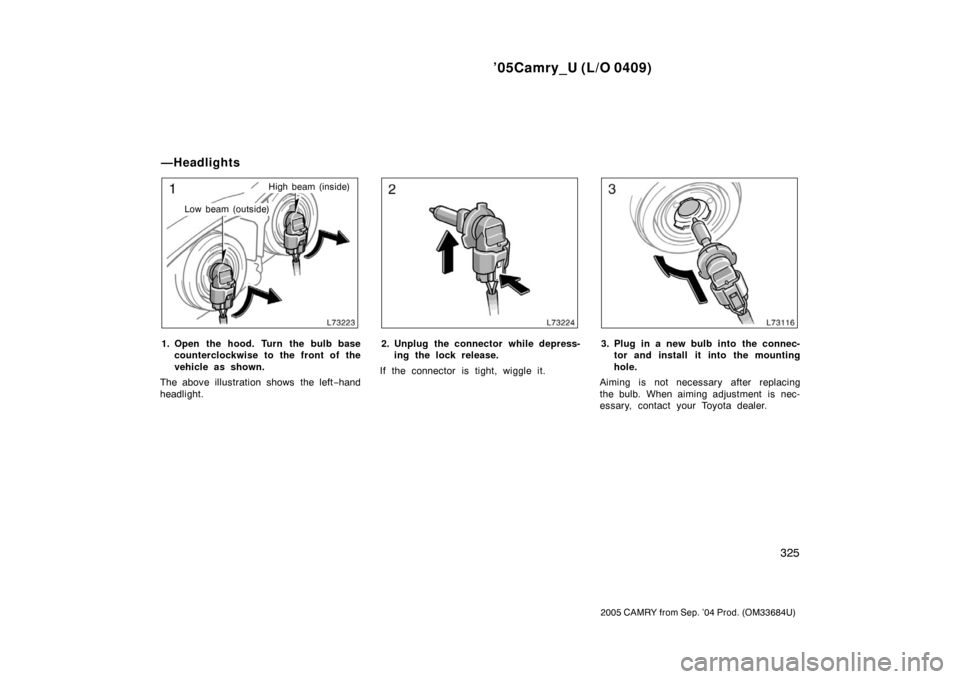
Low beam (outside)High beam (inside)
1. Open the hood. Turn the bulb base
counterclockwise to the front of the
vehicle as shown.
The above illustration shows the left −hand
headlight.2. Unplug the connector while depress- ing the lock release.
If the connector is tight, wiggle it.3. Plug in a new bulb into the connec- tor and install it into the mounting
hole.
Aiming is not necessary after replacing
the bulb. When aiming adjustment is nec-
essary, contact your Toyota dealer.
—Headlights
Page 341 of 352

’05Camry_U (L/O 0409)
333
2005 CAMRY from Sep. ’04 Prod. (OM33684U)
AUTOMATIC TRANSAXLE
Fluid capacity (drain and refill), L (qt.,
Imp. qt.):3.5 (3.7, 3.1)
Fluid type: Toyota Genuine ATF Type T −IV
Change automatic transmission fluid only
as necessary.
Generally, it is necessary to change
automatic transmission fluid only if your
vehicle is driven under one of the Special
Operating Conditions listed in your
“Scheduled Maintenance Guide” or
“Owner ’s Manual Supplement”. When
changing the automatic transmission fluid,
use only “Toyota Genuine ATF Type T −IV”
(ATF JWS3309 or NWS6500) to aid in
assuring optimum transaxle performance.
Notice: Using automatic transmission
fluid other than “Toyota Genuine ATF
Type TIV” may cause deterioration in
shift quality, locking up of your trans-
mission accompanied by vibration, and
ultimately damage the automatic trans-
mission of your vehicle.
Please contact your Toyota dealer for fur-
ther details. BRAKES
Minimum pedal clearance when depressed
with the force of 490 N (50 kgf, 110 lbf)
with the engine running, mm (in.):
63 (2.5)
∗
∗
: Fixed type and adjustable type (in front
most position)
Pedal free play, mm (in.):
Fixed type 1—6 (0.04—0.24)
Adjustable type (in front most position) 1—8 (0.04—0.31)
Pad wear limit, mm (in.): 1.0 (0.04)
Lining wear limit, mm (in.): 1.0 (0.04)
Parking brake Lever type—Parking brake adjustment when pulled
with the force of 196 N (20 kgf, 44
lbf):6—9 clicks
Pedal type— Parking brake adjustment when de-
pressed with the force of 300 N (31
kgf, 67 lbf):3—6 clicks
Fluid type: SAE J1703 or FMVSS No.116 DOT 3 STEERING
Wheel free play:
Less than 30 mm (1.2 in.)
Power steering fluid type: Automatic transmission fluid DEXRON �II
or III