Page 454 of 801

YH4
GRAND
VITARA
G16 / J20 Engines
H25 Engine
1. PCM
2. 4WD low switch
3. J / C
7B1-52 AUTOMATIC TRANSMISSION (4 A / T)
DTC P1875 4WD LOW SWITCH CIRCUIT MALFUNCTION (if equipped)
WIRING DIAGRAM
DTC DETECTING CONDITION AND TROUBLE AREA
DTC DETECTING CONDITIONTROUBLE AREA
While driving at higher than specified vehicle speed
and with more than specified throttle valve opening,
the following conditions are satisfied for specified time.
�Vehicle speed sensed by vehicle speed sensor is
more than 10 km / h higher than that sensed by A / T
output speed sensor.
(2 driving cycles detection logic)�4WD LOW switch or its circuit
�PCM
DTC CONFIRMATION PROCEDURE
WARNING:
�When performing a road test, select a place where there is no traffic or possibility of a traffic accident
and be very careful during testing to avoid occurrence of an accident.
�Road test should be carried out with 2 persons, a driver and a tester, on a level road.
1) Connect scan tool to DLC with ignition switch OFF.
2) Clear DTC, pending DTC and freeze frame data in PCM memory by using scan tool.
3) Start engine.
4) Increase vehicle speed to about 30 km/h (19 mph) or more in D range and is in 2H position.
5) Keep driving at above vehicle speed for 30 seconds.
6) Stop vehicle and shift transfer lever to 4L position with A/T selector lever is in P range
7) Increase vehicle speed to about 25 km/h (15 mph) or more in D range and is in 4L position.
8) Keep driving at above vehicle speed for 30 seconds.
9) Stop vehicle and check pending DTC and DTC by using scan tool.
Page 458 of 801

YH4
GRAND
VITARA
7B1-56 AUTOMATIC TRANSMISSION (4 A / T)
8) Stall speed should be within the following specification.
Stall speed: 2,100 ± 2,400 r / min. for G16 engine
2,300 ± 2,600 r / min. for J20 engine
2,300 ± 2,600 r / min. for H25 engine
Check result
Possible cause
Lower than standard
level�Faulty engine output
�Defective torque converter
Higher than standard
level in ªDº range�Slippery O/D clutch
�Slippery forward clutch
�Malfunctioning O/D one-way clutch
�Malfunctioning one-way clutch No. 2
�Low line pressure
Higher than standard
level in ªRº range�Slippery direct clutch
�Slippery reverse brake
�Low fluid pressure
�Slippery O/D clutch
�Defective O/D one-way clutch
ROAD TEST
This test is to check if upshift and downshift take place at specified
speed while actually driving vehicle on a level road.
WARNING:
�Carry out test in very little traffic area to prevent an acci-
dent.
�Test requires 2 persons, a driver and a tester.
1) Warm up engine.
2) With engine running at idle, shift select lever ªDº.
3) Accelerate vehicle speed by depressing accelerator pedal grad-
ually.
4) While driving in ªDº range, check if gear shift occurs properly as
shown in Gear Shift Diagram in this section.
Test result
Possible cause
When 1 � 2 upshift fails to
occur1±2 shift valve stuck
When 2 � 3 upshift fails to
occur2±3 shift valve stuck
When 3 � O/D upshift
fails to occur3±4 shift valve stuck
When gear shift point is in-
correct�Maladjusted throttle cable
�Defective shift solenoid valve
-A or -B
�1±2, 2±3 or 3±4 shift valve not
operating properly
Page 460 of 801

YH4
GRAND
VITARA
7B1-58 AUTOMATIC TRANSMISSION (4 A / T)
ENGINE BRAKE TEST
WARNING:
Before test, make sure that there is no vehicle behind so as
to prevent rear-end collision.
1) While driving vehicle in 3rd gear of ªDº range, shift select lever
down to ª2º range and check if engine brake operates.
2) In the same way as in step 1, check engine brake for operation
when select lever is shifted down to ªLº range.
3) If engine brake fails to operate in above tests, possible causes
for such failure are as follows. Check each part which is sus-
pected to be the cause.
Condition
Possible cause
Fails to operate when shifted
down to ª2º rangeSecond coast brake defec-
tive
Fails to operate when shifted
down to ªLº rangeReverse brake defective
ªPº RANGE TEST
1) Stop vehicle on a slope, shift select lever to ªPº range and at the
same time apply parking brake.
2) After stopping engine, depress brake pedal and release parking
brake.
3) Then, release brake pedal gradually and check that vehicle re-
mains stationary.
4) Depress brake pedal and shift select lever to ªNº range.
5) Then, release brake pedal gradually and check that vehicle
moves.
WARNING:
Before test, check to make sure no one is around vehicle
or down on a slope and keep watchful for safety during
test.
Page 462 of 801

YH4
GRAND
VITARA
1. Dipstick (G16 / J20)
2. Dipstick (H25)
1. Drain plug
2. Propeller shaft
1. Dipstick (G16 / J20)
2. Dipstick (H25)
7B1-60 AUTOMATIC TRANSMISSION (4 A / T)
LEVEL CHECK AT ROOM TEMPERATURE
The fluid level check at room temperature performed after repair or
fluid change before test driving is just preparation for level check of
normal operating temperature. The checking procedure itself is the
same as that described previously. If the fluid level is between FULL
COLD and LOW COLD, proceed to test drive. And when the fluid
temperature has reached the normal operating temperature, check
fluid level again and adjust it as necessary.
FLUID CHANGE
1) Lift up vehicle.
2) With engine is cool, remove drain plug from oil pan and drain A / T
fluid.
3) Install drain plug.
Tightening Torque
(a): 23 N
.m (2.3 kg-m, 17.0 lb-ft)
4) Lower vehicle and fill proper amount of an equivalent of DEX-
RON�-III.
5) Check fluid level according to procedure described under LEV-
EL CHECK NORMAL OPERATING TEMPERATURE.
Fluid specification
An equivalent of DEXRON�-III
Fluid capacity
When draining
from drain plug
hole
2.5 liters (5.28/4.40 US/lmp.pt.)
When
overhauling
6.9 liters (14.58/12.14 US/lmp.pt.)
for G16
7.1 liters (15.00/12.50 US/lmp.pt.)
for J20 / H25
Page 466 of 801
YH4
GRAND
VITARA
7B1-64 AUTOMATIC TRANSMISSION (4 A / T)
1. A / T vehicle (output) speed sensor
ªNº reference
line
Center line on
manual valve shaft
G16 / J20
1. Service wire
2. PCM connectors disconnected
Switch
position
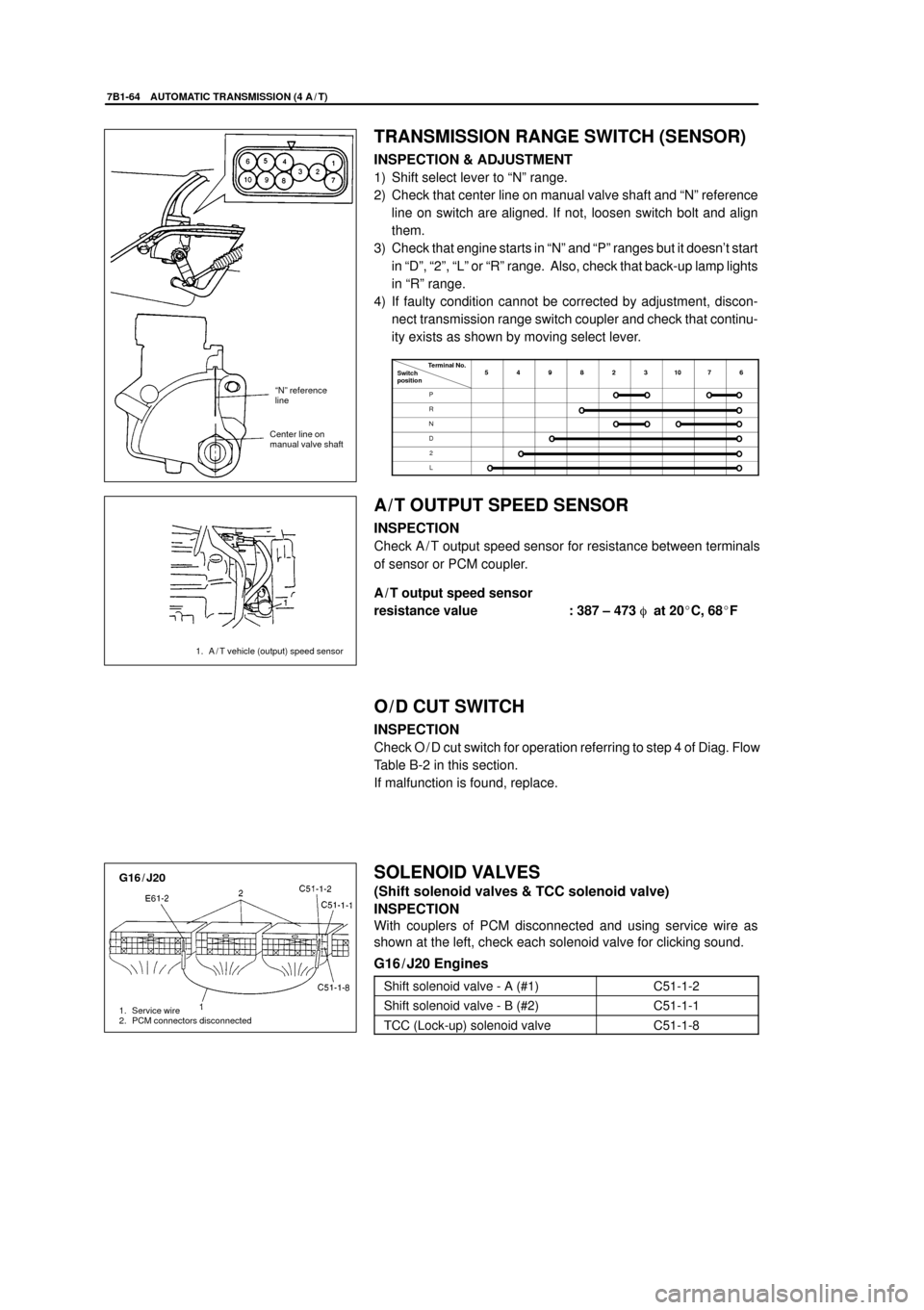
TRANSMISSION RANGE SWITCH (SENSOR)
INSPECTION & ADJUSTMENT
1) Shift select lever to ªNº range.
2) Check that center line on manual valve shaft and ªNº reference
line on switch are aligned. If not, loosen switch bolt and align
them.
3) Check that engine starts in ªNº and ªPº ranges but it doesn't start
in ªDº, ª2º, ªLº or ªRº range. Also, check that back-up lamp lights
in ªRº range.
4) If faulty condition cannot be corrected by adjustment, discon-
nect transmission range switch coupler and check that continu-
ity exists as shown by moving select lever.
Terminal No.54982310765498231076
P
R
N
D
2
L
A / T OUTPUT SPEED SENSOR
INSPECTION
Check A / T output speed sensor for resistance between terminals
of sensor or PCM coupler.
A / T output speed sensor
resistance value : 387 ± 473 � at 20�C, 68�F
O / D CUT SWITCH
INSPECTION
Check O / D cut switch for operation referring to step 4 of Diag. Flow
Table B-2 in this section.
If malfunction is found, replace.
SOLENOID VALVES
(Shift solenoid valves & TCC solenoid valve)
INSPECTION
With couplers of PCM disconnected and using service wire as
shown at the left, check each solenoid valve for clicking sound.
G16 / J20 Engines
Shift solenoid valve - A (#1)C51-1-2
Shift solenoid valve - B (#2)C51-1-1
TCC (Lock-up) solenoid valveC51-1-8
Page 473 of 801

YH4
GRAND
VITARA
AUTOMATIC TRANSMISSION (4 A / T) 7B1-71
Ignition switch side
1. Ignition switch assembly
2. Clamp screw
3. Interlock cable
Select lever side
Type-1
1. Inner end of interlock cable
2. Interlock cam (or key release cam)
3. Stud bolt4. Cam boss
5. Claw
Select lever side
Type-2
KEY INTERLOCK CABLE
NOTE:
Don't bend interlock cable excessively when removing and
installing it, or system will not operate correctly.
Removal
1) Disconnect negative (±) cable from battery.
2) If equipped with air bag system, disable air bag system.
Refer to ªDisabling Air bag Systemº in Section 10B.
3) Remove steering column hole cover.
4) Tilt steering column if steering column is adjustable.
If no adjustable, loosen steering column bolts.
5) Remove steering column cover.
6) Remove interlock cable clamp screw located at ignition switch
assembly.
7) Disconnect interlock cable inner end.
(Ignition switch side.)
8) With console box removed, take out interlock cable by loosening
lock nuts.
9) Detach cable end from interlock cam (or key release cam) while
pressing claws of interlock cam boss. At this time, be careful not
to cause damage to its claws.
Page 477 of 801

YH4
GRAND
VITARA
AUTOMATIC TRANSMISSION (4 A / T) 7B1-75
1. Drain plug
2. Filler and level plug
1. Drain plug
2. Front propeller shaft
1. Match marks
1. Right side transmission stiffener (if equipped)
G16 / J20
ON LIFT
1) Drain transfer oil for 4WD vehicle or A / T fluid for 2WD vehicle.
NOTE:
If 4WD automatic transmission is overhauled later on,
draining A / T fluid at this point will facilitate work.
Tightening Torque
(a): 23 N
.m (2.3 kg-m, 17.0 lb-ft)
2) Before removing propeller shaft, give match marks on joint
flange and propeller shaft as shown in left figure.
3) Remove universal joint flange bolts and take out rear propeller
shaft.
4) Likewise, take out front propeller shaft. (if equipped)
5) Remove nut from the end of select cable and bracket to set
cable free.
6) Remove select cable bracket by removing its 2 bolts.
7) Remove exhaust No.1 and No.2 pipe.
8) Remove transmission stiffener (right side) if equipped.
9) Unclamp and disconnect oil cooler hoses from pipes.
NOTE:
To avoid leakage of transmission fluid, plug open ends of
oil cooler pipes and hoses right after they are discon-
nected.
10) Remove torque converter housing lower plate.
11) Holding drive plate stationary with special tool or the like, re-
move torque converter mounting bolts with wrench.
Special Tool (only for G16 / J20)
(A): 09927-56010
Page 478 of 801

YH4
GRAND
VITARA
7B1-76 AUTOMATIC TRANSMISSION (4 A / T)
12) Remove engine to transmission nuts.
13) Disconnect connectors from VSS, output speed sensor, input
speed sensor, TR switch, shift & TCC solenoid valves and oth-
er electrical parts, and release their wire harness from clamps.
14) Apply transmission jack and take off rear mounting member by
removing its bolts.
15) With transmission (and transfer if equipped) assembly held up
on jack, move them to the rear and lower them including torque
converter.
WARNING:
Transmission (and transfer if equipped) assembly may
tilt rearward on jack. It is recommended to use an auxil-
iary arm of jack for the purpose of safety.
AFTER DISMOUNTING
WARNING:
Be sure to keep transmission (and transfer if equipped) as-
sembly horizontal throughout the work. Should they be
tilted, torque converter may fall off and cause personal inju-
ry and A / T fluid may flow out.
1) Remove breather hoses.
2) Remove transfer by removing its bolts, if equipped.