Page 309 of 477

8-8
Driving tips
Off road driving
Because of the AWD feature and higher ground clear-
ance, your SUBARU can be driven on ordinary roads
or off-road. But please keep in mind that an AWD
SUBARU is a passenger car and is neither a conven-
tional off-road vehicle nor an all-terrain vehicle. If you
do take your SUBARU off-road, certain common
sense precautions such as the following should be taken: y
Make certain that you and all of your passengers
are wearing seatbelts. y Carry some emergency equipment, such as a tow-
ing rope or chain, a shovel, wheel blocks, first aid kit
and cell phone or citizens band radio. y Drive carefully. Do not take unnecessary risks by
driving in dangerous areas or over rough terrain.y Slow down and employ extra caution at all times.
When driving off-road, you will not have the benefit of
marked traffic lanes, banked curves, traffic signs and
the like. y Do not drive across steep slopes. Instead, drive ei-
ther straight up or straight down the slopes. A vehicle
can much more easily tip over sideways than it can
end over end. Avoid driving straight up or down slopes
that are too steep.y Avoid sharp turning maneuvers, especially at higher speeds. y
Do not grip the inside or spokes of the steering
wheel. A bad bump could jerk the wheel and injure
your hands. Instead drive with your fingers and
thumbs on the outside of the rim.y If driving through water, such as when crossing
shallow streams, first check the depth of the water and
the bottom of the stream bed for firmness and ensure
that the bed of the stream is flat. Drive slowly and com-
pletely through the stream. The water should be shal-
low enough that it does not reach the vehicle’s under-
carriage. Water entering the engine air intake or the
exhaust pipe or water splashing onto electrical parts
may damage your vehicle and may cause it to stall.
Never attempt to drive through rushing water; regard-
less of its depth, it can wash away the ground from un-
der your tires, resulting in possible loss of traction and
even vehicle rollover. y Always check your brakes for effectiveness immedi-
ately after driving in sand, mud or water. Do this by
driving slowly and stepping on the brake pedal. Re-
peat that process several times to dry out the brake
discs and brake pads.y Do not drive or park over or near flammable materi-
als such as dry grass or fallen leaves, as they may
burn easily. The exhaust system is very hot while the
engine is running and right after the engine stops. This
Page 334 of 477
8-33
Driving tips
– CONTINUED –
for proper operation of the turn signals, the brake
lights and parking lights each time you hitch up.
Direct splicing or other improper connection of
trailer lights may damage your vehicle’s electri-
cal system and cause a malfunction of your ve-
hicle’s lighting system.
T Tires
Make sure that all the tires on your vehicle are properly
inflated to the pressure specified on the tire placard lo-
cated on the driver’s side center pillar.
Trailer tire condition, size, load rating and proper infla-
tion pressure should be in accordance with the trailer
manufacturer’s specifications. „ Trailer towing tips
yNever exceed 45 mph (72 km/h) when towing
a trailer in hilly country on hot days. y When towing a trailer, steering, stability,
stopping distance and braking performance will be different from normal operation. For
safety’s sake, you should employ extra caution
when towing a trailer and you should never
speed. You should also keep the following tips
in mind:
T Before starting out on a trip
y Check that the vehicle and vehicle-to-hitch mount-
ing are in good condition. If any problems are appar-
ent, do not tow the trailer.y Check that the vehicle sits horizontally with the trail-
er attached. If the vehicle is tipped sharply up at the
front and down at the rear, check the total trailer
weight, GVW, GAWs and tongue load again, then con-
firm that the load and its distribution are acceptable. y Check that the tire pressures are correct.
y Check that the vehicle and trailer are connected
properly. Confirm that
– the trailer tongue is connected properly to the
hitch ball.
– the trailer lights connector is connected properly
and trailer’s brake lights illuminate when the vehi-
cle’s brake pedal is pressed, and that the trailer’s
turn signal lights flash when the vehicle’s turn signal
lever is operated.
– the safety chains are connected properly.
Page 338 of 477

9-1
9
In case of emergency
If you park your vehicle in case of an emergency ............................................ 9-2
Flat tires ......................................................... 9-3 Changing a flat tire ........................................... 9-3
Jump starting ................................................ 9-9 How to jump start ............................................. 9-10
Engine overheating ....................................... 9-12 If steam is coming from the engine compartment .................................................. 9-12
If no steam is coming from the engine compartment .................................................. 9-12
Towing ........................................................... 9-13 Towing and tie-down hooks ............................ 9-13
Using a flat-bed truck ....................................... 9-15
Towing with all wheels on the ground ............ 9-15
Rear gate – if the rear gate cannot be unlocked ..................................................... 9-17
Moonroof – if the moonroof cannot be closed ......................................................... 9-18
Maintenance tools ......................................... 9-19 Jack and jack handle ........................................ 9-19
Page 340 of 477
9-3
In case of emergency
– CONTINUED –
Flat tires
If you have a flat tire while driving, never brake sud-
denly; keep driving straight ahead while gradually re-
ducing speed. Then slowly pull off the road to a safe
place. „Changing a flat tire
yDo not jack up the vehicle on an incline or a
loose road surface. The jack can come out of
the jacking point or sink into the ground and
this can result in a severe accident.y Use only the jack provided with your vehicle.
The jack supplied with the vehicle is designed
only for changing a tire. Never get under the ve-
hicle while supporting the vehicle with this jack. y Always turn the engine off before raising the
flat tire off the ground using the jack. Never
swing or push the vehicle supported with the
jack. The jack can come out of the jacking point
due to a jolt and this can result in a severe acci-
dent. 1. Park on a hard, level surface, whenever possible,
then stop the engine.
2. Set the parking brake securely and shift a manual
transmission vehicle in reverse or an automatic trans-
mission vehicle in the “P” (Park) position.
3. Turn on the hazard warning flasher and have ev-
eryone get out of the vehicle.
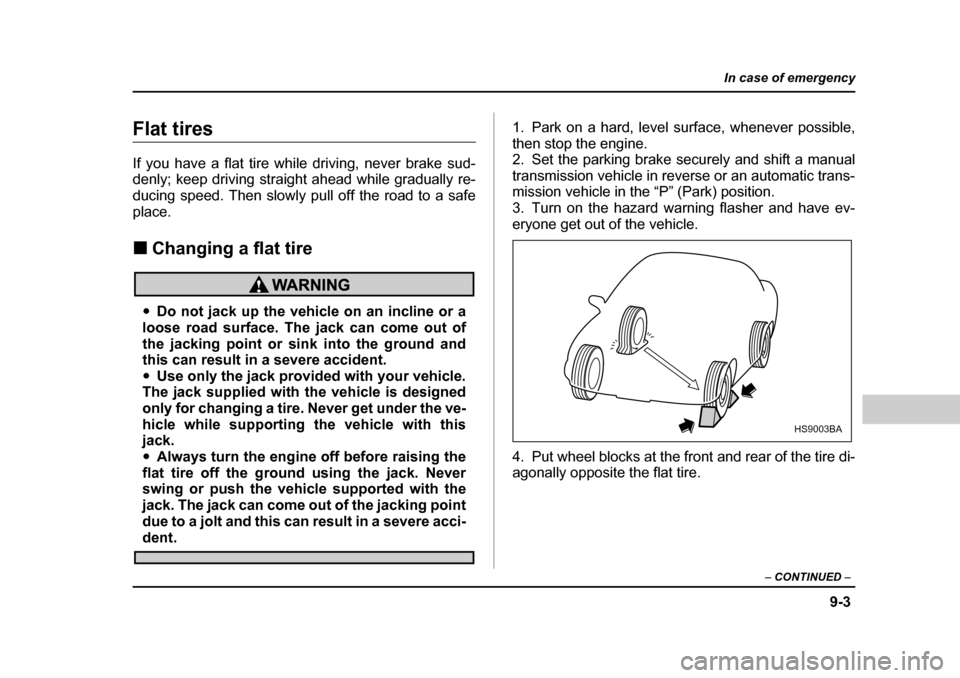
4. Put wheel blocks at the front and rear of the tire di-
agonally opposite the flat tire.
HS9003BA
Page 344 of 477
9-7
In case of emergency
– CONTINUED –
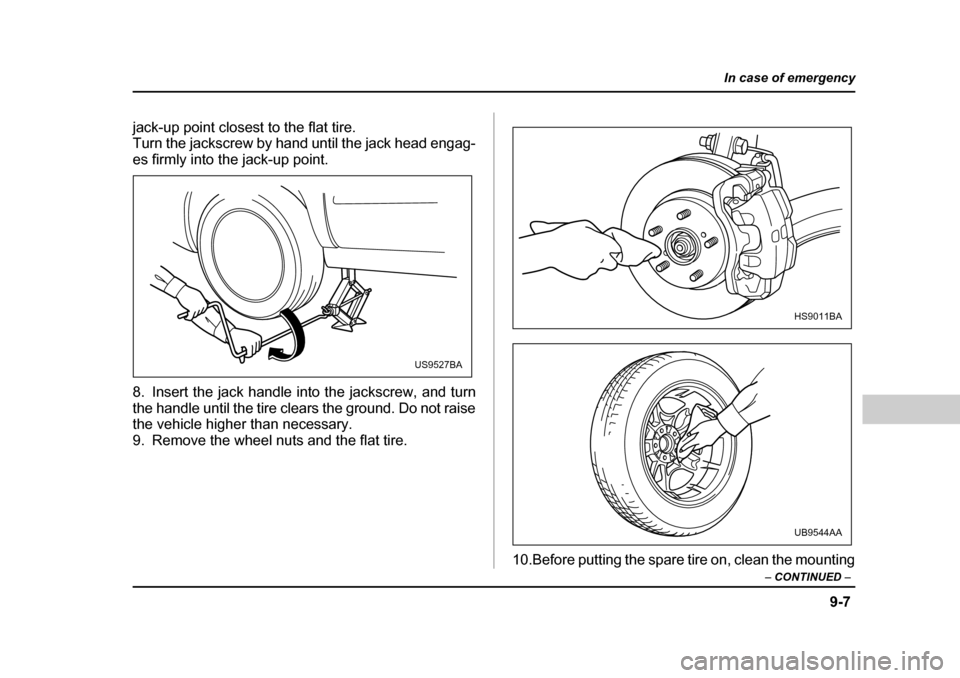
jack-up point closest to the flat tire.
Turn the jackscrew by hand until the jack head engag-
es firmly into the jack-up point.
8. Insert the jack handle into the jackscrew, and turn
the handle until the tire clears the ground. Do not raise
the vehicle higher than necessary.
9. Remove the wheel nuts and the flat tire.
10.Before putting the spare tire on, clean the mounting
US9527BA
HS9011BA
UB9544AA
Page 345 of 477
9-8
In case of emergency
surface of the wheel and hub with a cloth.
11.Put on the spare tire. Replace the wheel nuts.
Tighten them by hand.
Do not use oil or grease on the wheel studs or
nuts when the spare tire is installed. This could
cause the nuts to become loose and lead to an
accident.
12.Turn the jack handle counterclockwise to lower the
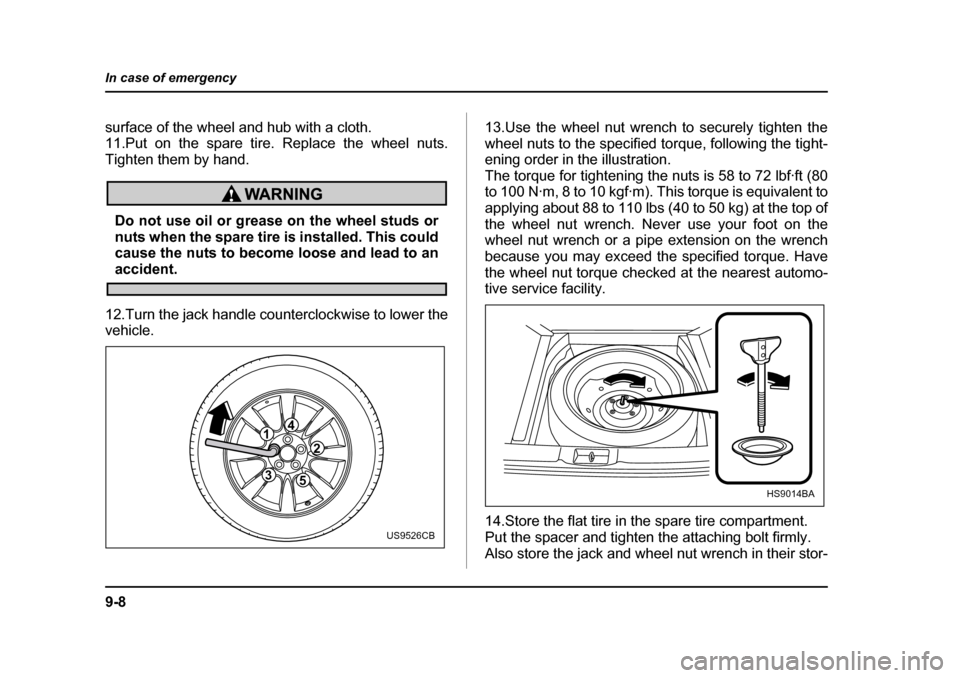
vehicle. 13.Use the wheel nut wrench to securely tighten the
wheel nuts to the specified torque, following the tight-
ening order in the illustration.
The torque for tightening the nuts is 58 to 72 lbf·ft (80
to 100 N·m, 8 to 10 kgf·m). This torque is equivalent to
applying about 88 to 110 lbs (40 to 50 kg) at the top of
the wheel nut wrench. Never use your foot on the
wheel nut wrench or a pipe extension on the wrench
because you may exceed the specified torque. Have
the wheel nut torque checked at the nearest automo-
tive service facility.
14.Store the flat tire in the spare tire compartment.
Put the spacer and tighten the attaching bolt firmly.
Also store the jack and wheel nut wrench in their stor-
3
412
5
US9526CB
HS9014BA
Page 357 of 477
9-20
In case of emergency
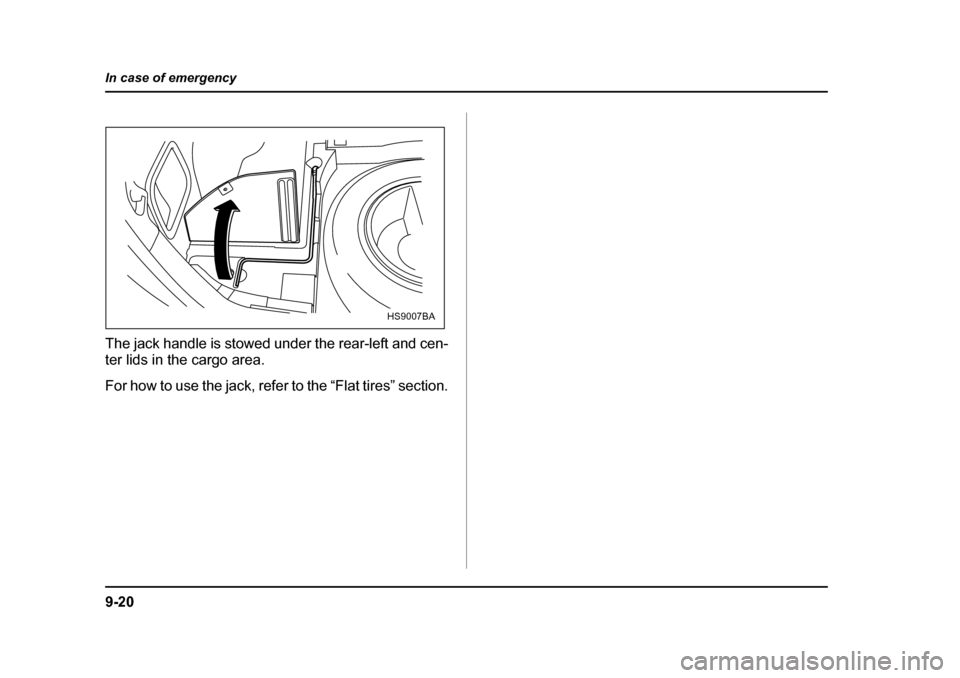
The jack handle is stowed under the rear-left and cen-
ter lids in the cargo area.
For how to use the jack, refer to the “Flat tires” section.
HS9007BA
Page 415 of 477
11 - 5 0
Maintenance and service
Aluminum wheels (if equipped)
Aluminum wheels can be scratched and damaged
easily. Handle them carefully to maintain their appear-
ance, performance, and safety. y
When any of the wheels is removed and replaced
for tire rotation or to change a flat, always check the
tightness of the wheel nuts after driving approximately
600 miles (1,000 km). If any nut is loose, tighten it to
the specified torque.y Never apply oil to the threaded parts, wheel nuts, or
tapered surface of the wheel.y Never let the wheel rub against sharp protrusions or
curbs. y Be sure to fit tire chains on uniformly and completely
around the tire, otherwise the chains may scratch the
wheel.y When wheel nuts, balance weights, or the center
cap is replaced, be sure to replace them with genuine
SUBARU parts designed for aluminum wheels.Windshield washer fluid
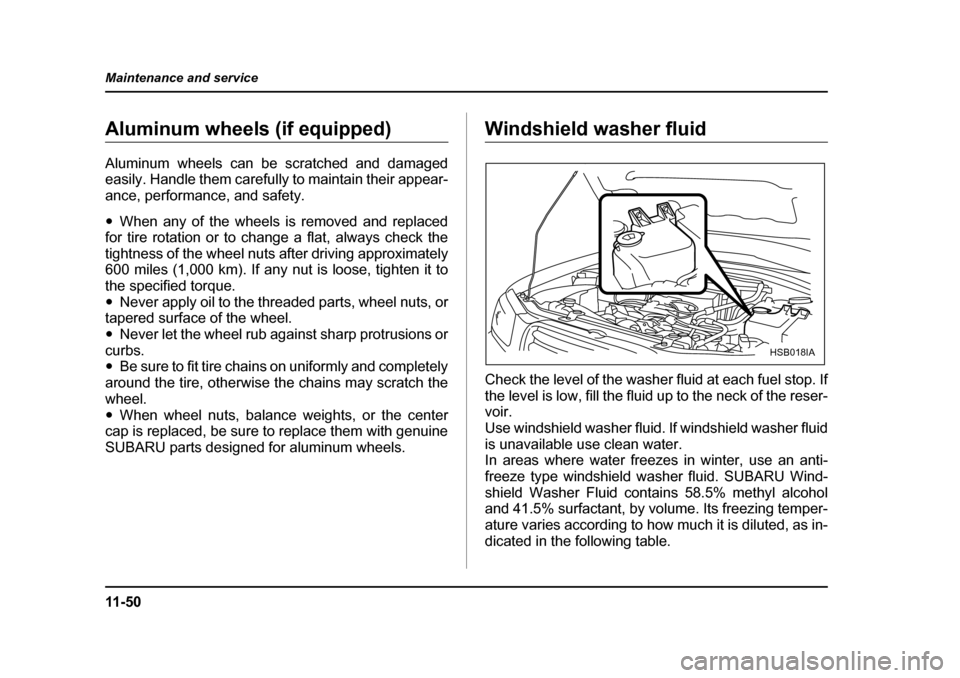
Check the level of the washer fluid at each fuel stop. If
the level is low, fill the fluid up to the neck of the reser- voir.
Use windshield washer fluid. If windshield washer fluid
is unavailable use clean water.
In areas where water freezes in winter, use an anti-
freeze type windshield washer fluid. SUBARU Wind-
shield Washer Fluid contains 58.5% methyl alcohol
and 41.5% surfactant, by volume. Its freezing temper-
ature varies according to how much it is diluted, as in-
dicated in the following table.
HSB018IA