2005 SUBARU BAJA change wheel
[x] Cancel search: change wheelPage 124 of 469

3-1
3
Instruments and controls
Ignition switch .............................................. 3-2 LOCK .................................................................. 3-2
ACC .................................................................... 3-3
ON ....................................................................... 3-3
START ................................................................ 3-4
Key reminder chime .......................................... 3-4
Ignition switch light (if equipped) .................... 3-4
Key interlock release (AT vehicles) ................. 3-4
Hazard warning flasher ................................ 3-5
Meters and gauges ....................................... 3-6 Speedometer ..................................................... 3-6
Odometer/Trip meter ........................................ 3-6
Tachometer ........................................................ 3-7
Outside temperature indicator (if equipped) .. 3-7
Fuel gauge ......................................................... 3-8
Temperature gauge ........................................... 3-8
Warning and indicator lights ....................... 3-9 Seatbelt warning light and chime .................... 3-9
SRS airbag system warning light .................... 3-10
CHECK ENGINE warning light/Malfunction indicator lamp ................................................. 3-10
Charge warning light ........................................ 3-11
Oil pressure warning light ................................ 3-12
AT OIL TEMPerature warning light (AT vehicles) ................................................... 3-12
ABS warning light ............................................. 3-12
Brake system warning light ............................. 3-13
Door ajar warning lights ................................... 3-14
Switchback door indicator light ...................... 3-14
Low fuel warning light ...................................... 3-14
All-Wheel Drive warning light (AT vehicles) ... 3-14 Security system status indicator light
(if equipped) .................................................... 3-15
Selector lever position indicator (AT vehicles) ................................................... 3-15
Gear position indicator (Turbo-AT vehicles) .. 3-16
Turn signal indicator lights .............................. 3-16
High beam indicator light ................................. 3-16
Cargo lamp indicator light ............................... 3-16
Cruise control set indicator light .................... 3-16
Clock .............................................................. 3-17
Light control switch ...................................... 3-18 Headlights ......................................................... 3-18
High/low beam change (dimmer) .................... 3-19
Headlight flasher ............................................... 3-19
Daytime running light system ......................... 3-20
Turn signal lever ........................................... 3-20
Illumination brightness control ................... 3-21
Parking light switch ...................................... 3-22
Fog light button ............................................. 3-23
Wiper and washer ......................................... 3-23 Windshield wiper and washer switches ......... 3-25
Rear window defogger button ..................... 3-26
Windshield wiper deicer (if equipped) ........ 3-27
Mirrors ............................................................ 3-28 Inside mirror ...................................................... 3-28
Outside mirrors ................................................. 3-30
Tilt steering wheel ......................................... 3-33
Horn ................................................................ 3-34
Page 305 of 469
8-28
Driving tips
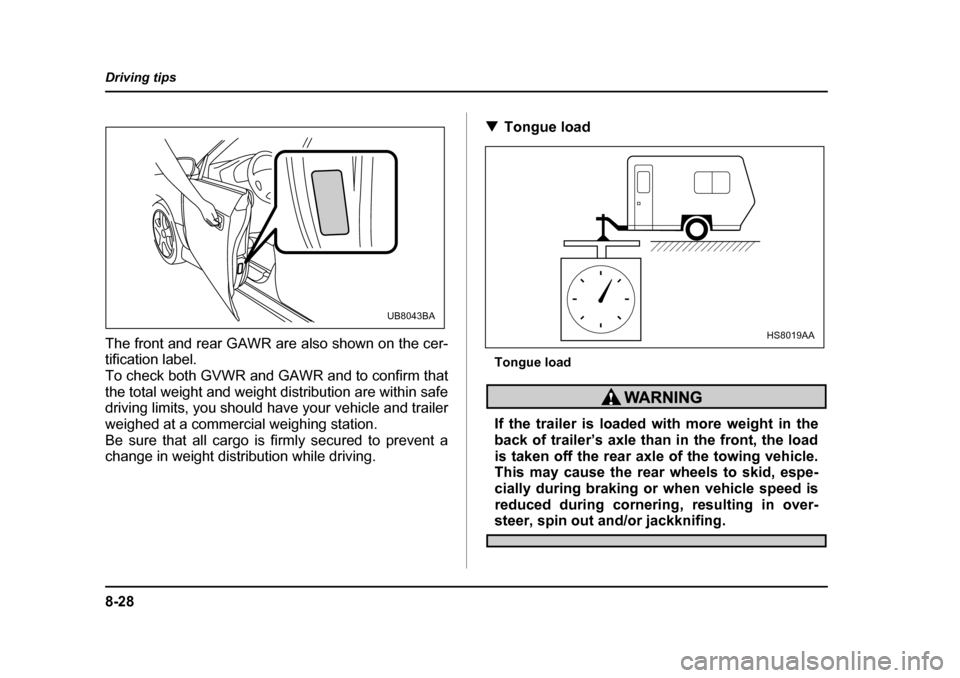
The front and rear GAWR are also shown on the cer- tification label.
To check both GVWR and GAWR and to confirm that
the total weight and weight distribution are within safe
driving limits, you should have your vehicle and trailer
weighed at a commercial weighing station.
Be sure that all cargo is firmly secured to prevent a
change in weight distribution while driving.
T
Tongue load
Tongue load
If the trailer is loaded with more weight in the
back of trailer’s axle than in the front, the load
is taken off the rear axle of the towing vehicle.
This may cause the rear wheels to skid, espe-
cially during braking or when vehicle speed is
reduced during cornering, resulting in over-
steer, spin out and/or jackknifing.
UB8043BA
HS8019AA
Page 401 of 469
11 - 5 0
Maintenance and service
ible, the tire is worn beyond the acceptable limit
and must be replaced immediately. With a tire
in this condition, driving at high speeds in wet
weather can cause the vehicle to hydroplane.
The resulting loss of vehicle control can lead to
an accident.
NOTE
For safety, inspect the tire tread regularly and re-
place the tires before their tread wear indicators
become visible. „
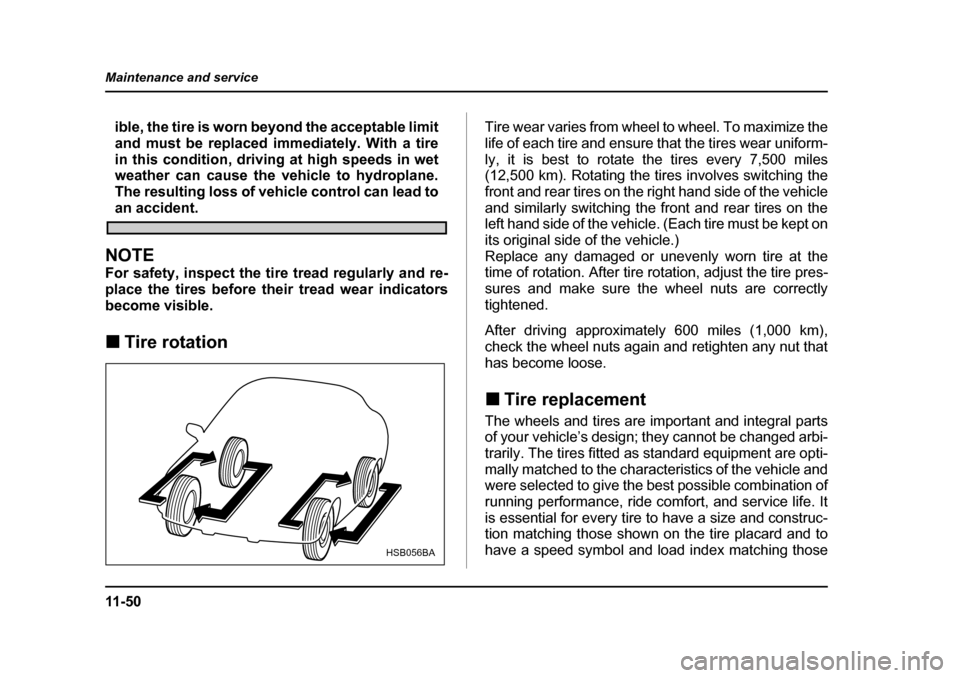
Tire rotation Tire wear varies from wheel to wheel. To maximize the
life of each tire and ensure that the tires wear uniform-
ly, it is best to rotate the tires every 7,500 miles
(12,500 km). Rotating the tires involves switching the
front and rear tires on the right hand side of the vehicle
and similarly switching the front and rear tires on the
left hand side of the vehicle. (Each tire must be kept on
its original side of the vehicle.)
Replace any damaged or unevenly worn tire at the
time of rotation. After tire rotation, adjust the tire pres-
sures and make sure the wheel nuts are correctly
tightened.
After driving approximately 600 miles (1,000 km),
check the wheel nuts again and retighten any nut that
has become loose. „
Tire replacement
The wheels and tires are important and integral parts
of your vehicle’s design; they cannot be changed arbi-
trarily. The tires fitted as standard equipment are opti-
mally matched to the characteristics of the vehicle and
were selected to give the best possible combination of
running performance, ride comfort, and service life. It
is essential for every tire to have a size and construc-
tion matching those shown on the tire placard and to
have a speed symbol and load index matching those
HSB056BA
Page 402 of 469
11 -5 1
Maintenance and service
– CONTINUED –
shown on the tire placard.
Using tires of a non-specified size detracts from con-
trollability, ride comfort, braking performance, speed-
ometer accuracy and odometer accuracy. It also cre-
ates incorrect body-to-tire clearances and inappropri-
ately changes the vehicle’s ground clearance.
All four tires must be the same in terms of manufactur-
er, brand (tread pattern), construction, and size. You
are advised to replace the tires with new ones that are
identical to those fitted as standard equipment.
For safe vehicle operation, SUBARU recommends re-
placing all four tires at the same time.
yAll four tires must be the same in terms of
manufacturer, brand (tread pattern), construc-
tion, degree of wear, speed symbol, load index
and size. Mixing tires of different types, sizes or
degrees of wear can result in damage to the ve-
hicle’s power train. Use of different types or siz-
es of tires can also dangerously reduce control-
lability and braking performance and can lead
to an accident. y Use only radial tires. Do not use radial tires
together with belted bias tires and/or bias-ply tires. Doing so can dangerously reduce control-
lability, resulting in an accident.
„ Wheel replacement
When replacing wheels due, for example, to damage,
make sure the replacement wheels match the specifi-
cations of the wheels that are fitted as standard equip-
ment. Replacement wheels are available from
SUBARU dealers.
Use only those wheels that are specified for
your vehicle. Wheels not meeting specifica-
tions could interfere with brake caliper opera-
tion and may cause the tires to rub against the
wheel well housing during turns. The resulting
loss of vehicle control could lead to an acci-
dent.
Page 403 of 469
11 - 5 2
Maintenance and service
Aluminum wheels
Aluminum wheels can be scratched and damaged
easily. Handle them carefully to maintain their appear-
ance, performance, and safety. y
When any of the wheels is removed and replaced
for tire rotation or to change a flat, always check the
tightness of the wheel nuts after driving approximately
600 miles (1,000 km). If any nut is loose, tighten it to
the specified torque.y Never apply oil to the threaded parts, wheel nuts, or
tapered surface of the wheel.y Never let the wheel rub against sharp protrusions or
curbs. y Be sure to fit tire chains on uniformly and completely
around the tire, otherwise the chains may scratch the
wheel.y When wheel nuts, balance weights, or the center
cap is replaced, be sure to replace them with genuine
SUBARU parts designed for aluminum wheels.Windshield washer fluid
Never use engine coolant as washer fluid be-
cause it could cause paint damage.
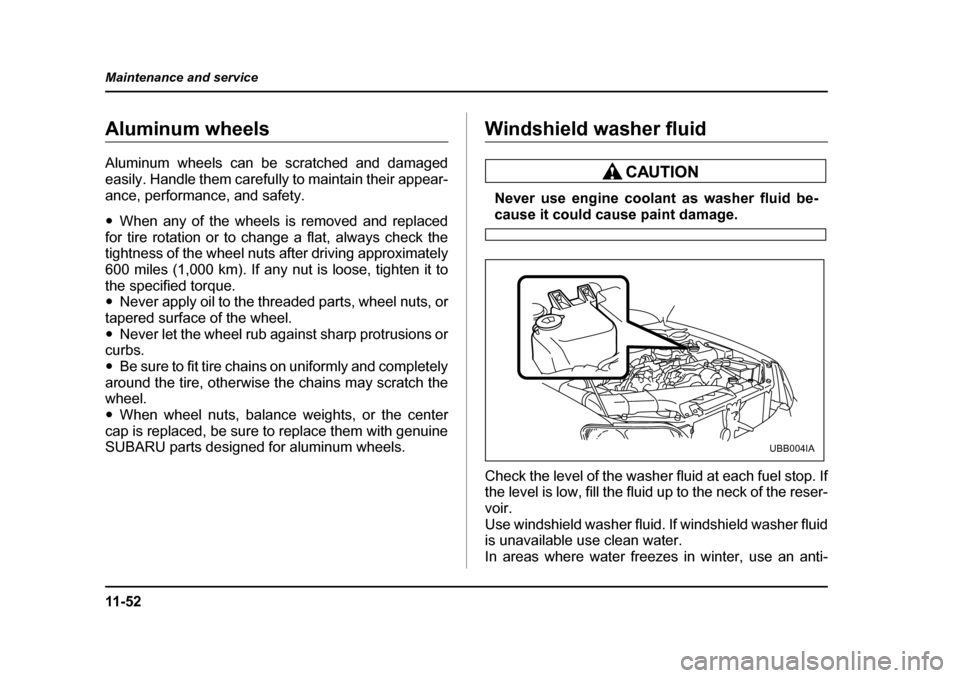
Check the level of the washer fluid at each fuel stop. If
the level is low, fill the fluid up to the neck of the reser- voir.
Use windshield washer fluid. If windshield washer fluid
is unavailable use clean water.
In areas where water freezes in winter, use an anti-
UBB004IA
Page 433 of 469

12-2
Specifications
SpecificationsSpecifications
These specifications are subject to change without notice. „
Dimensions
in (mm)
„ Engine
ModelBAJA, BAJA-SportBAJA-Turbo
Overall length199.3 (4,910)
Overall width70.1 (1,780)
Overall height62.1 (1,760)62.6 (1,775)
Wheelbase104.3 (2,650)
TreadFront57.7 (1,465)
Rear57.7 (1,465)
Ground clearance8.4 (213)
ItemNon-turboTurbo
Engine modelEJ251EJ255
Engine typeHorizontally opposed, liquid cooled 4 cylinder, 4 stroke gasoline engine
Displacement cc (cu-in)2,457 (150)
Bore × Stroke in (mm)3.92 × 3.11 (99.5 × 79.0)
Compression ratio10.0 : 18.2 : 1
Firing order1 - 3 - 2 - 4