2005 SUBARU BAJA parking brake
[x] Cancel search: parking brakePage 309 of 469

8-32
Driving tips
standard side mirrors provide a good rearward field of
view without significant blind spots. If significant blind
spots occur with the vehicle’s standard side mirrors,
use towing mirrors that conform with Federal, state/
province and/or other applicable regulations. T
Trailer lights
Direct splicing or other improper connection of
trailer lights may damage your vehicle’s electri-
cal system and cause a malfunction of your ve-
hicle’s lighting system.
Connection of trailer lights to your vehicle’s electrical
system requires modifications to the vehicle’s lighting
circuit to increase its capacity and accommodate wir-
ing changes. To ensure the trailer lights are connected
properly, please consult your SUBARU dealer. Check
for proper operation of the turn signals, the brake
lights and parking lights each time you hitch up. T Tires
Never tow a trailer when the temporary spare tire is used. The temporary spare tire is not de-
signed to sustain the towing load. Use of the
temporary spare tire when towing can result in
failure of the spare tire and/or less stability of
the vehicle.
Make sure that all the tires on your vehicle are properly
inflated.
The recommended cold tire pressure is shown on the
vehicle placard attached to the driver’s side door jamb.
Trailer tire condition, size, load rating and proper infla-
tion pressure should be in accordance with the trailer
manufacturer’s specifications.
In the event your vehicle gets a flat tire when towing a
trailer, ask a commercial road service to repair the flat tire.
If you carry a regular size spare tire in your vehicle or
trailer as a precaution against getting a flat tire, be
sure that the spare tire is firmly secured.
Page 312 of 469
8-35
Driving tips
– CONTINUED –
overheating” section in chapter 9, and “Warning and
indicator lights” section in chapter 3.
NOTE (Turbo models only)
In a vehicle that has an automatic transmission,
the engine is less likely to overheat with the “D”
range selected than it is with the manual mode se-
lected. yIf your vehicle has an automatic transmission, avoid
using the accelerator pedal to stay stationary on an
uphill slope instead of using the parking brake or foot
brake. That may cause the transmission fluid to over-
heat. y Non-turbo models only: If your vehicle is equipped
with an automatic transmission, avoid driving with the
gear selector lever in “D” when towing a heavy trailer
to prevent fluid overheating. A lower gear should be
used. T Parking on a grade
Always block the wheels under both vehicle and trailer
when parking. Apply the parking brake firmly. You
should not park on a hill or slope. But if parking on a
hill or slope cannot be avoided, you should take the
following steps:
1. Apply the brakes and hold the pedal down.
2. Have someone place wheel blocks under both the vehicle and trailer wheels.
3. When the wheel blocks are in place, release the
regular brakes slowly until the blocks absorb the load.
4. Apply the regular brakes and then apply the park-
ing brake; slowly release the regular brakes.
5. Shift into 1st or reverse gear (manual transmission)
or “P” (automatic transmission) and shut off the en-
gine.
Page 325 of 469
9-12
In case of emergency
Flat tires
If you get a flat tire while driving, never brake sudden-
ly; keep driving straight ahead while gradually reduc-
ing speed. Then slowly pull off the road to a safe place. „
Changing a flat tire
yDo not jack up the vehicle on an incline or a
loose road surface. The jack can come out of
the jacking point or sink into the ground and
this can result in a serious accident. y Use only the jack provided with your vehicle.
The jack supplied with the vehicle is designed
only for changing a tire. Never get under the ve-
hicle while supporting the vehicle with thisjack. y Always turn the engine off before raising the
flat tire off the ground using the jack. Never
swing or push the vehicle supported with the
jack. The jack can come out of the jacking point
due to a jolt and this can result in a serious ac-
cident. y Never place a tire or tire changing tools in the
passenger compartment after changing wheels. In a sudden stop or collision, loose
equipment could strike occupants and cause
injury. Store the tire and all tools in the proper
place.
1. Park on a hard, level surface, whenever possible,
then stop the engine.
2. Set the parking brake securely and shift a manual
transmission vehicle into reverse or an automatic
transmission vehicle into the “P” (Park) position.
3. Turn on the hazard warning flasher and have ev-
eryone get out of the vehicle.
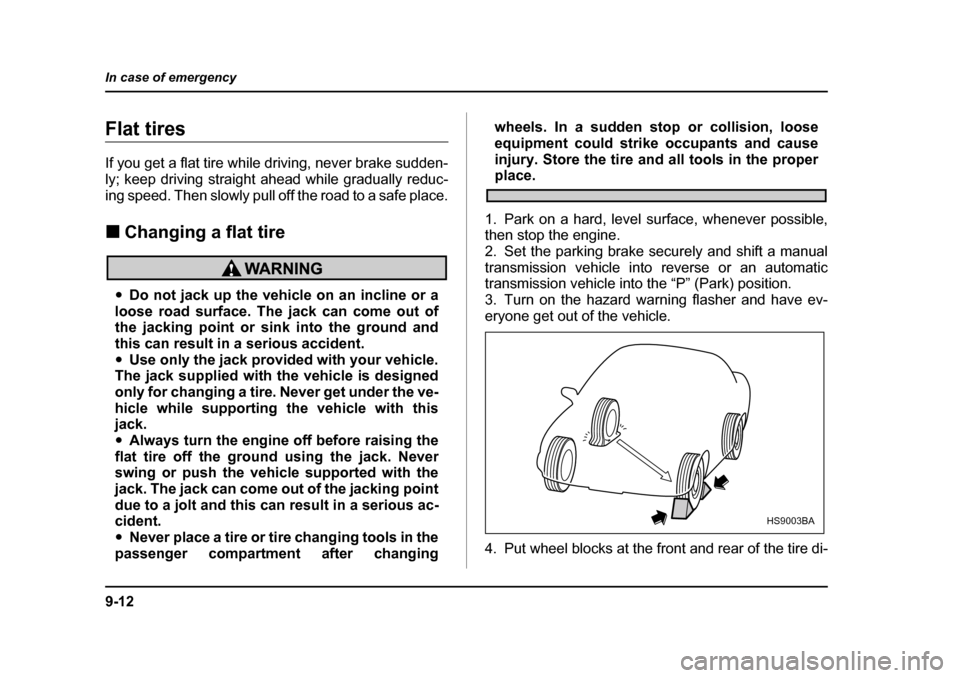
4. Put wheel blocks at the front and rear of the tire di-
HS9003BA
Page 340 of 469
9-27
In case of emergency
– CONTINUED –
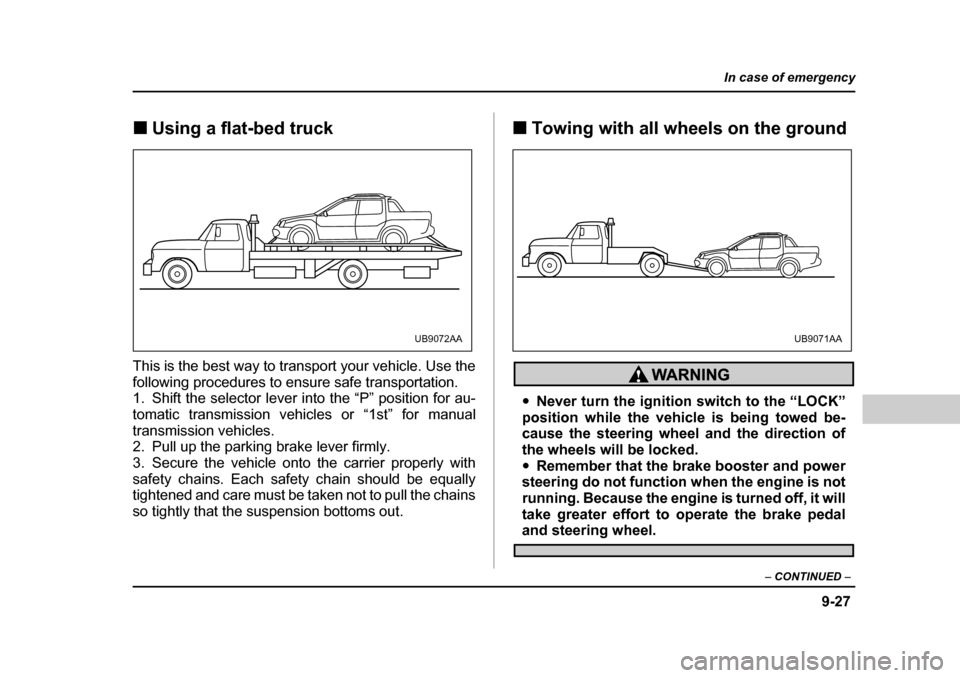
„Using a flat-bed truck
This is the best way to transport your vehicle. Use the
following procedures to ensure safe transportation.
1. Shift the selector lever into the “P” position for au-
tomatic transmission vehicles or “1st” for manual
transmission vehicles.
2. Pull up the parking brake lever firmly.
3. Secure the vehicle onto the carrier properly with
safety chains. Each safety chain should be equally
tightened and care must be taken not to pull the chains
so tightly that the suspension bottoms out. „
Towing with all wheels on the ground
yNever turn the ignition switch to the “LOCK”
position while the vehicle is being towed be-
cause the steering wheel and the direction of
the wheels will be locked.y Remember that the brake booster and power
steering do not function when the engine is not
running. Because the engine is turned off, it will
take greater effort to operate the brake pedal
and steering wheel.
UB9072AAUB9071AA
Page 341 of 469
9-28
In case of emergency
y
If transmission failure occurs, transport your
vehicle on a flat-bed truck. y Do not run the engine while the vehicle is be-
ing towed using this method. Transmission
damage could result if the vehicle is towed with
the engine running. y For vehicles with automatic transmission,
the traveling speed must be limited to less than
20 mph (30 km/h) and the traveling distance to
less than 30 miles (50 km). For greater speeds
and distances, transport your vehicle on a flat-
bed truck.
1. Check the transmission and differential oil levels
and add oil to bring it to the upper level if necessary.
2. Release the parking brake and put the transmis-
sion in neutral.
3. The ignition switch should be in the “ACC” position
while the vehicle is being towed.
4. Take up slack in the towline slowly to prevent dam-
age to the vehicle. Moonroof – if the moonroof cannot be
closed
If the moonroof cannot be closed with the moonroof
switch, you can close the moonroof manually.
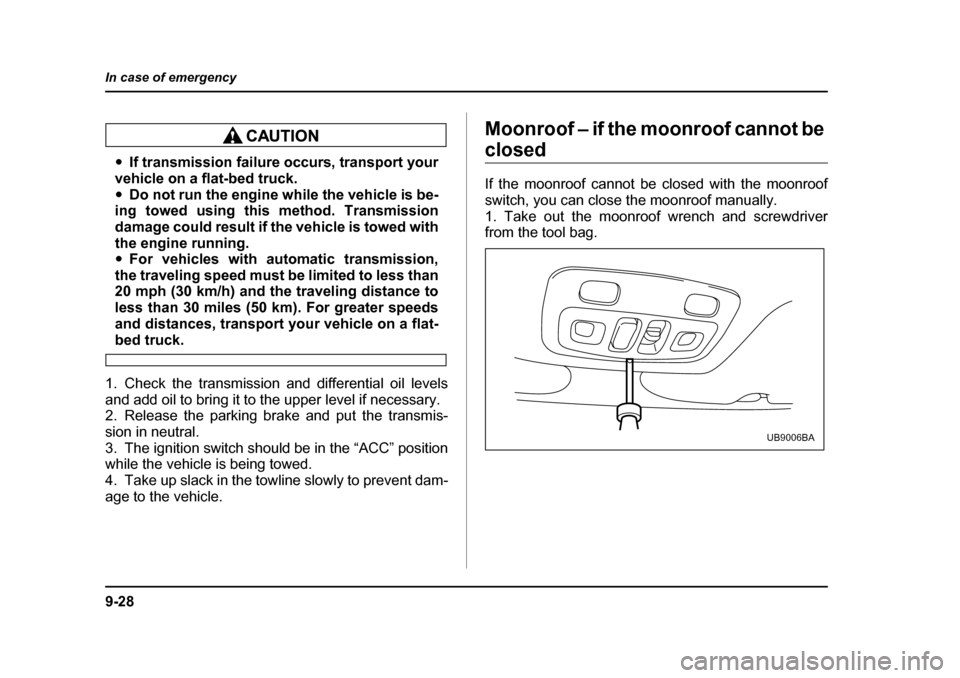
1. Take out the moonroof wrench and screwdriver
from the tool bag.
UB9006BA
Page 352 of 469

11 - 1
11
Maintenance and service
Maintenance schedule ................................. 11-3
Maintenance precautions ............................ 11-3 Before checking or servicing in the engine compartment .................................................. 11-4
When you do checking or servicing in the engine compartment while the engine is
running ............................................................ 11-5
Engine hood .................................................. 11-5
Engine compartment overview ................... 11-8 Non-turbo models ............................................. 11-8
Turbo models .................................................... 11-9
Engine oil ...................................................... 11-10 Checking the oil level ....................................... 11-10
Changing the oil and oil filter .......................... 11-12
Recommended grade and viscosity ................ 11-15
Recommended grade and viscosity under severe driving conditions .............................. 11-16
Cooling system ............................................. 11-17 Hose and connections ...................................... 11-18
Engine coolant .................................................. 11-18
Air cleaner element ...................................... 11-23 Replacing the air cleaner element ................... 11-23
Spark plugs ................................................... 11-25 Recommended spark plugs ............................. 11-26
Drive belts ..................................................... 11-26
Manual transmission oil ............................... 11-27 Checking the oil level ....................................... 11-27
Recommended grade and viscosity ................ 11-28
Automatic transmission fluid ...................... 11-29 Checking the fluid level .................................... 11-29
Recommended fluid ......................................... 11-31
Front differential gear oil (AT vehicles) ...... 11-32 Checking the oil level ....................................... 11-32
Recommended grade and viscosity ............... 11-32
Rear differential gear oil ............................... 11-33 Checking the gear oil level .............................. 11-33
Recommended grade and viscosity ............... 11-35
Power steering fluid ...................................... 11-36 Checking the fluid level .................................... 11-36
Recommended fluid ......................................... 11-37
Brake fluid ..................................................... 11-38 Checking the fluid level .................................... 11-38
Recommended brake fluid ............................... 11-39
Clutch fluid (MT vehicles) ............................ 11-39 Checking the fluid level .................................... 11-39
Recommended clutch fluid .............................. 11-40
Brake booster ................................................ 11-41
Brake pedal .................................................... 11-41 Checking the brake pedal free play ................ 11-41
Checking the brake pedal reserve distance ... 11-42
Clutch pedal (Manual transmission vehicles) ............... 11-42Checking the clutch function .......................... 11-42
Checking the clutch pedal free play ............... 11-43
Replacement of brake pad and lining ......... 11-43 Breaking-in of new brake pads and linings .... 11-44
Parking brake stroke .................................... 11-45
Tires and wheels ........................................... 11-45
Page 355 of 469
11 - 4
Maintenance and service
the materials in the vehicle may be hazardous if
improperly used or handled, for example, bat-tery acid. y
Your vehicle should only be serviced by per-
sons fully competent to do so. Serious person-
al injury may result to persons not experienced
in servicing vehicles. y Always use the proper tools and make certain
that they are well maintained. y Never get under the vehicle supported only
by a jack. Always use a safety stands to sup-
port the vehicle. y Never keep the engine running in a poorly
ventilated area, such as a garage or other
closed areas. y Do not smoke or allow open flames around
the fuel or battery. This will cause a fire. y Because the fuel system is under pressure,
replacement of the fuel filter should be per-
formed only by your SUBARU dealer.y Wear adequate eye protection to guard
against getting oil or fluids in your eyes. If
something does get in your eyes, thoroughly
wash them out with clean water. y Do not tamper with the wiring of the SRS air-
bag system or seatbelt pretensioner system, or
attempt to take its connectors apart, as that may activate the system or it can render it inop-
erative. The wiring and connectors of these
systems are yellow for easy identification. NEV-
ER use a circuit tester for these wiring.
If your SRS airbag or seatbelt pretensioner
needs service, consult your nearest SUBARU
dealer.
„ Before checking or servicing in the en-
gine compartment
yAlways stop the engine and set the parking
brake firmly to prevent the vehicle from mov-
ing. y Always let the engine cool down. Engine
parts become very hot when the engine is run-
ning and remain hot for some time after the en-
gine is stopped.y Do not spill engine oil, engine coolant, brake
fluid or any other fluid on hot engine compo-
nents. This may cause a fire.y Always remove the key from the ignition
switch. When the ignition switch is in the “ON”
position, the cooling fan may operate suddenly
Page 395 of 469
11 - 4 4
Maintenance and service
when the brake pedal is applied.
If you hear this scraping noise each time you apply the
brake pedal, have the brake pads serviced by your
SUBARU dealer as soon as possible. „
Breaking-in of new brake pads and lin- ings
When replacing the brake pad or lining, use only gen-
uine SUBARU parts. After replacement, the new parts
must be broken in as follows: T Brake pad and lining
While maintaining a speed of 30 to 40 mph (50 to 65
km/h), step on the brake pedal lightly. Repeat this five
or more times. T Parking brake lining
A safe location and situation should be select-
ed for break-in driving.
Pulling the parking brake lever too forcefully may cause the rear wheels to lock. To avoid
this, be certain to pull the lever up slowly and
gently.
1. Drive the vehicle at a speed of about 22 mph (35 km/h).
2. With the parking brake release button pushed in,
pull the parking brake lever SLOWLY and GENTLY.
(Pulling with a force of approximately 33 lbs [147 N, 15 kg].)
3. Drive the vehicle for about 220 yards (200 meters)
in this condition.
4. Wait 5 to 10 minutes for the parking brake to cool
down. Repeat this procedure.
5. Check the parking brake stroke. If the parking
brake stroke is out of the specified range, adjust it by
turning the adjusting nut located on the parking brake
lever.
Parking brake stroke:
7 – 8 notches / 44 lbs (196 N, 20 kg)