2005 SKODA OCTAVIA phone
[x] Cancel search: phonePage 174 of 315
Communication173
Using the systemSafetyDriving TipsGeneral MaintenanceBreakdown assistanceTechnical Data
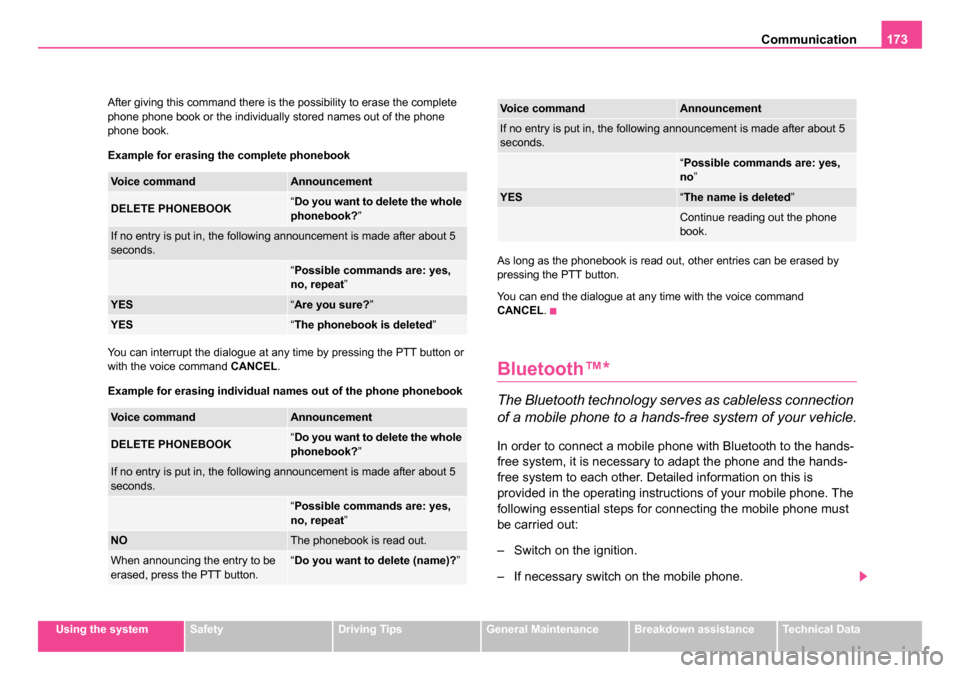
After giving this command there is the possibility to erase the complete
phone phone book or the individually stored names out of the phone
phone book.
Example for erasing the complete phonebook
You can interrupt the dialogue at any time by pressing the PTT button or
with the voice command
CANCEL.
Example for erasing individual names out of the phone phonebook As long as the phonebook is read out, other entries can be erased by
pressing the PTT button.
You can end the dialogue at any time with the voice command
CANCEL
.
Bluetooth™*
The Bluetooth technology serves as cableless connection
of a mobile phone to a hands-free system of your vehicle.
In order to connect a mobile phone with Bluetooth to the hands-
free system, it is necessary to adapt the phone and the hands-
free system to each other. Detailed information on this is
provided in the operating instructions of your mobile phone. The
following essential steps for connecting the mobile phone must
be carried out:
– Switch on the ignition.
– If necessary switch on the mobile phone.
Voice commandAnnouncement
DELETE PHONEBOOK“Do you want to delete the whole
phonebook? ”
If no entry is put in, the following announcement is made after about 5
seconds.
“Possible commands are: yes,
no, repeat ”
YES“Are you sure? ”
YES“The phonebook is deleted ”
Voice commandAnnouncement
DELETE PHONEBOOK“Do you want to delete the whole
phonebook? ”
If no entry is put in, the following announcement is made after about 5
seconds.
“Possible commands are: yes,
no, repeat ”
NOThe phonebook is read out.
When announcing the entry to be
erased, press the PTT button.“Do you want to delete (name)? ”
If no entry is put in, the following announcement is made after about 5
seconds.
“Possible commands are: yes,
no ”
YES“The name is deleted ”
Continue reading out the phone
book.
Voice commandAnnouncement
s24s.book Page 173 Thursday, November 24, 2005 12:27 PM
Page 175 of 315
Communication
174
– Select the corresponding menu option on the mobile phone, which searches for suitable Bluetooth devices (hands-free
system).
– If the hands-free system on the display of the mobile tele- phone announces Skoda UHV, enter the PIN 1234 within 30
seconds and wait, until the connection is established.
9)
In the modern business world as well as within the private sector the
mobile communication gains increasingly on importance. Mobile phones
from different manufacturers can be connected with the hands-free
system by means of Bluetooth. During the connecting procedure, no other
mobile phone may be connected via Bluetooth with the hands-free
system.
Up to four mobile phones can be connected to the hands-free system by
means of Bluetooth, whereby only one mobile phone can communicate
via Bluetooth with the hands-free system. If a fifth mobile phone is
connected to the handsfree-system, then the telephone, which has not
been used together with the handsfree system for the longest period, is
disconnected.
Establishing the Bluetooth connection
After switching on the ignition, the Bluetooth connection is automatically
established for the already adapted mobile phone
9). You can hear an
increasing tone sequence from the loudspeakers of the vehicle.
Disconnecting the Bluetooth connection
After withdrawing the ignition key, the Bluetooth connection is dison-
nected. You can hear an increasing tone sequence from the loudspeakers
of the vehicle.
WARNING
•Pay attention primarily to the traffic situation! As the driver you
are fully responsible for the traffic safety. Use the telephone
system only to such an extent, so that you are in full control of your
vehicle at any time - risk of accident!
•In the event of air transport, the Bluetooth function of the hands-
free-system must be switched off by a specialist garage.
Caution
Taking the mobile phone out of the adapter during the call can lead to
interruption of the connection. When taking out the mobile phone, the
connection to the factory-fitted antenna is interrupted, this reduces the
quality of the transmitting and receiving signal. This might result addition-
ally in harmful radiation from the mobile phone in the interior of the vehicle
and the charging of the telephone battery is interrupted.
Note
•Not valid for all mobile phones which enable a communication via
Bluetooth.
•Please operate your mobile phone exclusively with a suitable adapter,
in order to keep a low radiation in the vehicle.
•Inserting the mobile phone into the adapter ensures an optimal
sending and receiving power and offers at the same time the advantage
of the battery charging.
•If you insert the mobile telephone into the adapter, the connection is
established via the interface in the adapter set and the Bluetooth connec-
tion is disconnected. You can hear an increasing tone sequence from the
loudspeakers of the vehicle.
•Note that the range of the Bluetooth connection to the handsfree-
system is limited to the vehicle interior. The range is dependent on local
factors, e.g. obstacles between the devices and interferences with other 9)Some mobile phones have a menu, in which the authorization for establishing a
Bluetooth connection is performed via the input of a code. If the input for the au-
thorization is necessary, it must always be performed when re-establishing the
Bluetooth connection.
s24s.book Page 174 Thursday, November 24, 2005 12:27 PM
Page 176 of 315

Communication175
Using the systemSafetyDriving TipsGeneral MaintenanceBreakdown assistanceTechnical Data
devices. If your mobile phone is e.g. in a jacket pocket, this can lead to
difficulties when establishing the Bluetooth connection with the handsfree-
system or the data transfer.
•If you have set the Portuguese language in the information display, it
is used automatically for the mobile phone operation, as this is the
language, which was entered during coding of the handsfree-system.
Mobile phones and two-way radio
systems
The installation of a mobile phone and two-way radio system in a vehicle
should only be carried out by a Škoda Dealer.
Škoda Auto permits the operation of mobile phones and two-way radio
systems with a professionally installed external aerial and a maximum
transmission power of up to 10 watts.
Our specialist garage is also happy to inform you about the possibilities
available for installing and operating mobile telephones and radio trans-
mitters which have an output greater than 10 watts. The Škoda dealers
can provide you with details about the technical possibilities for retrofitting
of mobile telephones and radio transmitters.
Operation of mobile phones or two-way radio systems may interfere with
functioning of the electronic systems of your vehicle. The reasons for this
may be:
•no external aerial
•external aerial incorrectly installed
•transmission power greater than 10 watts.
You should therefore not operate a mobile phone or two-way radio
system inside the vehicle without the use of an external aerial, or with
an external aerial which has been incorrectly installed. You should also be aware of the fact that only an
external aerial makes it
possible to achieve the optimal range of such equipment.
WARNING
•If a mobile phone or two-way radio system is operated inside the
vehicle without using an external aerial, or with an external aerial
which has been incorrectly installed, the result can be excessive
electromagnetic fields which may cause harm to your health.
•Please always pay full attention to the traffic situation around
you!
•You must not install two-way radio systems, mobile phones or
mounts on the covers of the airbags or within the immediate
deployment range of airbags. This might result in injuries to the
occupants in the event of an accident.
Note
Please also refer to the operating instructions of the mobile phones and
two-way radio systems.
s24s.book Page 175 Thursday, November 24, 2005 12:27 PM
Page 179 of 315
Passive Safety
178
For this reason you will be provided with information on why this equip-
ment is very important, how it protects you and the occupants, what
should be observed when using the equipment and how you and the
people travelling with you can make full use of the existing safety equip-
ment. This Owner's Manual contains important warning notes, which you
and those travelling with you should pay attention to in order to reduce a
risk of injury.
Safety concerns everybody!
Before setting off
The driver is always fully responsible for his occupants
and for the operating safety of the vehicle.
For your own safety and the safety of the people travelling with you,
please pay attention to the following points before setting off:
•Ensure that the lighting and the turn signal system are functioning
properly.
•Inspect the tyre inflation pressure.
•Ensure that all the windows offer a good visibility to the outside.
•Safely attach the items of luggage ⇒page 92, “Loading the luggage
compartment”.
•Ensure that no objects can obstruct the pedal.
•Adjust the mirror, the front seat and the head restraint to match your
body size.
•Point out to your occupants that the head restraints must be adjusted
to match their body size.
•Protect the children in suitable child seats with correctly fastened seat
belts ⇒page 202, “Transporting children safely”.
•Adopt the correct seated position ⇒page 179, “Correct seated posi-
tion”. Also inform your occupants to adopt the correct seated position.
•Fasten the seat belt correctly. Also inform your occupants to properly
fasten the seat belts ⇒page 186, “How are seat belts correctly
fastened?”.
What influences the driving safety?
The driving safety is primarily determined by the style of
driving and the personal behaviour of all the occupants.
The driver is fully responsible for himself and his occupants. If your driving
safety is effected, you place yourself and the oncoming traffic at risk.
Please refer to the following guidelines.
•Do not get distracted from concentrating on the traffic situation, e.g. by
your occupants or mobile phone calls.
•Never drive when your driving ability is impaired, e.g. through medica-
tion, alcohol, drugs.
•Keep to the traffic regulations and the permissible speed limit.
•Adjust the driving speed at all times to the road condition as well as to
the traffic and weather conditions.
•Take regular breaks on long journeys - at the latest every two hours.
s24s.book Page 178 Thursday, November 24, 2005 12:27 PM
Page 195 of 315

Airbag system
194
Important safety informat ion regarding the front
airbag system
Correct use of the airbag system considerably reduces the
risk of injury!
WARNING
•Never transport children on the front seat of a vehicle without
using a proper restraint system. If airbags are deployed in the event
of an accident, the child might suff er severe or even fatal injuries!
•For the driver and front passenger it is important to maintain a
distance of at least 25 cm from the steering wheel or dash panel
⇒ fig. 164 . Not maintaining this minimu m distance will mean that
the airbag system will not be able to properly protect you - hazard!
The front seats and the head restraints must always also be
correctly adjusted to match the body size of the occupant.
•It is essential to always switch off ⇒page 199, “Deactivating an
airbag” the front passenger airbag when attaching a child safety seat on the front passenger seat where the child is seated with its
back facing in direction of travel (in some countries also when the
child is facing the direction of travel). If this is not done, there is a
risk of the child suffering severe or
even fatal injuries if the front
passenger airbag is deployed. In certain countries national legal
provisions also require that the side or head passenger airbags be
deactivated. When transporting a child on the front passenger seat,
please comply with the appropriat e national regulations regarding
the use of child safety seats.
•There must not be any further persons, animals or objects posi-
tioned between the front seated occupants and the deployment
area of the airbag.
•The steering wheel and the surface of the airbag module in the
dash panel on the passenger side must not be stuck onto, covered
or modified in any other way. Th ese parts should only be cleaned
with a dry cloth or a cloth moistened with water. No objects such
as cup holders, mobile phone mounts, etc. may be attached to the
covers of the airbag modules or be located within the immediate
area.
•No modifications of any kind may be made to parts of the airbag
system. Any work on the airbag system including installing and
removing system components because of other repair work (e.g.
removing the steering wheel) must only be carried out by a
specialist garage.
•Never carry out changes on the front bumper or on the body.
•Never place any objects on the surface of the front passenger
airbag in the dash panel.
Fig. 164 Safe distance
to steering wheel
WARNING (continued)
s24s.book Page 194 Thursday, November 24, 2005 12:27 PM
Page 283 of 315

Breakdown assistance
282
Both batteries must have a rated voltage of 12 V. The capacity (Ah) of the
battery supplying the power must not be significantly less than the
capacity of the discharged battery in your vehicle.
Jump-start cables
Only use jump-start cables which have an adequately large cross-section
and insulated terminal clamps. Please pay attention to the manufacturer's
instructions.
Positive cable - colour coding in the majority of cases red.
Negative cable - colour coding in the majority of cases black.
WARNING
•A discharged battery may already freeze at temperatures just
below 0°C. In case of frozen battery carry out no jump-starting - risk
of explosion!
•Please pay attention to the warning instructions relating to
working in the engine compartment ⇒page 248.
Note
•There must not be any contact between the two vehicles otherwise
current may flow as soon as the negative terminals are connected.
•The discharged battery must be properly connected to the system of
the vehicle.
•Switch off any mobile phone, pay attention to the instructions for use
of the mobile phone in such a situation.
•We recommend purchasing jump-start cables from a Škoda dealer as
a Škoda original accessory or from retailers who sell branded batteries.
Starting engine
It is important to connect the jump-start cables in the correct
order:
Connecting positive terminals
– Attach one end to the positive terminal ⇒fig. 212 of the
discharged battery .
– Attach the other end to the positive terminal of the battery supplying the power .
Connecting negative terminal and engine block
– Attach one end to the negative terminal of the battery supplying the power .
Fig. 212 Jump-starting
using the battery from
another vehicle: A - flat
vehicle battery, B -
battery providing
current
A1
AA
A2
AB
A3
AB
s24s.book Page 282 Thursday, November 24, 2005 12:27 PM
Page 291 of 315

Fuses and light bulbs
290
Caution
•When unlocking and locking the fuse cover, it must be pressed on the
sides to the box, otherwise damage can occur to the locking mechanism.
•Carefully position the fuse cover in the engine compartment. If the
cover was not correctly positioned, water can get into the fuses and this
results in a damage to the vehicle!
Fuse assignment in engine compartment - version 1
Certain electrical components are only standard on certain vehicle model
versions or only suppliable as optional equipment for certain models.
Fig. 219 Schematic
representation of fuse
box in engine compart-
ment - version 1
No.Power consumerAmperes
F1Pump for ABS30
F2Valves for ABS30
F3Control unit for convenience functions20
F4Measuring circuit5
F5Horn15
F6Valve for fuel dosing15
F7Not assigned
F8Not assigned
F9Activated charcoal filter, exhaust gas recirculation
valve10
F10Leakage diagnosis pump10
F11Lambda probe upstream of catalytic converter,
engine control unit10
F12Lambda probe downstream of catalytic converter10
F13Control unit for automatic gearbox15
F14Not assigned
F15Coolant pump10
F16Windshield wiper lever and turn signal light lever5
F17Instrument cluster5
F18Audio amplifier (sound system)30
F19Radio15
F20Phone5
F21Not assigned
F22Not assigned
s24s.book Page 290 Thursday, November 24, 2005 12:27 PM
Page 293 of 315

Fuses and light bulbs
292
Certain electrical components are only standard on certain vehicle model
versions or only suppliable as optional equipment for certain models.
No.Power consumerAmperes
F1Control unit for convenience functions20
F2Windshield wiper lever and turn signal light lever5
F3Measuring circuit5
F4Valves for ABS30
F5Control unit for automatic gearbox15
F6Instrument cluster5
F7Not assigned
F8Radio15
F9Phone5
F10Engine control unit, Main relay5
F11Control unit for auxiliary heating20
F12Control unit for CAN databus5
F13Engine control unit25/30
F14Ignition20
F15Lambda probe, NOx-sensor, Fuel pump relay15
F16Pump for ABS30
F17Horn15
F18Amplifier for digital sound processor30
F19Front window wiper30
F20Not assigned5
F21Lambda probe15
F22Clutch pedal switch, brake pedal switch5
F23Secondary air pump
Air mass meter
Fuel high pressure pump5
10
15
F24Activated charcoal filter, exhaust gas recirculation
valve10
F25Right lighting system40
F26Left lighting system40
F27Secondary air pump
Preglowing40
50
F28Power suppy terminal 15, Starter40
F29Power supply terminal 3050
F30Te r m i n a l Xa)40
a)In order not to drain the battery unnecessarily when starting the engine, the elec-
trical components of this terminal are automatically switched off.
No.Power consumerAmperes
s24s.book Page 292 Thursday, November 24, 2005 12:27 PM