2005 SKODA OCTAVIA spare wheel
[x] Cancel search: spare wheelPage 265 of 315

Wheels and Tyres
264
Tyre life
The life of your tyres very much depends on the following points:
Tyre pressure
The working life of tyres will be shortened considerably if the tyres are
insufficiently or over-inflated and this will have an adverse effect on the
handling of your vehicle.
Correctly inflated tyres are of particular importance when travelling at high
speeds. It is therefore good to check the pressure at least once a month
and also before setting off on a long trip. Please do not forget the spare
wheel when checking the tyres.
The tyre inflation pressures for summer tyres are indicated on the inside
of the fuel filler flap ⇒fig. 199 . The inflation pressures for winter tyres are
20 kPa (0.2 bar) higher than those for summer tyres ⇒page 268.
The tyre pressure should be at the highest pressure specified for your
vehicle at all times. The tyre inflation pressure of the emergency spare wheel R 18 is 420 kPa
(4.2 bar).
Always check the inflation pressure of tyres when cold. Do not reduce the
higher pressure of warm tyres. Adapt the inflation pressure of the tyres
accordingly if your vehicle is carrying a significantly higher payload.
Driving style
Fast cornering, sharp acceleration and braking (squealing tyres) increase
wear-and-tear on your tyres.
Balancing wheels
The wheels of a new vehicle are balanced. There are a wide range of influ-
ences when driving which may result in an imbalance and which makes
themselves felt through vibration in the steering.
You should have the wheels rebalanced since any imbalance increases
wear-and-tear on the steering, the suspension and tyres. A wheel must
also be rebalanced when a new tyre is fitted and each time a tyre is
repaired.
Wheel alignment errors
Incorrect wheel alignment at the front and rear will not only increase wear-
and-tear on the tyres but will also has an adverse effect on vehicle safety.
Contact your specialist garage if you notice any unusual tyre wear.
WARNING
If the inflation pressure is too low, the tyre must perform a greater
flexing work. At higher speeds the tyre will warm up as a result of
this. This can result in tread separation and even a tyre blowout.
•Immediately replace the damaged rims or tyres.
For the sake of
the environment
Tyres which are insufficiently inflated increase your fuel consumption.
Fig. 199 An opened
fuel filler flap with the
tyre inflation pressure
table
s24s.book Page 264 Thursday, November 24, 2005 12:27 PM
Page 267 of 315

Wheels and Tyres
266
New tyres and wheels
Tyres and wheel rims are important design elements. One should there-
fore use the tyres and wheel rims which have been released for use by
Škoda Auto. They are exactly matched to the vehicle type and therefore
contribute significantly to good road holding and safe driving characteris-
tics ⇒ .
Only fit radial tyres of the same type on all 4 wheels, size (rolling circum-
ference) and, if possible, the same tread pattern on one axle.
Škoda dealers have access to the most current information about which
tyres we have released for use.
We recommend that you have any work relating to tyres or wheels carried
out by your Škoda dealer . Your dealer has all of the necessary special
tools and replacement parts available plus the required specialist knowl-
edge and is also in a position to properly dispose of the old tyres. A large
number of Škoda dealers also have an attractive range of tyres and
wheels available.
The tyre/wheel combinations which are approved for your vehicle are indi-
cated in your vehicle documents. Approval and licensing may differ
according to the legislation prevailing in individual countries.
Proper knowledge of the tyre data makes it easier for you to select the
correct type of tyre. Tyres do, for example, have the following inscription
on their walls:
195 / 65 R 15 91 T
What this means is: The following
speed restrictions apply to tyres.
The date of manufacture is also stated on the tyre wall (possibly only on
the inside of wheel):
DOT ... 40 04...
means, for example, that the tyre was manufactured in the 40th week of
the year 2004.
Any spare wheel which differs from the tyres fitted to the vehicle (e.g.
winter tyres or low-profile tyres) should only be used only for a short time
in the event of a puncture and when adopting an appropriately cautious
style of driving. It should be replaced as quickly as possible by a normal
wheel.
WARNING
•Only use those tyres or wheel ri ms which have been approved
for your model of Škoda Auto vehicle. Failure to observe this
instruction will adversely affect the road safety of your vehicle -
195Tyr e wi dth i n mm
65Height/width ratio in %
RCode letter for the type of tyre - Radial
15Diameter of wheel in inches
91Load index
TSpeed symbol
Speed symbolPermissible maximum speed
S180 km/h
T190 km/h
H210 km/h
V240 km/h
W270 km/h
s24s.book Page 266 Thursday, November 24, 2005 12:27 PM
Page 268 of 315

Wheels and Tyres267
Using the systemSafetyDriving TipsGeneral MaintenanceBreakdown assistanceTechnical Data
risk of accident! Approval and li
cencing of your vehicle on public
roads may also become void as a result.
•You must on no account drive at a higher speed than is permis-
sible for your tyres - risk of an accident resulting from tyre damage
and loss of control over your vehicle.
•Tyres which are 6 years old or more should only be fitted in
exceptional cases and when adopting an appropriately cautious
style of driving.
•Never fit tyres which have already been used without having
adequate knowledge of their previous history. Tyres age even if
they have not been used at all or only very little. A spare tyre must
only be used in exceptional cases and only then when adopting an
appropriately cautious style of driving.
•Do not, where possible, replace individual tyres but at least
replace them on both wheels of a given axle at the same time.
Always fit the tyres with the deeper tread depth to the front wheels.
For the sake of the environment
Old tyres must be disposed of in conformity with the appropriate regula-
tions.
Note
It is not normally possible to fit wheels from other models of cars for tech-
nical reasons. This may also apply in certain circumstances to the wheels
of the same type of vehicle.
Wheel bolts
Wheels and wheel bolts are matched to each other in terms of design.
Each time you fit other wheels - e.g. light alloy wheels or wheels with
winter tyres - you must therefore also use the matching wheel bolts of the
correct length and shape of spherical cap. This is essential to ensure that
the wheels are tightly fitted and that the brake system operates properly.
If you retrofit wheel trims (or have this done), please also ensure that an
adequate flow of air remains assured for cooling the brake system.
Škoda dealers are instructed in the technical possibilities which exist
regarding converting or retrofitting wheels, tyres and wheel trim.
WARNING
•In case of incorrect treatment of the wheel bolts, the wheel can
loosen when the car is moving - risk of accident!
•The wheel bolts must be clean and must turn easily. However,
they must never be treated with grease or oil.
•If the wheel bolts are tightened to a too low tightening torque,
the rim can lossen when the car is moving - risk of accident! A tight-
ening torque which is too high can damage the bolts and threads
and this can result in perman ent deformation of the contact
surfaces on the rims.
Caution
The prescribed tightening torque of the wheel bolts for steel and light alloy
wheels is 120 Nm.
WARNING (continued)
s24s.book Page 267 Thursday, November 24, 2005 12:27 PM
Page 269 of 315

Wheels and Tyres
268
Winter tyres
The handling of your vehicle will be significantly improved when driving on
wintry roads and at temperatures below 7 °C if you fit winter tyres.
Summer tyres do not offer the same grip on ice and snow at a temperature
below 7 °C because of their construction (width, rubber blend, tread
pattern). This particularly applies to vehicles which are equipped with low-
profile tyres or high-speed tyres (code index H or V on wall of tyre).
Winter tyres must be mounted on all four wheels to obtain the best
handling characteristics.
You must only fit those types of winter tyre which are approved for your
vehicle. The permissible sizes of winter tyres are stated in your vehicle
documents. Approvals may differ because of national legislation.
Please remember that the tyres should be inflated to 20 kPa (0.2 bar)
more than is the case for summer tyres ⇒page 264, fig. 199 .
Winter tyres no longer offer the same winter performance once the tyre
tread has worn down to a depth of about 4 mm.
Ageing also causes winter tyres to lose most of their winter performance
properties - even in cases where the remaining tread depth is still clearly
more than 4 mm.
Speed restrictions apply to winter tyres as well as to summer tyres
⇒ page 266, ⇒ .
You can fit winter tyres of a lower speed category to your vehicle provided
that you also do not drive faster than the permissible maximum speed for
such tyres, even if the possible maximum speed of your vehicle is higher.
The corresponding tyre category can damage the tyres when exceeding
the permissible maximum speed.
Please pay attention to the notes if you decide to fit winter tyres
⇒ page 263.
You can also fit so-called “all-weather tyres” instead of winter tyres. Please contact your specialist garage if there are any points which are not
clear who will be able to provide you with information regarding the
maximum speed fo
r your tyres.
WARNING
You must on no account drive your car at more than the permis-
sible maximum speed for your winter tyres - risk of an accident
resulting from tyre damage and loss of control over your car.
For the sake of the environment
Fit your summer tyres on again in good time since summer tyres offer you
better grip and handling on roads which are free of snow and ice as well
as ar temperatures below 7 °C - the braking distance is shorter, there is
less tyre noise, tyre wear is reduced and fuel consumption is reduced.
Note
Please observe the various differing legal requirements regarding tyres.
Unidirectional tyres*
The direction of rotation of the tyres is marked by arrows on the wall of
the tyre . This indicates the direction of rotation of the tyre, and it is essen-
tial that the tyres are fitted on to run in this direction. Only then are the
tyres able to provide the optimal properties in terms of grip, low noise,
wear-and-tear and aquaplaning.
Should it be necessary to fit on a spare wheel in exceptional cases with a
tyre not dedicated to the running direction or in opposite running direction,
please adopt a cautious style of driving as the tyre is no longer able to
provide optimal grip and handling in such a situation. This particularly
s24s.book Page 268 Thursday, November 24, 2005 12:27 PM
Page 270 of 315

Wheels and Tyres269
Using the systemSafetyDriving TipsGeneral MaintenanceBreakdown assistanceTechnical Data
important on wet roads. Please refer to the notes
⇒page 275, “Spare
wheel”.
You should have the defective tyre replaced as soon as possible and
restore the correct direction of rotation on all tyres
Snow chains
Snow chains must only be mounted on the front wheels.
When driving on wintry roads, snow chains improve not only traction, but
also the braking performance.
For technical reasons, it is only permissible to fit snow chains with the
following wheel/tyre combinations:
Only use fine-link snow chains . They must not project more than 15 mm
- including the chain lock.
Remove the full wheel trims if you wish to fit snow chains to the wheels.
Observe the national legal requirements relating to the maximum vehicle
speed with snow chains.
WARNING
Please pay attention to the information in the supplied fitting
instructions of the snow chain manufacturer.
Caution
You must take the chains off as soon as you drive on roads which are free
of snow. They adversely affect the handling of your vehicle, damage the
tyres and are rapidly destroyed.
Note
We recommend that you use snow chains from the Škoda genuine
accessories.
Wheel sizeDepth (D)Tyre size
6J x 1547 mm195/65
6.5J x 1550 mm195/65
6J x 1650 mm205/55
s24s.book Page 269 Thursday, November 24, 2005 12:27 PM
Page 275 of 315

Breakdown assistance
274
compartment. You can open the compartment by turning the locks in the
direction of arrow ⇒fig. 203 .
If you wish to equip your vehicle additionally with a warning triangle,
please contact a specialist garage.
Note
Pay attention to the use-by-date of the contents of the first-aid box.
Fire extinguisher*
The fire extinguisher is attached with straps in a holder under the driver
seat.
Please read carefully the instructions which are attached to the fire
extinguisher.
The fire extinguisher must be checked by an authorised person or
company annually (please observe the differing legal equirements).
WARNING
If the fire extinguisher is not correctly attached, in case of sudden
manoeuvres or an accident it can be “thrown” through the interior
compartment and cause injuries.
Note
•The fire extinguisher must comply with the relevant and valid legal
requirements.
•Pay attention to the expiration date of the fire extinguisher. If the fire
extinguisher is used after the expiration date, its proper function is no
longer assured.
•The fire extinguisher is only supplied in certain countries within the
scope of delivery.
Vehicle tool kit
The vehicle tool kit and the lifting jack are stored in a locable box in the
spare wheel ⇒fig. 204 . There is also space here for the removable ball for
the trailer towing device*. The box is attached with a strap on the spare
wheel.
The vehicle tool kit contains the following parts (depending on equipment
fitted):
•Hook for pulling off a full wheel trim,
•Plastic clip for a wheel bolt cover,
•Wheel wrench,
•Towing eye,
Fig. 204 Luggage
compartment: Storage
compartment for
vehicle too kit
s24s.book Page 274 Thursday, November 24, 2005 12:27 PM
Page 276 of 315
Breakdown assistance275
Using the systemSafetyDriving TipsGeneral MaintenanceBreakdown assistanceTechnical Data
•Adapter for the wheel bolts lock,
After using the lifting jack, screw in the arm of the lifting jack fully before
placing it back in its stowage area.
WARNING
•The factory-supplied lifting jack is only intended for your model
of vehicle. On no account attempt to lift a heavier vehicle or other
loads - risk of injury!
•Ensure that the vehicle tool kit is safely attached in the luggage
compartment.
Note
Ensure that the box is always secured with the strap.
Tyre repair kit*
The tyre repair kit is intended for the repair of minor tyre defects. The tyre
repair kit contains a compressor, inflation bottle, operating instructions
and accessories.
The repair with the tyre repair kit is not at all intended to replace a
permanent repair on the tyre, this repair only serves to reach the next
specialist garage. The repair can be undertaken on the vehicle immedi-
ately. Please read the attached instructions carefully before the
repair.
The tyre repair kit is located in a well under the floor covering in the
luggage compartment.
Spare wheel
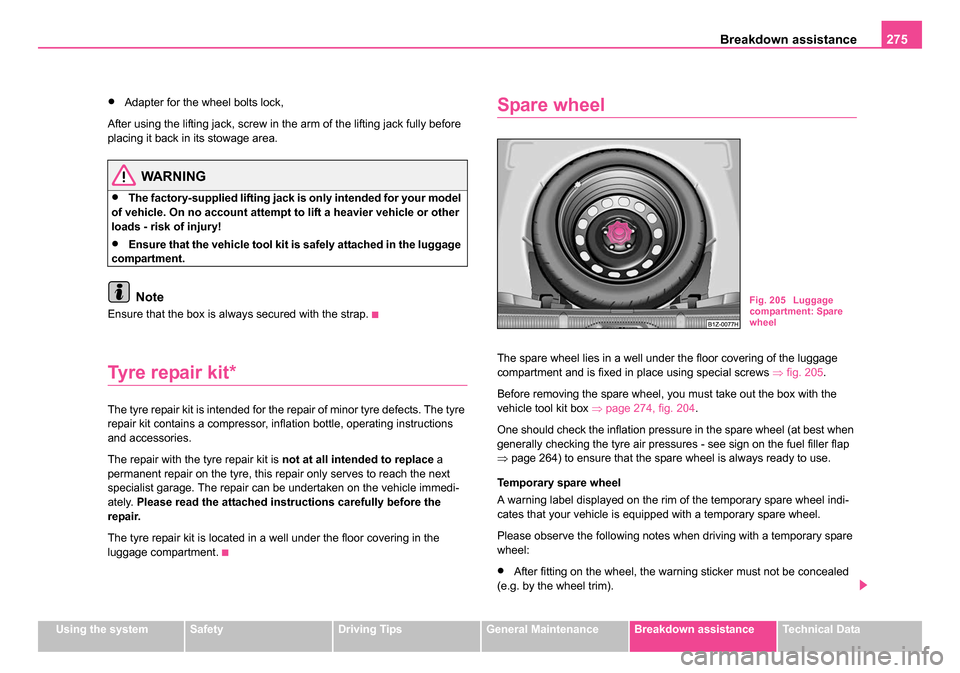
The spare wheel lies in a well under the floor covering of the luggage
compartment and is fixed in place using special screws ⇒fig. 205 .
Before removing the spare wheel, you must take out the box with the
vehicle tool kit box ⇒page 274, fig. 204 .
One should check the inflation pressure in the spare wheel (at best when
generally checking the tyre air pressures - see sign on the fuel filler flap
⇒ page 264) to ensure that the spare wheel is always ready to use.
Temporary spare wheel
A warning label displayed on the rim of the temporary spare wheel indi-
cates that your vehicle is equipped with a temporary spare wheel.
Please observe the following notes when driving with a temporary spare
wheel:
•After fitting on the wheel, the warning sticker must not be concealed
(e.g. by the wheel trim).
Fig. 205 Luggage
compartment: Spare
wheel
s24s.book Page 275 Thursday, November 24, 2005 12:27 PM
Page 277 of 315

Breakdown assistance
276
•Do not drive with this spare wheel at more than 80 km/h - risk of acci-
dent. Avoid accelerating at full throttle, sharp braking and fast cornering.
•The inflation pressure for this spare wheel is identical to the inflation
pressure of the standard tyres. The temporary spare wheel R 18 must
have an inflation pressure of 420 kPa (4.2 bar)!
•Use this spare wheel only to reach the nearest specialist garage as it
is not intended for continuous use.
•No other summer or winter tyres must be mounted on the rim of the
spare wheel R 18.
Changing a wheel
Preliminary work
The following steps should be carried out before actually
changing the wheel.
– If it is necessary to change a wheel, park the vehicle as far away as possible from the traffic flow. The place you choose
should be level.
–Have all the occupants get out. While changing a wheel, the
occupants of the vehicle should not stand on the road (it is
better behind a crash barrier).
– Apply the handbrake firmly.
– Engage 1st gear or if your vehicle is fitted with an automatic
gearbox, position the selector lever into position P .
– If a trailer is coupled, uncouple it. – Take the
vehicle tool kit ⇒ page 274 and the spare wheel
⇒ page 275 out of the luggage compartment.
WARNING
•If you find yourself in flowing traffic switch on the hazard
warning lights system and place the warning triangle on the side of
the road at the prescribed distance from your vehicle while
observing all national legal provisions. In this way you are
protecting not only yourself but also other road users.
•Never start the engine with the vehicle sitting on the raised jack
- danger of suffering injury!
Caution
If you have to change a wheel on a slope first block the opposite wheel
with a stone or similar object in order to secure the vehicle from unexpect-
edly rolling away.
Note
Comply with the national legal regulations.
Changing a wheel
Always change a wheel on a level surface as far as possible.
– Take off the full wheel trim* ⇒page 278 or the caps
⇒ page 278.
– In the case of light alloy wheels remove the wheel trim cap ⇒page 279.
s24s.book Page 276 Thursday, November 24, 2005 12:27 PM