Page 112 of 250
Downloaded from www.Manualslib.com manuals search engine
NU761_2_G2-FRA.qxd 4/11/05 10:48 Page 2.12
2.12
ADVICE ON EMISSION CONTROL, FUEL ECONOMY AND DRIVING (continued)
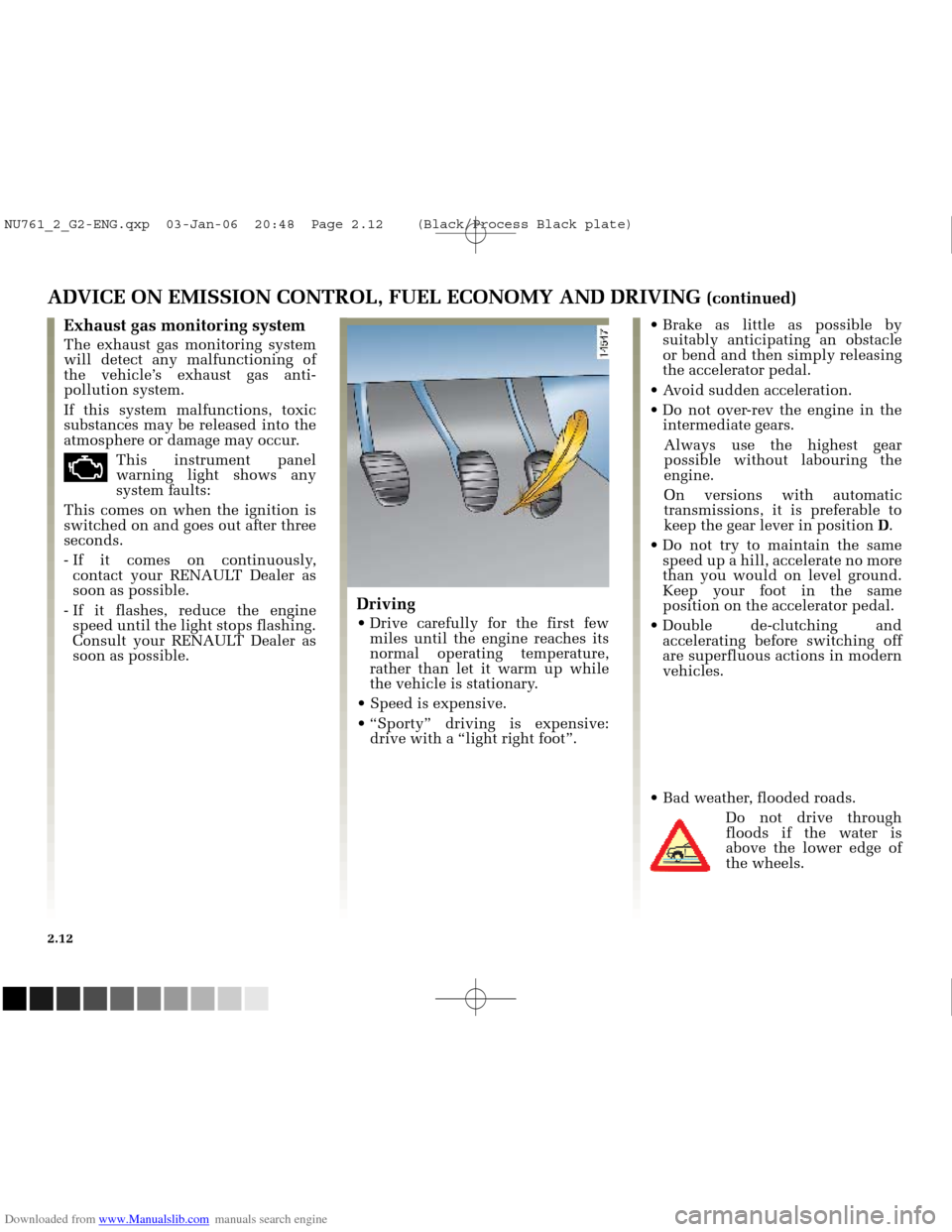
Driving
miles until the engine reaches its
normal operating temperature,
rather than let it warm up while
the vehicle is stationary.
drive with a “light right foot”.
Exhaust gas monitoring system
The exhaust gas monitoring system
will detect any malfunctioning of
the vehicle’s exhaust gas anti-
pollution system.
If this system malfunctions, toxic
substances may be released into the
atmosphere or damage may occur.
äThis instrument panel
warning light shows any
system faults:
This comes on when the ignition is
switched on and goes out after three
seconds.
- If it comes on continuously, contact your RENAULT Dealer as
soon as possible.
- If it flashes, reduce the engine speed until the light stops flashing.
Consult your RENAULT Dealer as
soon as possible.
suitably anticipating an obstacle
or bend and then simply releasing
the accelerator pedal.
intermediate gears.
Always use the highest gear
possible without labouring the
engine.
On versions with automatic
transmissions, it is preferable to
keep the gear lever in position D.
speed up a hill, accelerate no more
than you would on level ground.
Keep your foot in the same
position on the accelerator pedal.
accelerating before switching off
are superfluous actions in modern
vehicles.
Do not drive through
floods if the water is
above the lower edge of
the wheels.
NU761_2_G2-ENG.qxp 03-Jan-06 20:48 Page 2.12 (Black/Process Black\
plate)
Page 115 of 250
Downloaded from www.Manualslib.com manuals search engine
NU761_2_G2-FRA.qxd 4/11/05 10:48 Page 2.15
TYRE PRESSURE MONITOR
Operating principle
Each wheel (except the spare wheel)
has a sensor in the inflation valve
which periodically measures the
tyre pressure.
The system informs the driver that
the tyres are sufficiently inflated
and warns if they are deflated or if
there is a leak.
This system monitors the tyre
inflation pressure.
The pressures must be adjusted
when the tyres are cold.
If tyre pressures cannot be checked
when the tyres are
cold, assume an
increase of 0.2 to 0.3 bar ( 3PSI).
Never deflate a hot tyre.
2.15
This function is an
additional driving aid.
However, the function does
not take the place of the
driver. It cannot, therefore, under
any circumstances replace the
vigilance or the responsibility of
the driver.
Check the tyre pressures, including
the spare wheel, once a month.
NU761_2_G2-ENG.qxp 03-Jan-06 20:48 Page 2.15 (Black/Process Black\
plate)
Page 116 of 250
Downloaded from www.Manualslib.com manuals search engine
B
A
C
D
2
1
1
NU761_2_G2-FRA.qxd 4/11/05 10:48 Page 2.16
2.16
TYRE PRESSURE MONITOR (continued)
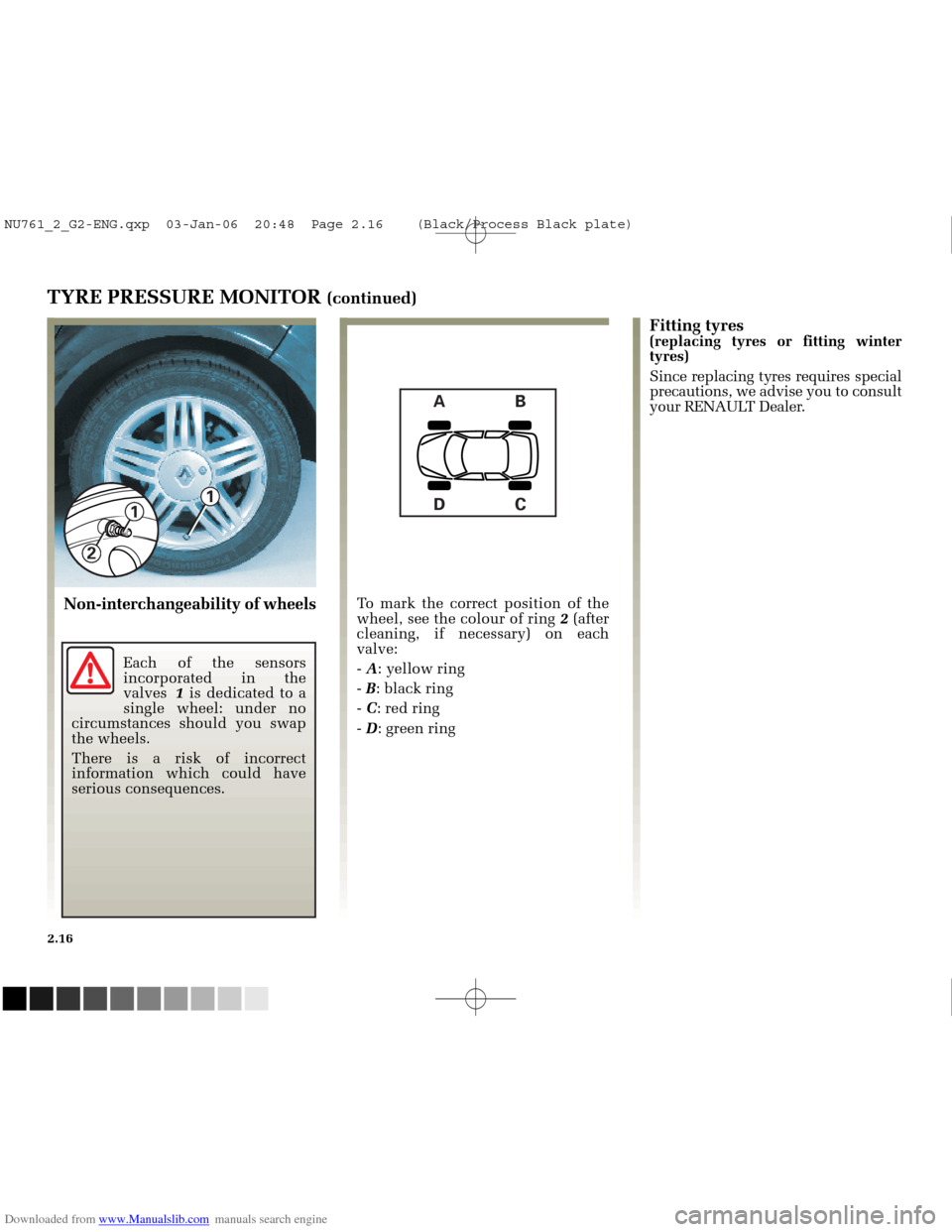
Non-interchangeability of wheels
To mark the correct position of the
wheel, see the colour of ring 2(after
cleaning, if necessary) on each
valve:
- A : yellow ring
- B : black ring
- C : red ring
- D : green ring
Fitting tyres(replacing tyres or fitting winter
tyres)
Since replacing tyres requires special
precautions, we advise you to consult
your RENAULT Dealer.
Each of the sensors
incorporated in the
valves 1is dedicated to a
single wheel: under no
circumstances should you swap
the wheels.
There is a risk of incorrect
information which could have
serious consequences.
NU761_2_G2-ENG.qxp 03-Jan-06 20:48 Page 2.16 (Black/Process Black\
plate)
Page 117 of 250
Downloaded from www.Manualslib.com manuals search engine
1
1
NU761_2_G2-FRA.qxd 4/11/05 10:48 Page 2.17
TYRE PRESSURE MONITOR (continued)
Emergency spare wheel
The spare wheel has no sensor, and
cannot be recognised by the system.
When it is fitted in the place of
another wheel, the system then
detects an operation fault.
Replacing wheels/tyres
This system requires special
equipment (wheels, wheel trims, etc.).
Contact your RENAULT Dealer to
find out about accessories
compatible with the system and
which may be purchased from
RENAULT outlets: the use of any
other accessory could affect the
correct operation of the system.
Tyre repair aerosols
Because the valves are specially
designed, use only aerosols
approved by Renault’s Technical
Department.
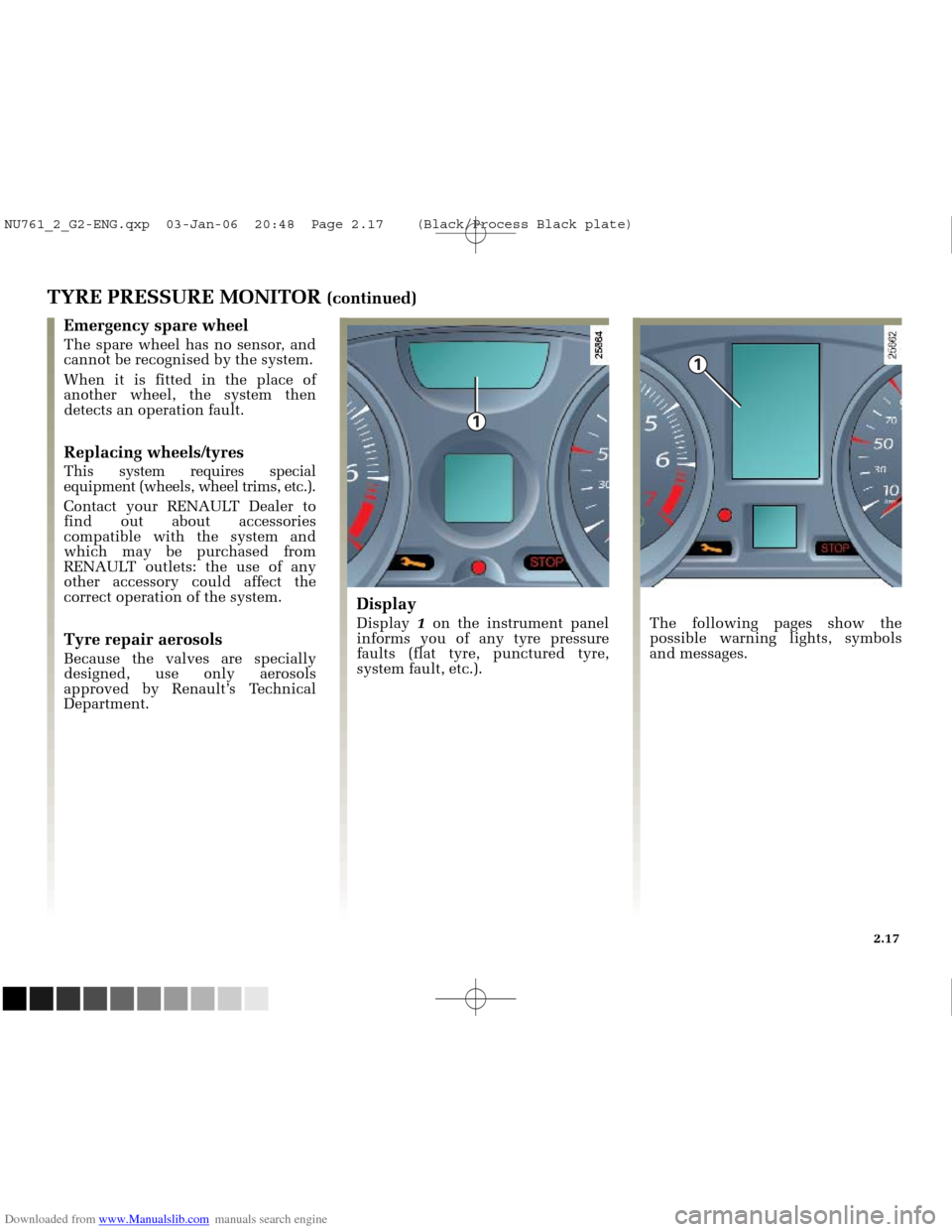
Display
Display 1on the instrument panel
informs you of any tyre pressure
faults (flat tyre, punctured tyre,
system fault, etc.). The following pages show the
possible warning lights, symbols
and messages.
2.17
NU761_2_G2-ENG.qxp 03-Jan-06 20:48 Page 2.17 (Black/Process Black\
plate)
Page 118 of 250
Downloaded from www.Manualslib.com manuals search engine
A
B
NU761_2_G2-FRA.qxd 4/11/05 10:48 Page 2.18
2.18
TYRE PRESSURE MONITOR (continued)Examples of messages which may appear on the display
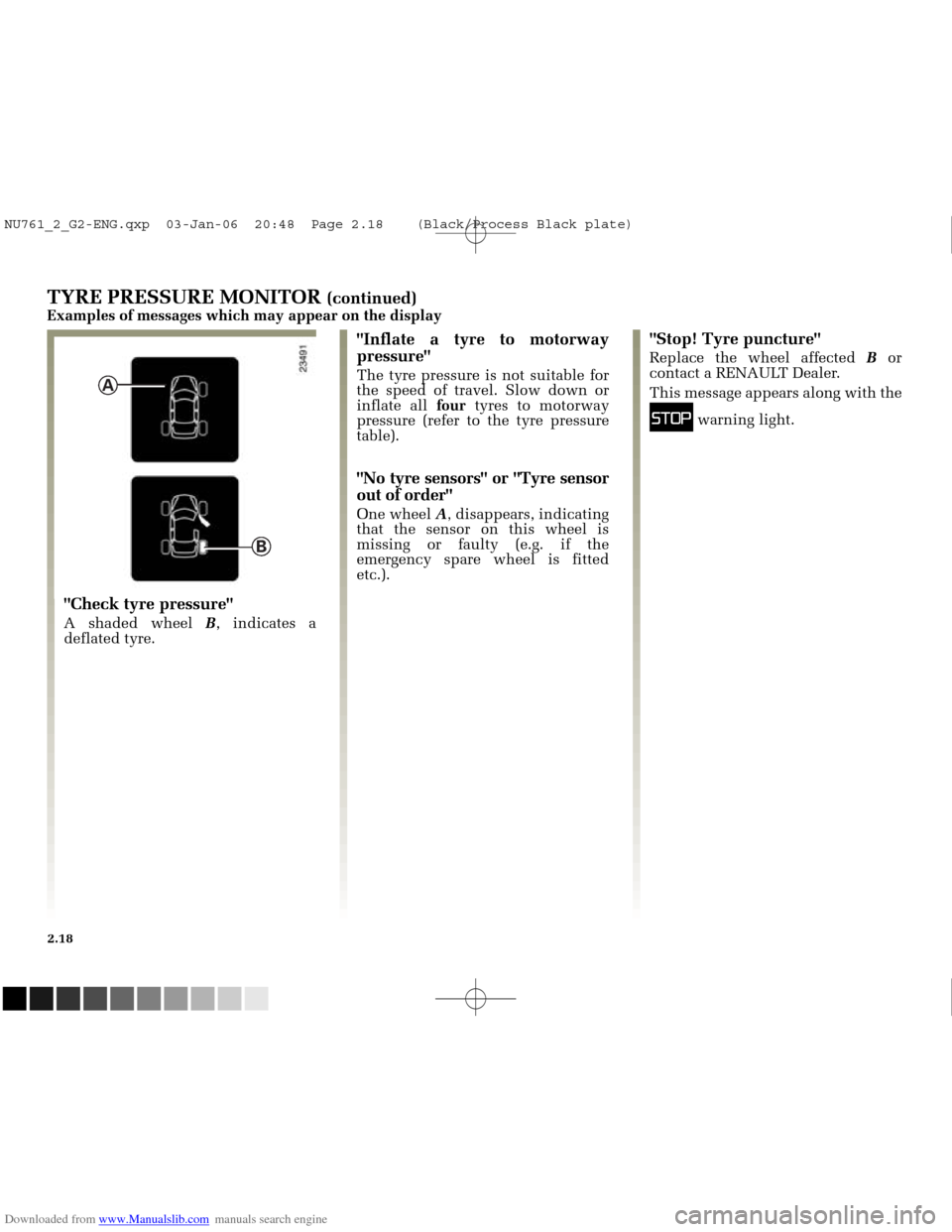
"Check tyre pressure"
A shaded wheel B, indicates a
deflated tyre.
"Stop! Tyre puncture"
Replace the wheel affected Bor
contact a RENAULT Dealer.
This message appears along with the
ûwarning light.
"Inflate a tyre to motorway
pressure"
The tyre pressure is not suitable for
the speed of travel. Slow down or
inflate all fourtyres to motorway
pressure (refer to the tyre pressure
table).
"No tyre sensors" or "Tyre sensor
out of order"
One wheel A, disappears, indicating
that the sensor on this wheel is
missing or faulty (e.g. if the
emergency spare wheel is fitted
etc.).
NU761_2_G2-ENG.qxp 03-Jan-06 20:48 Page 2.18 (Black/Process Black\
plate)
Page 119 of 250

Downloaded from www.Manualslib.com manuals search engine
A
NU761_2_G2-FRA.qxd 4/11/05 10:48 Page 2.19
ELECTRONIC STABILITY PROGRAM: ESP WITH UNDERSTEER CONTROL
When the function begins to
operate, warning light Aflashes to
warn you.
If the warning light comes on
accompanied by the “ASR/ESP
deactivated” message when the
engine is started, slowly turn the
steering wheel from lock to lock to
reinitialise the system.
Understeer control
This system optimises the operation
of the ESP in the case of pronounced
understeering (loss of front axle
roadholding).
Operating faults
If the system detects an operating
fault, the message “Check traction
control” or “ESP/ASR not
functioning” is displayed on the
instrument panel display along with
indicator light and indicator
light A.
Contact your RENAULT Dealer.
This system helps to keep control of
the vehicle in critical driving
situations (avoiding an obstacle, loss
of grip when cornering, etc.) and
works in conjunction with the
understeer control system.
Operating principle
A sensor in the steering wheel
detects the direction selected by the
driver.
Other sensors throughout the vehicle
measure the actual direction.
The system compares the direction
selected by the driver and the actual
direction of the vehicle and corrects
this as necessary by applying the
brakes selectively and/or acting on
the engine power.
2.19
This function is an
additional aid in case of
critical driving conditions
to enable the vehicle
behaviour to be adapted to suit
the driving conditions.
However, the function does not
take the place of the driver. It
does not increase the vehicle’s
limits and should not encourage
you to drive more quickly.
Therefore, it can under no
circumstances replace the
vigilance or responsibility of the
driver when manoeuvring the
vehicle (the driver must always
be ready for sudden incidents
which may occur when driving).
NU761_2_G2-ENG.qxp 03-Jan-06 20:48 Page 2.19 (Black/Process Black\
plate)
Page 120 of 250

Downloaded from www.Manualslib.com manuals search engine
A
NU761_2_G2-FRA.qxd 4/11/05 10:48 Page 2.20
2.20
TRACTION CONTROL: ASR
Operating principle
Using the wheel sensors, the system
measures and compares the speed of
the drive wheels at all times and
slows down their over-rotation.
If a wheel is starting to spin, the
system brakes automatically until
the drive supplied becomes
compatible with the level of grip.The system also adjusts the engine
speed to the grip available under the
wheels, independently of the
pressure exerted on the accelerator
pedal.
When the function begins to
operate, warning light
Aflashes to
warn you.
This system helps to limit skidding
on drive wheels and to control the
vehicle when pulling away or
accelerating.
This function is an
additional aid in case of
critical driving conditions
to enable the vehicle
behaviour to be adapted to suit
the driving conditions.
However, the function does not
take the place of the driver. I t
does not increase the vehicle’s
limits and should not encourage
you to drive more quickly.
Therefore, it can under no
circumstances replace the
vigilance or responsibility of the
driver when manoeuvring the
vehicle (the driver must always
be ready for sudden incidents
which may occur when driving).
NU761_2_G2-ENG.qxp 03-Jan-06 20:48 Page 2.20 (Black/Process Black\
plate)
Page 121 of 250
Downloaded from www.Manualslib.com manuals search engine
1
A
NU761_2_G2-FRA.qxd 4/11/05 10:48 Page 2.21
TRACTION CONTROL: ASR (continued)Operating faults
If the system detects an operating
fault, the message Check traction
control or ESP/ASR not functioning
is displayed on the instrument panel
display along with the
warning light and warning light A.
Contact your RENAULT Dealer.
If the warning light comes on
accompanied by the “ASR
deselected” message when the engine
is started, slowly turn the steering
wheel from lock to lock to reinitialise
the system.
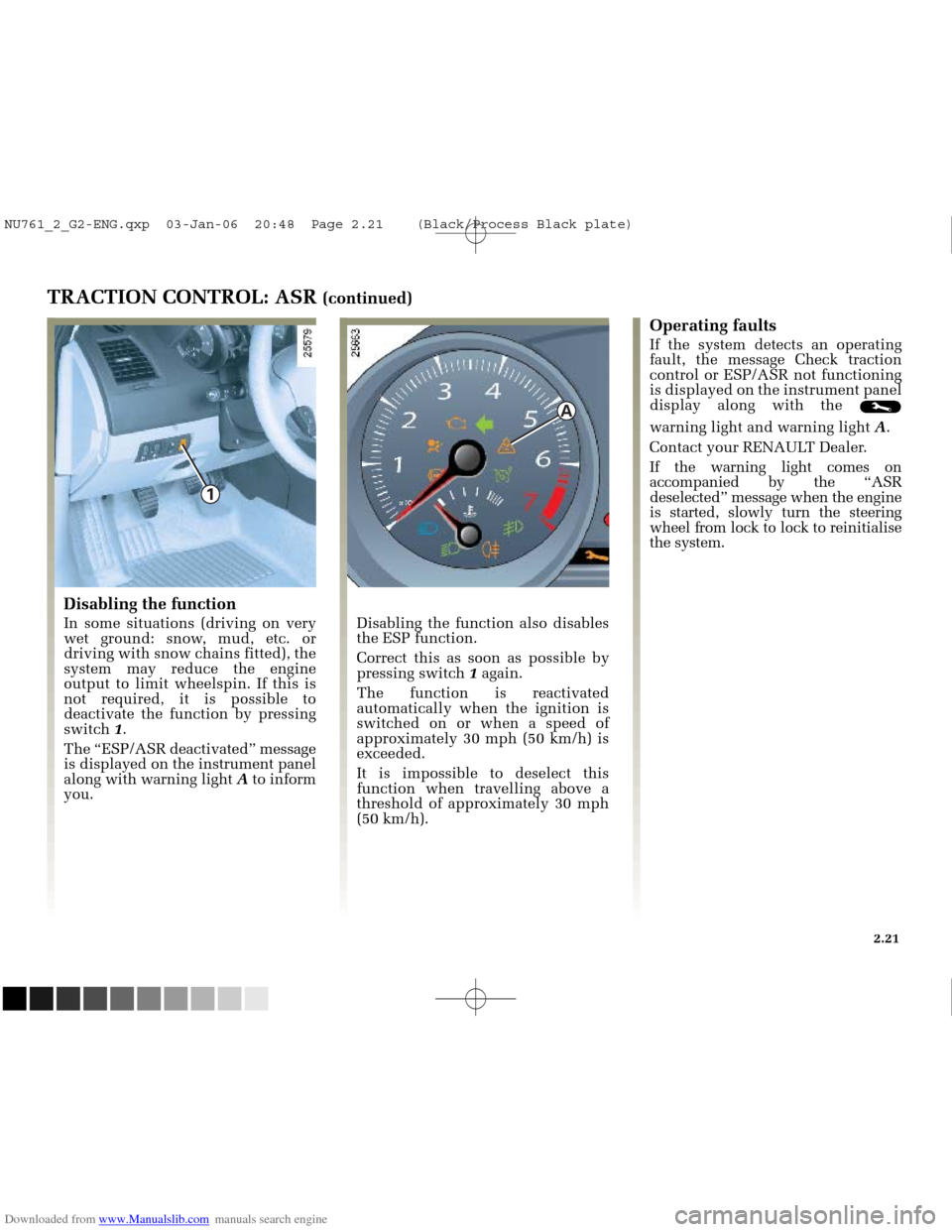
Disabling the function also disables
the ESP function.
Correct this as soon as possible by
pressing switch 1again.
The function is reactivated
automatically when the ignition is
switched on or when a speed of
approximately 30 mph (50 km/h) is
exceeded.
It is impossible to deselect this
function when travelling above a
threshold of approximately 30 mph
(50 km/h).
Disabling the function
In some situations (driving on very
wet ground: snow, mud, etc. or
driving with snow chains fitted), the
system may reduce the engine
output to limit wheelspin. If this is
not required, it is possible to
deactivate the function by pressing
switch 1.
The “ESP/ASR deactivated” message
is displayed on the instrument panel
along with warning light Ato inform
you.
2.21
NU761_2_G2-ENG.qxp 03-Jan-06 20:48 Page 2.21 (Black/Process Black\
plate)