2005 RENAULT MEGANE tow
[x] Cancel search: towPage 154 of 250
Downloaded from www.Manualslib.com manuals search engine
NU761_2_G3-FRA.qxd 4/11/05 10:51 Page 3.16
3.16
AIR CONDITIONING: information and operating advice
Fuel consumption
You will normally notice an
increase in fuel consumption
(especially in town) when the air
conditioning is operating.
For vehicles fitted with manual air
conditioning, switch off the system
when it is not required.
Some advice for reducing
consumption and therefore helping
to conserve the environment:
It is advisable to drive with the
vents open and the windows
closed.
If the vehicle has been parked in the
sun, open the doors for a few
moments to let the hot air escape
before starting the engine.Maintenance
Refer to the Warranty and Services
booklet for your vehicle for the
replacement frequency.
Operating faults
Generally, in the event of an
operating fault, consult your
RENAULT Dealer. - Reduction in de-icing, demisting
or air conditioning performance.
This may be caused by the
passenger compartment filter
cartridge becoming clogged.
- No cold air is being produced.
Check that the controls are set
correctly and that the fuses are
sound. Otherwise, switch off the
system.
- Presence of water under the
vehicle . After prolonged use of the
air conditioning system, it is
normal for water to be present
under the vehicle. This is caused
by condensation.
Do not open the refrigerant fluid
circuit. The fluid may damage the
eyes or skin.
NU761_2_G3-ENG.qxp 1/5/2006 5:28 PM Page 3.16 (Black plate)
Page 170 of 250
Downloaded from www.Manualslib.com manuals search engine
1
2
NU761_2_G3-FRA.qxd 4/11/05 10:52 Page 3.32
3.32
REAR PARCEL SHELF
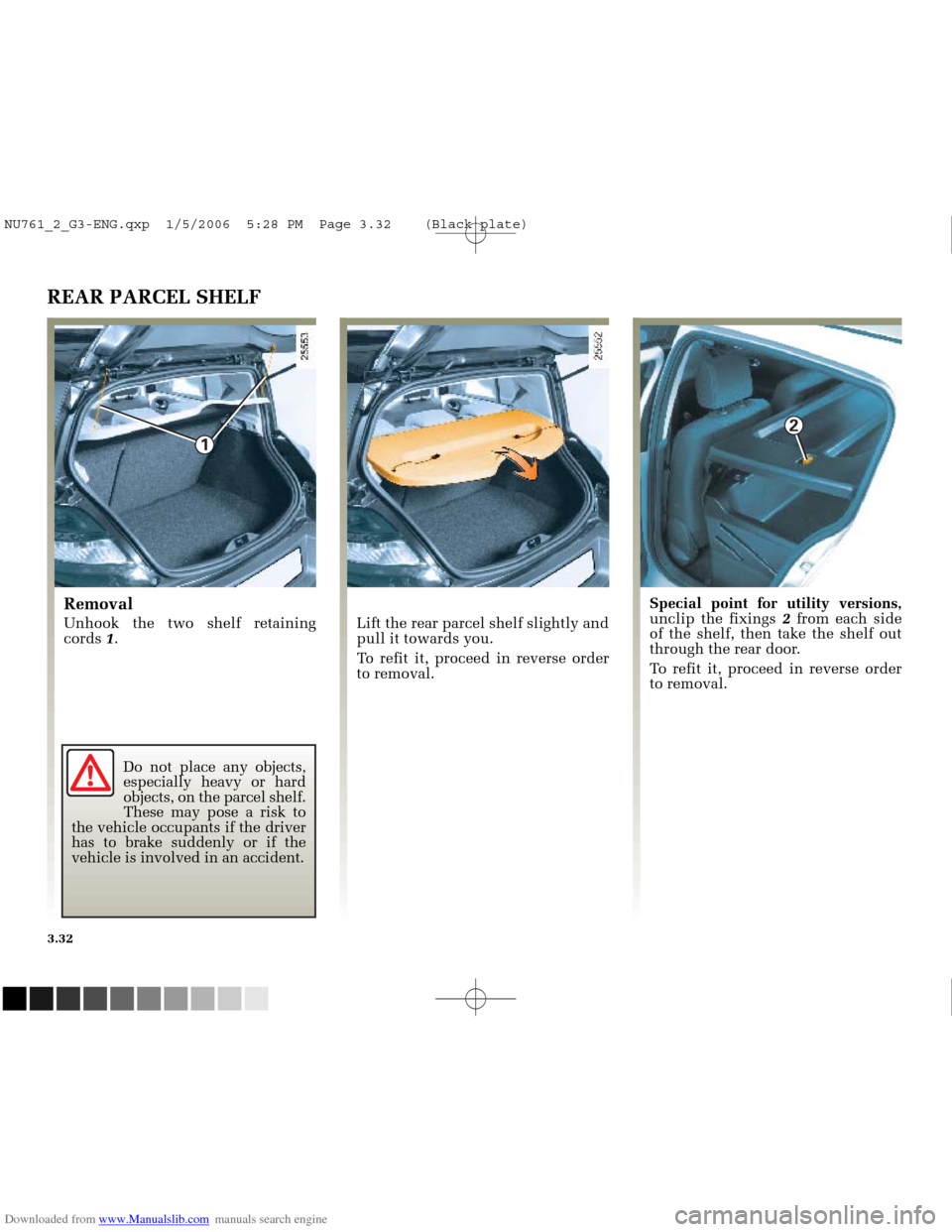
Removal
Unhook the two shelf retaining
cords 1. Lift the rear parcel shelf slightly and
pull it towards you.
To refit it, proceed in reverse order
to removal. Special point for utility versions,
unclip the fixings
2from each side
of the shelf, then take the shelf out
through the rear door.
To refit it, proceed in reverse order
to removal.
Do not place any objects,
especially heavy or hard
objects, on the parcel shelf.
These may pose a risk to
the vehicle occupants if the driver
has to brake suddenly or if the
vehicle is involved in an accident.
NU761_2_G3-ENG.qxp 1/5/2006 5:28 PM Page 3.32 (Black plate)
Page 171 of 250
Downloaded from www.Manualslib.com manuals search engine
1
2
1
1
1
NU761_2_G3-FRA.qxd 4/11/05 10:52 Page 3.33
3.33
STORAGE COMPARTMENTS/LUGGAGE COMPARTMENT FITTINGS
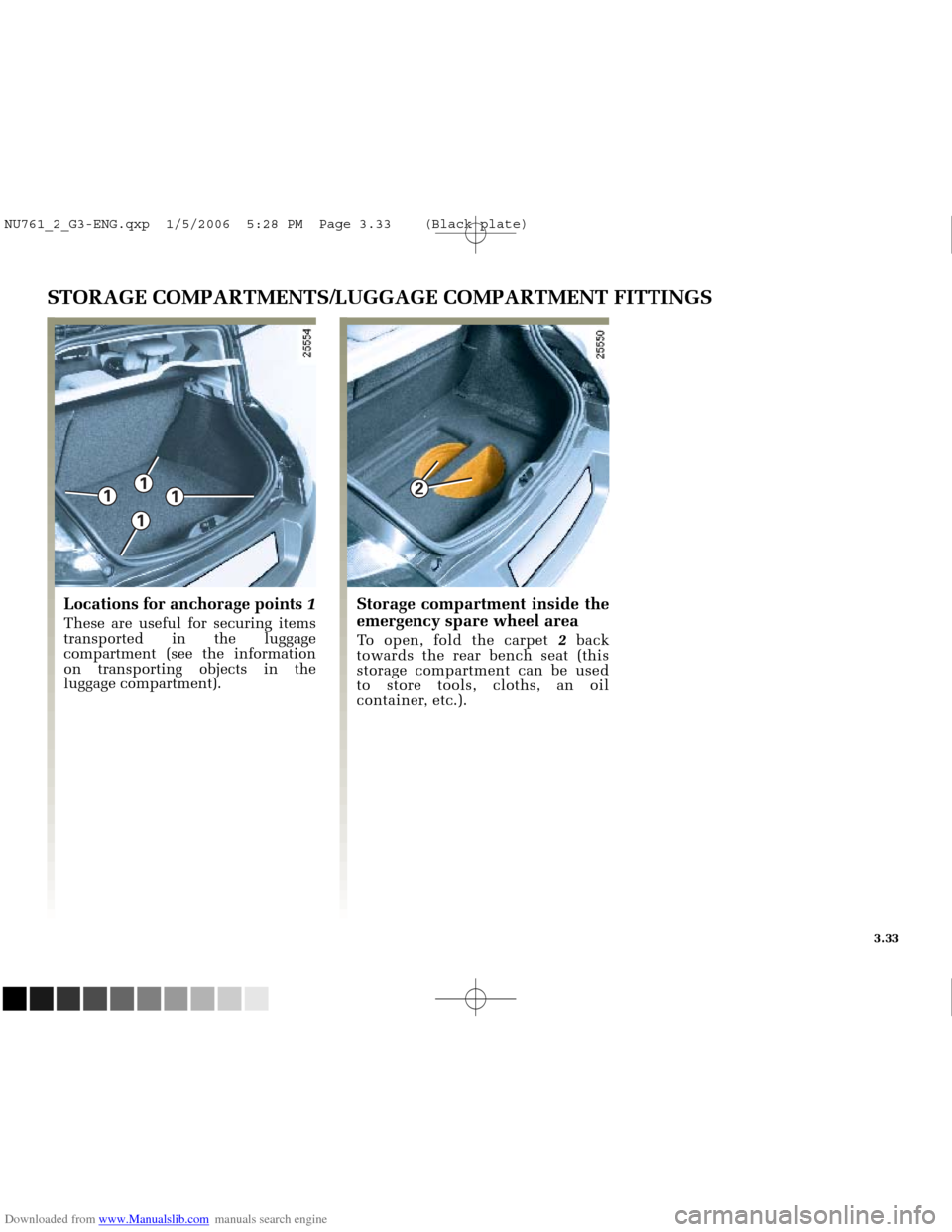
Locations for anchorage points 1
These are useful for securing items
transported in the luggage
compartment (see the information
on transporting objects in the
luggage compartment).
Storage compartment inside the
emergency spare wheel area
To open, fold the carpet 2back
towards the rear bench seat (this
storage compartment can be used
to store tools, cloths, an oil
container, etc.).
NU761_2_G3-ENG.qxp 1/5/2006 5:28 PM Page 3.33 (Black plate)
Page 189 of 250
Downloaded from www.Manualslib.com manuals search engine
NU761_2_G5-FRA.qxd 4/11/05 11:09 Page 5.01
Section 5: Practical advice
Emergency spare wheel ........................................................................\
...........................................................................5.02
Toolkit (Jack - Wheelbrace, etc.)
........................................................................\
....................................................... .....5.03
Wheel trims
........................................................................\
....................................................... .........................................5.04
Changing a wheel
........................................................................\
....................................................... ..............................5.05
Tyres (tyre safety, wheels, winter use)
........................................................................\
....................................5.06 ➟5.08
Headlights (replacing bulbs)
........................................................................\
.....................................................5.09 ➟5.12
Rear lights (replacing bulbs)
........................................................................\
.......................................................5.13 - 5.14
Side mounted indicators (replacing bulbs)
........................................................................\
.........................................5.14
Interior lighting (replacing bulbs)
........................................................................\
............................................5.15 ➟5.17
Fuses
........................................................................\
....................................................... .........................................5.18 - 5.19
Battery
........................................................................\
....................................................... .....................................5.20 ➟5.22
RENAULT card: battery
........................................................................\
....................................................... ....................5.23
Fitting a radio/accessories
........................................................................\
....................................................... ....5.24 - 5.25
Wipers (replacing the blades)
........................................................................\
.....................................................5.26 - 5.27
Towing
........................................................................\
....................................................... ....................................5.28 ➟5.30
Operating faults
........................................................................\
....................................................... ....................5.31 ➟5.38
5.01
NU761_2_G5-ENG.qxp 1/5/2006 5:30 PM Page 5.01 (Black plate)
Page 191 of 250
Downloaded from www.Manualslib.com manuals search engine
1
3
4
2
5
A
NU761_2_G5-FRA.qxd 4/11/05 11:09 Page 5.03
5.03
TOOL KIT
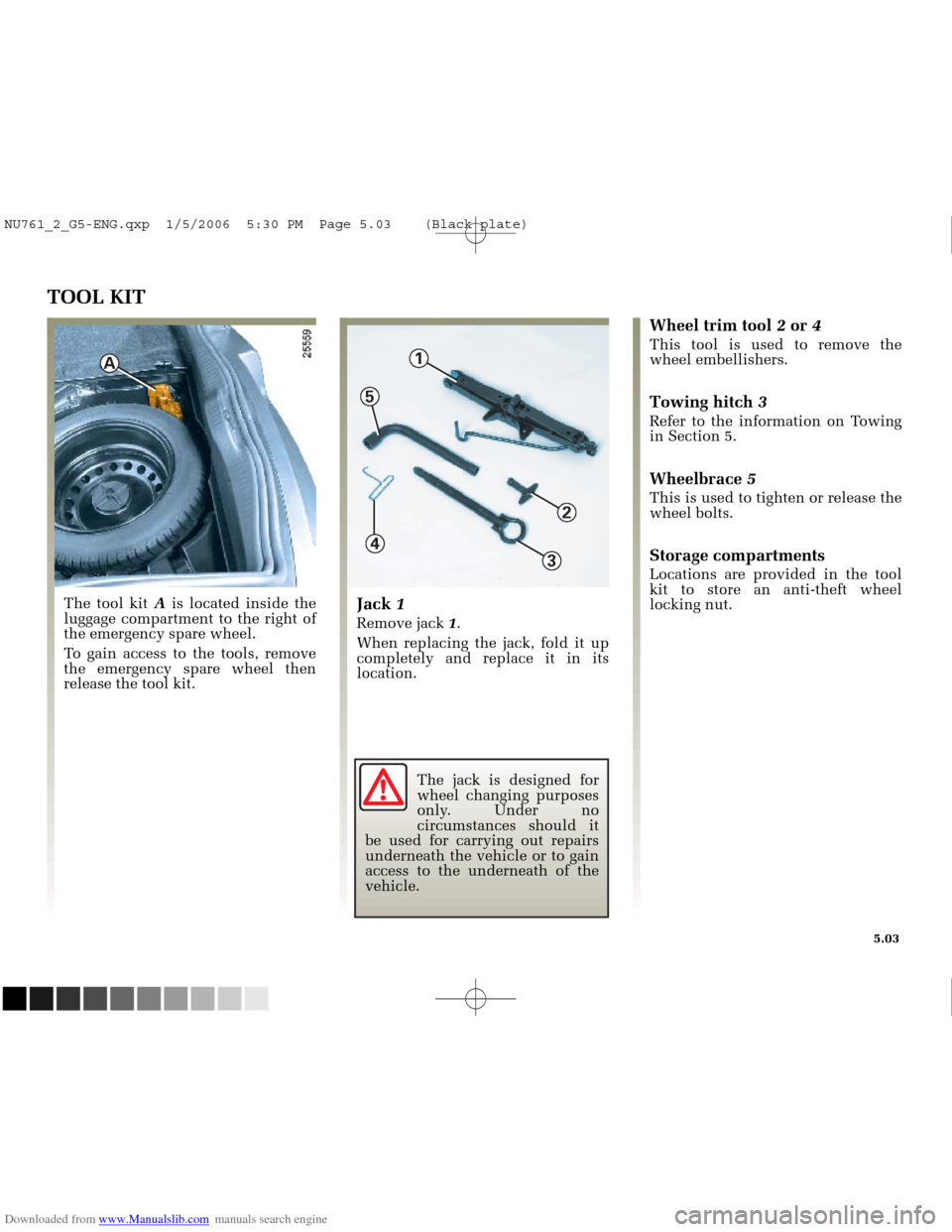
The tool kit Ais located inside the
luggage compartment to the right of
the emergency spare wheel.
To gain access to the tools, remove
the emergency spare wheel then
release the tool kit.
Wheel trim tool 2or 4
This tool is used to remove the
wheel embellishers.
Towing hitch 3
Refer to the information on Towing
in Section 5.
Wheelbrace 5
This is used to tighten or release the
wheel bolts.
Storage compartments
Locations are provided in the tool
kit to store an anti-theft wheel
locking nut.
Jack 1
Remove jack 1.
When replacing the jack, fold it up
completely and replace it in its
location.
The jack is designed for
wheel changing purposes
only. Under no
circumstances should it
be used for carrying out repairs
underneath the vehicle or to gain
access to the underneath of the
vehicle.
NU761_2_G5-ENG.qxp 1/5/2006 5:30 PM Page 5.03 (Black plate)
Page 201 of 250
Downloaded from www.Manualslib.com manuals search engine
1
2
6
3
4
5
NU761_2_G5-FRA.qxd 4/11/05 11:09 Page 5.13
5.13
REAR LIGHTS: replacing bulbs
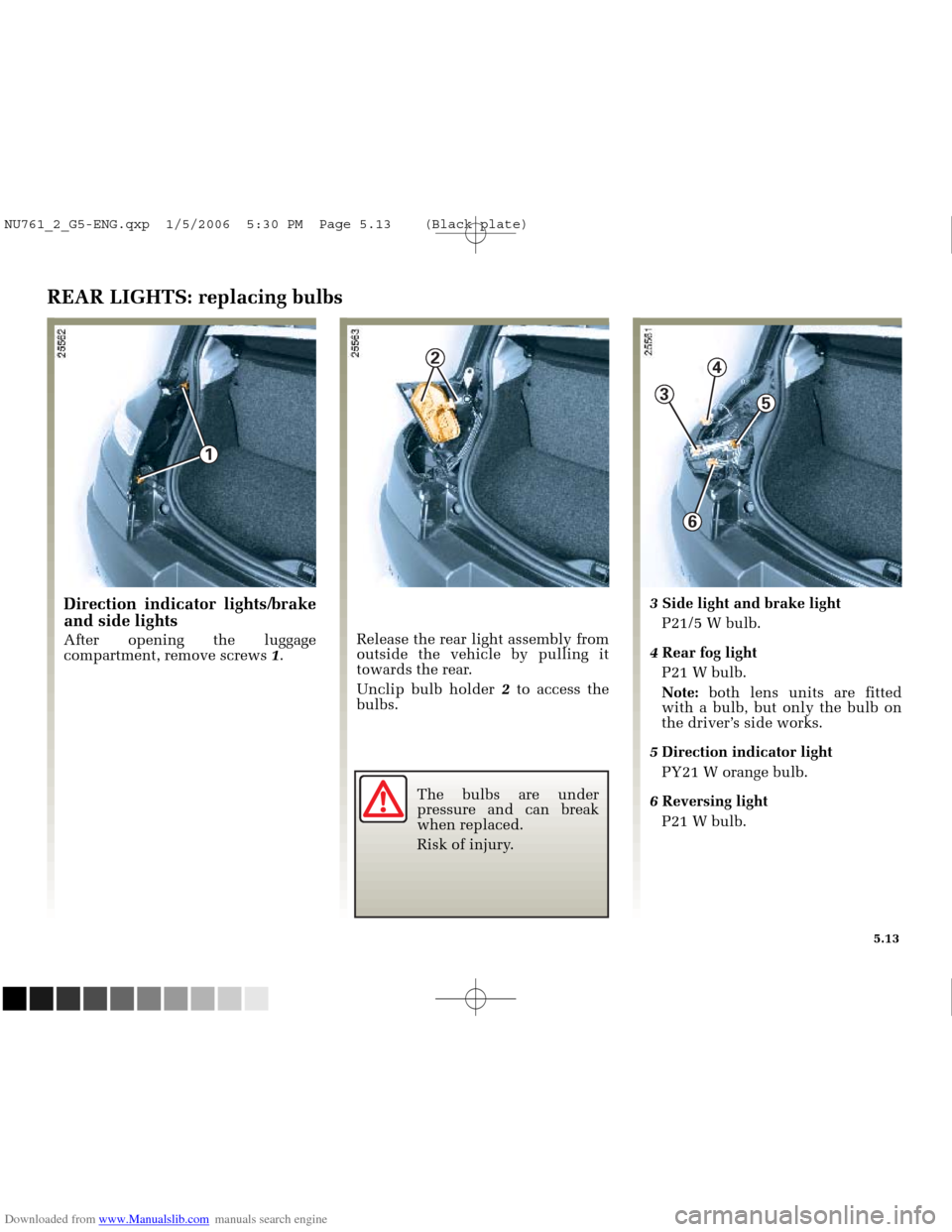
Release the rear light assembly from
outside the vehicle by pulling it
towards the rear.
Unclip bulb holder 2to access the
bulbs.
Direction indicator lights/brake
and side lights
After opening the luggage
compartment, remove screws 1. 3
Side light and brake light
P21/5 W bulb.
4 Rear fog light
P21 W bulb.
Note: both lens units are fitted
with a bulb, but only the bulb on
the driver’s side works.
5 Direction indicator light
PY21 W orange bulb.
6 Reversing light
P21 W bulb.
The bulbs are under
pressure and can break
when replaced.
Risk of injury.
NU761_2_G5-ENG.qxp 1/5/2006 5:30 PM Page 5.13 (Black plate)
Page 209 of 250
Downloaded from www.Manualslib.com manuals search engine
NU761_2_G5-FRA.qxd 4/11/05 11:09 Page 5.21
5.21
BATTERY: troubleshooting (continued)
Connecting a battery charger
The battery charger should be
compatible with a battery with a
nominal voltage of 12 Volts.
With the engine switched off, it is
essential to disconnect the cables
connected to both battery terminals,
starting with the negative terminal .
Do not disconnect the battery when
the engine is running. Follow the
manufacturer’s instructions for the
battery charger you are using.
Only a well-charged and well-
maintained battery will have a long
and useful life and enable you to
start the vehicle’s engine normally.
The battery must be kept clean and
dry.
Have the battery’s charge status
checked regularly:
Especially if you use your vehicle for short journeys or for frequent
driving in town. When the external temperature
drops (in winter), the charge
decreases . In winter, only use
electrical equipment which is
really necessary.
Finally, you should understand that the charge decreases naturally
as a result of certain “permanent
electrical consumers” such as the
clock, After-Sales accessories, etc.
When many accessories are fitted to
the vehicle, have them connected
to + after ignition feed . In this case,
it is advisable to have your vehicle
fitted with a battery which has an
increased capacity. Contact your
RENAULT Dealer. If your vehicle is to be left stationary
for a relatively long time, disconnect
the battery or have it recharged
regularly, in particular during cold
weather. The equipment with a
memory, radio etc. will then have to
be reprogrammed. The battery must
be stored in a cool dry place,
protected from frost.
Special procedures may
be required to charge
some batteries. Contact
your RENAULT Dealer.
Avoid all risk of sparks which
may cause an immediate
explosion and charge the battery
in a well-ventilated area. Risk of
serious injury.
NU761_2_G5-ENG.qxp 1/5/2006 5:30 PM Page 5.21 (Black plate)
Page 216 of 250
Downloaded from www.Manualslib.com manuals search engine
NU761_2_G5-FRA.qxd 4/11/05 11:10 Page 5.28
5.28
TOWING: breakdown
Press the Start/Stop button twice in
succession once towing is finished
(risk of running down the battery).
Furthermore, it is essential to
respect the towing regulations
defined in the legislation of the
country concerned and, if your
vehicle is the towing vehicle, do not
exceed the towing weight of your
vehicle. Contact your RENAULT
Dealer.Towing procedure
Before any towing, check that the
steering column is not locked.
If it is not locked, insert the
RENAULT card into the reader and
press the start/stop button for five
seconds without pressing on the
pedals. The steering column
unlocks, the vehicle accessory
functions are supplied with power
and you can use the lights (stop
lights, directional indicator lights,
etc.): the vehicle must have its lights
on at night.
Do not remove the RENAULT card
from the reader at any point when
the vehicle is being towed.
Towing a vehicle with
automatic transmission: special
information
Engine switched off: The gearbox is
no longer lubricated. It is preferable
to tow this type of vehicle on a
trailer or tow it with the front
wheels off the ground.
Under exceptional circumstances ,
you may tow the vehicle with all
four wheels on the ground, only
going forward, with the gear lever in
the N position, and for a distance
not exceeding 30 miles (50 km).
If the lever is stuck at P,
even though you are
depressing the brake
pedal, the lever can be
released manually.
To do this, unclip the upper
section of the cover at the base of
the lever.
Press simultaneously on the mark
on the gaiter and the unlocking
button on the lever.
NU761_2_G5-ENG.qxp 1/5/2006 5:30 PM Page 5.28 (Black plate)