Page 83 of 250
Downloaded from www.Manualslib.com manuals search engine
23505
23507
23508
NU761_2_G1-FRA.qxd 10/11/05 15:54 Page 1.73
1.73
TRIP COMPUTER AND WARNING SYSTEM (continued)
Examples of information messages
Message Display
Instrument panel variant 1 Message Display
Instrument panel variant 2 Interpretation of messages
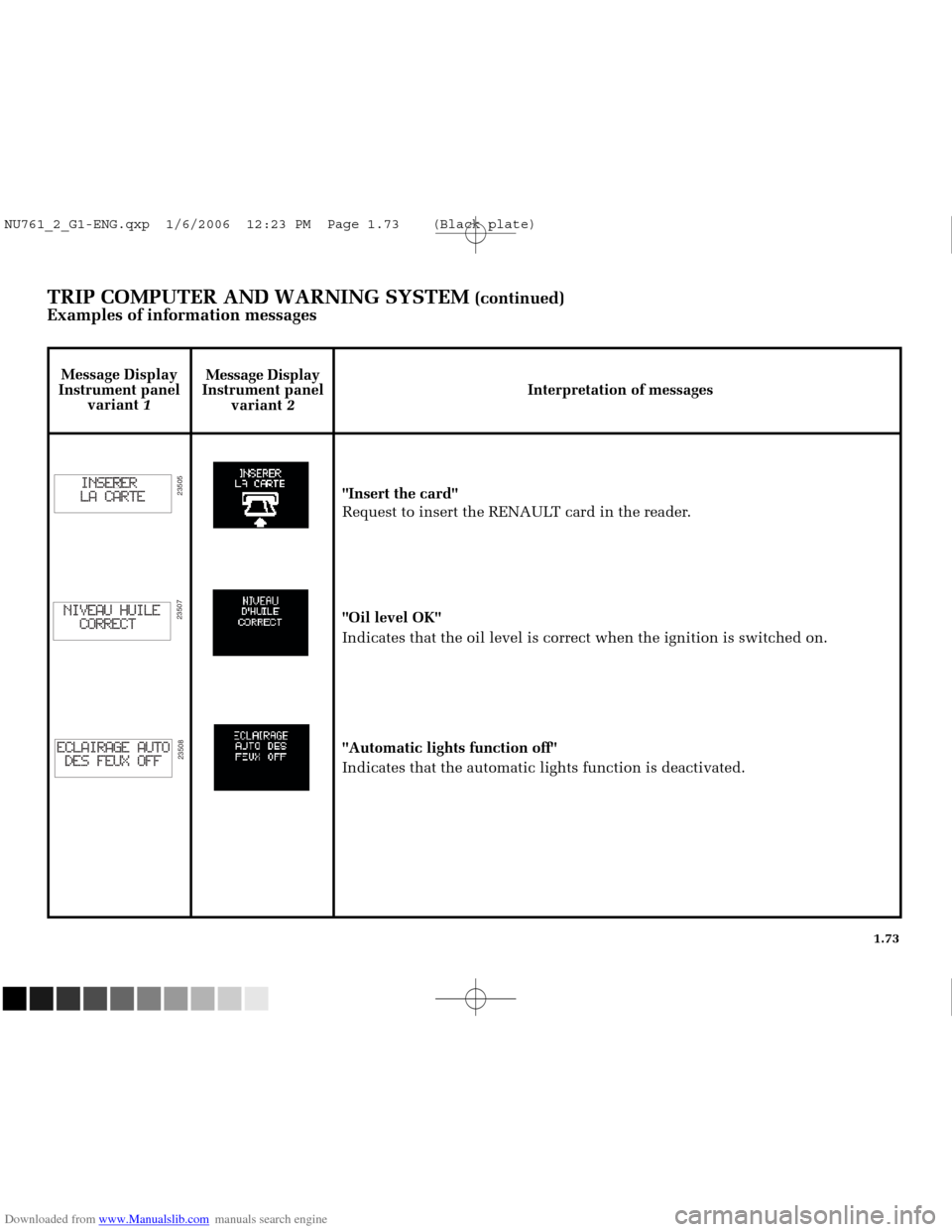
"Insert the card"
Request to insert the RENAULT card in the reader.
"Oil level OK"
Indicates that the oil level is correct when the ignition is switched on\
.
"Automatic lights function off"
Indicates that the automatic lights function is deactivated.
NU761_2_G1-ENG.qxp 1/6/2006 12:23 PM Page 1.73 (Black plate)
Page 92 of 250
Downloaded from www.Manualslib.com manuals search engine
1
4
1
3
2
NU761_2_G1-FRA.qxd 10/11/05 15:55 Page 1.82
1.82
EXTERIOR LIGHTING AND SIGNALS
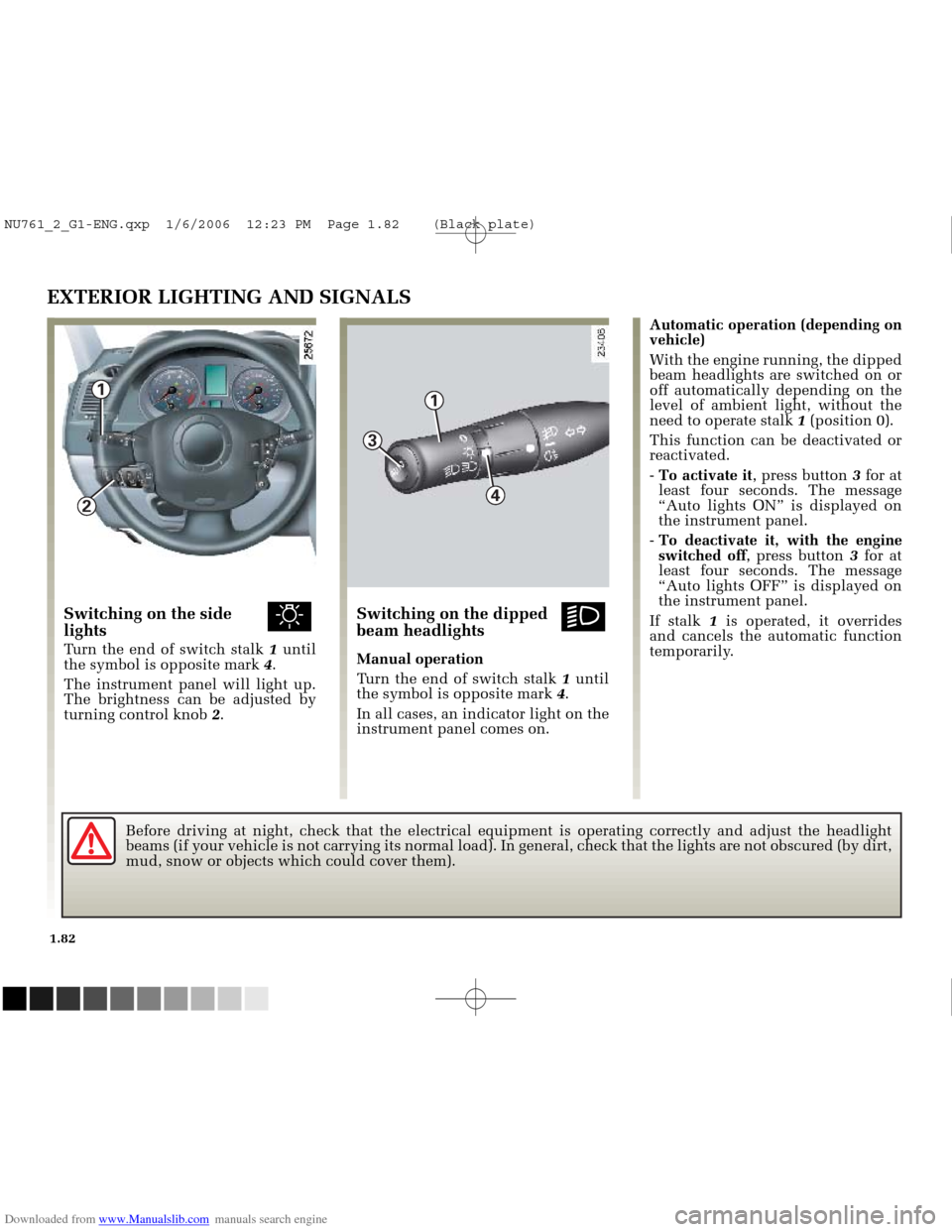
Switching on the side ulights
Turn the end of switch stalk 1until
the symbol is opposite mark 4.
The instrument panel will light up.
The brightness can be adjusted by
turning control knob 2.
Switching on the dipped kbeam headlights
Manual operation
Turn the end of switch stalk 1until
the symbol is opposite mark 4.
In all cases, an indicator light on the
instrument panel comes on. Automatic operation (depending on
vehicle)
With the engine running, the dipped
beam headlights are switched on or
off automatically depending on the
level of ambient light, without the
need to operate stalk
1(position 0).
This function can be deactivated or
reactivated.
- To activate it , press button 3for at
least four seconds. The message
“Auto lights ON” is displayed on
the instrument panel.
- To deactivate it, with the engine
switched off , press button 3for at
least four seconds. The message
“Auto lights OFF” is displayed on
the instrument panel.
If stalk 1is operated, it overrides
and cancels the automatic function
temporarily.
Before driving at night, check that the electrical equipment is operatin\
g correctly and adjust the headlight
beams (if your vehicle is not carrying its normal load). In general, c\
heck that the lights are not obscured (by dirt,
mud, snow or objects which could cover them).
NU761_2_G1-ENG.qxp 1/6/2006 12:23 PM Page 1.82 (Black plate)
Page 106 of 250
Downloaded from www.Manualslib.com manuals search engine
NU761_2_G2-FRA.qxd 4/11/05 10:48 Page 2.06
2.06
SPECIAL FEATURES OF PETROL VERSIONS
If you notice any of the above faults,
have the necessary repairs carried
out as soon as possible by your
RENAULT Dealer.
These faults may be avoided by
regularly taking your vehicle to your
RENAULT Dealer at the intervals
specified in your Warranty and
Services booklet.
Starting faults
To avoid damaging the catalytic
converter, do not keep trying to start
the engine (using the Start button, or
by pushing or towing the vehicle)
without having identified and
corrected the starting fault .
If the fault cannot be identified, do
not continue to try to start the
engine, contact a RENAULT Dealer.
The following operating conditions
should be avoided:
low fuel level warning light is lit,
are not approved by RENAULT.
Or operating faults such as:
fuel or spark plug disconnected
resulting in the engine misfiring
and bucking while driving,
may cause the catalytic converter to
overheat and thus reduce its
efficiency, or destroy it and cause
heat damage to the vehicle .
Do not park the vehicle or
run the engine in locations
where combustible
substances or materials such
as grass or leaves can come into
contact with the hot exhaust system.
NU761_2_G2-ENG.qxp 03-Jan-06 20:48 Page 2.06 (Black/Process Black\
plate)
Page 110 of 250
Downloaded from www.Manualslib.com manuals search engine
1
2
NU761_2_G2-FRA.qxd 4/11/05 10:48 Page 2.10
2.10
HANDBRAKE POWER STEERING
Never drive with an inadequately-
charged battery.
Variable power assisted steering
The variable assistance power
steering has an electronic
management system that adapts the
level of assistance to the vehicle
speed.
Steering is made easier during
parking manoeuvres (for added
comfort) whilst the force needed to
steer rises progressively as speed
increases (for enhanced safety at
high speeds).
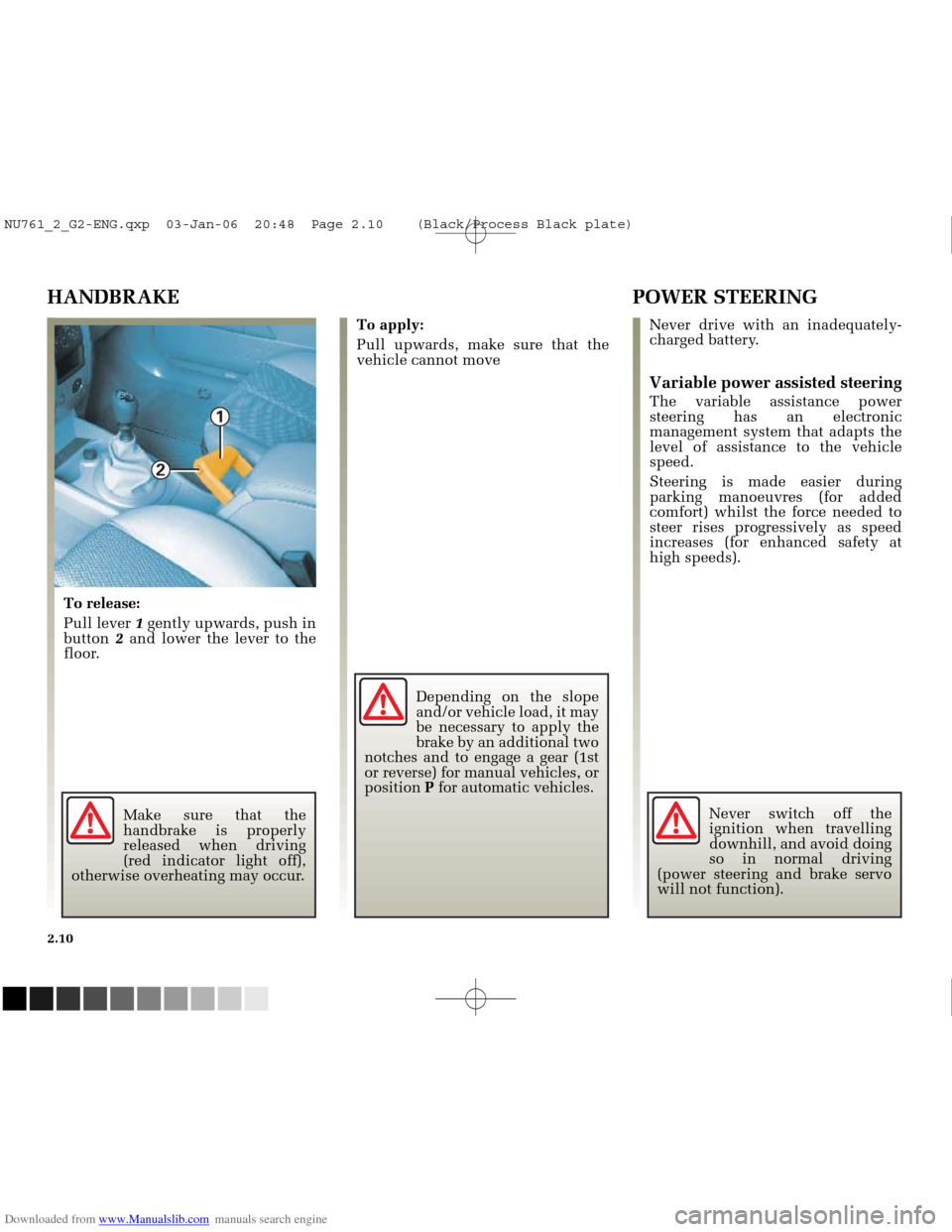
To apply:
Pull upwards, make sure that the
vehicle cannot move
To release:
Pull lever 1gently upwards, push in
button 2and lower the lever to the
floor.
Make sure that the
handbrake is properly
released when driving
(red indicator light off),
otherwise overheating may occur. Depending on the slope
and/or vehicle load, it may
be necessary to apply the
brake by an additional two
notches and to engage a gear (1st
or reverse) for manual vehicles, or
position Pfor automatic vehicles.
Never switch off the
ignition when travelling
downhill, and avoid doing
so in normal driving
(power steering and brake servo
will not function).
NU761_2_G2-ENG.qxp 03-Jan-06 20:48 Page 2.10 (Black/Process Black\
plate)
Page 111 of 250
Downloaded from www.Manualslib.com manuals search engine
NU761_2_G2-FRA.qxd 4/11/05 10:48 Page 2.11
ADVICE ON FUEL ECONOMY AND DRIVING
Maintenance
It should be noted that failure to
respect anti-pollution standards
may lead to legal action being taken
against the vehicle owner. In
addition, replacing engine, fuel
supply system and exhaust
components with parts other than
those originally recommended by
the manufacturer may alter your
vehicle so that it no longer complies
with anti-pollution standards.
Have your vehicle checked and
adjusted by your RENAULT Dealer
in accordance with the instructions
in the vehicle’s Warranty and
Services booklet.
Your RENAULT Dealer has all the
equipment necessary for ensuring
that your vehicle is maintained to its
original standard.
Engine adjustments
• ignition: this does not require
adjustment.
plugs: for optimum fuel
economy, efficiency and
performance the specifications laid
down by our Design Department
must be strictly applied.
If the spark plugs have to be
changed, use the make, type and
gap specified for your vehicle’s
engine. Contact your Renault
Dealer for this information.
this does not require
adjustment.
A clogged
cartridge hinders performance and
must be replaced.
RENAULT is actively striving to
reduce pollutant exhaust gas
emissions and to save energy.
By virtue of its design, moderate fuel
consumption and initial settings,
your RENAULT conforms to current
anti-pollution standards. Technical
design, however, cannot achieve all.
The fuel consumption of your
vehicle and the level of pollutant
exhaust gas emissions are also your
responsibility. Make sure that your
vehicle is maintained and used
correctly.
2.11
NU761_2_G2-ENG.qxp 03-Jan-06 20:48 Page 2.11 (Black/Process Black\
plate)
Page 112 of 250
Downloaded from www.Manualslib.com manuals search engine
NU761_2_G2-FRA.qxd 4/11/05 10:48 Page 2.12
2.12
ADVICE ON EMISSION CONTROL, FUEL ECONOMY AND DRIVING (continued)
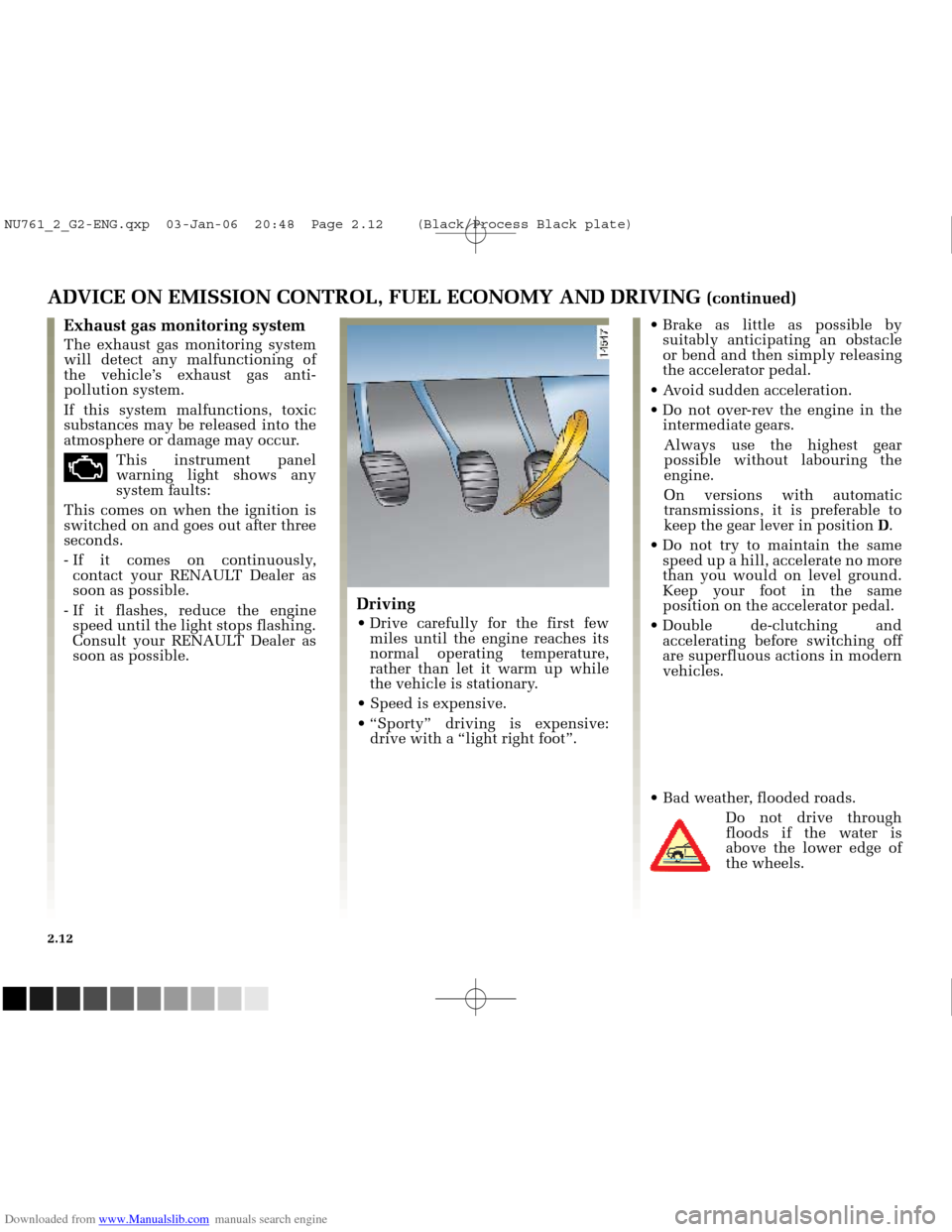
Driving
miles until the engine reaches its
normal operating temperature,
rather than let it warm up while
the vehicle is stationary.
drive with a “light right foot”.
Exhaust gas monitoring system
The exhaust gas monitoring system
will detect any malfunctioning of
the vehicle’s exhaust gas anti-
pollution system.
If this system malfunctions, toxic
substances may be released into the
atmosphere or damage may occur.
äThis instrument panel
warning light shows any
system faults:
This comes on when the ignition is
switched on and goes out after three
seconds.
- If it comes on continuously, contact your RENAULT Dealer as
soon as possible.
- If it flashes, reduce the engine speed until the light stops flashing.
Consult your RENAULT Dealer as
soon as possible.
suitably anticipating an obstacle
or bend and then simply releasing
the accelerator pedal.
intermediate gears.
Always use the highest gear
possible without labouring the
engine.
On versions with automatic
transmissions, it is preferable to
keep the gear lever in position D.
speed up a hill, accelerate no more
than you would on level ground.
Keep your foot in the same
position on the accelerator pedal.
accelerating before switching off
are superfluous actions in modern
vehicles.
Do not drive through
floods if the water is
above the lower edge of
the wheels.
NU761_2_G2-ENG.qxp 03-Jan-06 20:48 Page 2.12 (Black/Process Black\
plate)
Page 120 of 250

Downloaded from www.Manualslib.com manuals search engine
A
NU761_2_G2-FRA.qxd 4/11/05 10:48 Page 2.20
2.20
TRACTION CONTROL: ASR
Operating principle
Using the wheel sensors, the system
measures and compares the speed of
the drive wheels at all times and
slows down their over-rotation.
If a wheel is starting to spin, the
system brakes automatically until
the drive supplied becomes
compatible with the level of grip.The system also adjusts the engine
speed to the grip available under the
wheels, independently of the
pressure exerted on the accelerator
pedal.
When the function begins to
operate, warning light
Aflashes to
warn you.
This system helps to limit skidding
on drive wheels and to control the
vehicle when pulling away or
accelerating.
This function is an
additional aid in case of
critical driving conditions
to enable the vehicle
behaviour to be adapted to suit
the driving conditions.
However, the function does not
take the place of the driver. I t
does not increase the vehicle’s
limits and should not encourage
you to drive more quickly.
Therefore, it can under no
circumstances replace the
vigilance or responsibility of the
driver when manoeuvring the
vehicle (the driver must always
be ready for sudden incidents
which may occur when driving).
NU761_2_G2-ENG.qxp 03-Jan-06 20:48 Page 2.20 (Black/Process Black\
plate)
Page 136 of 250
Downloaded from www.Manualslib.com manuals search engine
NU761_2_G2-FRA.qxd 4/11/05 10:48 Page 2.36
2.36
AUTOMATIC TRANSMISSION (continued)Parking the vehicle
When the vehicle is stationary,
keeping your foot on the brake
pedal, move the lever to position P
(park): the gearbox is in neutral and
the drive wheels are mechanically
locked by the transmission.
Engage the handbrake.
Special circumstances
- If the bends and hills on the road
do not allow you to stay in
automatic mode (e.g.: in the
mountains), we recommend that
you change to manual mode.
This will prevent the automatic
transmission from changing gears
repeatedly when climbing, and
permit engine braking on long
descents.
- To prevent the engine stalling in
cold weather, start the engine and
wait a few seconds before shifting
the selector lever from position P
or Nand engaging it in Dor R.
- Vehicles not fitted with traction
control: on a slippery surface or
surface with a low level of
adhesion, change to manual mode
and select second gear (or even
third) before starting the engine to
avoid wheelspin when starting.
NU761_2_G2-ENG.qxp 03-Jan-06 20:48 Page 2.36 (Black/Process Black\
plate)