2005 PORSCHE CAYENNE TURBO spare wheel
[x] Cancel search: spare wheelPage 179 of 369

Controls, Safety, Instruments
179
Opening rear lidOn vehicles with spare wheel bracket, the bracket
must be swung aside before the rear lid can be
opened.
fPlease observe the chapter “SPARE WHEEL”
on Page 299.
fPress unlocking handle (arrow) and open the
rear lid.
Closing rear lidThe rear lid has a power closing mechanism.
fPull down the rear lid using the closing handle
(arrow) and rest it against the lock.
The rear lid is automatically pulled closed and
locked.
Warning!
Danger of crushing. The rear lid is auto-
matically pulled into the lock and locked.
fMake sure that your fingers are not under the
rear lid.
fKeep foreign objects or limbs away from mov-
ing parts (latch striker) of the power closing
mechanism.
fDo not leave children in the car unattended.
Automatic locking
fPlease observe the chapter “TAILGATE” on
Page 102.
Page 216 of 369

216
Shifting Gear, Traction Systems
Switching off PSMfPress button A.
PSM is switched off after a short delay.
With PSM switched off, the PSM warning light
in the instrument panel and the information
light in the button are lit.
During braking, the vehicle is stabilised even
when PSM is switched off.
One-sided spinning of the wheels is prevented,
even with PSM switched off.PSM should always be switched on during
“normal” driving.
H o w e v e r, i t c a n b e o f a d v a n t a g e t o s w i t c h o f f P S M
temporarily in exceptional situations:
– On a loose surface or in deep snow
– When “rocking the vehicle free”
– When using snow chains.
When the PSM is switched off the slip monitoring
function of the Tiptronic is also deactivated.
Information light
– The light indicates a control operation, includ-
ing when PSM is switched off (brake control in
the event of one-sided wheel spin).
Warning light
– The warning light in the instrument panel lights
up in combination with the indicator light in the
button for a lamp check when the ignition is
switched on.
– Together with the information light in the
button, the warning light indicates that PSM is
switched off.
– A fault is indicated by the warning light in the
instrument panel and an indication on the multi-
purpose display of the instrument panel. PSM
is out of order.
Please have the fault remedied at an autho-
rized Porsche dealer.Collapsible spare wheel
fNever switch the PSM off when driving with a
collapsible spare wheel.
To w i n g
fPlease observe the chapter “TOWING” on
Page 340.
Tip on driving
When PSM is switched off, wheel-specific brake in-
terventions and the traction control system (TCS)
are also inactive.
The automatic brake differential (ABD) remains on.
Switching on PSMfPress button A.
PSM is switched on after a short delay.
Page 230 of 369

230
Shifting Gear, Traction Systems Lowering the vehicle
1st actuation: Low level
2nd actuation: Loading level
Warning messageVarious messages are indicated on the multi-pur-
pose display of the instrument panel if there is a
system fault or if the compressor switches off due
to overload.fPlease observe the chapter “WARNING LIGHTS
AND WARNING MESSAGES” on Page 106.
fAdapt your driving behavior to the changed
conditions.
fConsult an authorized Porsche dealer in order
to remedy a system fault.
fIf the overload-protection function causes the
compressor to switch off, wait for a time until
it has cooled down. The system will function
again as soon as it has cooled sufficiently.
The warning message appears when the control
system is switched off and when the collapsible
spare wheel is being filled. This does not indicate
a fault.
The warning message will go out once these pro-
cedures have been completed.
Raising vehicle with the jackWhenever it is necessary to jack up the vehicle:
fManually set normal level and then switch off
level control.
Switching off level control
1. Switch ignition on.
2. Push rocker switch forward for 5 to
10 seconds.
A message is shown on the multi-purpose
display of the instrument panel.
The vehicle can now be raised.
Switching level control back on
1. Switch ignition on.
2. Push rocker switch forward for 5 to
10 seconds or
3. Drive forward with the vehicle.
Level control switches on automatically.Transporting the vehicles on car trains,
ferries and car transportersfTie the vehicle down only at its wheels.
Page 234 of 369

234
Maintenance, Car Care
Exercise Extreme Caution when
Working on your Vehicle
Danger!
Ignoring the following instructions may
cause serious personal injury or death.
fThe engine compartment of any motor vehicle
is a potentially hazardous area. If you are not
fully familiar with proper repair procedures, do
not attempt the adjustments described on the
following pages.
This caution applies to the entire vehicle.
fO n l y w o r k o n y o u r v e h i c l e o u t d o o r s o r i n a w e l l
ventilated area.
fEnsure that there are no open flames in the
area of your vehicle at any time when fuel
fumes might be present. Be especially cau-
tious of such devices such as hot water heat-
ers which ignite a flame intermittently.
fBefore working on any part in the engine com-
partment, turn the engine off and let it cool
down sufficiently. Hot engine compartment
components can burn skin on contact.
fBe alert and cautious around engine at all
times while the engine is running.
If work has to be performed with the engine
running, always set the parking brake, and
make sure the selector lever is in position “P“
or “N“.fIn particular, be very careful to ensure that
items of clothing (ties, shirt, sleeves etc.), jew-
elry, long hair, hand or fingers cannot get
caught in the fan, belts or other moving parts.
The radiator and radiator fans are in the front
of the car.
The fans can start or continue running as a
function of temperature, even with the engine
switched off.
Carry out work in these areas only with the en-
gine off and exercise extreme caution.
fYour Porsche is equipped with an electronic ig-
nition system. When the ignition is on, high volt-
age is present in all wires connected with the
ignition system; therefore, exercise extreme
caution when working on any part of the engine
while the ignition is on or the engine is running.
fAlways support your car with safety stands if it
is necessary to work under the car. The jack
supplied with the car is not adequate for this
purpose.
fWhen working under the car without safety
stands but with the wheels on the ground,
make sure the car is on level ground, the
wheels are blocked, and that the engine can-
not be started.
Withdraw ignition keys (switch ignition off in ve-
hicles that have Porsche Entry & Drive).
fDo not smoke or allow an open flame around
the battery or fuel.
Keep a fire extinguisher in close reach.fIncomplete or improper servicing may cause
problems in the operation of the car. If in doubt
about any servicing, have it done by your au-
thorized Porsche dealer.
Improper maintenance during the warranty pe-
riod may affect your Porsche warranty cove-
rage.
fSupplies of fluids, e.g. engine oil, washer fluid,
brake fluid or coolant, are hazardous to your
health.
Keep these fluids out of children's reach and
dispose of them in accordance with the appro-
priate regulations.
fSome countries require additional tools and
special spare parts to be carried.
Please make enquiries before driving abroad.
Power measurementsPower measurements on dynamometers are not
approved by Porsche.
Page 268 of 369

268
Practical Tips, Minor Repairs
Exercise Extreme Caution when
Working on your Vehicle
Danger!
Ignoring the following instructions may
cause serious personal injury or death.
fThe engine compartment of any motor vehicle
is a potentially hazardous area. If you are not
fully familiar with proper repair procedures, do
not attempt the adjustments described on the
following pages.
This caution applies to the entire vehicle.
fO n l y w o r k o n y o u r v e h i c l e o u t d o o r s o r i n a w e l l
ventilated area.
fEnsure that there are no open flames in the
area of your vehicle at any time when fuel
fumes might be present. Be especially cau-
tious of such devices such as hot water heat-
ers which ignite a flame intermittently.
fBefore working on any part in the engine com-
partment, turn the engine off and let it cool
down sufficiently. Hot engine compartment
components can burn skin on contact.
fBe alert and cautious around engine at all
times while the engine is running.
If work has to be performed with the engine
running, always set the parking brake, and
make sure the selector lever is in position “P“
or “N“.fIn particular, be very careful to ensure that
items of clothing (ties, shirt, sleeves etc.), jew-
elry, long hair, hand or fingers cannot get
caught in the engine-compartment blower, fan,
belts or other moving parts.
The radiator and radiator fans are in the front
of the car.
The fans can start or continue running as a
function of temperature, even with the engine
switched off.
Carry out work in these areas only with the en-
gine off and exercise extreme caution.
fYour Porsche is equipped with an electronic ig-
nition system. When the ignition is on, high volt-
age is present in all wires connected with the
ignition system; therefore, exercise extreme
caution when working on any part of the engine
while the ignition is on or the engine is running.
fAlways support your car with safety stands if it
is necessary to work under the car. The jack
supplied with the car is not adequate for this
purpose.
fWhen working under the car without safety
stands but with the wheels on the ground,
make sure the car is on level ground, the
wheels are blocked, and that the engine can-
not be started.
Remove the ignition key.fDo not smoke or allow an open flame around
the battery or fuel.
Keep a fire extinguisher in close reach.
fIncomplete or improper servicing may cause
problems in the operation of the car. If in doubt
about any servicing, have it done by your au-
thorized Porsche dealer.
Improper maintenance during the warranty pe-
riod may affect your Porsche warranty cover-
age.
fSupplies of fluids, e.g. engine oil, brake fluid or
coolant, are hazardous to your health. Keep
these fluids out of children's reach and dispose
of them in accordance with the appropriate
regulations.
fSome countries require additional tools and
special spare parts to be carried.
Please make enquiries before driving abroad.
Page 269 of 369

Practical Tips, Minor Repairs
269
Notes on Minor RepairsTool kitThe tool kit is accommodated in the spare-wheel
well under the cover of the loadspace floor.
Tires/WheelsThe original equipment tires and wheel rims on
your Porsche comply with all applicable Federal
Motor Vehicle Safety Standards.
For your safety remember the following:
– Wheel rims and wheel bolts are matched to fit
your Porsche.
– If you intend to use other than original equip-
ment wheels, be sure that they conform to
Porsche specifications for your model.Only
tires with the same make and with the same
specification code (e.g. “N0“, “N1“...) can be
mounted.
– The use of wheel rims and wheel bolts that do
not meet specifications of the original factory
installed equipment will affect the safe opera-
tion of your vehicle.
– Before you plan on exchanging wheels, or
snow tires already mounted on the wheel rims,
consult your authorized Porsche dealer.
Your dealer has the technical information nec-
essary to advise you which wheel rims and
wheel bolts are compatible with the original
factory installations.
Danger!
Risk of loss of control and serious personal
injury or death.
fIf while driving, your vehicle experiences a sud-
den vibration or ride disturbance, and/or you
suspect that possible damage to your tires or
vehicle has occurred, you should immediately
reduce your speed without excessive use of
the brakes.
fStop the vehicle as soon as possible, and in-
spect the tires.
If you cannot determine the cause for the dis-
turbance, have your vehicle towed to the near-
est Porsche or tire dealer to have your vehicle
or tire(s) inspected.
fContinuing to operate the vehicle without cor-
rection could result in a loss of control and se-rious personal injury.
Page 273 of 369
Practical Tips, Minor Repairs
273
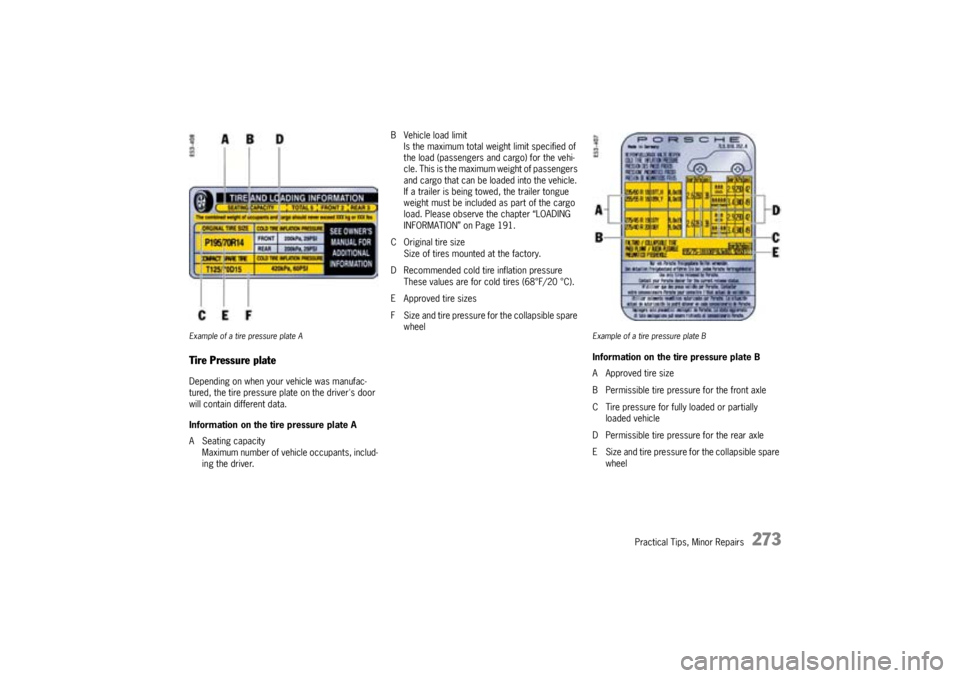
Example of a tire pressure plate ATire Pressure plateDepending on when your vehicle was manufac-
tured, the tire pressure plate on the driver's door
will contain different data.
Information on the tire pressure plate A
A Seating capacity
Maximum number of vehicle occupants, includ-
ing the driver.B Vehicle load limit
Is the maximum total weight limit specified of
the load (passengers and cargo) for the vehi-
cle. This is the maximum weight of passengers
and cargo that can be loaded into the vehicle.
If a trailer is being towed, the trailer tongue
weight must be included as part of the cargo
load.Please observe the chapter “LOADING
INFORMATION” on Page 191.
C Original tire size
Size of tires mounted at the factory.
D Recommended cold tire inflation pressure
These values are for cold tires (68°F/20 °C).
E Approved tire sizes
F Size and tire pressure for the collapsible spare
wheel
Example of a tire pressure plate BInformation on the tire pressure plate B
A Approved tire size
B Permissible tire pressure for the front axle
C Tire pressure for fully loaded or partially
loaded vehicle
D Permissible tire pressure for the rear axle
E Size and tire pressure for the collapsible spare
wheel
Page 278 of 369

278
Practical Tips, Minor Repairs
Removing and storing tiresfAfter changing, adjust tire pressure and torque
wheel bolts diagonally.
Please observe the chapter “CHANGING
WHEELS” on Page 286.
Tires must always remain on the same side of
the vehicle.
When wheels are removed, the direction of rota-
tion and position of each wheel should be marked.
Example
FR (front right), FL, RR and RL.
Wheels must always be fitted in accordance with
their marking.
The perception that tire durability and perfor-
mance are not affected by storage and age is un-
founded.
Chemical additives, which make the rubber elas-
tic, lose their effectiveness over the course of
time and the rubber becomes brittle and cracks.
Therefore, the tires, especially the spare tire,
should be inspected from time to time.Note
Under no circumstances should tires older than
6 years be used on your Porsche.
The age of the tire can be obtained from the “DOT“
code number. If, for example, the last three num-
bers read 1202, then the tire was produced in the
12th week of 2002.
fStore tires in a cool and dry place.
fRotate periodically to avoid flat spots.