Page 90 of 788
Page 91 of 788
Page 97 of 788
IGNITION SYSTEM
ENGINE ELECTRICAL16-33
SPARK PLUG CHECK AND CLEANING
<4G6>
M1163004300353
CAUTION
When pulling off the spark plug cable from the
plug always hold the cable cap, not the cable.
1. Remove the spark plug cables.
2. Remove the spark plugs.
CAUTION
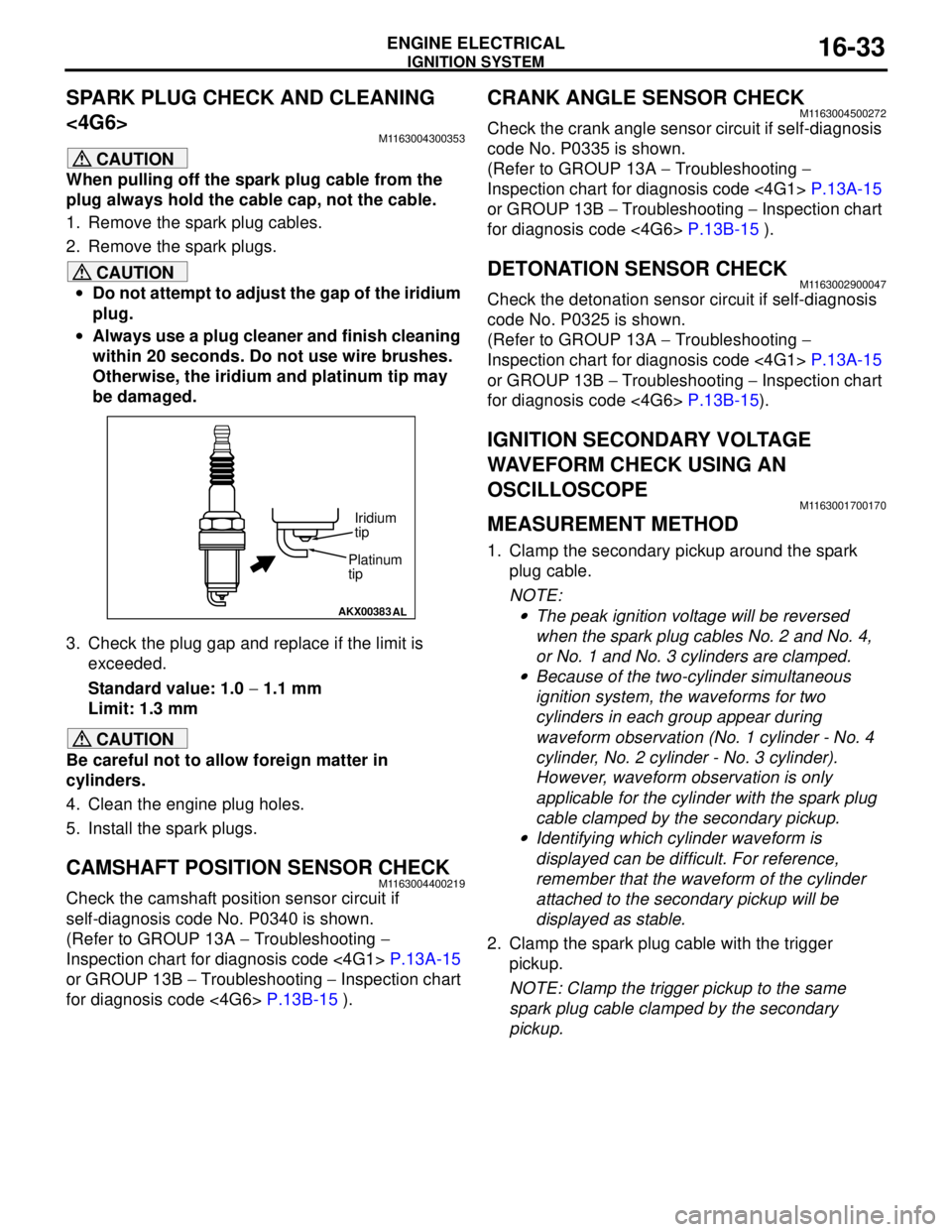
•Do not attempt to adjust the gap of the iridium
plug.
•Always use a plug cleaner and finish cleaning
within 20 seconds. Do not use wire brushes.
Otherwise, the iridium and platinum tip may
be damaged.
3. Check the plug gap and replace if the limit is
exceeded.
Standard value: 1.0 − 1.1 mm
Limit: 1.3 mm
CAUTION
Be careful not to allow foreign matter in
cylinders.
4. Clean the engine plug holes.
5. Install the spark plugs.
CAMSHAFT POSITION SENSOR CHECKM1163004400219
Check the camshaft position sensor circuit if
self-diagnosis code No. P0340 is shown.
(Refer to GROUP 13A − Troubleshooting −
Inspection chart for diagnosis code <4G1> P.13A-15
or GROUP 13B − Troubleshooting − Inspection chart
for diagnosis code <4G6> P.13B-15 ).
CRANK ANGLE SENSOR CHECKM1163004500272
Check the crank angle sensor circuit if self-diagnosis
code No. P0335 is shown.
(Refer to GROUP 13A − Troubleshooting −
Inspection chart for diagnosis code <4G1> P.13A-15
or GROUP 13B − Troubleshooting − Inspection chart
for diagnosis code <4G6> P.13B-15 ).
DETONATION SENSOR CHECKM1163002900047
Check the detonation sensor circuit if self-diagnosis
code No. P0325 is shown.
(Refer to GROUP 13A − Troubleshooting −
Inspection chart for diagnosis code <4G1> P.13A-15
or GROUP 13B − Troubleshooting − Inspection chart
for diagnosis code <4G6> P.13B-15).
IGNITION SECONDARY VOLTAGE
WAVEFORM CHECK USING AN
OSCILLOSCOPE
M1163001700170
MEASUREMENT METHOD
1. Clamp the secondary pickup around the spark
plug cable.
NOTE: .
•The peak ignition voltage will be reversed
when the spark plug cables No. 2 and No. 4,
or No. 1 and No. 3 cylinders are clamped.
•Because of the two-cylinder simultaneous
ignition system, the waveforms for two
cylinders in each group appear during
waveform observation (No. 1 cylinder - No. 4
cylinder, No. 2 cylinder - No. 3 cylinder).
However, waveform observation is only
applicable for the cylinder with the spark plug
cable clamped by the secondary pickup.
•Identifying which cylinder waveform is
displayed can be difficult. For reference,
remember that the waveform of the cylinder
attached to the secondary pickup will be
displayed as stable.
2. Clamp the spark plug cable with the trigger
pickup.
NOTE: Clamp the trigger pickup to the same
spark plug cable clamped by the secondary
pickup.
AKX00383
AL
Platinum
tipIridium
tip
Page 98 of 788
IGNITION SYSTEM
ENGINE ELECTRICAL16-34
STANDARD WAVEFORM
Observation Conditions
Observation Conditions (The only change from above condition is the pattern selector.)Function Secondary
Pattern height High (or Low)
Pattern selector Raster
Engine revolutions Curb idle speed
Pattern selector Display
AKX00278
kV
0 Secondary
ignition voltage
wave patternIgnition voltage
(point D)Spark line (point A)
Dwell sectionWave dampling reduction section (point B)
Point C
Time
AD
Page 99 of 788

IGNITION SYSTEM
ENGINE ELECTRICAL16-35
WAVEFORM OBSERVATION POINTS
Point A: The height, length and slope of the spark line show the following trends (Refer to abnormal
waveform examples, 1, 2, 3 and 4).
Point B: Number of vibration in reduction vibration section (Refer to abnormal waveform example 5)
Point C: Number of vibrations at beginning of dwell section (Refer to abnormal waveform example 5)
Point D: Ignition voltage height (distribution per each cylinder) shows the following trends.
AKX01275
kV
Secondary ignition
voltage wave pattern
0
2NO. 1 cylinder
NO. 3 cylinder
ignition noise
Newtral sectionNO. 4 cylinderNO. 2 cylinder
ignition noise
Time
AC
Spark line Plug gap Condition of
electrodeCompression
force Concentration
of air mixtureIgnition
timingSpark plug
cable
Length Long Small Normal Low Rich Advanced Leak
Short Large Large wear High Lean Retarded High
resistance
Height High Large Large wear High Lean Retarded High
resistance
Low Small Normal Low Rich Advanced Leak
Slope Large Plug is fouled
−− −−
Number of vibrations Coil and condenser
3 or more Normal
Except above Abnormal
Number of vibrations Coil
5 − 6 or higher Normal
Except above Abnormal
Ignition
voltagePlug gap Condition of
electrodeCompression
forceConcentration
of air mixtureIgnition
timingSpark plug
cable
High Large Large wear High Lean Retarded High
resistance
Low Small Normal Low Rich Advanced Leak
Page 100 of 788
IGNITION SYSTEM
ENGINE ELECTRICAL16-36
EXAMPLES OF ABNORMAL
WAV E F O R M S
Example 1
•Wave characteristics
Spark line is high and short.
•Cause of problem
Spark plug gap is too large.
Example 2
•Wave characteristics
Spark line is low and long, and is sloping.
Also, the second half of the spark line is distorted.
This could be a result of misfiring.
•Cause of problem
Spark plug gap is too small.Example 3
•Wave characteristics
Spark line is low and long, and is sloping.
However, there is almost no spark line
distortion.
•Cause of problem
Spark plug gap is fouled.
Example 4
•Wave characteristics
Spark line is high and short.
Difficult to distinguish between this and abnormal
waveform example 1.
•Cause of problem
Spark plug cable is nearly falling off (Causing a
dual ignition).
Example 5
•Wave characteristics
No waves in wave damping section.
•Cause of problem
Layer short in ignition coil.
AKX00280
AKX00281
AKX00282
AKX00283
AKX00284
Page 119 of 788

EMISSION CONTROL
ENGINE AND EMISSION CONTROL17-11
1. Disconnect the vacuum hose (red stripe) from
throttle body and connect it to a hand vacuum
pump.
2. Plug the nipple from which the vacuum hose was
removed.
3. When the engine is cold or hot, apply a vacuum of
53 kPa, and check the condition of the vacuum.
When engine is cold
(Engine coolant temperature: 40°C or less)
When engine is hot
(Engine coolant temperature: 80°C or higher)
PURGE PORT VACUUM CHECKM1173001500177
1. Disconnect the vacuum hose (red stripe) from the
throttle body and connect a hand vacuum pump to
the nipple.
2. Plug the vacuum hose (red stripe).3. Start the engine.
4. Check that a fairly constant negative pressure is
generated regardless of the engine speed.
5. If no negative pressure is generated, the port is
probably blocked and should be cleaned.
PURGE CONTROL SOLENOID VALVE
CHECK
M1173001700193
NOTE: When disconnecting the vacuum hose,
always make a mark so that it can be reconnected at
original position.
1. Disconnect the vacuum hose from the solenoid
valve.
2. Disconnect the harness connector.
3. Connect a hand vacuum pump to nipple (A) of the
solenoid valve (refer to the illustration at left). Engine condition Normal condition
At idle Vacuum is maintained.
3,000 r/min
Engine condition Normal condition
At idle Vacuum is maintained.
3,000 r/min (within 3
minutes after engine
starts)Vacuum will leak.
AK300773
<4G1>
AB
Plug
Vacuum hose
AK300774
<4G6>
AB
Plug
Vacuum hose
AK100011AC
Vac-
uum
Engine speed (r/min)
AK100012AC
Battery A
AK100013
Page 123 of 788
EMISSION CONTROL
ENGINE AND EMISSION CONTROL17-15
EGR SYSTEM CHECKM1173002600348
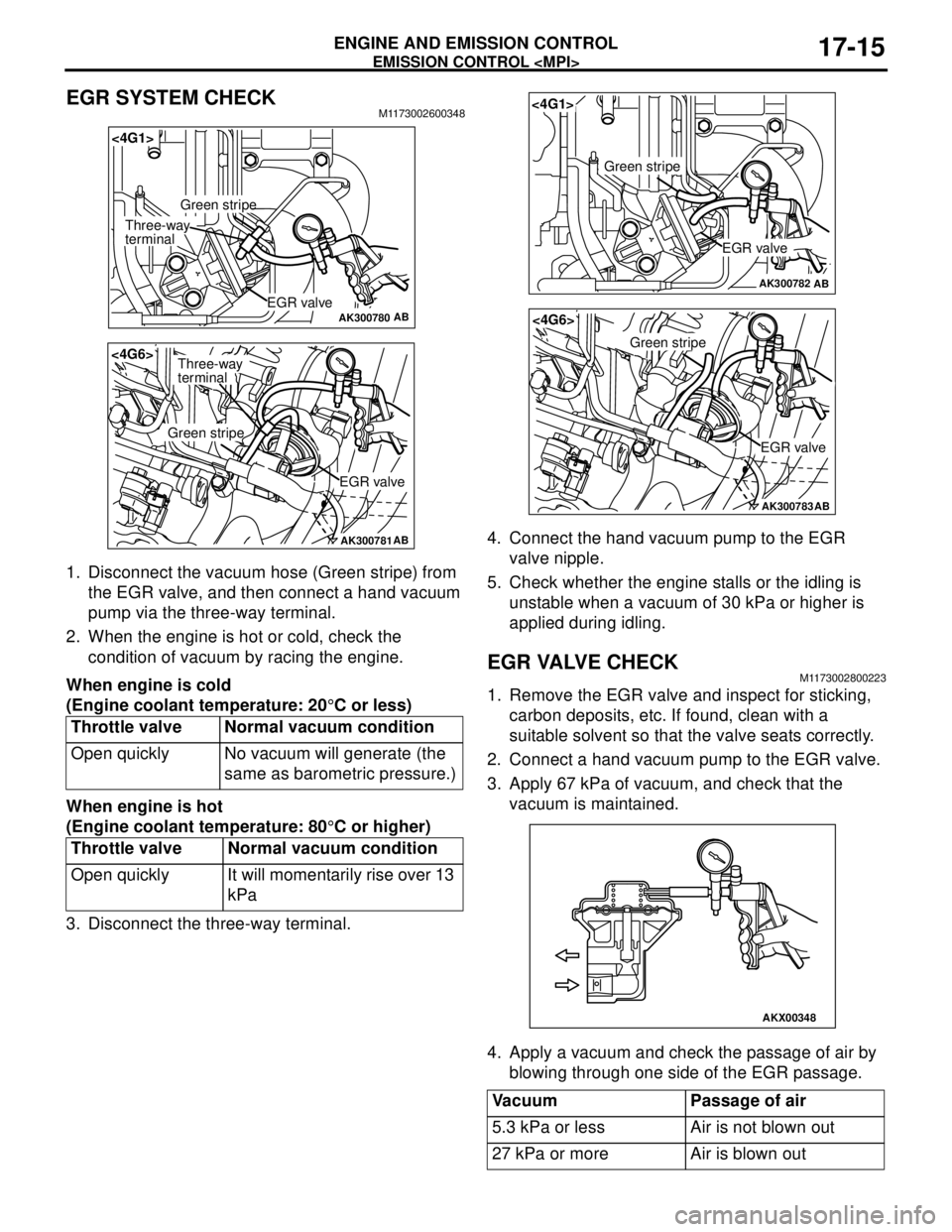
1. Disconnect the vacuum hose (Green stripe) from
the EGR valve, and then connect a hand vacuum
pump via the three-way terminal.
2. When the engine is hot or cold, check the
condition of vacuum by racing the engine.
When engine is cold
(Engine coolant temperature: 20°C or less)
When engine is hot
(Engine coolant temperature: 80°C or higher)
3. Disconnect the three-way terminal.4. Connect the hand vacuum pump to the EGR
valve nipple.
5. Check whether the engine stalls or the idling is
unstable when a vacuum of 30 kPa or higher is
applied during idling.
EGR VALVE CHECKM1173002800223
1. Remove the EGR valve and inspect for sticking,
carbon deposits, etc. If found, clean with a
suitable solvent so that the valve seats correctly.
2. Connect a hand vacuum pump to the EGR valve.
3. Apply 67 kPa of vacuum, and check that the
vacuum is maintained.
4. Apply a vacuum and check the passage of air by
blowing through one side of the EGR passage. Throttle valve Normal vacuum condition
Open quickly No vacuum will generate (the
same as barometric pressure.)
Throttle valve Normal vacuum condition
Open quickly It will momentarily rise over 13
kPa
AK300780AB
<4G1>
EGR valve
Green stripe
Three-way
terminal
AK300781AB
<4G6>
EGR valve
Green stripe
Three-way
terminal
Vacuum Passage of air
5.3 kPa or less Air is not blown out
27 kPa or more Air is blown out
AK300782AB
<4G1>
EGR valve
Green stripe
AK300783AB
<4G6>
EGR valve
Green stripe
AKX00348


