EMISSION CONTROL
ENGINE AND EMISSION CONTROL17-80
COMPONENT LOCATIONM1173007400189
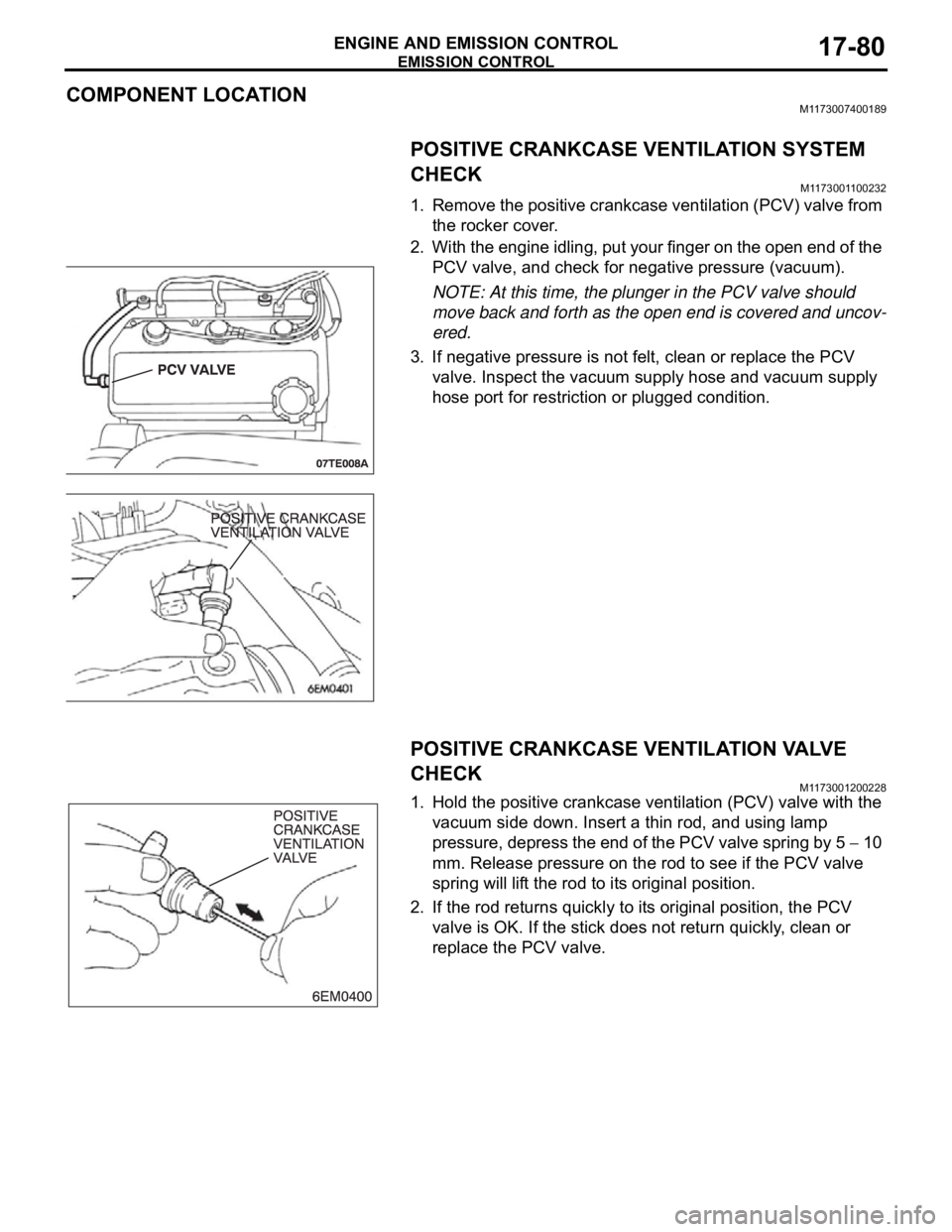
POSITIVE CRANKCASE VENTILATION SYSTEM
CHECK
M1173001100232
1. Remove the positive crankcase ventilation (PCV) valve from
the rocker cover.
2. With the engine idling, put your finger on the open end of the
PCV valve, and check for negative pressure (vacuum).
NOTE: At this time, the plunger in the PCV valve should
move back and forth as the open end is covered and uncov-
ered.
3. If negative pressure is not felt, clean or replace the PCV
valve. Inspect the vacuum supply hose and vacuum supply
hose port for restriction or plugged condition.
POSITIVE CRANKCASE VENTILATION VALVE
CHECK
M1173001200228
1. Hold the positive crankcase ventilation (PCV) valve with the
vacuum side down. Insert a thin rod, and using lamp
pressure, depress the end of the PCV valve spring by 5
10
mm. Release pressure on the rod to see if the PCV valve
spring will lift the rod to its original position.
2. If the rod returns quickly to its original position, the PCV
valve is OK. If the stick does not return quickly, clean or
replace the PCV valve.
AUTOMATIC TRANSMISSION DIAGNOSIS
AUTOMATIC TRANSMISSION23A-27
3. Connect the special tools (3.0 MPa (427 psi) oil pressure
gauge [MD998330] and adapters [MD998332, MD998900])
to each pressure discharge port.
NOTE: .
2ND: Second brake pressure port
UD: Underdrive clutch pressure port
LR: Low-reverse brake pressure port
DR: Torque converter release pressure port
DA: Torque converter apply pressure port
RV: Reverse clutch pressure port
OD: Overdrive clutch pressure port
DIR: Direct clutch pressure port
RED: Reduction clutch pressure port
4. Restart the engine.
5. Check that there are no leaks around the special tool port
adapters.
6. Measure the hydraulic pressure at each port under the
conditions given in the standard hydraulic pressure table,
and check that the measured values are within the standard
value ranges.
7. If the pressure is not within the standard value, stop the
engine and refer to the hydraulic pressure test diagnosis
table.
8. Remove the O-ring from the port plug and replace it.
9. Remove the special tool, and install the plugs to the
hydraulic pressure ports.
10.Start the engine and check that there are no leaks around
the plugs.
![MITSUBISHI 380 2005 Workshop Manual AUTOMATIC TRANSMISSION DIAGNOSIS
AUTOMATIC TRANSMISSION23A-27
3. Connect the special tools (3.0 MPa (427 psi) oil pressure
gauge [MD998330] and adapters [MD998332, MD998900])
to each pressure discha](/manual-img/19/57086/w960_57086-1485.png "MITSUBISHI 380 2005 Workshop Manual AUTOMATIC TRANSMISSION DIAGNOSIS
AUTOMATIC TRANSMISSION23A-27
3. Connect the special tools (3.0 MPa (427 psi) oil pressure
gauge [MD998330] and adapters [MD998332, MD998900])
to each pressure discha")