2005 LOTUS ELISE chassis
[x] Cancel search: chassisPage 10 of 205

properly restrained. Children, and short adults are at the great-
est risk. Be sure to follow all instructions and warnings in the handbook (See page 21 to 27).
Don’t Drink and Drive Alcohol and driving don’t mix. Even one drink can reduce your
ability to respond to changing conditions, and your reaction time
gets worse with every additional drink. So don’t drink and drive,
and don’t let your friends drink and drive, either.
Control Your Speed Excessive speed is a major factor in crash injuries and deaths.
Generally, the higher the speed the greater the risk, but serious accidents can also occur at lower speeds. Never drive faster
than is safe for current conditions, regardless of the maximum speed posted.
Keep Your Car in Safe Condition Having a tire blowout or a mechanical failure can be extremely
hazardous. To reduce the possibility of such problems, check
your tire pressures and condition frequently, and perform all
regularly scheduled maintenance (see separate Maintenance
Record booklet).
Safety Features Your car is equipped with many features that work together
to protect you and your passenger during a crash. The Lotus Elise has been designed to comply with applicable safety regulations. The Elise has passive safety features which include:
• A cockpit tub surrounded by substantial chassis side
frames.
• Energy absorbing front
composite ‘crash structure’.
• Energy absorbing rear steel
‘crash structure’.
• Side sill foam pads.
• A seat belt mounting frame incorporating a roof hoop
• Extruded aluminium door beams.
• A collapsible steering column.
• Airbags for both driver and passenger. Active safety features include:
• Lap and diagonal inertia reel seat belts with impact sensing
pre-tensioners.
Safety Information
8
oh_croft_InD.indd 820/05/2004 07:58:41ProCarManuals.com
Page 17 of 205

CAR IDENTIFICATIONThe Vehicle Identification Number (V.I.N.) is a unique 17-digit
number used to identify the car for warranty, spares order
-
ing and administrative purposes. For reference, the number may be viewed from outside the car at the left hand bottom
corner of the windscreen. The number is also printed on
a label stuck to the inside of the chassis sideframe alongside
the driver’s seat. It is repeated on the certification label on the
driver’s door jamb. This label contains tire pressure information.
The chassis frame is stamped with the V.I.N. in the right hand front wheelarch area, viewable with the front wheels turned to right full lock.
It is essential that the complete V.I.N. is quoted in any corre
-
spondence concerning the car, or when ordering spare parts.
VIN LABEL ON DOOR JAMB VIN LABEL ON CHASSIS
Car Identification
15
ohs119a
ohs149
oh_croft_InD.indd 1520/05/2004 07:58:42ProCarManuals.com
Page 18 of 205

Engine NumberThe engine number is stamped on the rear end of the cylinder
block, exhaust side, and is followed by ‘2ZZ’.
ohs133ohs104
Car Identification
16
ENGINE NUMBER
V.I.N ON
CHASSIS
oh_croft_InD.indd 1620/05/2004 07:58:43ProCarManuals.com
Page 95 of 205

SERVICING AND MAINTENANCEBODYCARE
Body Features Lotus are among the world leaders in the field of automotive
composite moulding design and manufacturing techniques.
Composite materials have major advantages for specialist car bodies, and these brief notes introduce some features of the
construction and service properties of automotive composite bodies. The manufacturing process enables the thickness of com
-
posite mouldings to be varied in order to provide ef ficient structures of high strength and low weight. Composites will not
corrode, so the strength of composite components is retained regardless of age, unless physical damage is sustained. On
the Elise, the body construction utilises several mouldings to
form a single unit for the whole of the nose and front wings, and
a second unit for the whole of the rear body aft of the doors.
These two moulded assemblies are fixed using threaded fasten
-
ers to permit easy removal for access to chassis or powertrain
components, or to allow simple and economic accident repair.
Other composite mouldings include the door shells, sills, front access panels, windscreen frame and rear bulkhead, some panels being bonded to the aluminium alloy chassis with an
elastomeric adhesive.
Several different processes are used to manufacture the
various panels depending on the functional requirements, with the main outer panels using an injection compression mould
-
ing technique which eliminates the ‘gelcoat’ used on the outer
surface of conventionally manufactured composite panels. This
process provides considerably increased resistance to surface
damage from minor knocks, where a conventional composite panel would suffer cracking of the gel coat, or a steel panel be
-
come dented. If severe damage is caused to a composite panel
where the underlying structure is broken, repairs may take the
form of panel replacement, or of panel repair using techniques
where new composite material is integrated with the old to result in undiminished panel strength.
Servicing & Maintenance
93
oh_croft_InD.indd 9320/05/2004 07:59:03ProCarManuals.com
Page 97 of 205

It is not recommended to store a wet car in a poorly ventilated
garage. If good ventilation cannot be provided, storage outside
on a hard standing or under a carport is to be preferred.
Paintwork Polishing Eventually some loss of gloss, and an accumulation of traffic
film, will occur. At this stage, after normal washing, the appli
-
cation of a good quality liquid polish will restore the original lustre of the paint film.
Higher gloss of the paint finish, and added protection against
contamination, can be obtained by the use of a wax polish.
However, this can only be used successfully on a clean surface,
from which the previous application has been removed with white
spirit or a liquid polish cleaner.
Washing NOTICE: Lotus recommends hand washing of the painted
bodywork. The car is a speciality sports vehicle not intended
to go through an automatic car wash. Automatic car washing machines and jet wash facilities may have a detrimental effect on the paint film and the soft top. Use of automatic car washes
will invalidate the terms of the Limited Warranty.
Many contaminants are water soluble and can be removed
before any harm occurs by thorough washing with plenty of
lukewarm water, together with a proprietary car wash additive
(Household detergent and washing up liquid can contain cor
-
rosive salts, and will remove wax and accelerate oxidation).
Frequent washing is the best safeguard against both seen and
invisible contaminants. Wash in the shade, and use a cotton chenille wash mitt or a
sponge rinsed frequently to minimise the retension of dirt parti
-
cles in the mitt or sponge. Use a straight back and forth washing motion to avoid swirled micro scratches, and rinse thoroughly.
In order to minimise degradation from road salt, the underside
of the chassis should be rinsed with clean water as soon as possible after driving on treated roads. Many fuel filling stations
offer pressure washing facilities ideal for this purpose, but do
not use on the painted bodywork or soft top roof.
Servicing & Maintenance
95
oh_croft_InD.indd 9520/05/2004 07:59:04ProCarManuals.com
Page 135 of 205
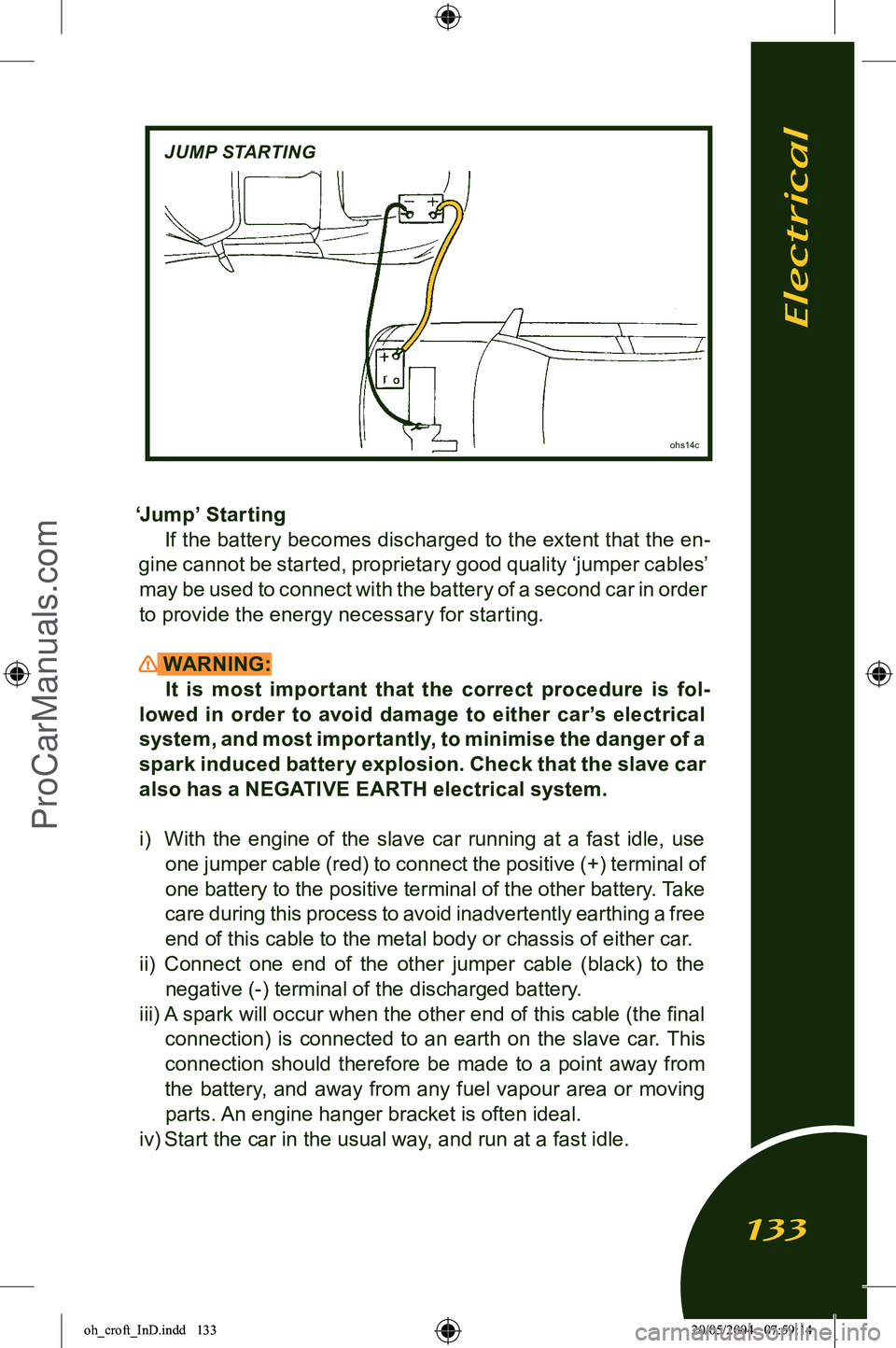
‘Jump’ StartingIf the battery becomes discharged to the extent that the en
-
gine cannot be started, proprietary good quality ‘jumper cables’ may be used to connect with the battery of a second car in order
to provide the energy necessary for starting.
WARNING: It is most important that the correct procedure is fol
-
lowed in order to avoid damage to either car’s electrical system, and most importantly, to minimise the danger of a
spark induced battery explosion. Check that the slave car
also has a NEGATIVE EARTH electrical system.
i) With the engine of the slave car running at a fast idle, use one jumper cable (red) to connect the positive (+) terminal of
one battery to the positive terminal of the other battery. Take
care during this process to avoid inadvertently earthing a free end of this cable to the metal body or chassis of either car.
ii) Connect one end of the other jumper cable (black) to the negative (-) terminal of the discharged battery.
iii) A spark will occur when the other end of this cable (the final connection) is connected to an earth on the slave car. This
connection should therefore be made to a point away from
the battery, and away from any fuel vapour area or moving
parts. An engine hanger bracket is often ideal.
iv) Start the car in the usual way, and run at a fast idle.
ohs14c
JUMP STARTING
Electrical
133
oh_croft_InD.indd 13320/05/2004 07:59:14ProCarManuals.com
Page 149 of 205

Towing a Trailer
WARNING:The Elise is not suitable for towing a trailer.
Car Tie-Down When moving a car by transporter or trailer, the car should be
secured only by chocking and strapping around the road wheels.
Attaching restraints around suspension linkages or chassis or body components may cause damage.
Lifting & Towing
147
oh_croft_InD.indd 14720/05/2004 07:59:17ProCarManuals.com
Page 150 of 205

Lifting Your Car
WARNING:
• Using a lifting jack can be dangerous. If the car falls off the jack, you or others could be seriously injured or killed.
NEVER get under a car when it is supported only by a
jack.
• Before raising the car with a jack: - Turn off the engine;
- Firmly apply the parking brake;
- Engage first or reverse gear;
- Securely chock all wheels not to be lifted.
• Use only those lifting points identified above. Jacking at any other point, or with a jack improperly positioned, may
damage the chassis or body structure and/or jeopardise safety.
Care must be taken when using a lifting jack or hoist to po
-
sition the device only in one of the areas shown in the illustration.
Use a suitable rubber or timber pad to protect the chassis from
surface damage:
A; Identified by a blue sticker. Beneath crossmember ahead of fuel tank bay. To be used one side at a time for wheel chang
-
ing - lifts both wheels on one side.
B; Garage use with 4-point lift. Beneath the front end of the right
or left hand main chassis rail, behind the front wheelarch.
ohs49
LIFTING POINTS
Lifting & Towing
148
oh_croft_InD.indd 14820/05/2004 07:59:18ProCarManuals.com