Page 235 of 328
STARTING
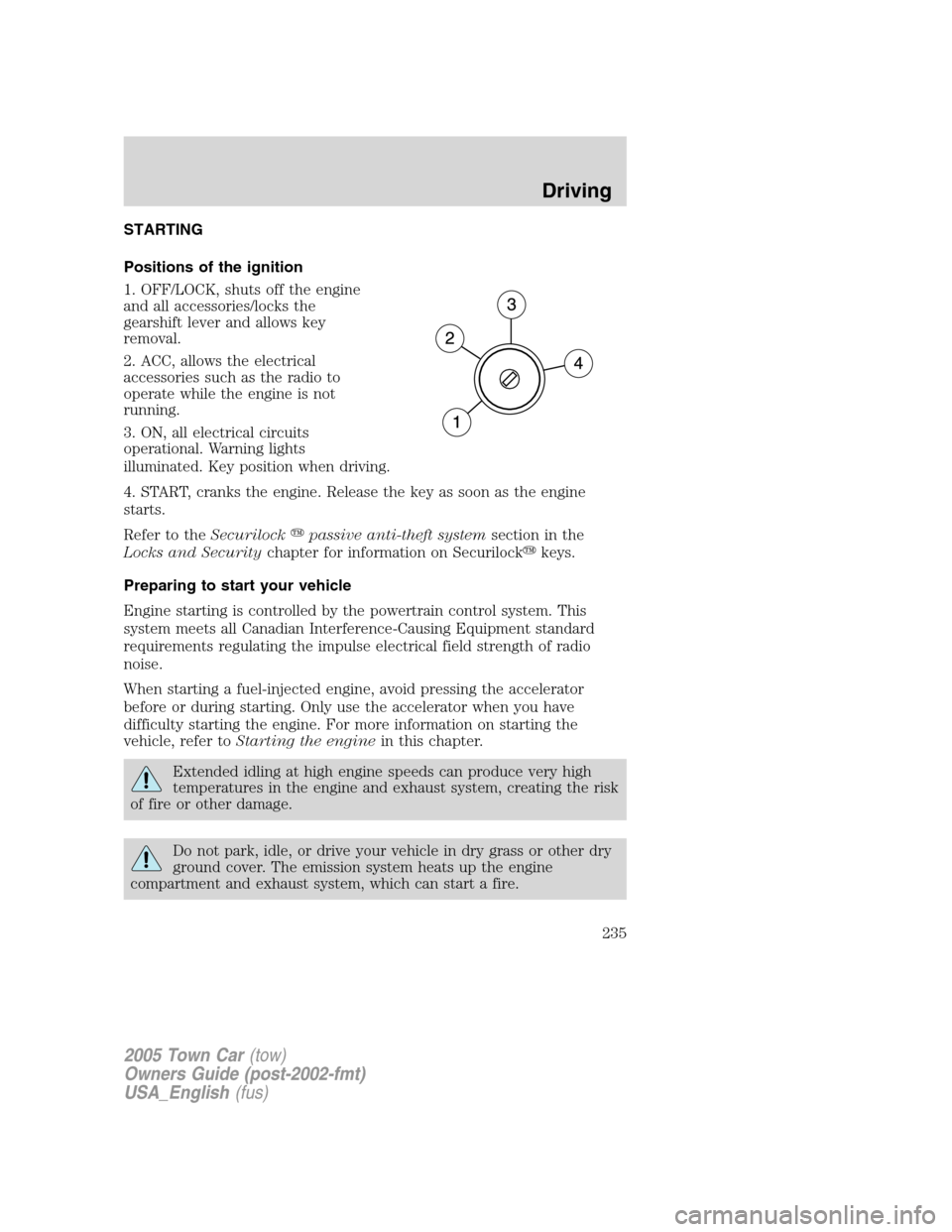
Positions of the ignition
1. OFF/LOCK, shuts off the engine
and all accessories/locks the
gearshift lever and allows key
removal.
2. ACC, allows the electrical
accessories such as the radio to
operate while the engine is not
running.
3. ON, all electrical circuits
operational. Warning lights
illuminated. Key position when driving.
4. START, cranks the engine. Release the key as soon as the engine
starts.
Refer to theSecurilock�passive anti-theft systemsection in the
Locks and Securitychapter for information on Securilock�keys.
Preparing to start your vehicle
Engine starting is controlled by the powertrain control system. This
system meets all Canadian Interference-Causing Equipment standard
requirements regulating the impulse electrical field strength of radio
noise.
When starting a fuel-injected engine, avoid pressing the accelerator
before or during starting. Only use the accelerator when you have
difficulty starting the engine. For more information on starting the
vehicle, refer toStarting the enginein this chapter.
Extended idling at high engine speeds can produce very high
temperatures in the engine and exhaust system, creating the risk
of fire or other damage.
Do not park, idle, or drive your vehicle in dry grass or other dry
ground cover. The emission system heats up the engine
compartment and exhaust system, which can start a fire.
2005 Town Car(tow)
Owners Guide (post-2002-fmt)
USA_English(fus)
Driving
235
Page 241 of 328
If the parking brake fails to release
after completing this procedure, use
the manual parking brake release
lever.
Pull the lever to manually release
the parking brake.
TRACTION CONTROL�
For Traction Control�warning lights refer toWarning Lightsin the
Instrument clusterchapter.
Your vehicle is equipped with a Traction Control�system (except on
commercial conversion packages). This system helps you maintain the
stability and steerability of your vehicle, especially on slippery road
surfaces such as snow- or ice-covered roads and gravel roads. The
system will allow your vehicle to make better use of available traction in
these conditions.
During Traction Control�operation, you may hear an electric motor
type of sound coming from the engine compartment and the engine will
not “rev-up” when you push further on the accelerator. This is normal
system behavior and should be no reason for concern.
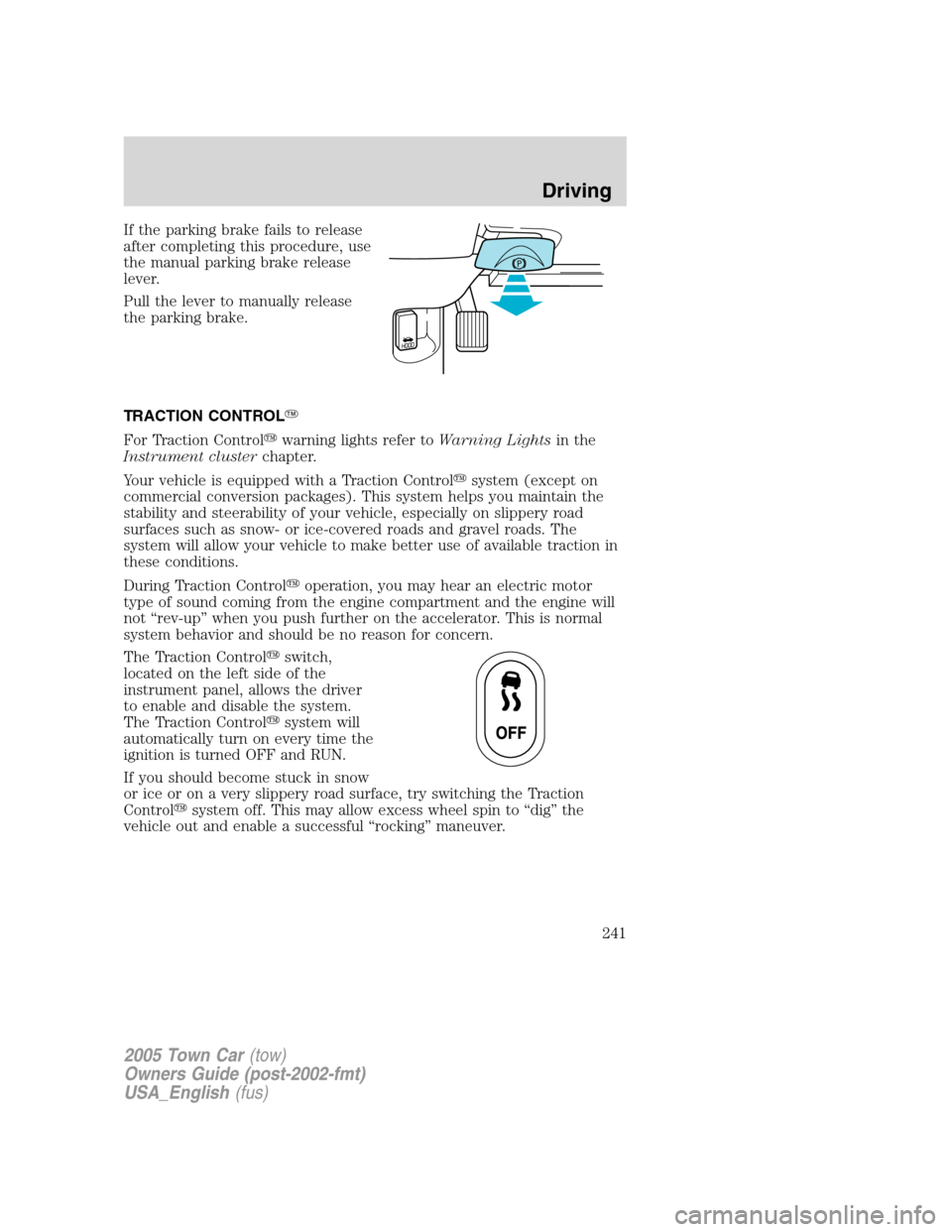
The Traction Control�switch,
located on the left side of the
instrument panel, allows the driver
to enable and disable the system.
The Traction Control�system will
automatically turn on every time the
ignition is turned OFF and RUN.
If you should become stuck in snow
or ice or on a very slippery road surface, try switching the Traction
Control�system off. This may allow excess wheel spin to “dig” the
vehicle out and enable a successful “rocking” maneuver.
2005 Town Car(tow)
Owners Guide (post-2002-fmt)
USA_English(fus)
Driving
241
Page 247 of 328
2 (Second)
This position allows for second gear only.
•Provides engine braking.
•Use to start-up on slippery roads.
•To return to
(Overdrive), move the gearshift lever into the
(Overdrive) position.
•Selecting 2 (Second) at higher speeds will cause the transmission to
downshift to second gear at the appropriate vehicle speed.
1 (First)
•Provides maximum engine braking.
•Allows upshifts by moving gearshift lever.
•Will not downshift into 1 (First) at high speeds; allows for 1 (First)
when vehicle reaches slower speeds.
Forced downshifts
•Allowed in
(Overdrive) or Drive.
•Depress the accelerator to the floor.
•Allows transmission to select an appropriate gear.
If your vehicle gets stuck in mud or snow
If your vehicle gets stuck in mud or snow, it may be rocked out by
shifting between forward and reverse gears, stopping between shifts in a
steady pattern. Press lightly on the accelerator in each gear.
If necessary, try turning the Traction Control�system off. This will allow
the wheels to spin, which may help to free your stuck vehicle. For more
information, refer toTraction Control�(if equipped)in this chapter.
Do not rock the vehicle if the engine is not at normal operating
temperature or damage to the transmission may occur.
Do not rock the vehicle for more than a minute or damage to the
transmission and tires may occur, or the engine may overheat.
TRACTION-LOK AXLE (IF EQUIPPED)
This axle provides added traction on slippery surfaces, particularly when
one wheel is on a poor traction surface. Under normal conditions, the
Traction-Lok axle functions like a standard rear axle. The axle may
exhibit a slight noise or vibration in tight turns with low vehicle speed.
This is normal behavior and indicates the axle is working.
2005 Town Car(tow)
Owners Guide (post-2002-fmt)
USA_English(fus)
Driving
247
Page 248 of 328
REVERSE SENSING SYSTEM
The extended rear park aid system sounds a tone to warn the driver of
obstacles near the rear bumper when the R (Reverse) gear is selected.
To help avoid personal injury, please read and understand the
limitations of the extended rear park assist system as contained
in this section. The park assist is only an aid for some (generally large
and fixed) objects when moving in reverse on a flat surface at “parking
speeds”. Inclement weather may also affect the function of the RSS;
this may include reduced performance or a false activation.
To help avoid personal injury, always use caution when in R
(Reverse) and when using the extended rear park aid.
This system is not designed to prevent contact with small or
moving objects. The system is designed to provide a warning to
assist the driver in detecting objects to avoid damaging the vehicle.
The system may not detect smaller objects, particularly those close to
the ground.
Certain add-on devices such as large trailer hitches, bike or
surfboard racks and any device that may block the normal
detection zone of the extended rear park aid system may create false
beeps.
The system will assist the driver in detecting certain objects while the
vehicle slowly moves in reverse at speeds less than 6 mph (10 km/h).
The system is not effective at speeds greater than 6 mph (10 km/h) and
may not detect certain angular or moving objects.
2005 Town Car(tow)
Owners Guide (post-2002-fmt)
USA_English(fus)
Driving
248
Page 251 of 328
GETTING ROADSIDE ASSISTANCE
To fully assist you should you have a vehicle concern, Ford Motor
Company offers a complimentary roadside assistance program. This
program is separate from the New Vehicle Limited Warranty. The service
is available:
•24–hours, seven days a week
•for the New Vehicle Limited Warranty period of three years or 36,000
miles (60,000 km), whichever occurs first on Ford and Mercury
vehicles, and four years or 50,000 miles (80,000 km) on Lincoln
vehicles.
Roadside assistance will cover:
•a flat tire change with a good spare (except Ford GT which has a tire
inflation kit)
•battery jump start
•lock-out assistance (key replacement cost is the customer’s
responsibility)
•fuel delivery (2.0 gallons [7.5L], maximum two occurrences within 12
month period)
•towing of your disabled vehicle to the nearest Ford Motor Company
dealership, or your selling dealer if within 35 miles (56.3 km) of the
nearest Ford Motor Company dealership (one tow per disablement).
Even non-warranty related tows, like accidents, are covered (some
exclusions apply, such as impound towing or repossession).
Canadian customers refer to your Owner Information Guide for
information on:
•coverage period
•exact fuel amounts
•towing of your disabled vehicle
•emergency travel expense reimbursement
•travel planning benefits
USING ROADSIDE ASSISTANCE
Complete the roadside assistance identification card and place it in your
wallet for quick reference. In the United States, this card is found in the
Owner Guide portfolio in the glove compartment. In Canada, the card is
found in theOwner Information Guidein the glove compartment.
U.S. Ford or Mercury vehicle customers who require roadside assistance,
call 1–800–241–3673; Lincoln vehicle customers call 1–800–521–4140.
2005 Town Car(tow)
Owners Guide (post-2002-fmt)
USA_English(fus)
Roadside Emergencies
251
Page 253 of 328
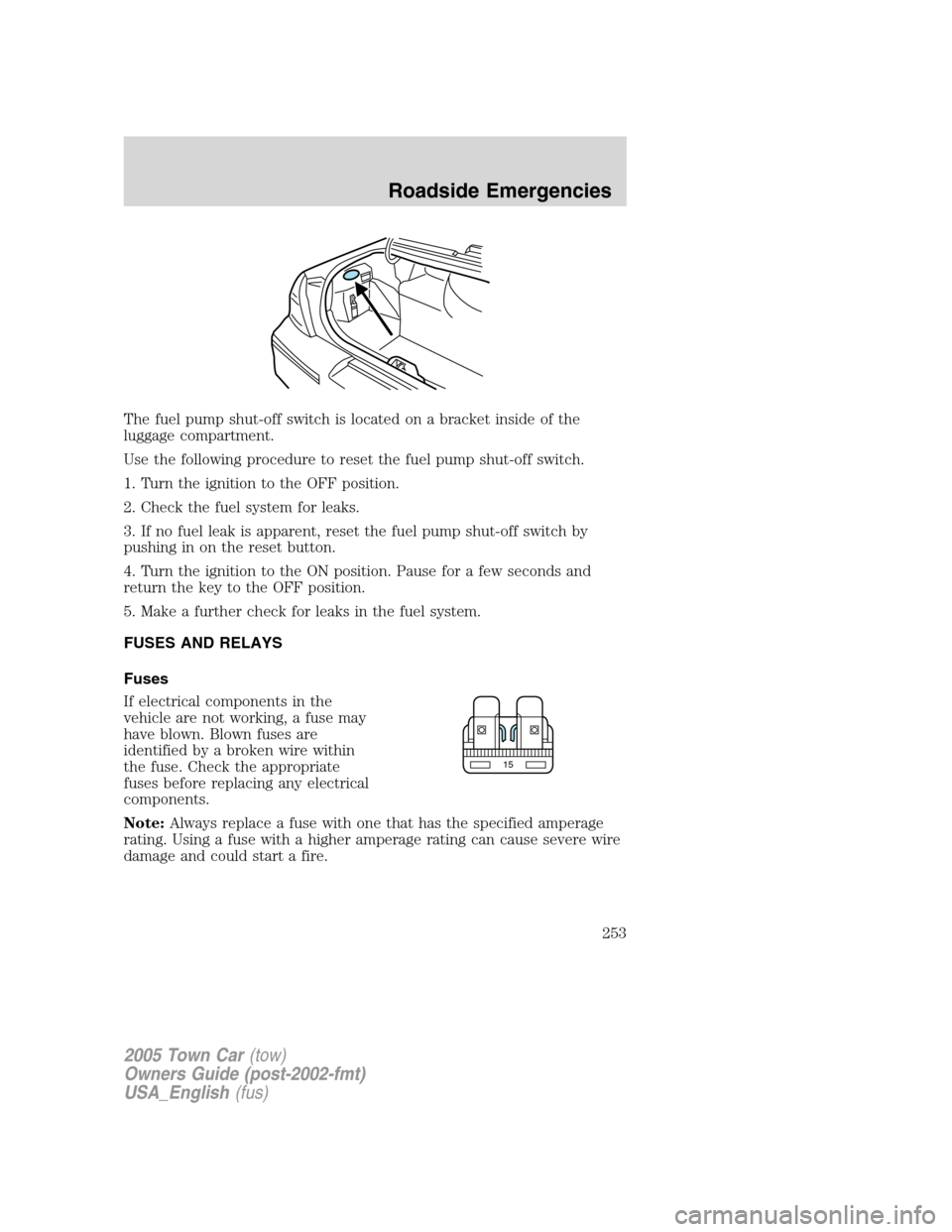
The fuel pump shut-off switch is located on a bracket inside of the
luggage compartment.
Use the following procedure to reset the fuel pump shut-off switch.
1. Turn the ignition to the OFF position.
2. Check the fuel system for leaks.
3. If no fuel leak is apparent, reset the fuel pump shut-off switch by
pushing in on the reset button.
4. Turn the ignition to the ON position. Pause for a few seconds and
return the key to the OFF position.
5. Make a further check for leaks in the fuel system.
FUSES AND RELAYS
Fuses
If electrical components in the
vehicle are not working, a fuse may
have blown. Blown fuses are
identified by a broken wire within
the fuse. Check the appropriate
fuses before replacing any electrical
components.
Note:Always replace a fuse with one that has the specified amperage
rating. Using a fuse with a higher amperage rating can cause severe wire
damage and could start a fire.
15
2005 Town Car(tow)
Owners Guide (post-2002-fmt)
USA_English(fus)
Roadside Emergencies
253
Page 254 of 328
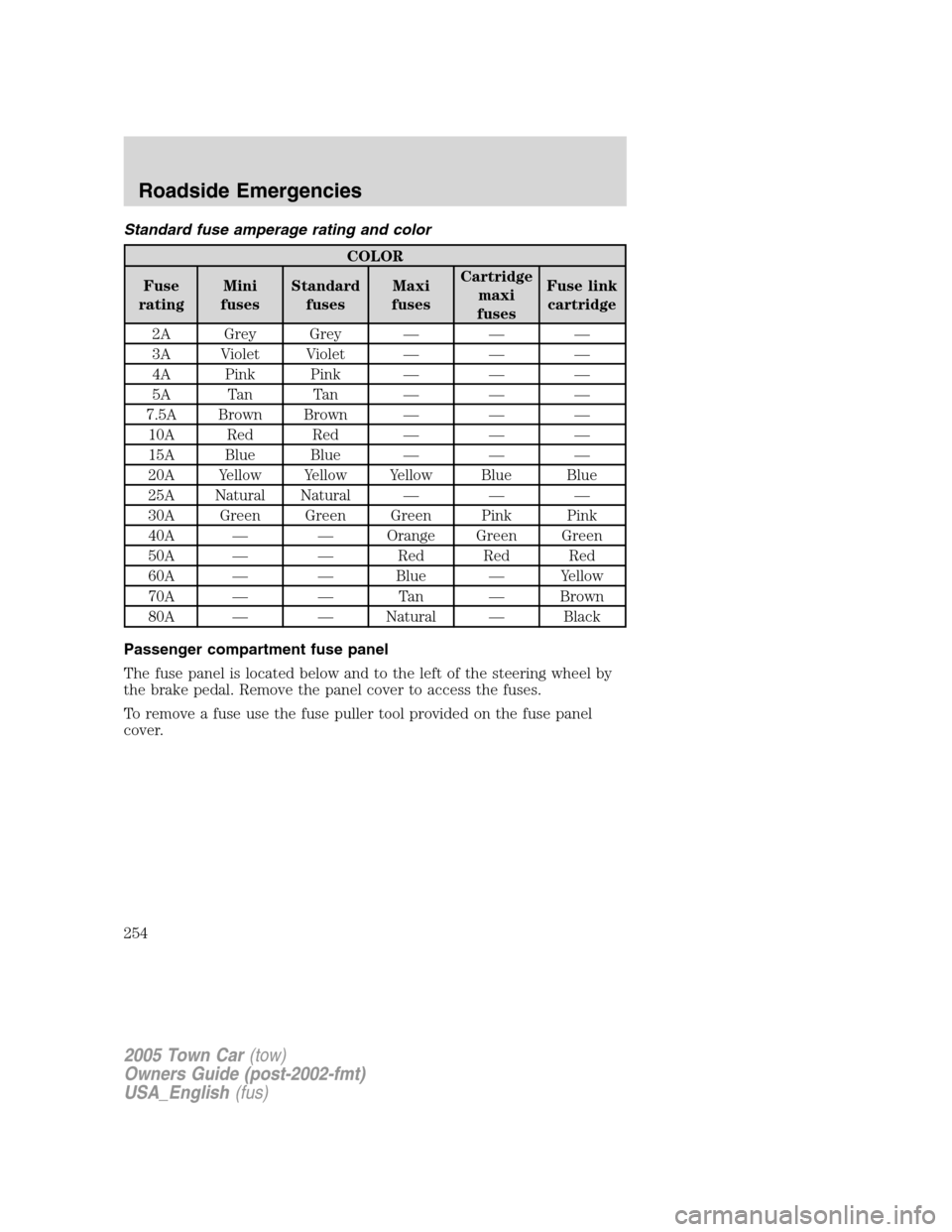
Standard fuse amperage rating and color
COLOR
Fuse
ratingMini
fusesStandard
fusesMaxi
fusesCartridge
maxi
fusesFuse link
cartridge
2A Grey Grey — — —
3A Violet Violet — — —
4A Pink Pink — — —
5A Tan Tan — — —
7.5A Brown Brown — — —
10A Red Red — — —
15A Blue Blue — — —
20A Yellow Yellow Yellow Blue Blue
25A Natural Natural — — —
30A Green Green Green Pink Pink
40A — — Orange Green Green
50A — — Red Red Red
60A — — Blue — Yellow
70A — — Tan — Brown
80A — — Natural — Black
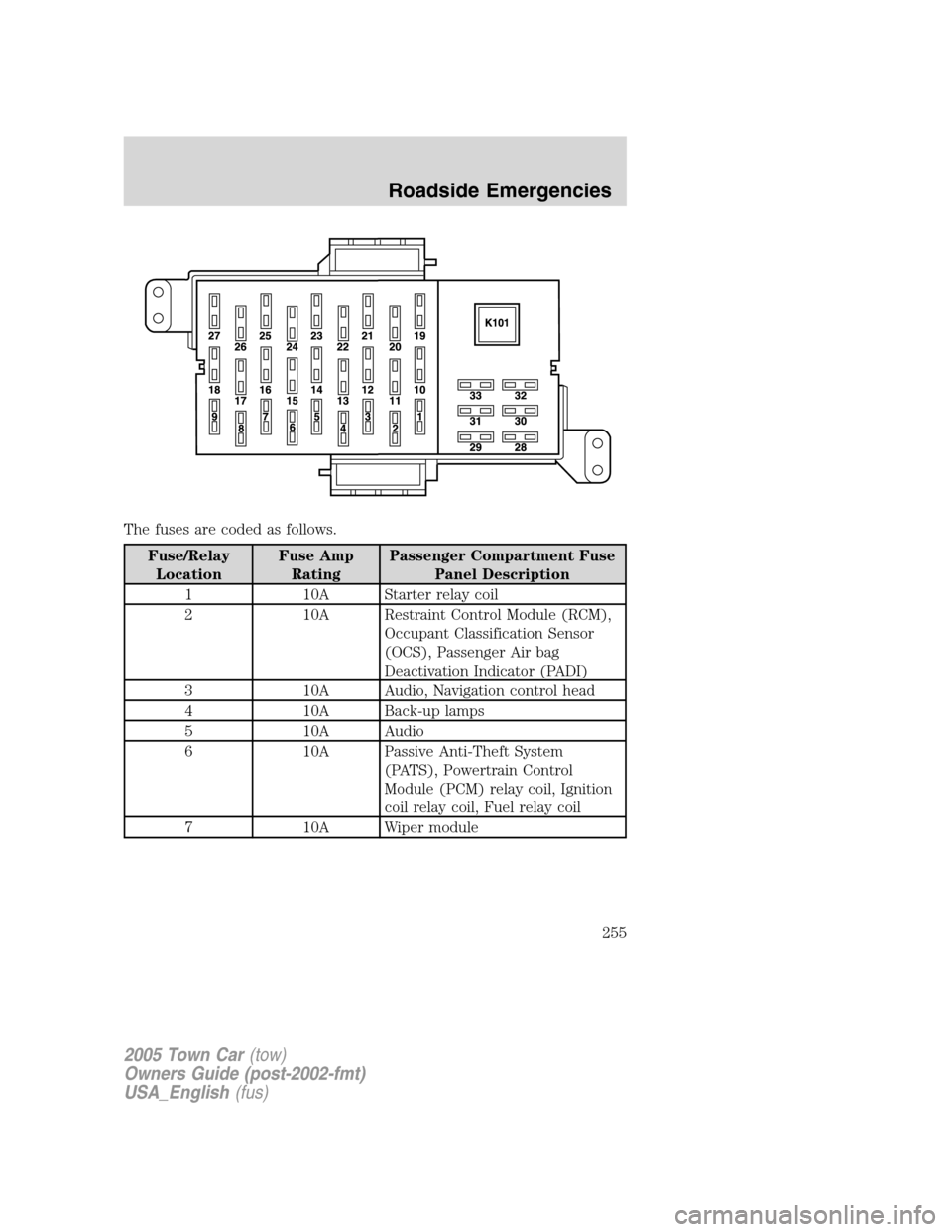
Passenger compartment fuse panel
The fuse panel is located below and to the left of the steering wheel by
the brake pedal. Remove the panel cover to access the fuses.
To remove a fuse use the fuse puller tool provided on the fuse panel
cover.
2005 Town Car(tow)
Owners Guide (post-2002-fmt)
USA_English(fus)
Roadside Emergencies
254
Page 255 of 328
The fuses are coded as follows.
Fuse/Relay
LocationFuse Amp
RatingPassenger Compartment Fuse
Panel Description
1 10A Starter relay coil
2 10A Restraint Control Module (RCM),
Occupant Classification Sensor
(OCS), Passenger Air bag
Deactivation Indicator (PADI)
3 10A Audio, Navigation control head
4 10A Back-up lamps
5 10A Audio
6 10A Passive Anti-Theft System
(PATS), Powertrain Control
Module (PCM) relay coil, Ignition
coil relay coil, Fuel relay coil
7 10A Wiper module
2005 Town Car(tow)
Owners Guide (post-2002-fmt)
USA_English(fus)
Roadside Emergencies
255