2005 KIA Sportage stop start
[x] Cancel search: stop startPage 6 of 354

13
1
2
3
4
5
6
7
8
9
Introduction
VEHICLE HANDLING
INSTRUCTIONSAs with other vehicles of this type,
failure to operate this vehicle correct-
ly may result in loss of control, an
accident or vehicle rollover.
Specific design characteristics (high-
er ground clearance, track, etc.) give
this vehicle a higher center of gravity
than other types of vehicles. In other
words they are not designed for cor-
nering at the same speeds as con-
ventional 2-wheel drive vehicles.
Avoid sharp turns or abrupt maneu-
vers. Again, failure to operate this
vehicle correctly may result in loss of
control, an accident or vehicle
rollover. Be sure to read the “on-
pavement” and “off-road” driving
guidelines, in section 5 of this manu-
al.
VEHICLE BREAK-IN
PROCESSNo special break-in period is needed.
By following a few simple precautions
for the first 1,000 km (600 miles) you
may add to the performance, econo-
my and life of your vehicle.
Do not race the engine.
Do not maintain a single speed for
long periods of time, either fast or
slow. Varying engine speed is
needed to properly break-in the
engine.
Avoid hard stops, except in emer-
gencies, to allow the brakes to seat
properly.
Avoid full-throttle starts.
KM CAN (ENG) 1.qxd 9/13/2004 4:10 PM Page 3
Page 128 of 354
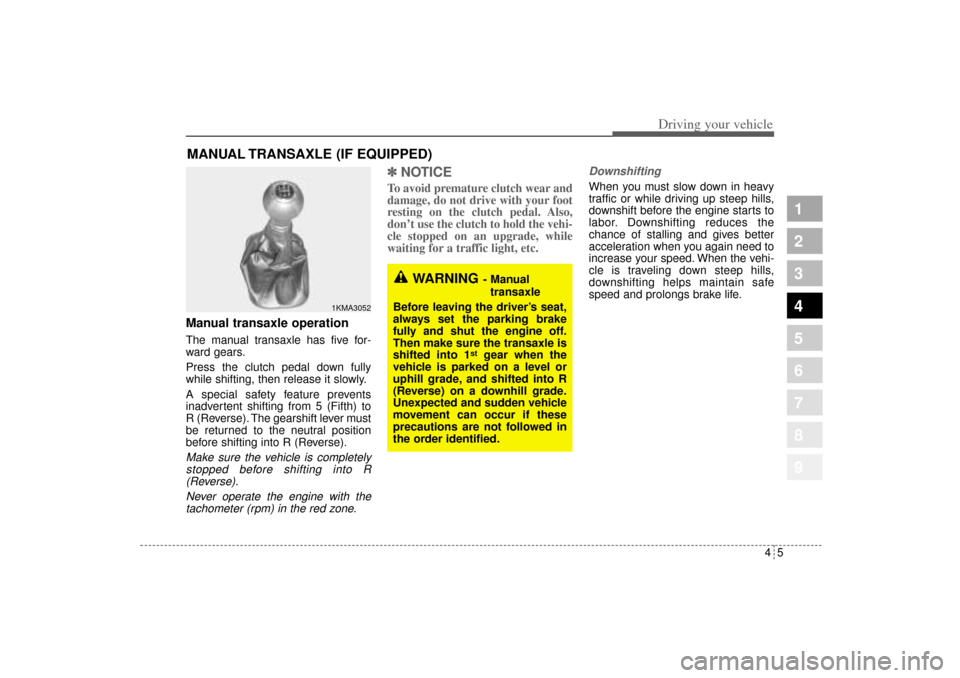
Manual transaxle operationThe manual transaxle has five for-
ward gears.
Press the clutch pedal down fully
while shifting, then release it slowly.
A special safety feature prevents
inadvertent shifting from 5 (Fifth) to
R (Reverse). The gearshift lever must
be returned to the neutral position
before shifting into R (Reverse).Make sure the vehicle is completely
stopped before shifting into R
(Reverse).
Never operate the engine with the
tachometer (rpm) in the red zone.
✽ ✽
NOTICETo avoid premature clutch wear and
damage, do not drive with your foot
resting on the clutch pedal. Also,
don’t use the clutch to hold the vehi-
cle stopped on an upgrade, while
waiting for a traffic light, etc.
DownshiftingWhen you must slow down in heavy
traffic or while driving up steep hills,
downshift before the engine starts to
labor. Downshifting reduces the
chance of stalling and gives better
acceleration when you again need to
increase your speed. When the vehi-
cle is traveling down steep hills,
downshifting helps maintain safe
speed and prolongs brake life.
MANUAL TRANSAXLE (IF EQUIPPED)
1KMA3052
WARNING
- Manual
transaxle
Before leaving the driver’s seat,
always set the parking brake
fully and shut the engine off.
Then make sure the transaxle is
shifted into 1
st
gear when the
vehicle is parked on a level or
uphill grade, and shifted into R
(Reverse) on a downhill grade.
Unexpected and sudden vehicle
movement can occur if these
precautions are not followed in
the order identified.
45
Driving your vehicle
1
2
3
4
5
6
7
8
9
KM CAN (ENG) 4.qxd 9/13/2004 4:48 PM Page 5
Page 139 of 354
Driving your vehicle16 4
1
2
3
4
5
6
7
8
9
If you need to drive in water, stop
your vehicle, set your transfer to
“4WD LOCK” and drive at less than
8 km/h (5 mph).
✽ ✽
NOTICE• Do not drive in water if the level is
higher than the bottom of the vehi-
cle.
• Check your brake condition once
you are out of mud or water. Press
the brake pedal several times as
you move slowly until you feel nor-
mal braking forces return.
• Shorten your scheduled mainte-
nance interval if you drive in off-
road conditions such as sand,
mud or water (see “Maintenance
Services” in the Index). Always
wash you car thoroughly.
• Since the driving torque is always
applied to the 4 wheels the per-
formance of the 4WD vehicle is
greatly affected by the condition of
the tires. Be sure to equip them
with all four tires with same size
and type.
• The full time four wheel drive
vehicle cannot be towed by an
ordinary tow truck. Make sure
that the vehicle is towed with its
four wheels raised off the ground.
WARNING
While the full-time 4WD vehicle
is being raised on a jack, never
start the engine or cause the
tires to rotate.
There is the danger that rotating
tires touching the ground could
cause the vehicle to go off the
jack and to jump forward.
CAUTION
If one of the front or rear wheels
begins to spin in mud, snow,
etc. the vehicle can sometimes
be driven out by depressing the
accelerator pedal further; how-
ever avoid running the engine
continuously at high rpm
because doing so could dam-
age the 4WD system.
WARNING
If you are driving in heavy wind,
the vehicle's higher center of
gravity decreases your steering
control capacity and requires
you to drive more slowly.
WARNING -
Driving
through water
If you are driving too fast in
water, the water spray can get
into the engine compartment
and wet the ignition system,
causing your vehicle to sudden-
ly stall. If this happens and your
vehicle is in a tilted position,
your vehicle may roll over.
KM CAN (ENG) 4.qxd 9/13/2004 4:48 PM Page 16
Page 146 of 354
423
Driving your vehicle
1
2
3
4
5
6
7
8
9
Even with the anti-lock brake sys-
tem, your vehicle still requires suf-
ficient stopping distance. Always
maintain a safe distance from the
vehicle in front of you.
Always slow down when cornering.
The anti-lock brake system cannot
prevent accidents resulting from
excessive speeds.
On loose or uneven road surfaces,
operation of the anti-lock brake
system may result in a longer stop-
ping distance than for vehicles
equipped with a conventional
brake system.
✽ ✽
NOTICE• If the ABS warning light is on and
stays on, you may have a problem
with the ABS system. In this case,
however, your regular brakes will
work normally.
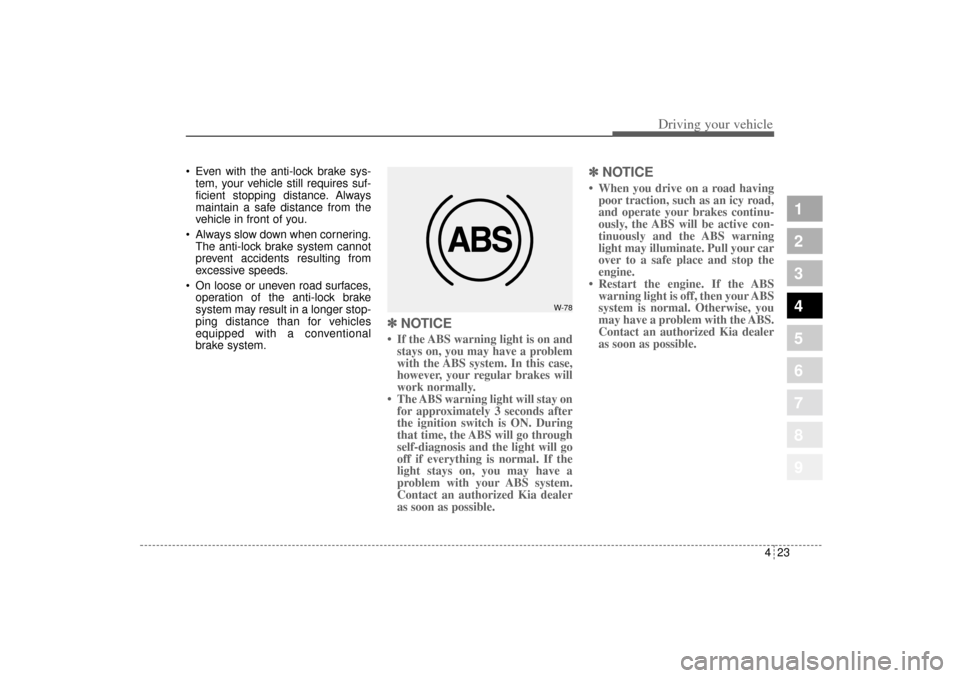
• The ABS warning light will stay on
for approximately 3 seconds after
the ignition switch is ON. During
that time, the ABS will go through
self-diagnosis and the light will go
off if everything is normal. If the
light stays on, you may have a
problem with your ABS system.
Contact an authorized Kia dealer
as soon as possible.
✽ ✽
NOTICE• When you drive on a road having
poor traction, such as an icy road,
and operate your brakes continu-
ously, the ABS will be active con-
tinuously and the ABS warning
light may illuminate. Pull your car
over to a safe place and stop the
engine.
• Restart the engine. If the ABS
warning light is off, then your ABS
system is normal. Otherwise, you
may have a problem with the ABS.
Contact an authorized Kia dealer
as soon as possible.
W-78
KM CAN (ENG) 4.qxd 9/13/2004 4:48 PM Page 23
Page 148 of 354
425
Driving your vehicle
1
2
3
4
5
6
7
8
9
Power steeringPower Steering uses energy from the
engine to assist you in steering the
vehicle. If the engine is off or if the
power steering system becomes
inoperative, the vehicle may still be
steered, but it will require increased
steering effort.
Should you notice any change in the
effort required to steer during normal
vehicle operation, have the power
steering checked by an Authorized
Kia Dealer.
✽ ✽
NOTICE• Never hold the steering wheel
against a stop (extreme right or
left turn) for more than 5 seconds
with the engine running. Holding
the steering wheel for more than 5
seconds in either position may
cause damage to the power steer-
ing pump.
• If the power steering drive belt
breaks or if the power steering
pump malfunctions, the steering
effort will greatly increase.
✽ ✽
NOTICEIf the vehicle is parked for extended
periods outside in cold weather
(below -10 °C/14 °F), the power
steering may require increased
effort when the engine is first start-
ed. This is caused by increased fluid
viscosity due to the cold weather and
does not indicate a malfunction.
When this happens, increase the
engine RPM by depressing accelera-
tor until the RPM reaches 1,500 rpm
then release or let the engine idle for
two or three minutes to warm up the
fluid.
STEERING WHEEL
KM CAN (ENG) 4.qxd 9/13/2004 4:48 PM Page 25
Page 171 of 354
Driving your vehicle48 4
1
2
3
4
5
6
7
8
9
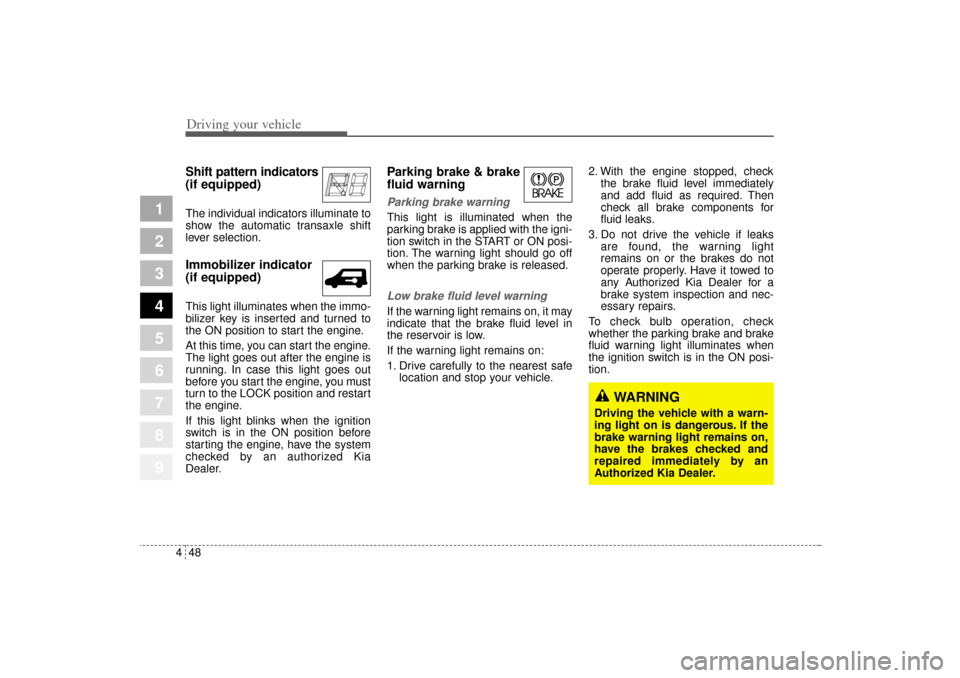
Shift pattern indicators
(if equipped)The individual indicators illuminate to
show the automatic transaxle shift
lever selection.Immobilizer indicator
(if equipped)This light illuminates when the immo-
bilizer key is inserted and turned to
the ON position to start the engine.
At this time, you can start the engine.
The light goes out after the engine is
running. In case this light goes out
before you start the engine, you must
turn to the LOCK position and restart
the engine.
If this light blinks when the ignition
switch is in the ON position before
starting the engine, have the system
checked by an authorized Kia
Dealer.
Parking brake & brake
fluid warning Parking brake warning This light is illuminated when the
parking brake is applied with the igni-
tion switch in the START or ON posi-
tion. The warning light should go off
when the parking brake is released.Low brake fluid level warningIf the warning light remains on, it may
indicate that the brake fluid level in
the reservoir is low.
If the warning light remains on:
1. Drive carefully to the nearest safe
location and stop your vehicle.2. With the engine stopped, check
the brake fluid level immediately
and add fluid as required. Then
check all brake components for
fluid leaks.
3. Do not drive the vehicle if leaks
are found, the warning light
remains on or the brakes do not
operate properly. Have it towed to
any Authorized Kia Dealer for a
brake system inspection and nec-
essary repairs.
To check bulb operation, check
whether the parking brake and brake
fluid warning light illuminates when
the ignition switch is in the ON posi-
tion.
WARNING
Driving the vehicle with a warn-
ing light on is dangerous. If the
brake warning light remains on,
have the brakes checked and
repaired immediately by an
Authorized Kia Dealer.
KM CAN (ENG) 4.qxd 9/13/2004 4:48 PM Page 48
Page 176 of 354
453
Driving your vehicle
1
2
3
4
5
6
7
8
9
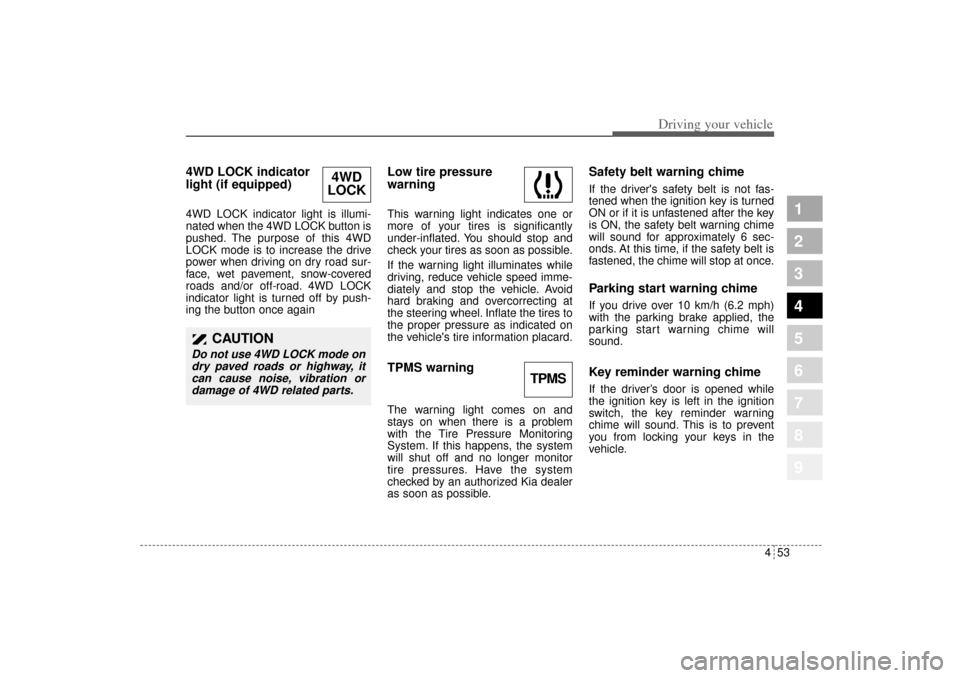
4WD LOCK indicator
light (if equipped) 4WD LOCK indicator light is illumi-
nated when the 4WD LOCK button is
pushed. The purpose of this 4WD
LOCK mode is to increase the drive
power when driving on dry road sur-
face, wet pavement, snow-covered
roads and/or off-road. 4WD LOCK
indicator light is turned off by push-
ing the button once again
Low tire pressure
warningThis warning light indicates one or
more of your tires is significantly
under-inflated. You should stop and
check your tires as soon as possible.
If the warning light illuminates while
driving, reduce vehicle speed imme-
diately and stop the vehicle. Avoid
hard braking and overcorrecting at
the steering wheel. Inflate the tires to
the proper pressure as indicated on
the vehicle's tire information placard.TPMS warning The warning light comes on and
stays on when there is a problem
with the Tire Pressure Monitoring
System. If this happens, the system
will shut off and no longer monitor
tire pressures. Have the system
checked by an authorized Kia dealer
as soon as possible.
Safety belt warning chime If the driver's safety belt is not fas-
tened when the ignition key is turned
ON or if it is unfastened after the key
is ON, the safety belt warning chime
will sound for approximately 6 sec-
onds. At this time, if the safety belt is
fastened, the chime will stop at once.Parking start warning chimeIf you drive over 10 km/h (6.2 mph)
with the parking brake applied, the
parking start warning chime will
sound.Key reminder warning chimeIf the driver’s door is opened while
the ignition key is left in the ignition
switch, the key reminder warning
chime will sound. This is to prevent
you from locking your keys in the
vehicle.
4WD
LOCK
CAUTION
Do not use 4WD LOCK mode on
dry paved roads or highway, it
can cause noise, vibration or
damage of 4WD related parts.
TPMS
KM CAN (ENG) 4.qxd 9/13/2004 4:48 PM Page 53
Page 177 of 354

Driving your vehicle54 4
1
2
3
4
5
6
7
8
9
➀
Low tire pressure indicator
➁
TPMS indicator
Your car is equipped with a Tire
Pressure Monitoring System (TPMS)
that turns on every time you start the
engine and monitors the pressure in
your tires while driving. TPMS uses a
sensor to check tire pressure levels
of the vehicle tires.
Each tire has its own pressure sen-
sor. If the air pressure of a tire
becomes significantly low, the sen-
sor in that tire immediately sends a
signal that causes the low tire pres-
sure indicator in the instrument clus-
ter to come on.
Low tire pressure indi-
catorWhen the tire pressure monitoring
system warning light is illuminated,
one or more of your tires is signifi-
cantly under-inflated. You should
stop and check your tires as soon as
possible. (If this occurs, reduce vehi-
cle speed immediately and stop the
vehicle. Avoid hard braking and over-
correcting the steering wheel.) Inflate
the tires to the proper pressure as
indicated on the vehicle's tire infor-
mation placard.
Driving on a significantly under-inflat-
ed tire causes the tire to overheat
and can lead to tire failure. Under-
inflation also reduces fuel efficiency
and tire tread life, and may affect the
vehicle's handling and stopping abili-
ty.Each tire, including the spare, should
be checked monthly when cold and
set to the recommend inflation pres-
sure as specified in the vehicle tire
information placard and owner's
manual.
Although your tire pressure is moni-
tored, it is important that you manu-
ally check the tire pressures monthly.
If the Low Tire Pressure Indicator
( ) illuminates while you are driv-
ing, you should have your tires
checked by an authorized Kia dealer
as soon as possible. If you think you
can safely drive a short distance to a
service station, proceed slowly to the
station and inflate the tire to the rec-
ommended pressure shown on the
tire information placard on the dri-
ver's door sill. If the tire is flat, or if the
tire pressure is too low to continue
driving, replace the tire with the com-
pact spare tire.
TIRES PRESSURE MONITORING SYSTEM (TPMS)
5GHN3003
➀
➁
KM CAN (ENG) 4.qxd 9/13/2004 4:48 PM Page 54