2005 KIA Sportage sensor
[x] Cancel search: sensorPage 85 of 354
Knowing your vehicle74 3
1
2
3
4
5
6
7
8
9
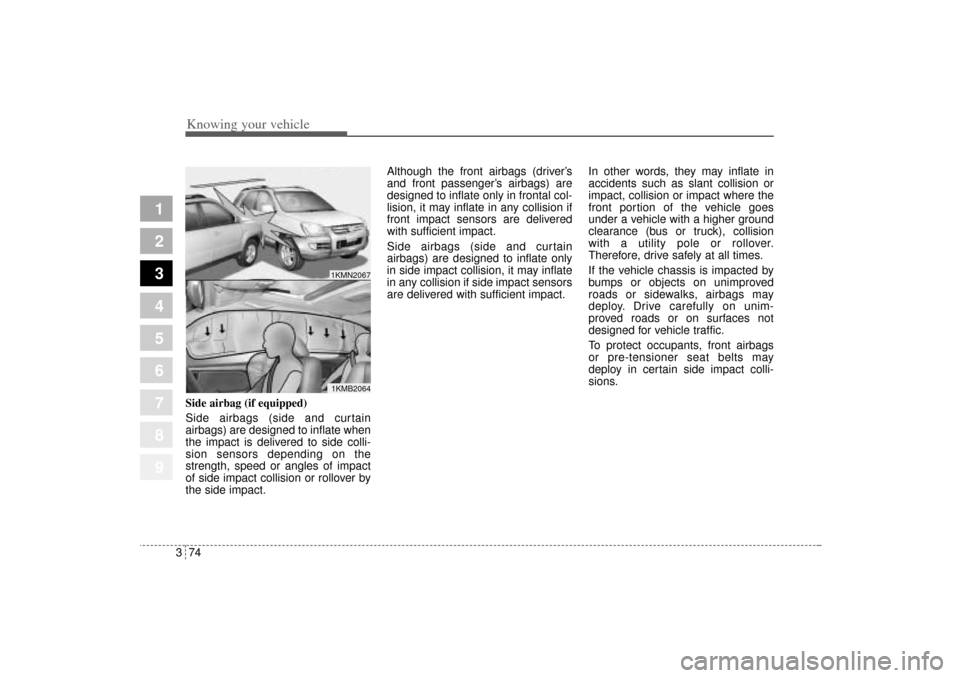
Side airbag (if equipped)
Side airbags (side and curtain
airbags) are designed to inflate when
the impact is delivered to side colli-
sion sensors depending on the
strength, speed or angles of impact
of side impact collision or rollover by
the side impact.Although the front airbags (driver’s
and front passenger’s airbags) are
designed to inflate only in frontal col-
lision, it may inflate in any collision if
front impact sensors are delivered
with sufficient impact.
Side airbags (side and curtain
airbags) are designed to inflate only
in side impact collision, it may inflate
in any collision if side impact sensors
are delivered with sufficient impact.In other words, they may inflate in
accidents such as slant collision or
impact, collision or impact where the
front portion of the vehicle goes
under a vehicle with a higher ground
clearance (bus or truck), collision
with a utility pole or rollover.
Therefore, drive safely at all times.
If the vehicle chassis is impacted by
bumps or objects on unimproved
roads or sidewalks, airbags may
deploy. Drive carefully on unim-
proved roads or on surfaces not
designed for vehicle traffic.
To protect occupants, front airbags
or pre-tensioner seat belts may
deploy in certain side impact colli-
sions.
1KMN20671KMB2064
KM CAN (ENG) 3 (~112).qxd 9/13/2004 4:50 PM Page 74
Page 88 of 354
377
1
2
3
4
5
6
7
8
9
Knowing your vehicle
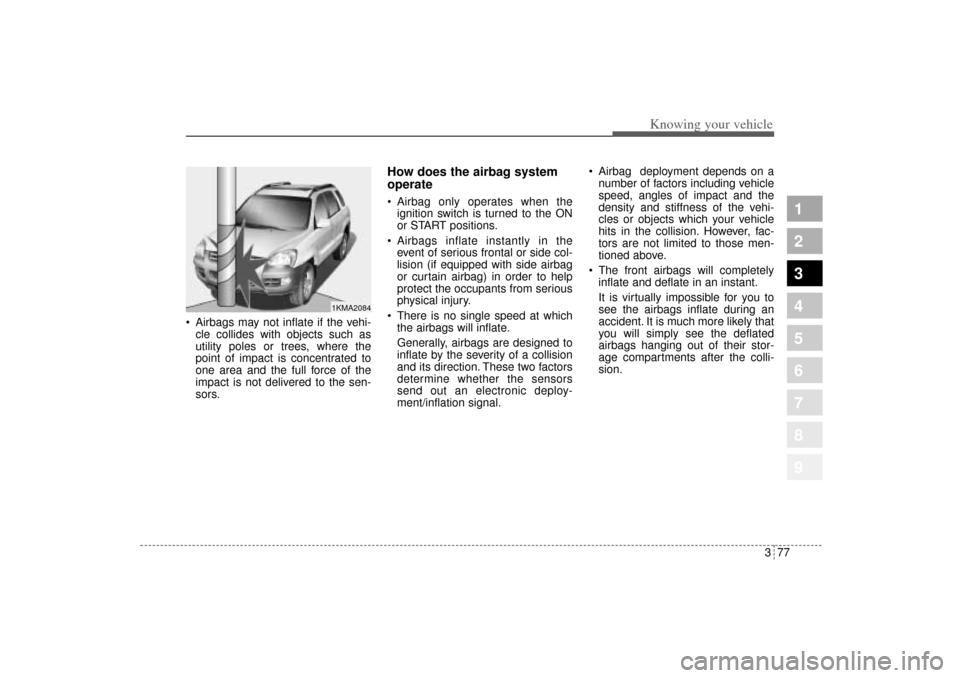
Airbags may not inflate if the vehi-
cle collides with objects such as
utility poles or trees, where the
point of impact is concentrated to
one area and the full force of the
impact is not delivered to the sen-
sors.
How does the airbag system
operate Airbag only operates when the
ignition switch is turned to the ON
or START positions.
Airbags inflate instantly in the
event of serious frontal or side col-
lision (if equipped with side airbag
or curtain airbag) in order to help
protect the occupants from serious
physical injury.
There is no single speed at which
the airbags will inflate.
Generally, airbags are designed to
inflate by the severity of a collision
and its direction. These two factors
determine whether the sensors
send out an electronic deploy-
ment/inflation signal. Airbag deployment depends on a
number of factors including vehicle
speed, angles of impact and the
density and stiffness of the vehi-
cles or objects which your vehicle
hits in the collision. However, fac-
tors are not limited to those men-
tioned above.
The front airbags will completely
inflate and deflate in an instant.
It is virtually impossible for you to
see the airbags inflate during an
accident. It is much more likely that
you will simply see the deflated
airbags hanging out of their stor-
age compartments after the colli-
sion.
1KMA2084
KM CAN (ENG) 3 (~112).qxd 9/13/2004 4:50 PM Page 77
Page 102 of 354
391
1
2
3
4
5
6
7
8
9
Knowing your vehicle
Electric type (if equipped)The electric day/night rearview mir-
ror automatically controls the glare
from the headlights of the car behind
you in nighttime or low light driving
conditions. The sensor mounted in
the mirror senses the light level
around the vehicle, and through a
chemical reaction, automatically
controls the headlight glare (10% to
70 %) from vehicles behind you.
When the engine is running, the
glare is automatically controlled by
the sensor mounted in the rearview
mirror.
Whenever the shift lever is shifted
into reverse (R), the mirror will auto-
matically go to the brightest setting in
order to improve the drivers view
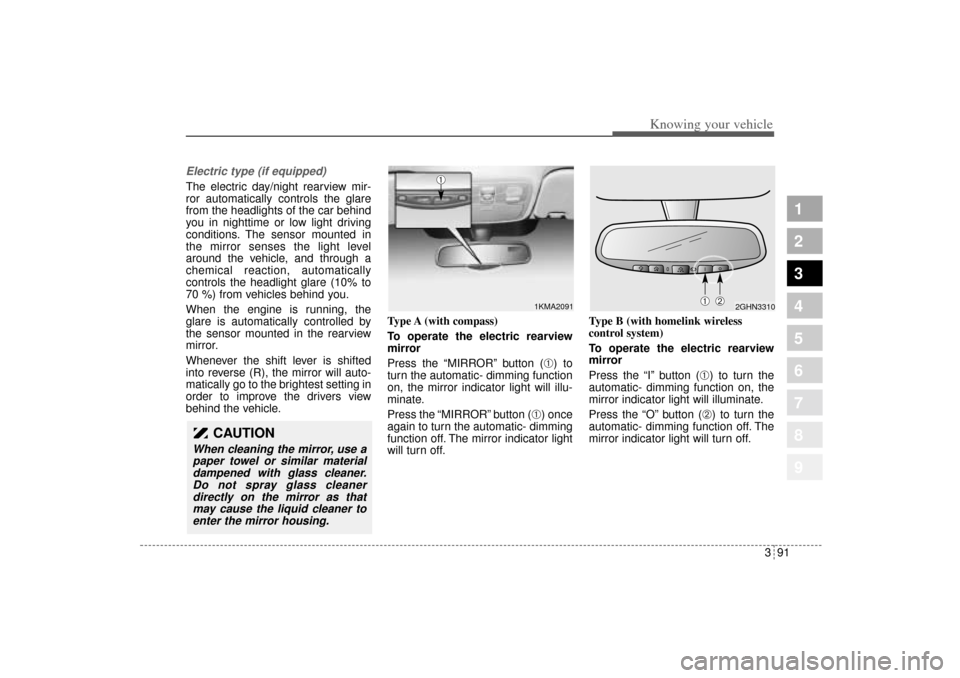
behind the vehicle.Type A (with compass)
To operate the electric rearview
mirror
Press the “MIRROR” button (
➀) to
turn the automatic- dimming function
on, the mirror indicator light will illu-
minate.
Press the “MIRROR” button (
➀) once
again to turn the automatic- dimming
function off. The mirror indicator light
will turn off.Type B (with homelink wireless
control system)
To operate the electric rearview
mirror
Press the “I” button (
➀) to turn the
automatic- dimming function on, the
mirror indicator light will illuminate.
Press the “O” button (➁) to turn the
automatic- dimming function off. The
mirror indicator light will turn off.
1KMA2091
➀
CAUTION
When cleaning the mirror, use a
paper towel or similar material
dampened with glass cleaner.
Do not spray glass cleaner
directly on the mirror as that
may cause the liquid cleaner to
enter the mirror housing.
2GHN3310
➀
➁
KM CAN (ENG) 3 (~112).qxd 9/13/2004 4:51 PM Page 91
Page 159 of 354
Driving your vehicle36 4
1
2
3
4
5
6
7
8
9
The Electronic Stability Program
(ESP) monitors information from
various vehicle sensors and then
compares the driver's commands
with the actual behavior of the
vehicle. If an unstable condition
occurs - a sudden evasive movement
for example - ESP intervenes within
fractions of a second via the engine
computer and brake system and
attempts to stabilize the vehicle.
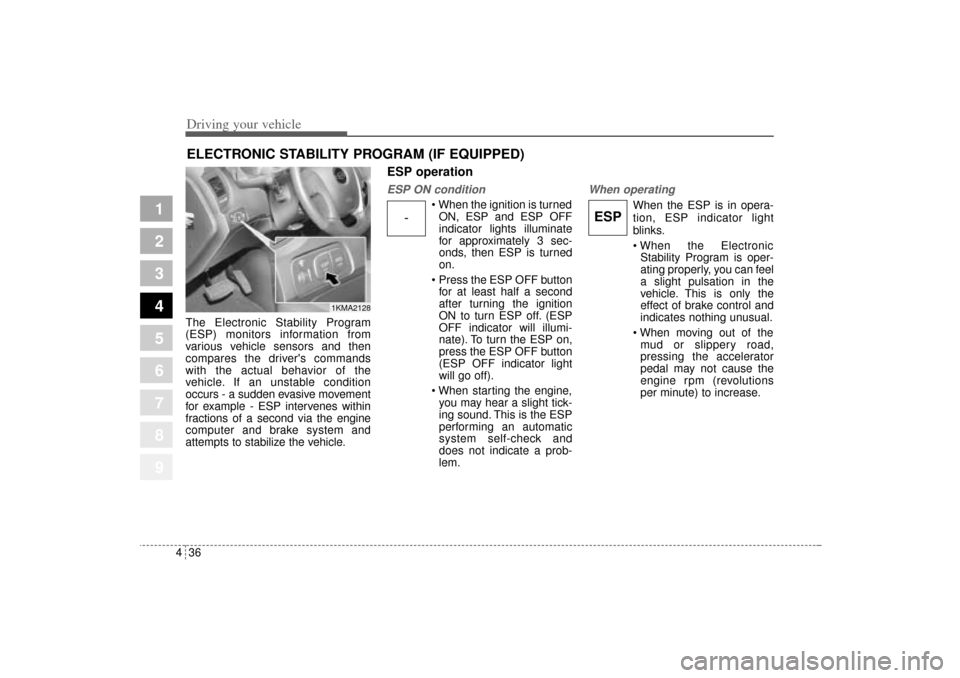
ESP operationESP ON condition
When the ignition is turned
ON, ESP and ESP OFF
indicator lights illuminate
for approximately 3 sec-
onds, then ESP is turned
on.
Press the ESP OFF button
for at least half a second
after turning the ignition
ON to turn ESP off. (ESP
OFF indicator will illumi-
nate). To turn the ESP on,
press the ESP OFF button
(ESP OFF indicator light
will go off).
When starting the engine,
you may hear a slight tick-
ing sound. This is the ESP
performing an automatic
system self-check and
does not indicate a prob-
lem.
When operating
When the ESP is in opera-
tion, ESP indicator light
blinks.
When the Electronic
Stability Program is oper-
ating properly, you can feel
a slight pulsation in the
vehicle. This is only the
effect of brake control and
indicates nothing unusual.
When moving out of the
mud or slippery road,
pressing the accelerator
pedal may not cause the
engine rpm (revolutions
per minute) to increase.
ELECTRONIC STABILITY PROGRAM (IF EQUIPPED)
-
ESP
1KMA2128
KM CAN (ENG) 4.qxd 9/13/2004 4:48 PM Page 36
Page 177 of 354

Driving your vehicle54 4
1
2
3
4
5
6
7
8
9
➀
Low tire pressure indicator
➁
TPMS indicator
Your car is equipped with a Tire
Pressure Monitoring System (TPMS)
that turns on every time you start the
engine and monitors the pressure in
your tires while driving. TPMS uses a
sensor to check tire pressure levels
of the vehicle tires.
Each tire has its own pressure sen-
sor. If the air pressure of a tire
becomes significantly low, the sen-
sor in that tire immediately sends a
signal that causes the low tire pres-
sure indicator in the instrument clus-
ter to come on.
Low tire pressure indi-
catorWhen the tire pressure monitoring
system warning light is illuminated,
one or more of your tires is signifi-
cantly under-inflated. You should
stop and check your tires as soon as
possible. (If this occurs, reduce vehi-
cle speed immediately and stop the
vehicle. Avoid hard braking and over-
correcting the steering wheel.) Inflate
the tires to the proper pressure as
indicated on the vehicle's tire infor-
mation placard.
Driving on a significantly under-inflat-
ed tire causes the tire to overheat
and can lead to tire failure. Under-
inflation also reduces fuel efficiency
and tire tread life, and may affect the
vehicle's handling and stopping abili-
ty.Each tire, including the spare, should
be checked monthly when cold and
set to the recommend inflation pres-
sure as specified in the vehicle tire
information placard and owner's
manual.
Although your tire pressure is moni-
tored, it is important that you manu-
ally check the tire pressures monthly.
If the Low Tire Pressure Indicator
( ) illuminates while you are driv-
ing, you should have your tires
checked by an authorized Kia dealer
as soon as possible. If you think you
can safely drive a short distance to a
service station, proceed slowly to the
station and inflate the tire to the rec-
ommended pressure shown on the
tire information placard on the dri-
ver's door sill. If the tire is flat, or if the
tire pressure is too low to continue
driving, replace the tire with the com-
pact spare tire.
TIRES PRESSURE MONITORING SYSTEM (TPMS)
5GHN3003
➀
➁
KM CAN (ENG) 4.qxd 9/13/2004 4:48 PM Page 54
Page 178 of 354

455
Driving your vehicle
1
2
3
4
5
6
7
8
9
TPMS indicator The TPMS indicator comes on and
stays on when there is a problem
with the Tire Pressure Monitoring
System. If this happens, the system
will shut off and no longer monitor
tire pressures. Have the system
checked by an authorized Kia dealer
as soon as possible.
Changing the tire with TPMSIf you have a flat tire, the Low Tire
Pressure indicator will come on.
Replace the flat tire with the compact
spare tire.
Each wheel is equipped with a tire
pressure sensor mounted inside the
tire behind the valve stem. You must
use TPMS specific wheels. It is rec-
ommended that you always have
your tires serviced by an authorized
Kia dealer.
After you replace the flat tire, the Low
Tire Pressure indicator ( ) in the
instrument cluster will stay on. This is
normal; however it is important to
remember that the system is not
monitoring the pressure of the spare
tire. Remember to manually check
the spare tire pressure including
other tires pressure for proper infla-
tion.
Never use a puncture-repairing
agent in a flat tire. If used, you will
have to replace the tire pressure
sensor. Have the flat tire repaired by
an authorized Kia dealer as soon as
possible.
✽ ✽
NOTICE• Do not use any tire sealant if your
vehicle is equipped with Tire
Pressure Monitors. The liquid
sealant can damage the tire pres-
sure monitor sensors.
• The TPMS cannot alert you to
severe and sudden tire damage
caused by external factors. This device complies with Industry
Canada Standard RSS-210.
Operation is subject to the following
two conditions:
1. This device may not cause inter-
ference, and
2. This device must accept any inter-
ference, including interference that
may cause undesired operation of
the device.
TPMS
KM CAN (ENG) 4.qxd 9/13/2004 4:48 PM Page 55
Page 205 of 354
Driving your vehicle82 4
1
2
3
4
5
6
7
8
9
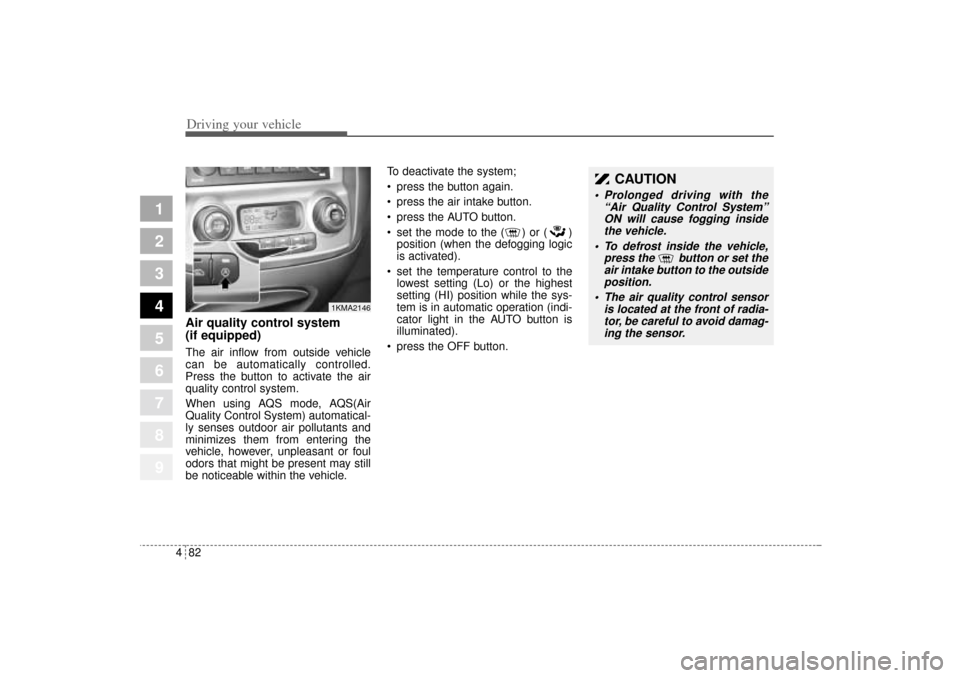
Air quality control system
(if equipped)The air inflow from outside vehicle
can be automatically controlled.
Press the button to activate the air
quality control system.
When using AQS mode, AQS(Air
Quality Control System) automatical-
ly senses outdoor air pollutants and
minimizes them from entering the
vehicle, however, unpleasant or foul
odors that might be present may still
be noticeable within the vehicle.To deactivate the system;
press the button again.
press the air intake button.
press the AUTO button.
set the mode to the ( ) or ( )
position (when the defogging logic
is activated).
set the temperature control to the
lowest setting (Lo) or the highest
setting (HI) position while the sys-
tem is in automatic operation (indi-
cator light in the AUTO button is
illuminated).
press the OFF button.
CAUTION
Prolonged driving with the
“Air Quality Control System”
ON will cause fogging inside
the vehicle.
To defrost inside the vehicle,
press the button or set the
air intake button to the outside
position.
The air quality control sensor
is located at the front of radia-
tor, be careful to avoid damag-
ing the sensor.
1KMA2146
KM CAN (ENG) 4.qxd 9/13/2004 4:49 PM Page 82
Page 219 of 354
Driving tips2 5FUEL REQUIREMENTSGasoline engine (unleaded)Your new Kia vehicle is designed to
use only unleaded fuel with a mini-
mum Octane Rating of 87 Anti-
Knock Index (AKI).✽ ✽
NOTICENEVER USE LEADED FUEL. The
use of leaded fuel is detrimental to
the catalytic converter and will
damage the engine control system’s
oxygen sensor and affect emission
control.
Never add any fuel system cleaning
agents to the fuel tank other than
what Kia has specified. (Consult an
Authorized Kia Dealer for details.)
Gasoline containing alcohol
and methanolGasohol, a mixture of gasoline and
ethanol (also known as grain alco-
hol), and gasoline or gasohol con-
taining methanol (also known as
wood alcohol) are being marketed
along with or instead of leaded or
unleaded gasoline.
Do not use gasohol containing more
than 10% ethanol, and do not use
gasoline or gasohol containing any
methanol. Either of these fuels may
cause drivability problems and dam-
age to the fuel system.
Discontinue using gasohol of any
kind if drivability problems occur.Vehicle damage or driveability prob-
lems may not be covered by the
manufacturer’s warranty if they result
from the use of:
1. Gasohol containing more than
10% ethanol.
2. Gasoline or gasohol containing
methanol.
3. Leaded fuel or leaded gasohol.
✽ ✽
NOTICENever use gasohol which contains
methanol. Discontinue use of any
gasohol product which impairs dri-
vability.
1
2
3
4
5
6
7
8
9KM CAN (ENG) 5.qxd 9/13/2004 4:48 PM Page 2