Page 113 of 238
Driving Your Vehicle4-32Key Reminder Warning Chime
If the driver’s door is opened and the ignition key is
left in the ignition switch, the key reminder warning
chime will sound. This is to remind you to remove
your keys from the ignition before you lock the vehi-
cle.Lights-On Warning ChimeThe lights-on warning chime will sound if the head-
light switch is left in the 1st or 2nd position and the
door is opened.Headlight High Beam Indicator This indicator illuminates when the headlights are on
and in the high beam position or when the turn signal
lever is pulled into the Flash-to-Pass position.O/D OFF Indicator
(automatic transaxle)This indicator comes on when the O/D system is
deactivated.
✽
NOTICE
A loose fuel filler cap may cause the On Board
DiagnosticSystem Malfunction Indicator Light
( ) in the instrument panel to illuminate
unnecessarily. Always make sure that the fuel
filler cap is tight.
CHECK
CHECK
RIO ENG CNA 4.qxd 7/29/05 5:06 PM Page 32
Page 114 of 238

4-33 Door Ajar Warning
This warning light comes on when a door is not closed
securely with the ignition switch in any position.Anti-Lock Brake System (ABS)
Warning Light (if equipped)This light illuminates when you start the engine. The
light will go off if the ABS system is operating nor-
mally. Also, this light comes on if the key is turned to
ON, and then goes off in 2-3 seconds if the system is
operating normally.
If this warning light illuminates while the vehicle is
being driven, have the vehicle checked by an autho-
rized Kia Dealer as soon as possible.Rear Window Defroster Indicator This light comes on when the rear defroster is ON.Rear Hatch Warning Light
(5 door-if equipped)This warning light comes on when a rear hatch is not
closed securely with the ignition switch in any posi-
tion.
AS2B04020
LightingLighting ControlTo turn the lights on, twist the knob on the end of the
control lever which is located on the steering column
to the left of the steering wheel.
First position
Tail, parking, license and sidemarker lights and instru-
ment panel lights ON.
Second position
Head, tail, parking, license and sidemarker lights and
instrument panel lights ON.
ABS
RIO ENG CNA 4.qxd 7/29/05 5:06 PM Page 33
Page 120 of 238

Hazard Warning Flasher
The hazard warning flasher causes the rear tail
lights and front turn signal lights to flash on and
off, which serves as a warning to other drivers to
exercise caution when approaching or passing
your vehicle.
To activate the flasher, depress the hazard warning
flasher switch. This switch operates in any igni-
tion switch position.
To turn the flashers off, depress the switch again.
4-39 Type B
The defroster heats the window to remove frost, fog
and thin ice from the interior and exterior of the rear
window. The ignition switch must be ON for the
defroster to operate.
To activate the rear window defroster, press the rear
window defroster button located in the center console
switch panel. The instrument panel rear window
defroster indicator illuminates when the defroster is ON.
The rear window defroster automatically turns OFF
after 20 minutes or when the ignition switch is turned
OFF. To turn off the defroster, press the rear window
defroster button again. If there is heavy accumulation
of snow on the rear window, brush it off before operat-
ing the rear defroster.
✽
NOTICE
To prevent damage to the conductors bonded to
the inside surface of the rear window, never use
sharp instruments or window cleaners containing
abrasives to clean the window.✽
NOTICE
To prevent the battery from being discharged,
operate the defroster only while the engine is run-
ning.
1B3104014B
RIO ENG CNA 4.qxd 7/29/05 5:06 PM Page 39
Page 139 of 238

Necessary InspectionsFluid levels, such as engine oil, engine coolant,
brake/clutch fluid, and washer fluid should be checked
on a regular basis, with the exact interval depending on
the fluid. Further details are provided in Maintenance,
Section 7.Before Starting Close and lock all doors.
Position the seat so that all controls are easily
reached.
Adjust the inside and outside rearview mirrors.
Be sure that all lights work.
Check all gauges.
Check the operation of warning lights when the
ignition switch is turned to the ON position.
Release the parking brake and make sure the brake
warning light goes out.
For safe operation, be sure you are familiar with your
vehicle and its equipment.
Drunk DrivingDrinking and driving is dangerous. Drunk driving is
the number one contributor to the highway death toll
each year. Alcohol impairs a driver’s judgment, vision
and muscular coordination. Even a small amount of
alcohol will affect a driver’s reflexes, perceptions and
judgment.
Please don’t drink and drive, or ride with a driver who
has been drinking. Choose a designated driver if you’re
with a group, or if you’re alone, call a cab.Drugs and DrivingDriving while under the influence of drugs is as
dangerous or more dangerous than driving under the
influence of alcohol, depending on the drug(s) used
and the quantity consumed. Don’t take drugs and drive.
If you are taking a prescription medicine, check with
your doctor or pharmacist regarding whether you may
operate a motor vehicle.
5-5
RIO ENG CNA 5.qxd 7/29/05 5:07 PM Page 5
Page 151 of 238

Road WarningHazard Warning FlasherThe hazard warning flasher serves as a warning to
other drivers to exercise extreme caution when
approaching, overtaking, or passing your vehicle. It
should be used whenever emergency repairs are being
made or when the vehicle is stopped near the edge of a
roadway.
Depress the flasher switch with the ignition switch in
any position. The flasher switch is located in the center
console. All turn signal lights will flash
simultaneously.
•The hazard warning flasher will operate whether
your vehicle is running or not.
The turn signals do not operate when the hazard
flasher is
ON
.
Care must be taken when using the hazard warning
flasher while the vehicle is being towed. Local
regulations may prohibit using it in this manner.
OverheatingIf your temperature gauge indicates overheating, if you
experience a loss of power, or if you hear a loud
knocking or pinging noise, the engine has probably
overheated. You should follow these procedures if you
experience any of these symptoms.
1. Turn the hazard warning flasher ON, then drive to
the nearest safe location and stop your vehicle; set
the automatic transaxle in P (Park), or shift the
manual transaxle to neutral and apply the parking
brake.
In Case Of An Emergency6-2
1B3104014B
RIO ENG CNA 6.qxd 7/29/05 5:15 PM Page 2
Page 159 of 238
In Case Of An Emergency6-10Fuse Panel DescriptionDriver’s side kick panel
DESCRIPTION FUSE PROTECTED
RATING COMPONENT
Drive’rs side kick panel
(A/BAG) 10A Airbag
TURN LAMP 10A Turn signal lamp
METER 10A Meterset, Backup lamp,
Warning sound
ILLUMI 10A Illumination
POWER SOCKET 15A Trunk room lamp, Power socket
HAZARD 10A Hazard lamp
STOP 15A Stop lamp, ABS
TAIL(RH) 10A Tail lamp
(Right-Rear/Left-Front),
Switch illumination
TAIL(LH) 10A Tail lamp
(Left-Rear/Right-Front)
CIGAR 15A Cigarette lighter
AUDIO 10A Audio, Electric rearview mirror
WIPER(FRT) 15A Wiper(front), Washer(front),
Sunroof
WIPER(RR) 15A Wiper(Rear), Washer(Rear)
(WARMER) 15A Seatwarmer
MIRROR DEF 10A Mirror defroster
START 10A Engine control unit,
ECAT unit
*( ):Optional
RIO ENG CNA 6.qxd 7/29/05 5:15 PM Page 10
Page 203 of 238
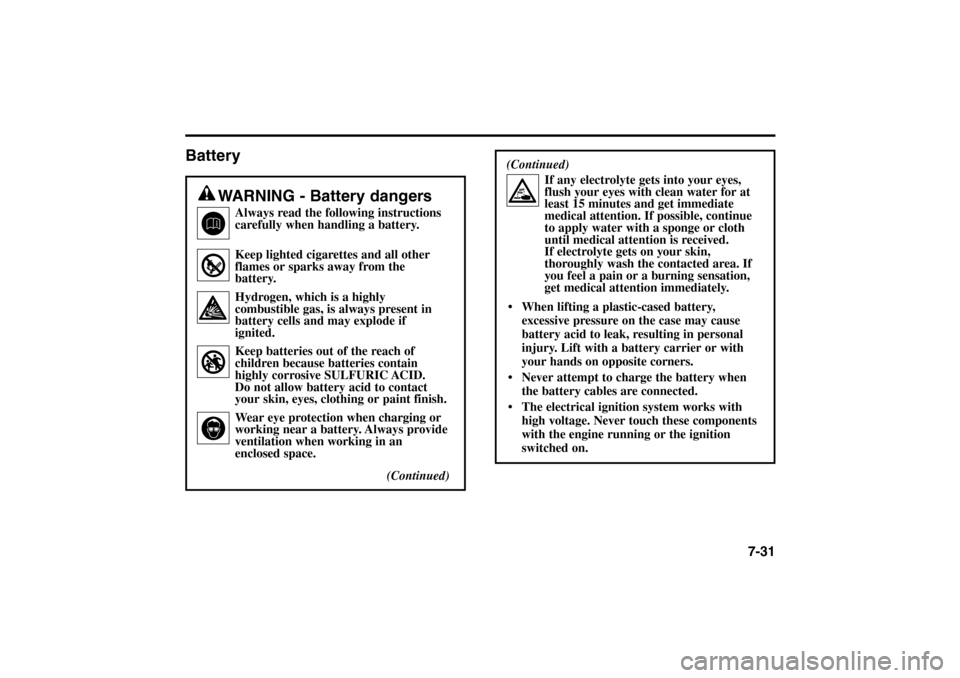
Battery
7-31
WARNING - Battery dangers
Always read the following instructions
carefully when handling a battery.
Keep lighted cigarettes and all other
flames or sparks away from the
battery.
Hydrogen, which is a highly
combustible gas, is always present in
battery cells and may explode if
ignited.
Keep batteries out of the reach of
children because batteries contain
highly corrosive SULFURIC ACID.
Do not allow battery acid to contact
your skin, eyes, clothing or paint finish.
Wear eye protection when charging or
working near a battery. Always provide
ventilation when working in an
enclosed space.
(Continued)
(Continued)
If any electrolyte gets into your eyes,
flush your eyes with clean water for at
least 15 minutes and get immediate
medical attention. If possible, continue
to apply water with a sponge or cloth
until medical attention is received.
If electrolyte gets on your skin,
thoroughly wash the contacted area. If
you feel a pain or a burning sensation,
get medical attention immediately.
• When lifting a plastic-cased battery,
excessive pressure on the case may cause
battery acid to leak, resulting in personal
injury. Lift with a battery carrier or with
your hands on opposite corners.
Never attempt to charge the battery when
the battery cables are connected.
The electrical ignition system works with
high voltage. Never touch these components
with the engine running or the ignition
switched on.
RIO ENG CNA 7-2.qxd 7/29/05 5:18 PM Page 31
Page 214 of 238

Maintenance7-42
1. Remove the headlight bulb cover by turning it
counterclockwise.
2. Disconnect the electrical connector from the bulb
assembly.
3. Unsnap the headlight bulb retaining wire by
depressing the end of it and pulling it upward.
4. Remove the bulb.
5. Install a new bulb by aligning the bulb with the
three(3) slots on the headlight assembly and snap the
headlight bulb retaining wire into position.
6. Connect the headlight bulb electrical connector.
7. Install the headlight bulb cover.
Bulb ReplacementHeadlight Bulb Replacement
WARNING - Halogen Bulbs
Wear eye protection when changing a bulb.
Allow the bulb to cool before handling it.
Halogen bulbs contain pressurized gas. If
broken, a halogen bulb will explode and will
produce flying pieces of glass.
Always handle halogen bulbs carefully to
avoid scratches and abrasion. If the bulbs
are lit, avoid contact with liquids. Never
touch the glass with bare hands. Residual oil
may cause the bulb to overheat and burst
when lit. A bulb should be operated only
when installed in the headlight assembly.
If a bulb becomes damaged or cracked,
replace it immediately and carefully dispose
it.
1B3106004B
RIO ENG CNA 7-2.qxd 7/29/05 5:18 PM Page 42

