Page 243 of 318
In case of an emergency
22
6
1 23456789
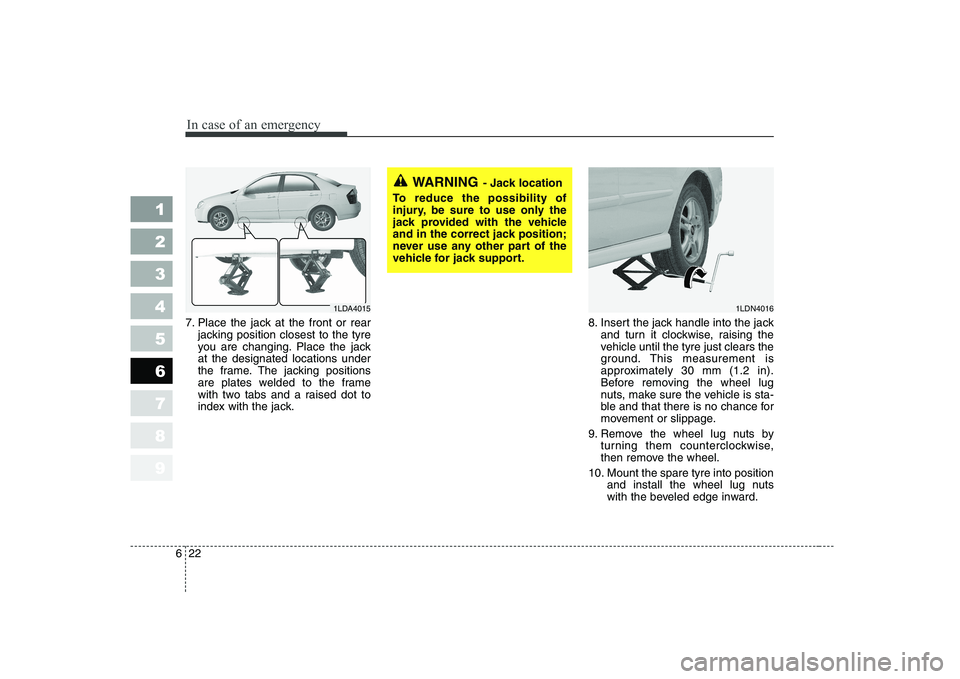
7. Place the jack at the front or rear
jacking position closest to the tyre
you are changing. Place the jackat the designated locations under
the frame. The jacking positions
are plates welded to the frame
with two tabs and a raised dot to
index with the jack. 8. Insert the jack handle into the jack
and turn it clockwise, raising the
vehicle until the tyre just clears the
ground. This measurement is
approximately 30 mm (1.2 in).
Before removing the wheel lug
nuts, make sure the vehicle is sta-
ble and that there is no chance for
movement or slippage.
9. Remove the wheel lug nuts by turning them counterclockwise,
then remove the wheel.
10. Mount the spare tyre into position and install the wheel lug nuts
with the beveled edge inward.
WARNING - Jack location
To reduce the possibility of
injury, be sure to use only the
jack provided with the vehicle
and in the correct jack position;
never use any other part of the
vehicle for jack support.
1LDN40161LDA4015
Page 244 of 318
623
In case of an emergency
1 23456789
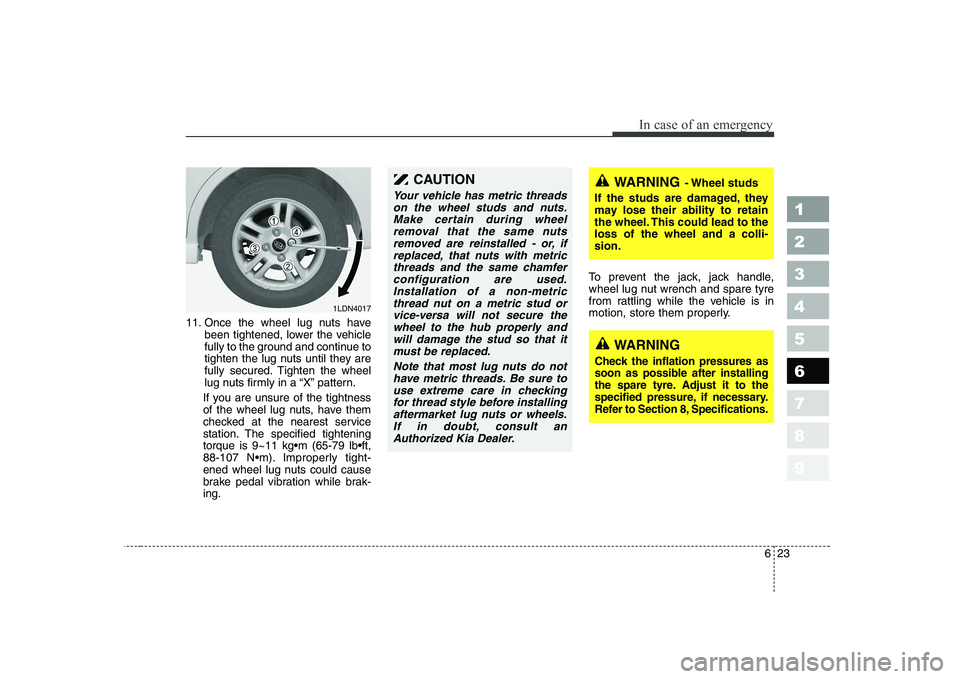
11. Once the wheel lug nuts havebeen tightened, lower the vehicle
fully to the ground and continue to
tighten the lug nuts until they are
fully secured. Tighten the wheel
lug nuts firmly in a “X” pattern.
If you are unsure of the tightness
of the wheel lug nuts, have them
checked at the nearest service
station. The specified tightening
Improperly tight-
ened wheel lug nuts could cause
brake pedal vibration while brak-ing. To prevent the jack, jack handle,
wheel lug nut wrench and spare tyre
from rattling while the vehicle is in
motion, store them properly.
1LDN4017
CAUTION
Your vehicle has metric threads
on the wheel studs and nuts. Make certain during wheelremoval that the same nutsremoved are reinstalled - or, if replaced, that nuts with metricthreads and the same chamferconfiguration are used. Installation of a non-metricthread nut on a metric stud orvice-versa will not secure thewheel to the hub properly and will damage the stud so that itmust be replaced.
Note that most lug nuts do nothave metric threads. Be sure to use extreme care in checkingfor thread style before installingaftermarket lug nuts or wheels.If in doubt, consult an Authorized Kia Dealer.
WARNING - Wheel studs
If the studs are damaged, they
may lose their ability to retain
the wheel. This could lead to theloss of the wheel and a colli-sion.
WARNING
Check the inflation pressures as
soon as possible after installing
the spare tyre. Adjust it to the
specified pressure, if necessary.
Refer to Section 8, Specifications.
Page 245 of 318
1 234567891 23456789
10
Maintenance services / 7-3 Normal maintenance schedule / 7-5
Maintenance under severe usage conditions / 7-11
Owner maintenance / 7-13Engine compartment / 7-16
Engine oil and oil filter / 7-19Engine cooling system / 7-22Brakes and clutch / 7-25Parking brake / 7-26Drive belts / 7-27
Power steering / 7-28
Steering wheel / 7-29Manual transaxle / 7-30Automatic transaxle / 7-32Lubricants and fluids / 7-35
Fuel filter / 7-36
Air cleaner / 7-37
Air conditioner air filter / 7-39
Wiper blades / 7-41
Maintenance
Page 246 of 318
1 23456789Battery / 7-43
Tyres and wheels / 7-46
Bulb replacement / 7-53
Lubricant specifications / 7-60 Exterior care / 7-62Interior care / 7-66
Maintenance
1 23456789
Page 257 of 318
713
Maintenance
1 23456789
OWNER MAINTENANCE
Owner maintenance schedule
The following lists are vehicle checks and inspections that should be per-
formed by the owner or an
Authorized Kia Dealer at the fre-quencies indicated to help ensure
safe, dependable operation of your
vehicle.
Any adverse conditions should be
brought to the attention of your deal-
er as soon as possible.
These Owner Maintenance Checks
are generally not covered by war-
ranties and you may be charged for
labor, parts and lubricants used.
When you stop for fuel:
Check the engine oil level.
Check coolant level in coolant reservoir.
Check the windshield washer fluid level.
Look for low or under-inflated tyres.
While operating your vehicle:
Note any changes in the sound ofthe exhaust or any smell of
exhaust fumes in the vehicle.
Check for vibrations in the steering wheel. Notice any increased steer-
ing effort or looseness in the steer-
ing wheel, or change in its straight-ahead position.
Notice if your vehicle constantly turns slightly or “pulls” to one side
when traveling on smooth, levelroad.
When stopping, listen and check for strange sounds, pulling to one
side, increased brake pedal travel
or “hard-to-push” brake pedal.
If any slipping or changes in the operation of your transaxle occurs,
check the transaxle fluid level.
Check automatic transaxle P (Park) function.
Check parking brake.
Check for fluid leaks under your vehicle (water dripping from the air conditioning system after use is
normal).
WARNING
Be careful when checking your
engine coolant level when the
engine is hot. Scalding hot
coolant and steam may blow out
under pressure. This could
cause serious injury.
Page 258 of 318
Maintenance
14
7
1 23456789
At least monthly:
Check coolant level in the coolant
recovery reservoir.
Check the operation of all exterior lights, including the stoplights, turn
signals and hazard warning flash-
ers.
Check the inflation pressures of all tyres including the spare.
At least twice a year
(i.e., every Spring and Fall) :
Check radiator, heater and air con- ditioning hoses for leaks or da-
mage.
Check windshield washer spray and wiper operation. Clean wiper
blades with clean cloth dampened
with washer fluid.
Check headlight alignment.
Check muffler, exhaust pipes, shields and clamps.
Check the lap/shoulder belts for wear and function.
Check for worn tyres and loose wheel lug nuts.
At least once a year :
Clean body and door drain holes.
Lubricate door hinges and checks,and hood hinges.
Lubricate door and hood locks and latches.
Lubricate door rubber weather- strips.
Check the air conditioning system before the warm weather season.
Check the power steering fluid level.
Inspect and lubricate automatic transaxle linkage and controls.
Clean battery and terminals.
Check the brake fluid level.
Page 273 of 318
729
Maintenance
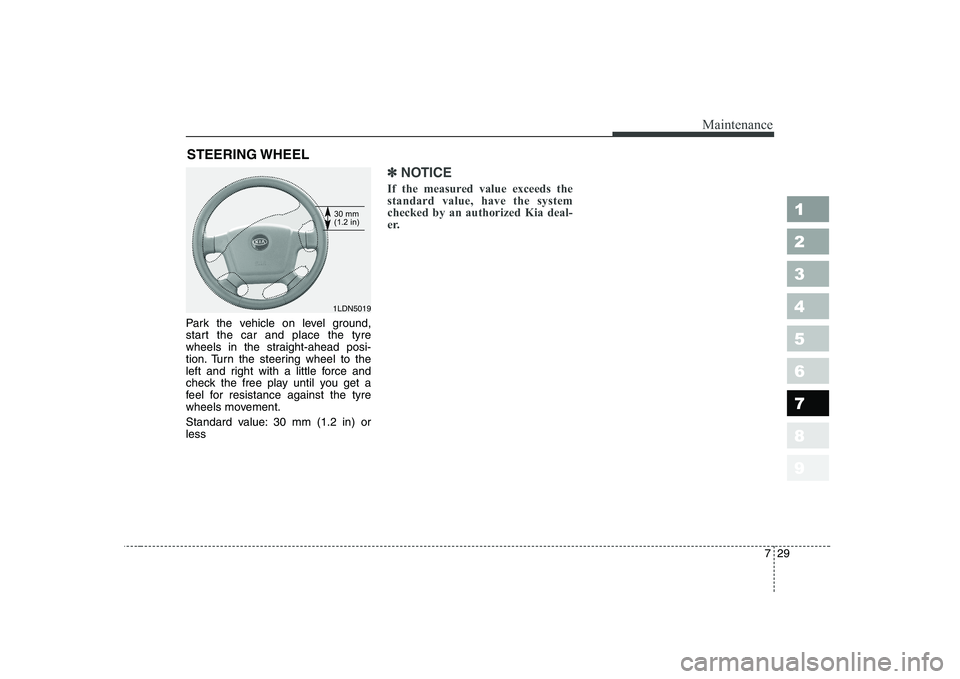
STEERING WHEEL
Park the vehicle on level ground,
start the car and place the tyre
wheels in the straight-ahead posi-
tion. Turn the steering wheel to the
left and right with a little force and
check the free play until you get a
feel for resistance against the tyre
wheels movement.
Standard value: 30 mm (1.2 in) or less
✽✽ NOTICE
If the measured value exceeds the standard value, have the systemchecked by an authorized Kia deal-
er.
1 23456789
1LDN5019
30 mm (1.2 in)
Page 290 of 318
Maintenance
46
7
1 23456789
TYRES AND WHEELS
Tyres care
For proper maintenance, safety, and
maximum fuel economy, you must
always maintain recommended tyre
inflation pressures and stay within
the load limits and weight distribution
recommended for your vehicle. Inflation pressures All tyre pressures (including the
spare) should be checked every day
when the tyres are cold. “Cold Tyres”
means the vehicle has not been driv-
en for at least three hours or drivenless than 1.6 km (one mile).
Recommended pressures must be
maintained for the best ride, top vehi-
cle handling, and minimum tyre
wear. All specifications (sizes and pres-
sures) can be found on a label
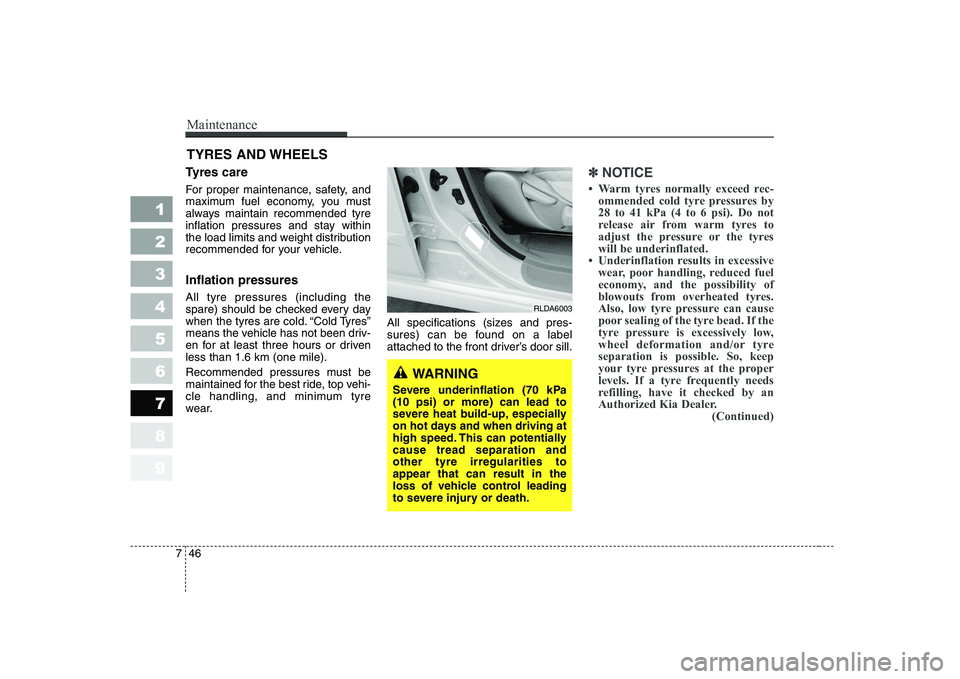
attached to the front driver’s door sill.
✽✽
NOTICE