Page 288 of 424
5. Shift automatic transmission into D (Drive) or manual
transmission into any forward gear.
6. Release brake pedal and ensure that there is no vehicle
movement.
7. Shut the engine OFF and place the ignition key into
the unlocked OFF position.
8. Shift automatic transmission into P (Park) or ensure
manual transmission is in any forward gear.
9. Apply parking brake.
10. Attach vehicle to the tow vehicle with tow bar.
11. Release parking brake.CAUTION!
Transmission damage may occur if the automatic
transmission is shifted into P (Park) with the transfer
case in N (Neutral) and the engine running. With the
transfer case in N (Neutral) ensure that the engine is
OFF prior to shifting the transmission into P (Park)
(refer to steps7 – 8 above).
Shifting Out Of Neutral (N)
Use the following procedure to prepare your vehicle for
normal usage.
1. Shift transmission into N (Neutral).
2. Turn engine off.
3. Shift transfer case lever to desired position.
4. Shift automatic transmission into P (Park).
288 STARTING AND OPERATING
Page 296 of 424
NOTE:If you have added aftermarket accessories to the
spare tire mounted carrier, it cannot exceed a gross
weight of 50 lbs (23 kg) including the weight of the spare
tire.
Preparations For Jacking
Park the vehicle on a firm level surface, avoid ice or
slippery areas,set the parking brakeand place auto-
matic transmission in P (Park), or manual transmission in
R (Reverse). Turn OFF the ignition.
WARNING!
Do not attempt to change a tire on the side of the
vehicle close to moving traffic. Pull far enough off
the road to avoid being hit when operating the jack
or changing the wheel.
•Turn on the Hazard Warning Flasher.
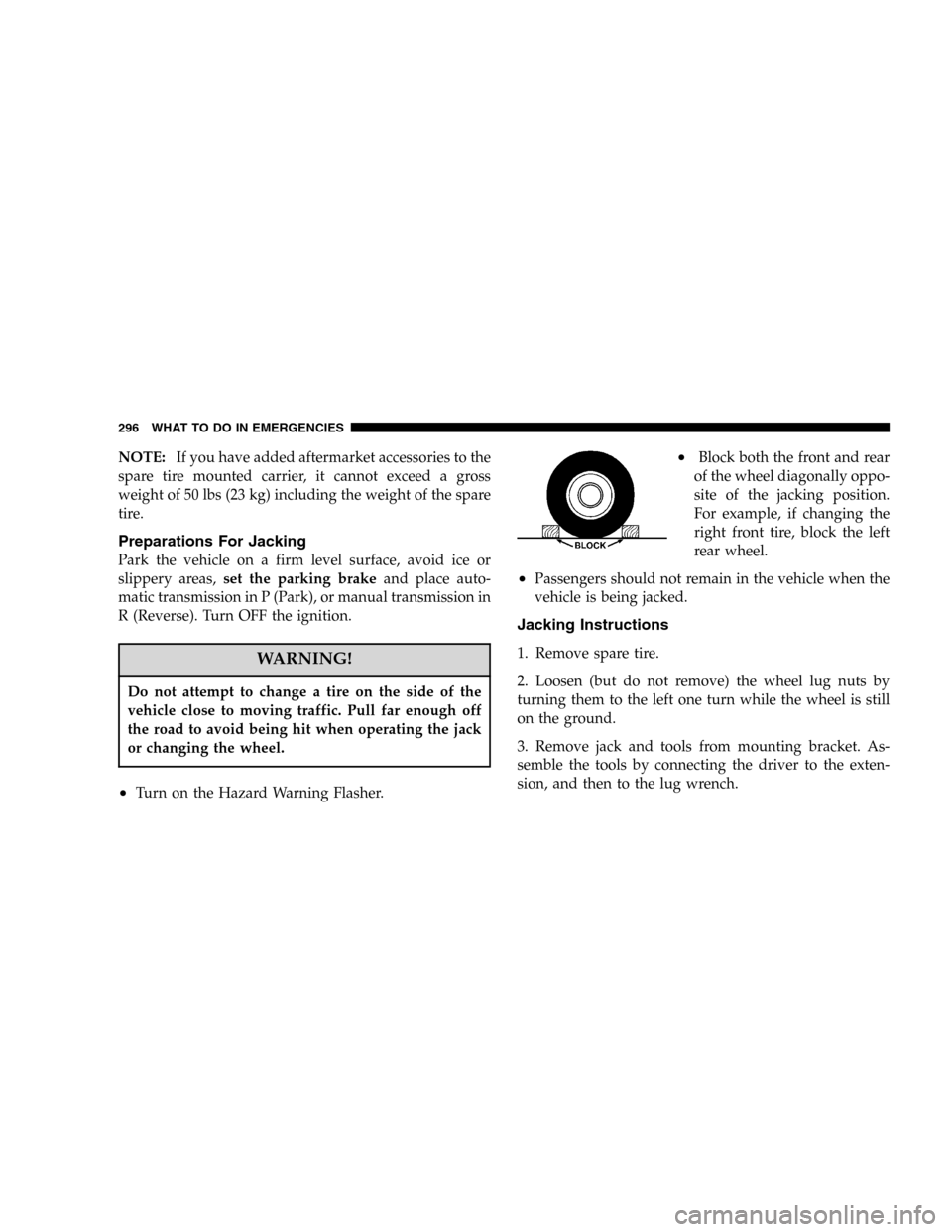
•Block both the front and rear
of the wheel diagonally oppo-
site of the jacking position.
For example, if changing the
right front tire, block the left
rear wheel.
•Passengers should not remain in the vehicle when the
vehicle is being jacked.
Jacking Instructions
1. Remove spare tire.
2. Loosen (but do not remove) the wheel lug nuts by
turning them to the left one turn while the wheel is still
on the ground.
3. Remove jack and tools from mounting bracket. As-
semble the tools by connecting the driver to the exten-
sion, and then to the lug wrench.
296 WHAT TO DO IN EMERGENCIES
Page 299 of 424

JUMP STARTING PROCEDURE
NOTE:Check the charge indicator on the battery. If the
indicator is light or yellow, replace the battery.
1. Wear eye protection and remove any metal jewelry
such as watch bands or bracelets that might make an
unintended electrical contact.
2. When boost is provided by a battery in another
vehicle, park that vehicle within booster cable reach but
without letting the vehicles touch. Set the parking brake,
place the automatic transmission in P (Park), or manual
transmission in N (Neutral), and turn the ignition to OFF
for both vehicles.
3. Turn off the heater, radio and all unnecessary electrical
loads.4. Connect one end of a jumper cable to the positive
terminal of the discharged battery. Connect the other end
of the same cable to the positive terminal of the booster
battery.
5. Connect the other cable, first to the negative terminal
of the booster battery and then connect the other end to
a non-paint metal surface on the engine of the vehicle
with the discharged battery. Make sure you have a good
contact on the engine.
6. Start the engine in the vehicle which has the booster
battery, let the engine idle a few minutes, then start the
engine in the vehicle with the discharged battery.
7. When removing the jumper cables, reverse the above
sequence exactly. Be careful of the moving belts and fan.
WHAT TO DO IN EMERGENCIES 299
6
Page 303 of 424
MAINTAINING YOUR VEHICLE
CONTENTS
�2.4L Engine...........................306
�3.7L Engine...........................307
�2.8L Turbo Diesel Engine.................308
�Onboard Diagnostic System — OBD II........309
▫Loose Fuel Filler Cap Message............309
�Emissions Inspection And Maintenance
Programs............................310
�Replacement Parts......................311
�Dealer Service.........................312�Maintenance Procedures..................312
▫Engine Oil..........................312
▫Drive Belts — Check Condition And Tension . . 316
▫Spark Plugs.........................317
▫Catalytic Converter....................317
▫Engine Timing Belt — 2.4L Engine.........319
▫Ignition Wiring System — 2.4L Engine......319
▫Crankcase Emission Control System........319
▫Air Cleaner Filter.....................319
7
Page 310 of 424
that the gas cap is properly tightened. Press the odometer
reset button to turn the message off. If the problem
persists, the message will appear the next time the
vehicle is started. This might indicate a damaged cap. If
the problem is detected twice in a row, the system will
turn on the Malfunction Indicator Light (MIL). Resolving
the problem will turn the MIL light off.
EMISSIONS INSPECTION AND MAINTENANCE
PROGRAMS
In some localities, it may be a legal requirement to pass
an inspection of your vehicle’s emissions control system.
Failure to pass could prevent vehicle registration.
For states which have an I/M (Inspection and
Maintenance) requirement, this check verifies the
following: the MIL (Malfunction Indicator Lamp)
is functioning and is not on when the engine is running,
and that the OBD (On Board Diagnostic) system is ready
for testing.Normally, the OBD system will be ready. The OBD
system maynotbe ready if your vehicle was recently
serviced, if you recently had a dead battery, or a battery
replacement. If the OBD system should be determined
not ready for the I/M test, your vehicle may fail the test.
Your vehicle has a simple ignition key actuated test
which you can use prior to going to the test station. To
check if your vehicle’s OBD system is ready, you must do
the following:
1. Insert your ignition key into the ignition switch.
2. Turn the ignition to the ON position, but do not crank
or start the engine.
3. If you crank or start the engine, you will have to start
this test over.
4. As soon as you turn your key to the ON position, you
will see your MIL symbol come on as part of a normal
bulb check.
310 MAINTAINING YOUR VEHICLE
Page 311 of 424
5. Approximately 15 seconds later, one of two things will
happen:
a. The MIL will flash for about 10 seconds and then
return to being fully illuminated until you turn off the
ignition key or start the engine. This means that your
vehicle’s OBD system isnot readyand you shouldnot
proceed to the I/M station.
b. The MIL will not flash at all and will remain fully
illuminated until you turn off the ignition key or start
the engine. This means that your vehicle’s OBD system
isreadyand you can proceed to the I/M station.
If your OBD system isnot ready,you should see your
authorized dealer or repair facility. If your vehicle was
recently serviced or had a battery failure or replacement,
you may need to do nothing more than drive your
vehicle as you normally would in order for your OBD
system to update. A recheck with the above test routine
may then indicate that the system is now ready.Regardless of whether your vehicle’s OBD system is
ready or not ready, if the MIL symbol is illuminated
during normal vehicle operation, you should have your
vehicle serviced before going to the I/M station. The I/M
station can fail your vehicle because the MIL symbol is on
with the engine running.
REPLACEMENT PARTS
Use of genuine Mopar�parts for normal/scheduled
maintenance and repairs is highly recommended to in-
sure the designed performance. Damage or failures
caused by the use of non-Mopar�parts for maintenance
and repairs will not be covered by the manufacturer’s
warranty.
MAINTAINING YOUR VEHICLE 311
7
Page 318 of 424
WARNING!
A hot exhaust system can start a fire if you park over
materials that can burn. Such materials might be
grass or leaves coming into contact with your ex-
haust system. Do not park or operate your vehicle in
areas where your exhaust system can contact any-
thing that can burn.
In unusual situations involving grossly malfunctioning
engine operation, a scorching odor may suggest severe
and abnormal catalyst overheating. If this occurs, stop
the vehicle, turn off the engine and allow it to cool.
Service, including a tune up to manufacturer’s specifica-
tions, should be obtained immediately.
To minimize the possibility of catalytic converter damage:
•Do not shut off the engine or interrupt the ignition
when the transmission is in gear and the vehicle is in
motion.
•Do not try to start the engine by pushing or towing the
vehicle.
•Do not idle the engine with any spark plug wires
disconnected or removed, such as when diagnostic
testing.
•Do not idle the engine for prolonged periods during
very rough idle or malfunctioning operating conditions.
•Do not allow vehicle to run out of fuel.
NOTE:Intentional tampering with emissions control
systems can result in civil penalties being assessed
against you.
318 MAINTAINING YOUR VEHICLE
Page 319 of 424
Engine Timing Belt — 2.4L Engine
Replace the engine timing belt at the intervals described
in the appropriate maintenance schedule.
Ignition Wiring System — 2.4L Engine
Replace the ignition cables at the intervals described in
the appropriate maintenance schedule.
Crankcase Emission Control System
Proper operation of this system depends on freedom
from sticking or plugging due to deposits. As vehicle
mileage builds up, the PCV valve and passages may
accumulate deposits. If a valve is not working properly,
replace it with a new valve. DO NOT ATTEMPT TO
CLEAN THE OLD PCV VALVE!
Check ventilation hose for indication of damage or
plugging deposits. Replace if necessary.
Air Cleaner Filter
Under normal driving conditions, replace the air filter at
the intervals shown on “Maintenance Schedule A.” If,
however, you drive the vehicle frequently under dusty or
severe conditions, the filter element should be inspected
periodically and replaced if necessary at the intervals
shown on “Maintenance Schedule B.”
WARNING!
The air cleaner can provide protection in the case of
engine backfire. Do not remove the air cleaner
unless it is necessary for repair or maintenance.
Make sure that no one is near the engine compart-
ment before starting the vehicle with the air cleaner
removed. Failure to do so can result in serious
personal injury.
MAINTAINING YOUR VEHICLE 319
7
