Page 255 of 424
Tire Sizing Chart
EXAMPLE:
Size Designation:
P= Passenger car tire size based on U.S. design standards
�....blank....�= Passenger car tire based on European design standards
LT= Light Truck tire based on U.S. design standards
T= Temporary Spare tire
31= Overall Diameter in Inches (in)
215= Section Width in Milimeters (mm)
65= Aspect Ratio in Percent (%)
—Ratio of section height to section width of tire.
10.5= Section Width in Inches (in)
R= Construction Code
—�R�means Radial Construction.
—�D�means Diagonal or Bias Construction.
15= Rim Diameter in Inches (in)
STARTING AND OPERATING 255
5
Page 259 of 424
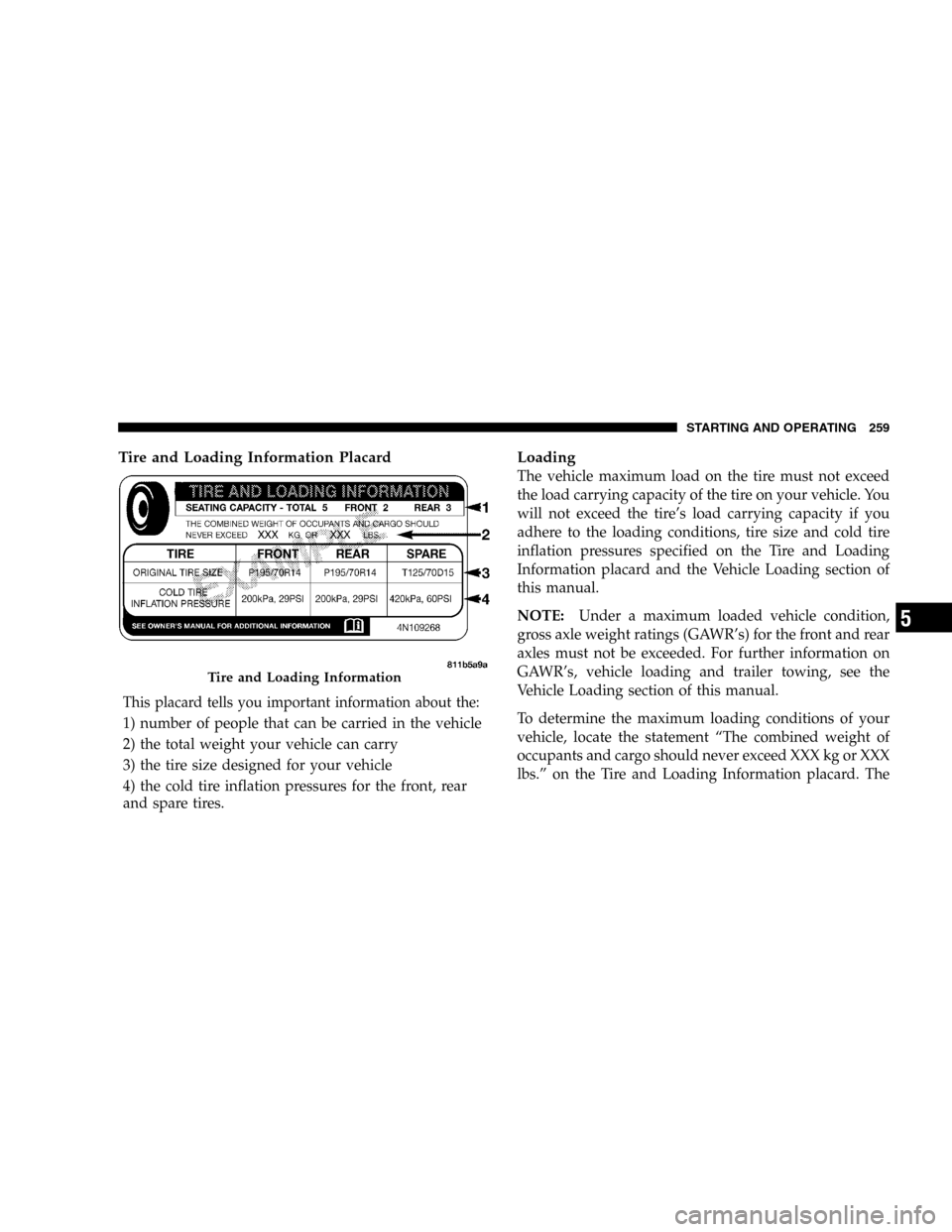
Tire and Loading Information Placard
This placard tells you important information about the:
1) number of people that can be carried in the vehicle
2) the total weight your vehicle can carry
3) the tire size designed for your vehicle
4) the cold tire inflation pressures for the front, rear
and spare tires.
Loading
The vehicle maximum load on the tire must not exceed
the load carrying capacity of the tire on your vehicle. You
will not exceed the tire’s load carrying capacity if you
adhere to the loading conditions, tire size and cold tire
inflation pressures specified on the Tire and Loading
Information placard and the Vehicle Loading section of
this manual.
NOTE:Under a maximum loaded vehicle condition,
gross axle weight ratings (GAWR’s) for the front and rear
axles must not be exceeded. For further information on
GAWR’s, vehicle loading and trailer towing, see the
Vehicle Loading section of this manual.
To determine the maximum loading conditions of your
vehicle, locate the statement “The combined weight of
occupants and cargo should never exceed XXX kg or XXX
lbs.” on the Tire and Loading Information placard. The
Tire and Loading Information
STARTING AND OPERATING 259
5
Page 266 of 424
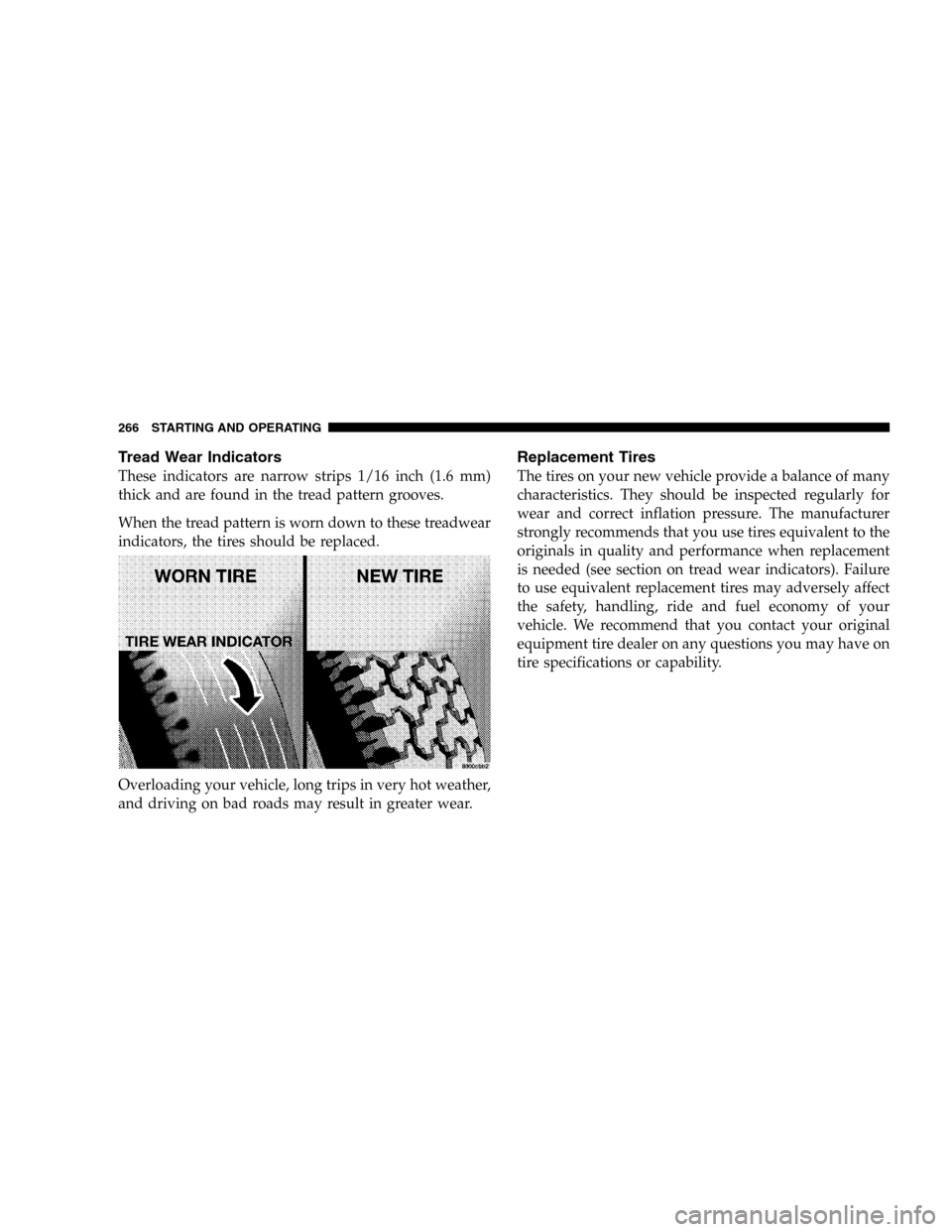
Tread Wear Indicators
These indicators are narrow strips 1/16 inch (1.6 mm)
thick and are found in the tread pattern grooves.
When the tread pattern is worn down to these treadwear
indicators, the tires should be replaced.
Overloading your vehicle, long trips in very hot weather,
and driving on bad roads may result in greater wear.
Replacement Tires
The tires on your new vehicle provide a balance of many
characteristics. They should be inspected regularly for
wear and correct inflation pressure. The manufacturer
strongly recommends that you use tires equivalent to the
originals in quality and performance when replacement
is needed (see section on tread wear indicators). Failure
to use equivalent replacement tires may adversely affect
the safety, handling, ride and fuel economy of your
vehicle. We recommend that you contact your original
equipment tire dealer on any questions you may have on
tire specifications or capability.
266 STARTING AND OPERATING
Page 275 of 424
TIRE ROTATION RECOMMENDATIONS
Tires on the front and rear axles of vehicles operate at
different loads and perform different steering, handling,
and braking functions. For these reasons, they wear at
unequal rates, and develop irregular wear patterns.
These effects can be reduced by timely rotation of tires.
The benefits of rotation are especially worthwhile with
aggressive tread designs such as those on On/Off Road
type tires. Rotation will increase tread life, help to main-
tain mud, snow, and wet traction levels, and contribute to
a smooth, quiet ride.2.4L/3.7L EnginesFollow the recommended tire rotation frequency for your
type of driving found in the “Maintenance Schedules”
Section of this manual. More frequent rotation is permis-
sible if desired. The reasons for any rapid or unusual wear
should be corrected prior to rotation being performed.
2.8L Turbo Diesel Engines
Rotate the tires every 6,000 miles (10 000 km).
NOTE:The Premium Tire Pressure Monitor System will
automatically locate the pressure values displayed in the
correct vehicle position following a tire rotation.
STARTING AND OPERATING 275
5
Page 283 of 424
Loose Fuel Filler Cap Message
If the vehicle diagnostic system determines that the fuel
filler cap is loose, improperly installed, or damaged, a
“CHECK GAS CAP” message will be displayed in the
EVIC (Electronic Vehicle Information Center). Refer to
“Overhead Console” in Section 3 of this manual. Tighten
the fuel filler cap properly and press the odometer reset
button to turn the message off. If the problem continues,
the message will appear the next time the vehicle is
started. Refer to “Onboard Diagnostic System — OBDII”
in Section 7 of this manual for more information.
CAUTION!
Damage to the fuel system or emission control
system could result from using an improper fuel
tank filler cap (gas cap). A poorly fitting cap could let
impurities into the fuel system.
WARNING!
•Never add fuel when the engine is running.
•Never have any smoking materials lit in or near
the vehicle when the fuel cap is removed or the
tank filled.
TRAILER TOWING
In this section you will find information on limits to the
type of towing you can reasonably do with your vehicle.
Before towing a trailer, carefully review this information
to tow your load as efficiently and safely as possible.
To maintain warranty coverage, follow the requirements
and recommendations in this manual concerning ve-
hicles used for trailer towing.
STARTING AND OPERATING 283
5
Page 284 of 424
Perform maintenance services as prescribed in the
“Maintenance Schedules” section. When your vehicle is
used for trailer towing, never exceed the gross axle
weight rating (GAWR) by the addition of:
•The tongue weight of the trailer.
•The weight of any other type of cargo or equipment
put in or on your vehicle.
Remember that everything put in or on the trailer adds to
the load on your vehicle.
Warranty Requirements
The manufacturer’s warranty will apply to vehicles used
to tow trailers for noncommercial use, however the
following conditions must be met:
•The “D” Overdrive range can be selected when tow-
ing. However, if frequent shifting occurs select the
“O/D Off” function or move the shift lever to the next
lower position to eliminate excessive automatic trans-
mission shifting. This action will also reduce the
possibility of transmission overheating and provide
better engine braking. Refer to “Transmission Shift-
ing” in this section for additional information.
•A load equalizing hitch is recommended for loaded
trailer weights above 1,000 lbs (454 kg).
284 STARTING AND OPERATING
Page 300 of 424
NOTE:To start the vehicle following connection of a
booster battery, the Security Alarm System must first be
disabled by cycling a front door key cylinder or by using
the keyless entry transmitter.
WARNING!
Jump starting can be dangerous. To avoid personal
injury or damage to electrical components in vehicle,
observe the following warnings:
•Battery fluid is a corrosive acid solution and can burn
or even blind you. Don’t allow battery fluid to contact
your eyes, skin, or clothing. Don’t lean over a battery
when attaching clamps. If acid splashes in eyes or on
skin, flush the area immediately with large amounts of
water.
•Do not use a booster battery or any other booster
source that has a greater than 12–volt system, i.e., do
not use a 24–volt power source.
•Never attempt to jump start a discharged battery that
is frozen, because it could rupture or explode during
jump starting.
•Be sure your vehicle is not touching the jump start
vehicle.
•Observe all Battery Warnings in Section 7 of this
manual, while jump starting your vehicle.
300 WHAT TO DO IN EMERGENCIES
Page 314 of 424
IfANYof these apply to you, then change your engine oil
at every interval shown in schedule “B” of the “Mainte-
nance Schedules” section of this manual.
If none of these apply to you, then change your engine oil
at every interval shown on schedule “A” of the “Main-
tenance Schedules” section of this manual
NOTE:Under no circumstances should oil change in-
tervals exceed 6,000 miles (10 000 km) or 6 months
whichever comes first.
Engine Oil Selection (Gasoline Engines)
For best performance and maximum protection for all
engines under all types of operating conditions, the
manufacturer recommends engine oils that are API Cer-
tified and meet the requirements of DaimlerChrysler
Material Standard MS-6395.
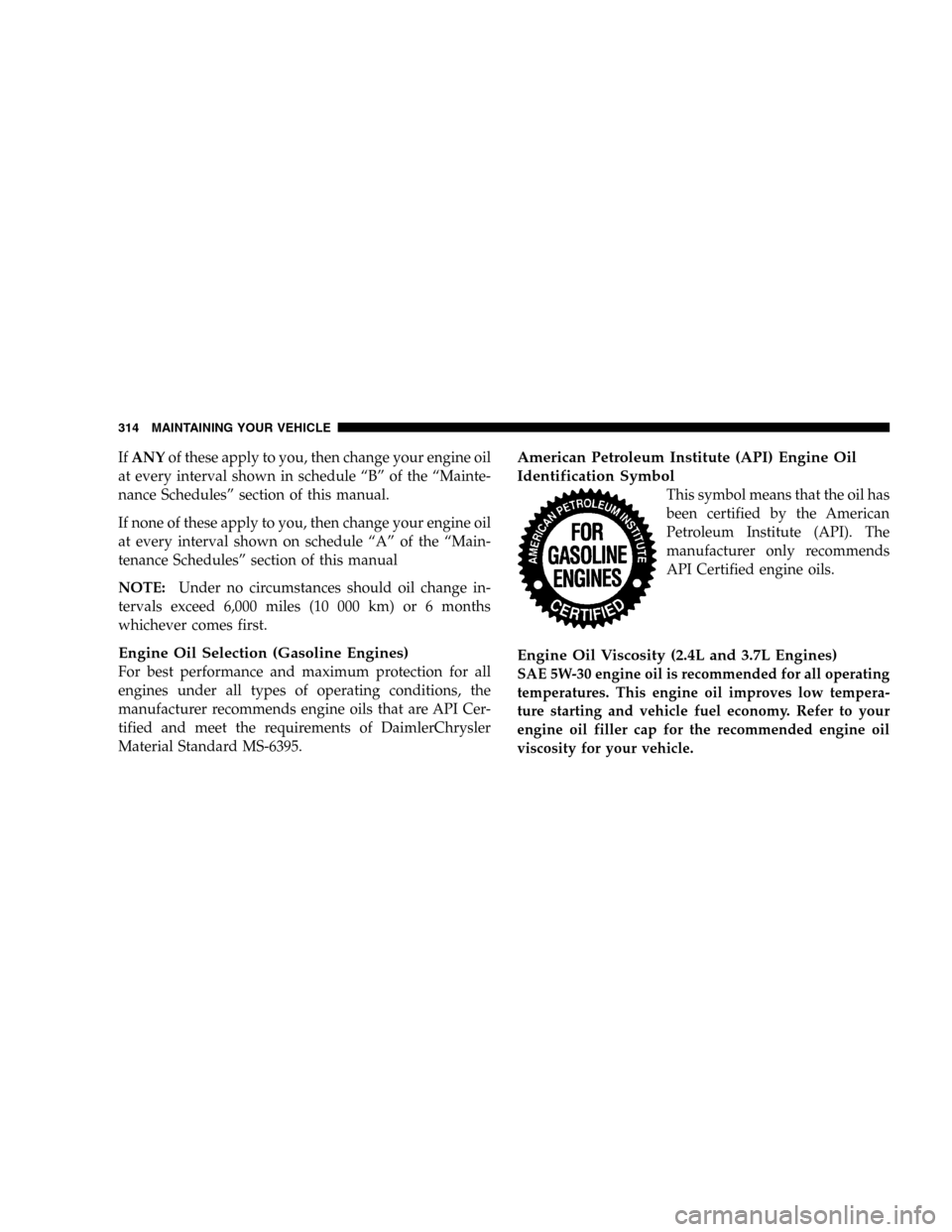
American Petroleum Institute (API) Engine Oil
Identification Symbol
This symbol means that the oil has
been certified by the American
Petroleum Institute (API). The
manufacturer only recommends
API Certified engine oils.
Engine Oil Viscosity (2.4L and 3.7L Engines)
SAE 5W-30 engine oil is recommended for all operating
temperatures. This engine oil improves low tempera-
ture starting and vehicle fuel economy. Refer to your
engine oil filler cap for the recommended engine oil
viscosity for your vehicle.
314 MAINTAINING YOUR VEHICLE