Page 253 of 424
After Driving Off-Road
Off-road operation puts more stress on your vehicle than
does most on-road driving. After going off-road it is
always a good idea to check for damage. That way you
can get any problems taken care of right away and have
your vehicle ready when you need it.
•Completely inspect the underbody of your vehicle.
Check tires, body structure, steering, suspension, and
exhaust system for damage.
•Check threaded fasteners for looseness, particularly on
the chassis, drivetrain components, steering, and sus-
pension. Retighten them, if required, and torque to the
values specified in the Service Manual.
•Check for accumulations of plants or brush. These
things could be a fire hazard. They might hide damage
to fuel lines, brake hoses, axle pinion seals, and
propeller shafts.
•After extended operation in mud, sand, water, or
similar dirty conditions, have brake rotors, wheels,
brake linings, and axle yokes inspected and cleaned as
soon as possible.
WARNING!
Abrasive material in any part of the brakes may
cause excessive wear or unpredictable braking. You
might not have full braking power when you need it
to prevent an accident. If you have been operating
your vehicle in dirty conditions, get your brakes
checked and cleaned as necessary.
•If you experience unusual vibration after driving in
mud, slush or similar conditions, check the wheels for
impacted material. Impacted material can cause a
wheel imbalance and freeing the wheels of it will
correct the situation.
STARTING AND OPERATING 253
5
Page 254 of 424

TIRE SAFETY INFORMATION
Tire Markings
NOTE:
•P(Passenger)-Metric tire sizing is based on U.S. design
standards. P-Metric tires have the letter “P” molded
into the sidewall preceding the size designation. Ex-
ample: P215/65R15 95H.
•European Metric tire sizing is based on European
design standards. Tires designed to this standard have
the tire size molded into the sidewall beginning with
the section width. The letter�P�is absent from this tire
size designation. Example: 215/65R15 96H
•LT(Light Truck)-Metric tire sizing is based on U.S.
design standards. The size designation for LT-Metric
tires is the same as for P-Metric tires except for the
letters “LT” that are molded into the sidewall preced-
ing the size designation. Example: LT235/85R16.
•Temporary Spare tires are high pressure compact
spares designed for temporary emergency use only.
Tires designed to this standard have the letter “T”
molded into the sidewall preceding the size designa-
tion. Example: T145/80D18 103M.
•High Flotation tire sizing is based on U.S. design
standards and begins with the tire diameter molded
into the sidewall. Example: 31x10.5 R15 LT.
254 STARTING AND OPERATING
Page 257 of 424
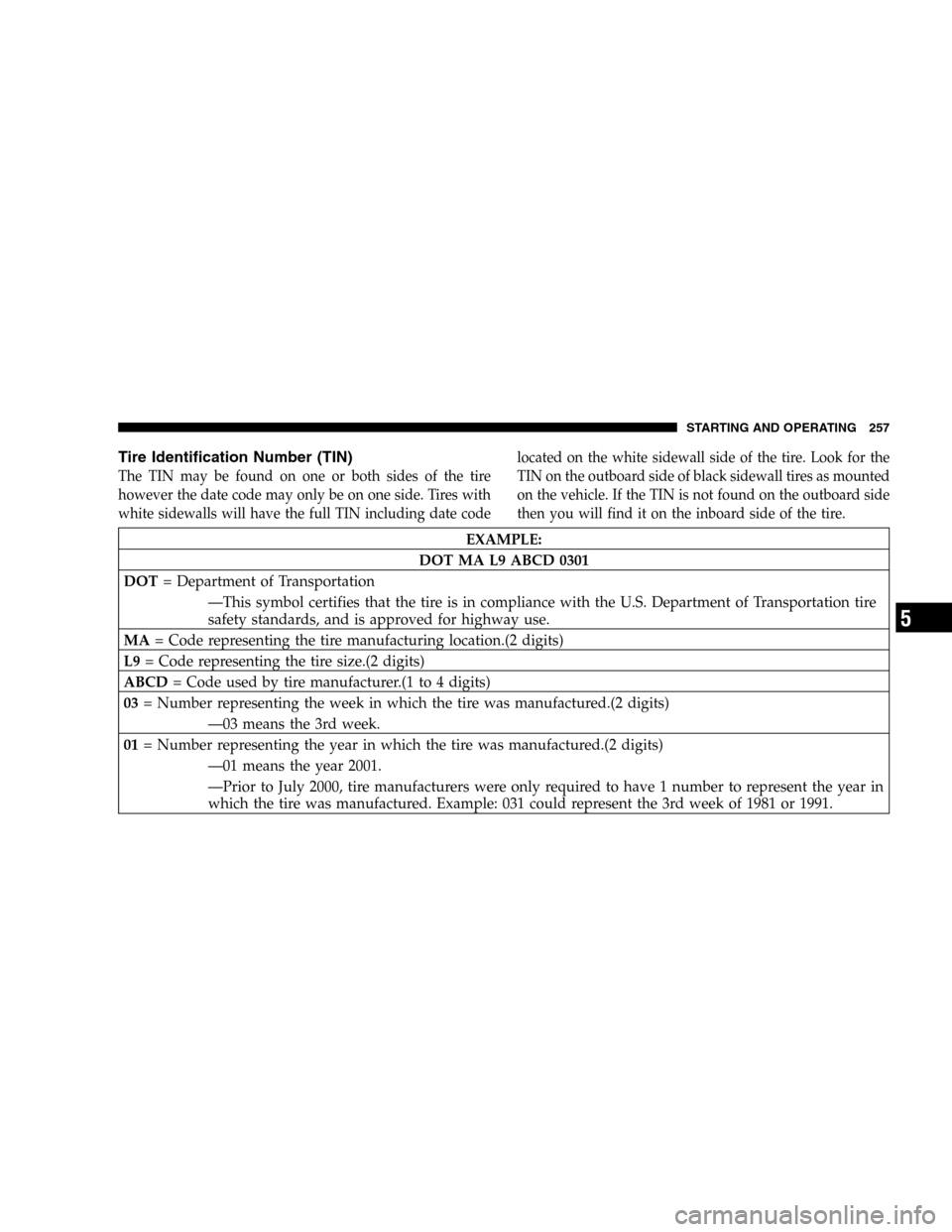
Tire Identification Number (TIN)
The TIN may be found on one or both sides of the tire
however the date code may only be on one side. Tires with
white sidewalls will have the full TIN including date codelocated on the white sidewall side of the tire. Look for the
TIN on the outboard side of black sidewall tires as mounted
on the vehicle. If the TIN is not found on the outboard side
then you will find it on the inboard side of the tire.
EXAMPLE:
DOT MA L9 ABCD 0301
DOT= Department of Transportation
—This symbol certifies that the tire is in compliance with the U.S. Department of Transportation tire
safety standards, and is approved for highway use.
MA= Code representing the tire manufacturing location.(2 digits)
L9= Code representing the tire size.(2 digits)
ABCD= Code used by tire manufacturer.(1 to 4 digits)
03= Number representing the week in which the tire was manufactured.(2 digits)
—03 means the 3rd week.
01= Number representing the year in which the tire was manufactured.(2 digits)
—01 means the year 2001.
—Prior to July 2000, tire manufacturers were only required to have 1 number to represent the year in
which the tire was manufactured. Example: 031 could represent the 3rd week of 1981 or 1991.
STARTING AND OPERATING 257
5
Page 259 of 424
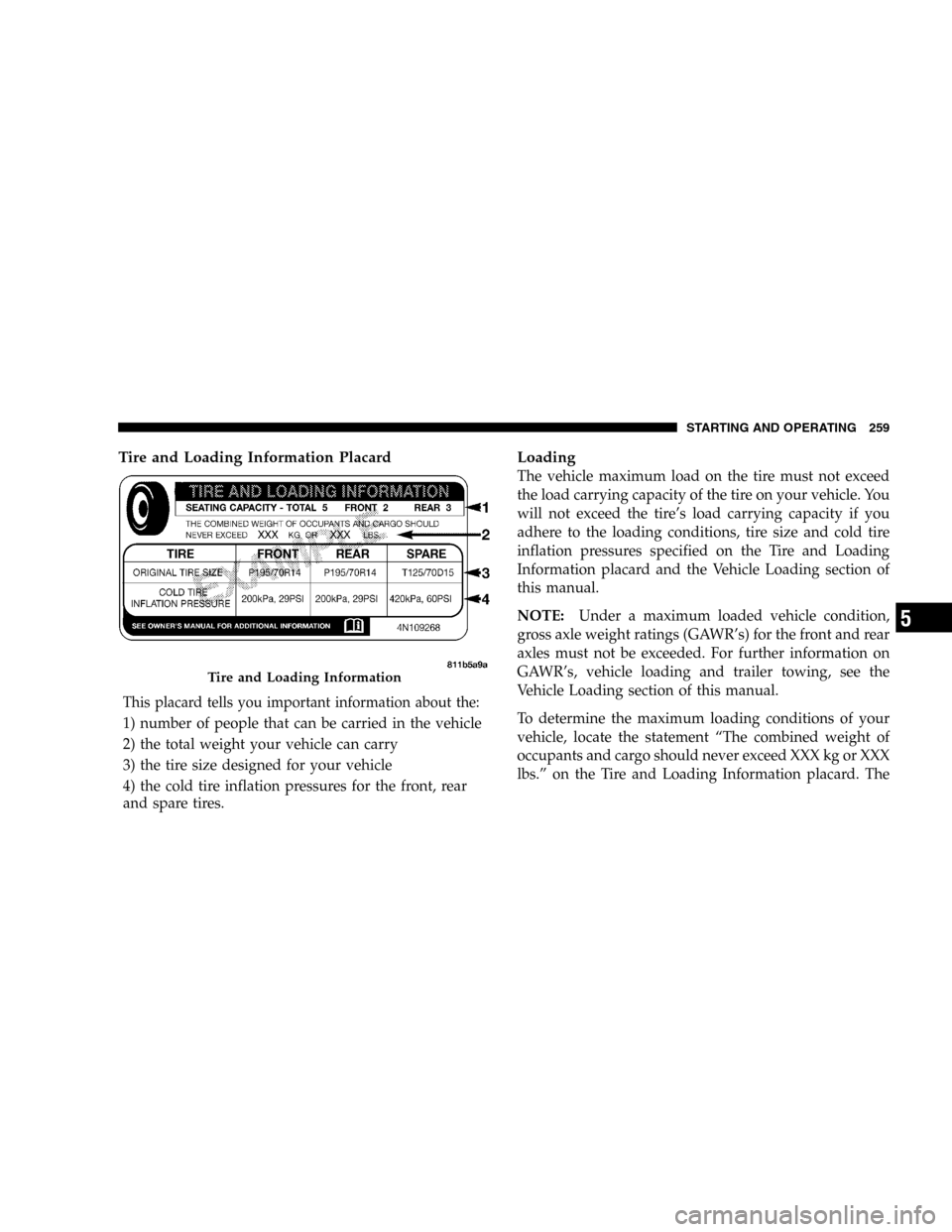
Tire and Loading Information Placard
This placard tells you important information about the:
1) number of people that can be carried in the vehicle
2) the total weight your vehicle can carry
3) the tire size designed for your vehicle
4) the cold tire inflation pressures for the front, rear
and spare tires.
Loading
The vehicle maximum load on the tire must not exceed
the load carrying capacity of the tire on your vehicle. You
will not exceed the tire’s load carrying capacity if you
adhere to the loading conditions, tire size and cold tire
inflation pressures specified on the Tire and Loading
Information placard and the Vehicle Loading section of
this manual.
NOTE:Under a maximum loaded vehicle condition,
gross axle weight ratings (GAWR’s) for the front and rear
axles must not be exceeded. For further information on
GAWR’s, vehicle loading and trailer towing, see the
Vehicle Loading section of this manual.
To determine the maximum loading conditions of your
vehicle, locate the statement “The combined weight of
occupants and cargo should never exceed XXX kg or XXX
lbs.” on the Tire and Loading Information placard. The
Tire and Loading Information
STARTING AND OPERATING 259
5
Page 262 of 424
WARNING!
Overloading of your tires is dangerous. Overloading
can cause tire failure, affect vehicle handling, and
increase your stopping distance. Use tires of the
recommended load capacity for your vehicle. Never
overload them.
TIRES — GENERAL INFORMATION
Proper tire inflation pressure is essential to the safe and
satisfactory operation of your vehicle. Three primary
areas are affected by improper tire pressure:1. Safety—
WARNING!
Improperly inflated tires are dangerous and can
cause accidents.
•Under inflation increases tire flexing and can
result in tire failure.
•Over inflation reduces a tire’s ability to cushion
shock. Objects on the road and chuck holes can cause
damage that results in tire failure.
•Unequal tire pressures can cause steering prob-
lems. You could lose control of your vehicle.
•Overinflated or under inflated tires can affect
vehicle handling and can fail suddenly, resulting in
loss of vehicle control.
Always drive with each tire properly inflated.
262 STARTING AND OPERATING
Page 264 of 424
more often if subject to a wide range of outdoor tempera-
tures, as tire pressures vary with temperature changes.
Inflation pressures specified on the label are always
“Cold Inflation Pressure.” Cold inflation pressure is
defined as the tire pressure after the vehicle has been idle
for at least 3 hours, or driven less than a mile after a 3
hour period. The cold inflation pressure of each tire
should be set according to the manufacturers recom-
mended pressure, and must not exceed the maximum
values molded into the tire sidewall.
Tire pressures may increase from 13 to 40 kPa (2 to 6 psi)
[0.138 to 0.414 bar] during operation. DO NOT reduce
this normal pressure buildup.High Speed Operation
WARNING!
High speed driving with your vehicle under load is
dangerous. The added strain on your tires could
cause them to fail. You could have a serious accident.
Don’t drive a vehicle loaded to maximum capacity at
continuous speeds above 75 mph (120 km/h).
The manufacturer advocates driving at safe speeds
within posted speed limits. Where speed limits or condi-
tions are such that the vehicle can be driven at high
speeds, correct tire inflation pressure is very important.
264 STARTING AND OPERATING
Page 265 of 424
Radial-Ply Tires
WARNING!
Combining radial ply tires with other types of tires
on your vehicle will cause your vehicle to handle
poorly. The instability could cause an accident. Al-
ways use radial tires in sets of four. Never combine
them with other types of tires.
Cuts and punctures in radial tires are repairable only in
the tread area because of sidewall flexing. Consult your
dealer for radial tire repairs.
Tire Spinning
When stuck in mud, sand, snow, or ice conditions, do not
spin your vehicle’s wheels above 35 mph (55 km/h).
WARNING!
Fast spinning tires can be dangerous. Forces gener-
ated by excessive wheel speeds may cause tire dam-
age or failure. A tire could explode and injure
someone. Do not spin your vehicle’s wheels faster
than 35 mph (55 km/h) when you are stuck, and do
not let anyone near a spinning wheel no matter what
the speed.
STARTING AND OPERATING 265
5
Page 266 of 424
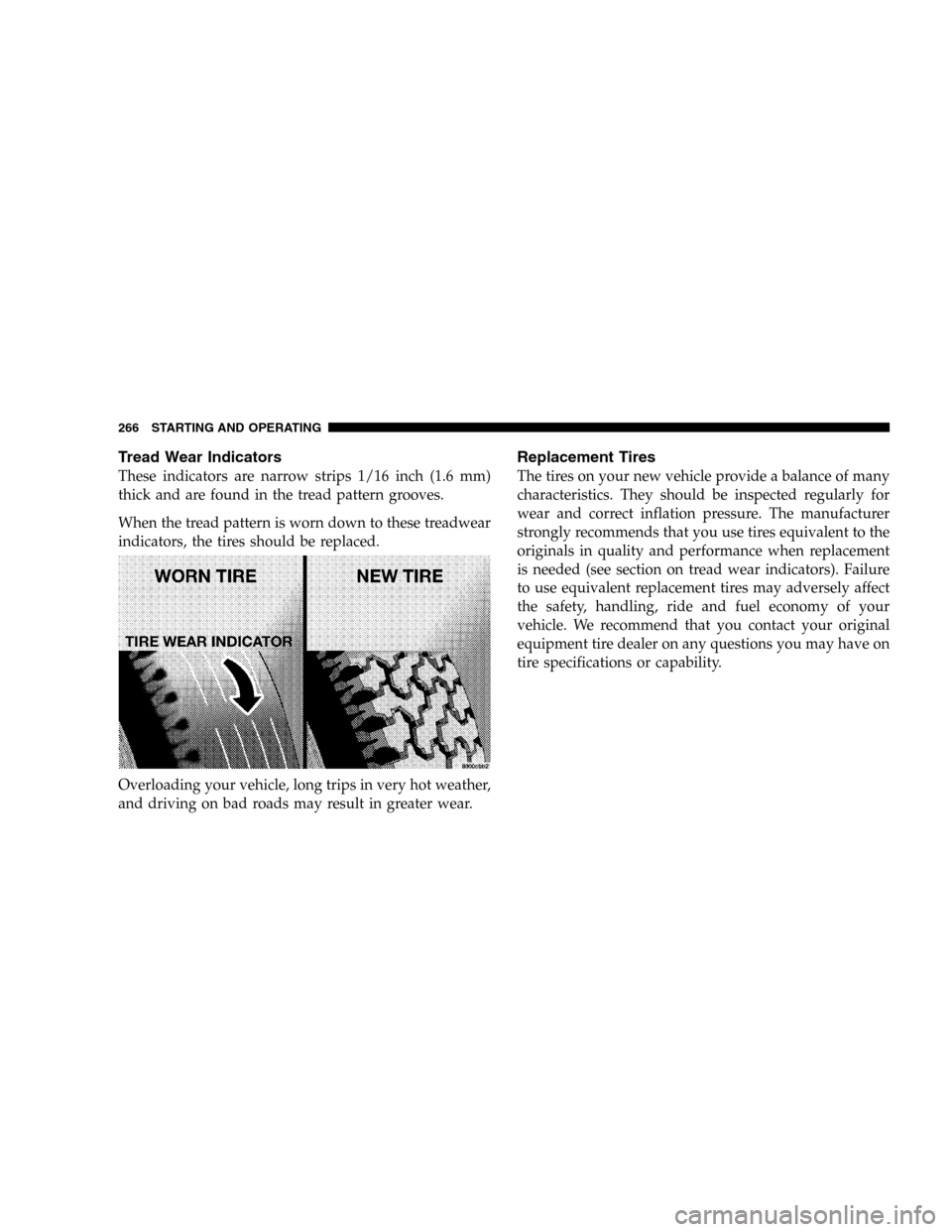
Tread Wear Indicators
These indicators are narrow strips 1/16 inch (1.6 mm)
thick and are found in the tread pattern grooves.
When the tread pattern is worn down to these treadwear
indicators, the tires should be replaced.
Overloading your vehicle, long trips in very hot weather,
and driving on bad roads may result in greater wear.
Replacement Tires
The tires on your new vehicle provide a balance of many
characteristics. They should be inspected regularly for
wear and correct inflation pressure. The manufacturer
strongly recommends that you use tires equivalent to the
originals in quality and performance when replacement
is needed (see section on tread wear indicators). Failure
to use equivalent replacement tires may adversely affect
the safety, handling, ride and fuel economy of your
vehicle. We recommend that you contact your original
equipment tire dealer on any questions you may have on
tire specifications or capability.
266 STARTING AND OPERATING