Page 228 of 424
WARNING!
When parking your vehicle, always leave a manual
transmission in first gear and apply the parking
brake fully to guard against vehicle movement and
possible injury or damage. Never use any gear as a
substitute for the parking brake.
CAUTION!
To drive as safely as possible and to prolong the life
of your manual transmission, follow these tips:
•Before shifting from a forward gear into reverse, or
from reverse to a forward gear, stop vehicle com-
pletely. Otherwise, accelerated transmission wear may
result.
•Do not operate at sustained high engine or road
speeds in lower gears. Engine damage may result.
•Do not downshift into a low gear while traveling at too
high a speed for that gear. Engine, clutch, or transmis-
sion damage may result.
•Do not rest your foot on the clutch pedal. This causes
heat buildup and damages the clutch.
•When you slow down or go up a grade, downshift as
speed requires or the engine may overheat.
•Never hold the vehicle stopped on a hill by using the
clutch pedal. The clutch may be damaged.
•During cold weather, you may experience increased
effort in shifting until the transmission fluid warms
up. This is normal.
•Push in the clutch pedal completely when shifting.
Otherwise, transmission or clutch damage may result.
228 STARTING AND OPERATING
Page 230 of 424
Automatic Transmission
Shifting from D (Drive) to P (Park) or R (Reverse) (or
from P or R to D) should be done only after the
accelerator pedal is released and the vehicle is stopped.
Be sure to keep your foot on the brake when moving the
shift lever between these gears.WARNING!
It is dangerous to shift the selector lever out of “P” or
“N” if the engine speed is higher than idle speed. If
your foot is not firmly on the brake pedal, the
vehicle could accelerate quickly forward or in re-
verse. You could lose control of the vehicle and hit
someone or something. Only shift into gear when
the engine is idling normally and when your right
foot is firmly on the brake pedal.
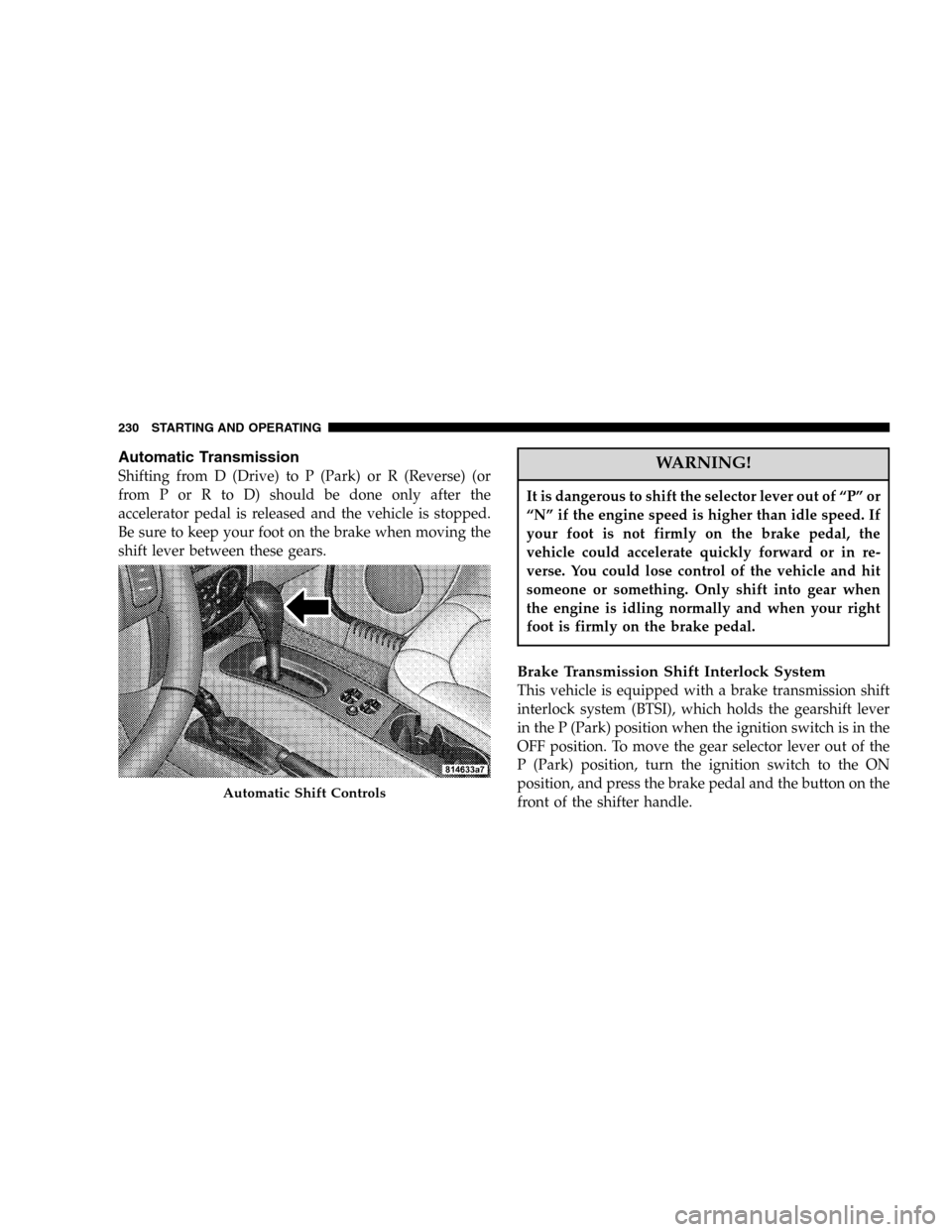
Brake Transmission Shift Interlock System
This vehicle is equipped with a brake transmission shift
interlock system (BTSI), which holds the gearshift lever
in the P (Park) position when the ignition switch is in the
OFF position. To move the gear selector lever out of the
P (Park) position, turn the ignition switch to the ON
position, and press the brake pedal and the button on the
front of the shifter handle.
Automatic Shift Controls
230 STARTING AND OPERATING
Page 231 of 424
Gear Ranges
P (Park)
Supplements the parking brake by locking the transmis-
sion. The engine can be started in this range. Never use P
(Park) while the vehicle is in motion. Apply the parking
brake when leaving the vehicle in this range. Always
place the gear selector in the P (Park) position first, and
then apply the parking brake.
WARNING!
Unintended movement of a vehicle could injure
those in and near the vehicle. As with all vehicles,
you should never exit a vehicle while the engine is
running. Before exiting a vehicle, you should always
shift the vehicle into P (Park), remove the key from
the ignition, and apply the parking brake. Once the
key is removed from the ignition, the transmission
shift lever is locked in the P (Park) position, securing
the vehicle against unwanted movement. Further-
more, you should never leave children unattended
inside a vehicle.
STARTING AND OPERATING 231
5
Page 234 of 424

NOTE:If the vehicle is started in cold outside tempera-
tures, shifts into Overdrive may be delayed. Normal
Overdrive and shifting operation will resume when the
temperature of the transmission reaches the appropriate
temperature. Refer to the “Note” under “Torque Con-
verter Clutch” later in this section.
If the transmission temperature gets too hot, the trans-
mission may downshift out of Overdrive or engage
overdrive at higher vehicle speeds until the transmission
cools down. After cooldown, Overdrive will resume
normal operation.
2 (Second)
For moderate grades and to assist braking on dry pave-
ment or in mud and snow. Begins at a stop in low gear
with automatic upshift to 2nd gear. Will not shift to 3rd.1 (First)
For hard pulling at low speeds in mud, sand, snow, or on
steep grades. Begins and stays in low gear with no upshift.
Provides engine compression braking at low speeds.
CAUTION!
•Never press on the accelerator pedal with the
engine running, vehicle in gear, and the brakes
applied. Always apply the brakes when stopped
on a incline. Failure to follow these instructions
can cause overheating and damage to the trans-
mission.
•When “rocking” a stuck vehicle by moving be-
tween “First” and R (Reverse), do not spin the
wheels faster than 15 mph (24 km/h), or drivetrain
damage may result.
234 STARTING AND OPERATING
Page 238 of 424
Proper operation of 4-wheel drive vehicles depends on
tires of equal size, type and circumference on each wheel.
Any difference will adversely affect shifting and can
cause damage to the transfer case.
WARNING!
•Because 4-wheel drive provides improved trac-
tion, there is a tendency to exceed safe turning and
stopping speeds. Do not go faster than road con-
ditions permit.
•You or others could be injured if you leave the
vehicle unattended with the transfer case in the
Neutral (N) position without first fully engaging
the parking brake. The transfer case Neutral (N)
position disengages both the front and rear drive-
shafts from the powertrain and will allow the
vehicle to move despite the transmission position.
The parking brake should always be applied
when the driver is not in the vehicle.
Shift Positions
For additional information on the appropriate use of each
transfer case mode position see the information below:
2H
Rear Wheel Drive High Range - Normal street and
highway driving. Dry hard surfaced roads.
4H
4-Wheel-Drive High Range - Locks the front and rear
driveshafts together. Forces the front and rear wheels to
rotate at the same speed. Additional traction for loose,
slippery road surfaces only.
N
Neutral - Disengages both the front and rear driveshafts
from the powertrain. To be used for flat towing behind
another vehicle. Refer to “Recreational Towing” in Sec-
tion 5 for more information.
238 STARTING AND OPERATING
Page 239 of 424
4L
4-Wheel-Drive Low Range - Low speed 4 wheel drive.
Locks the front and rear driveshafts together. Forces the
front and rear wheels to rotate at the same speed.
Additional traction and maximum pulling power for
loose, slippery road surfaces only. Do not exceed 25 mph
(40 km/h). (Allows engine starting without depressing
the clutch pedal on vehicles equipped with manual
transmission. Refer to “Starting Procedures — Manual
Transmission (4WD Models Only)” in this section.
Shifting Procedure
2H to 4H or 4H to 2H
Shifting between 2H and 4H can be made with the
vehicle in motion up to 55 mph (88 km/h). The transfer
case will engage/disengage faster if you momentarily
release the accelerator pedal after completing the shift.
Apply a constant force when shifting the transfer case
lever.
4H to 4L or 4L to 4H
With the vehicle rolling at 2 to 3 mph (3 to 5 km/h), shift
an automatic transmission to N (Neutral) or depress the
clutch on a manual transmission. While the vehicle is
coasting at 2 to 3 mph (3 to 5 km/h), shift the transfer
case lever firmly to the desired position. Do not pause in
transfer case N (Neutral).
NOTE:To shift from 4H to 4L, the shift lever should
pushed away from the driver, and then rearward into 4L.
In 4H, there is a neutral stop to prevent shifting into N
(Neutral) by accident.
NOTE:Pausing in transfer case N (Neutral) in vehicles
equipped with an automatic transmission may require
shutting the engine OFF to avoid gear clash while
completing the shift. If difficulty occurs, shift automatic
transmission to N (Neutral), hold foot on brake, and turn
engine OFF. Make shift to the desired mode.
STARTING AND OPERATING 239
5
Page 242 of 424
Proper operation of 4-wheel drive vehicles depends on
tires of equal size, type, and circumference on each
wheel. Any difference will adversely affect shifting and
can cause damage to the transfer case.
WARNING!
•Because 4-wheel drive provides improved trac-
tion, there is a tendency to exceed safe turning and
stopping speeds. Do not go faster than road con-
ditions permit.
•You or others could be injured if you leave the
vehicle unattended with the transfer case in the
Neutral (N) position without first fully engaging
the parking brake. The transfer case Neutral (N)
position disengages both the front and rear drive-
shafts from the powertrain and will allow the
vehicle to move regardless of the transmission
position. The parking brake should always be
applied when the driver is not in the vehicle.
Shift Positions
For additional information on the appropriate use of each
transfer case mode position see the information below:
2WD
Rear Wheel Drive High Range - Normal street and
highway driving. Dry hard surfaced roads.
4 PART TIME
Part Time 4–Wheel Drive High Range - Locks the transfer
case inter-axle differential. Forces the front and rear
wheels to rotate at the same speed. Additional traction
for loose, slippery road surfaces only.
4 FULL TIME
Full Time 4-Wheel Drive High Range - Employs an
inter-axle differential. This allows front and rear wheels
to rotate at different speeds, on all road surfaces.
242 STARTING AND OPERATING
Page 244 of 424
shifting. This will allow full engagement of the newly
selected position. Apply a constant force when shifting
the transfer case lever.
4 FULL TIME to 4 LO or 4 LO to 4 FULL TIME
With the vehicle rolling at 2 to 3 mph (3 to 5 km/h), shift
an automatic transmission to N (Neutral). While the
vehicle is coasting at 2 to 3 mph (3 to 5 km/h), shift the
transfer case lever firmly to the desired position. Do not
pause in transfer case N (Neutral).
NOTE:To shift from 4 FULL TIME to 4LO, the shift
lever should be pushed away from the driver, and then
rearward into 4LO. In 4 FULL TIME, there is a neutral
stop to prevent shifting into N (Neutral) by accident.
NOTE:Pausing in transfer case N (Neutral) in vehicles
equipped with an automatic transmission may require
shutting the engine OFF to avoid gear clash whilecompleting the shift. If difficulty occurs, shift transmis-
sion to N (Neutral), hold foot on brake, and turn engine
OFF. Make shift to desired mode.
NOTE:Shifting into or out of 4LO is possible with the
vehicle completely stopped, however difficulty may oc-
cur due to the mating clutch teeth not being properly
aligned. Several attempts may be required for clutch
teeth alignment and shift completion to occur. The pre-
ferred method is with the vehicle rolling 2 to 3 mph (3 to
5 km/h). Avoid attempting to engage or disengage 4LO
with the vehicle moving faster than 2 to 3 mph (3 to 5
km/h).
244 STARTING AND OPERATING