Page 236 of 424
normal condition and will not cause damage to the
transmission. The torque converter will refill within 5
seconds of shifting from P (Park) into any other gear
position.
Rocking the Vehicle
If the vehicle becomes stuck in snow, sand, or mud, it can
often be moved by a rocking motion. Move the gear
selector rhythmically between “First” and R (Reverse),
while applying slight pressure to the accelerator.
The least amount of accelerator pedal pressure to main-
tain the rocking motion without spinning the wheels or
racing the engine is most effective. Racing the engine or
spinning the wheels, due to the frustration of not freeing
the vehicle, may lead to transmission overheating and
failure. Allow the engine to idle with the transmission
selector in N (Neutral) for at least one minute after every
five rocking-motion cycles. This will minimize overheat-
ing and reduce the risk of transmission failure during
prolonged efforts to free a stuck vehicle.
CAUTION!
When “rocking” a stuck vehicle by moving between
“First” and R (Reverse), do not spin the wheels faster
than 15 mph (24 km/h), or drivetrain damage may
result.
FOUR-WHEEL DRIVE OPERATION
Command-Trac�Operating
Information/Precautions
The Command-Trac�transfer case provides 4 mode
positions-2(rear) wheel drive high range, 4-wheel drive
high range, neutral, and 4-wheel drive low range.
This transfer case is intended to be driven in the 2-wheel
drive position (2H) for normal street and highway con-
ditions such as dry hard surfaced roads.
236 STARTING AND OPERATING
Page 264 of 424
more often if subject to a wide range of outdoor tempera-
tures, as tire pressures vary with temperature changes.
Inflation pressures specified on the label are always
“Cold Inflation Pressure.” Cold inflation pressure is
defined as the tire pressure after the vehicle has been idle
for at least 3 hours, or driven less than a mile after a 3
hour period. The cold inflation pressure of each tire
should be set according to the manufacturers recom-
mended pressure, and must not exceed the maximum
values molded into the tire sidewall.
Tire pressures may increase from 13 to 40 kPa (2 to 6 psi)
[0.138 to 0.414 bar] during operation. DO NOT reduce
this normal pressure buildup.High Speed Operation
WARNING!
High speed driving with your vehicle under load is
dangerous. The added strain on your tires could
cause them to fail. You could have a serious accident.
Don’t drive a vehicle loaded to maximum capacity at
continuous speeds above 75 mph (120 km/h).
The manufacturer advocates driving at safe speeds
within posted speed limits. Where speed limits or condi-
tions are such that the vehicle can be driven at high
speeds, correct tire inflation pressure is very important.
264 STARTING AND OPERATING
Page 293 of 424
IF YOUR ENGINE OVERHEATS
In any of the following situations, you can reduce the
potential for overheating by taking the appropriate ac-
tion.
•On the highways — Slow down.
•In city traffic — While stopped, put transmission in N
(Neutral), but do not increase engine idle speed.
NOTE:There are steps that you can take to slow down
an impending overheat condition. If your air conditioner
is on, turn it off. The air conditioning system adds heat to
the engine cooling system and turning off the A/C
removes this heat. You can also turn the Temperature
Control to maximum heat, the Mode Control to floor, and
the Fan Control to High. This allows the heater core to act
as a supplement to the radiator and aids in removing heat
from the engine cooling system.If the pointer rises to the “H” (hot mark) on a vehicle
equipped with agasoline engine, pull over and stop the
vehicle. Do not turn the engine off. Idle the vehicle with
the air conditioning turned off, until the pointer drops
back into the normal range.CAUTION!
Driving with a hot cooling system could damage
your vehicle. If the temperature gauge reads “H”,
pull over and stop the vehicle. Idle the vehicle with
the air conditioner turned off until the pointer drops
back into the normal range. If the pointer remains on
the “H”, and you hear continuous chimes, turn the
engine off immediately, and call for service.
WHAT TO DO IN EMERGENCIES 293
6
Page 294 of 424
If the coolant temperature of a vehicle equipped with a
diesel engineapproaches the “H” (hot mark) a warning
chime will sound to alert the driver. The air conditioning
system will turn off automatically and power loss will
occur until the engine temperature returns to the normal
range.
If the overheating condition persists a continuous chime
will sound to alert the driver. Reduce the vehicle speed
and or stop the vehicle while allowing the engine to idle
and cool the engine.JACKING AND TIRE CHANGING
WARNING!
•Getting under a jacked-up vehicle is dangerous.
The vehicle could slip off the jack and fall on you.
You could be crushed. Never get any part of your
body under a vehicle that is on a jack. If you need
to get under a raised vehicle, take it to a service
center where it can be raised on a lift.
•The jack is designed to use as a tool for changing
tires only. The jack should not be used to lift the
vehicle for service purposes. The vehicle should
be jacked on a firm level surface only. Avoid ice or
slippery areas.
294 WHAT TO DO IN EMERGENCIES
Page 299 of 424

JUMP STARTING PROCEDURE
NOTE:Check the charge indicator on the battery. If the
indicator is light or yellow, replace the battery.
1. Wear eye protection and remove any metal jewelry
such as watch bands or bracelets that might make an
unintended electrical contact.
2. When boost is provided by a battery in another
vehicle, park that vehicle within booster cable reach but
without letting the vehicles touch. Set the parking brake,
place the automatic transmission in P (Park), or manual
transmission in N (Neutral), and turn the ignition to OFF
for both vehicles.
3. Turn off the heater, radio and all unnecessary electrical
loads.4. Connect one end of a jumper cable to the positive
terminal of the discharged battery. Connect the other end
of the same cable to the positive terminal of the booster
battery.
5. Connect the other cable, first to the negative terminal
of the booster battery and then connect the other end to
a non-paint metal surface on the engine of the vehicle
with the discharged battery. Make sure you have a good
contact on the engine.
6. Start the engine in the vehicle which has the booster
battery, let the engine idle a few minutes, then start the
engine in the vehicle with the discharged battery.
7. When removing the jumper cables, reverse the above
sequence exactly. Be careful of the moving belts and fan.
WHAT TO DO IN EMERGENCIES 299
6
Page 318 of 424
WARNING!
A hot exhaust system can start a fire if you park over
materials that can burn. Such materials might be
grass or leaves coming into contact with your ex-
haust system. Do not park or operate your vehicle in
areas where your exhaust system can contact any-
thing that can burn.
In unusual situations involving grossly malfunctioning
engine operation, a scorching odor may suggest severe
and abnormal catalyst overheating. If this occurs, stop
the vehicle, turn off the engine and allow it to cool.
Service, including a tune up to manufacturer’s specifica-
tions, should be obtained immediately.
To minimize the possibility of catalytic converter damage:
•Do not shut off the engine or interrupt the ignition
when the transmission is in gear and the vehicle is in
motion.
•Do not try to start the engine by pushing or towing the
vehicle.
•Do not idle the engine with any spark plug wires
disconnected or removed, such as when diagnostic
testing.
•Do not idle the engine for prolonged periods during
very rough idle or malfunctioning operating conditions.
•Do not allow vehicle to run out of fuel.
NOTE:Intentional tampering with emissions control
systems can result in civil penalties being assessed
against you.
318 MAINTAINING YOUR VEHICLE
Page 334 of 424
CAUTION!
Using a transmission fluid other than the manufac-
turer’s recommended fluid may cause deterioration
in transmission shift quality and/or torque converter
shudder. Using a transmission fluid other than the
manufacturer’s recommended fluid will result in
more frequent fluid and filter changes. Refer to
Recommended Fluids, Lubricants, and Genuine
Parts for correct fluid type.
Fluid Level Check – 3.7L Gasoline Engine (42RLE)
and 2.8L Diesel Engine (545RFE)
This fluid level should be checked when the engine is
fully warmed up and the fluid in the transmission is
heated to its normal operating temperature. Operation of
the transmission with an improper fluid level will greatly
reduce the life of the transmission and of the fluid.To check the automatic transmission fluid level properly,
the following procedure must be used:
1. The vehicle must be on level ground.
2. The engine should be running at curb idle speed for a
minimum of 60 seconds.
3. Fully apply parking brake.
4. Apply the brakes and shift the transmission into P
(Park).
5. The fluidMUSTbe checked with the transmission in
P (Park) to be sure that the fluid level is accurate.
6. Wipe the dipstick clean and reinsert until seated.
Remove dipstick and note reading.
At normal operating temperature (approximately 180° F
(82° C), the fluid level is correct if it is in the HOT region
334 MAINTAINING YOUR VEHICLE
Page 350 of 424
air conditioning system at idle for about five minutes
in the fresh air and high blower setting. This will
insure adequate system lubrication to minimize the
possibility of compressor damage when the system is
started again.
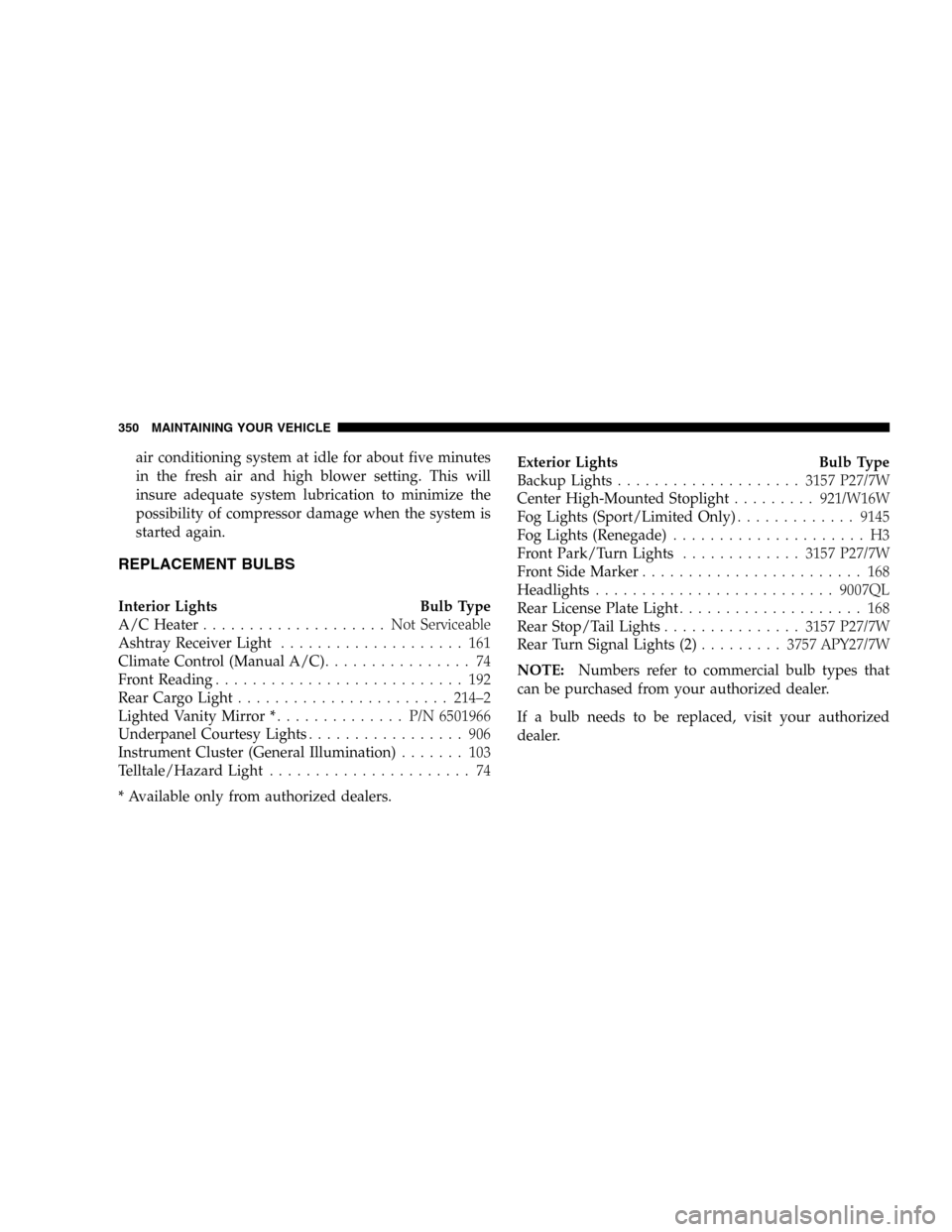
REPLACEMENT BULBS
Interior Lights Bulb Type
A/C Heater.................... NotServiceable
Ashtray Receiver Light.................... 161
Climate Control (Manual A/C)................ 74
Front Reading........................... 192
Rear Cargo Light.......................214–2
Lighted Vanity Mirror *.............. P/N6501966
Underpanel Courtesy Lights................. 906
Instrument Cluster (General Illumination)....... 103
Telltale/Hazard Light...................... 74
* Available only from authorized dealers.Exterior Lights Bulb Type
Backup Lights....................3157 P27/7W
Center High-Mounted Stoplight.........921/W16W
Fog Lights (Sport/Limited Only).............9145
Fog Lights (Renegade)..................... H3
Front Park/Turn Lights.............3157 P27/7W
Front Side Marker........................ 168
Headlights..........................9007QL
Rear License Plate Light.................... 168
Rear Stop/Tail Lights...............3157 P27/7W
Rear Turn Signal Lights (2).........3757 APY27/7W
NOTE:Numbers refer to commercial bulb types that
can be purchased from your authorized dealer.
If a bulb needs to be replaced, visit your authorized
dealer.
350 MAINTAINING YOUR VEHICLE