Page 331 of 424
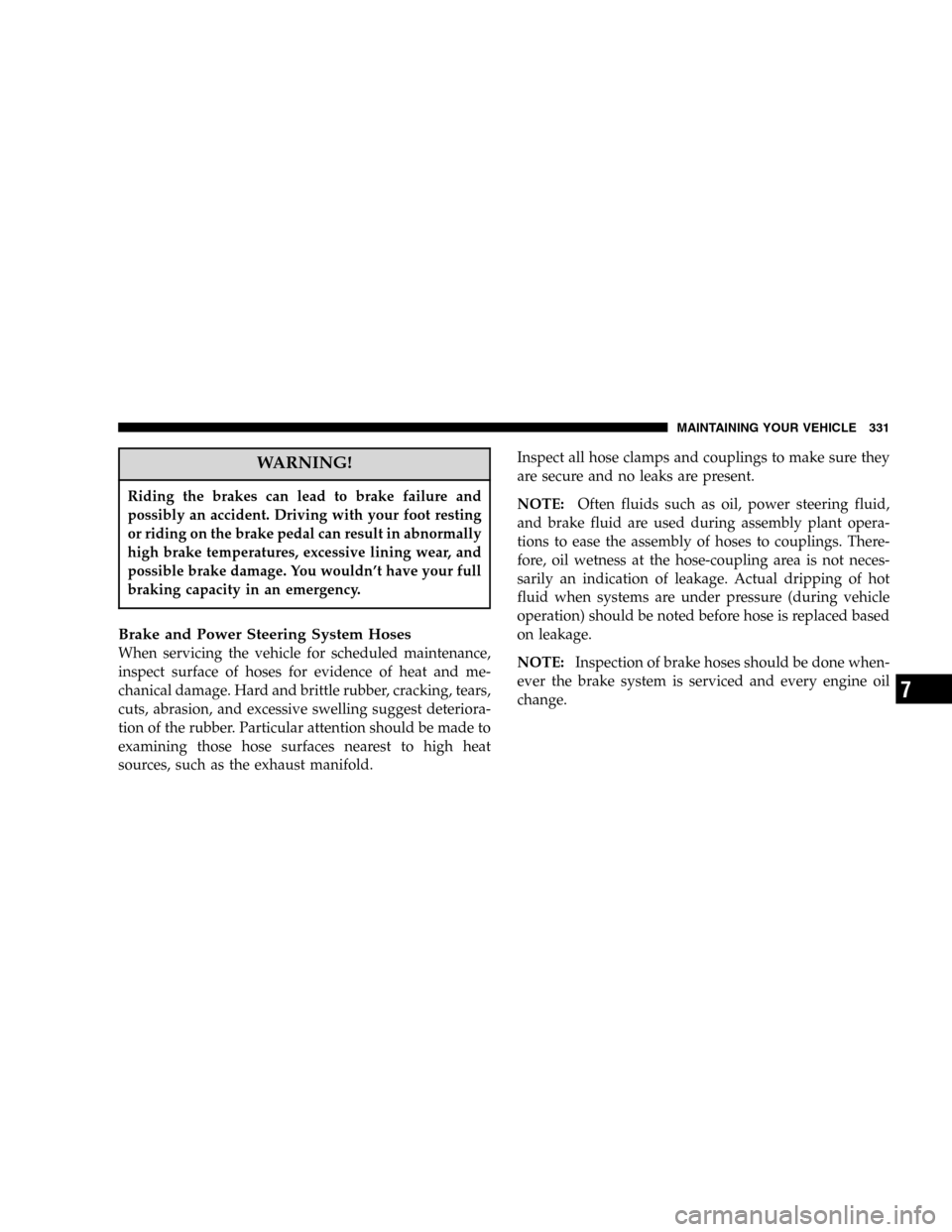
WARNING!
Riding the brakes can lead to brake failure and
possibly an accident. Driving with your foot resting
or riding on the brake pedal can result in abnormally
high brake temperatures, excessive lining wear, and
possible brake damage. You wouldn’t have your full
braking capacity in an emergency.
Brake and Power Steering System Hoses
When servicing the vehicle for scheduled maintenance,
inspect surface of hoses for evidence of heat and me-
chanical damage. Hard and brittle rubber, cracking, tears,
cuts, abrasion, and excessive swelling suggest deteriora-
tion of the rubber. Particular attention should be made to
examining those hose surfaces nearest to high heat
sources, such as the exhaust manifold.Inspect all hose clamps and couplings to make sure they
are secure and no leaks are present.
NOTE:Often fluids such as oil, power steering fluid,
and brake fluid are used during assembly plant opera-
tions to ease the assembly of hoses to couplings. There-
fore, oil wetness at the hose-coupling area is not neces-
sarily an indication of leakage. Actual dripping of hot
fluid when systems are under pressure (during vehicle
operation) should be noted before hose is replaced based
on leakage.
NOTE:Inspection of brake hoses should be done when-
ever the brake system is serviced and every engine oil
change.
MAINTAINING YOUR VEHICLE 331
7
Page 333 of 424
Use only manufacturer’s recommended brake fluid, refer
to Recommended Fluids, Lubricants, and Genuine Parts
for correct fluid type.
WARNING!
Use of a brake fluid that may have a lower initial
boiling point or unidentified as to specification, may
result in sudden brake failure during hard pro-
longed braking. You could have an accident.
WARNING!
Overfilling the brake fluid reservoir can result in
spilling brake fluid on hot engine parts and the
brake fluid catching fire.
Use only brake fluid that has been in a tightly closed
container to avoid contamination from foreign matter. Do
not allow petroleum base fluid to contaminate the brake
fluid as seal damage will result.
Automatic Transmission
Selection of Lubricant
It is important that the proper lubricant is used in the
transmission to assure optimum transmission perfor-
mance. Use only manufacturer’s recommended transmis-
sion fluid, refer to Recommended Fluids, Lubricants, and
Genuine Parts for correct fluid type. It is important that
the transmission fluid be maintained at the prescribed
level using the recommended fluid.
MAINTAINING YOUR VEHICLE 333
7
Page 334 of 424
CAUTION!
Using a transmission fluid other than the manufac-
turer’s recommended fluid may cause deterioration
in transmission shift quality and/or torque converter
shudder. Using a transmission fluid other than the
manufacturer’s recommended fluid will result in
more frequent fluid and filter changes. Refer to
Recommended Fluids, Lubricants, and Genuine
Parts for correct fluid type.
Fluid Level Check – 3.7L Gasoline Engine (42RLE)
and 2.8L Diesel Engine (545RFE)
This fluid level should be checked when the engine is
fully warmed up and the fluid in the transmission is
heated to its normal operating temperature. Operation of
the transmission with an improper fluid level will greatly
reduce the life of the transmission and of the fluid.To check the automatic transmission fluid level properly,
the following procedure must be used:
1. The vehicle must be on level ground.
2. The engine should be running at curb idle speed for a
minimum of 60 seconds.
3. Fully apply parking brake.
4. Apply the brakes and shift the transmission into P
(Park).
5. The fluidMUSTbe checked with the transmission in
P (Park) to be sure that the fluid level is accurate.
6. Wipe the dipstick clean and reinsert until seated.
Remove dipstick and note reading.
At normal operating temperature (approximately 180° F
(82° C), the fluid level is correct if it is in the HOT region
334 MAINTAINING YOUR VEHICLE
Page 343 of 424
Cavity Fuse Description
1 15 Amp Blue Horn Relay, Power Sunroof
Relay, Power Window Relay
2 10 Amp Red Rear Fog Lights (Export
Only)
3 20 Amp Yel-
lowCigar Lighter
4 10 Amp Red Headlight Low Beam Right
5 10 Amp Red Headlight Low Beam Left
6 20 Amp Yel-
lowBody Control Module/Power
Door Locks
7 10 Amp Red Left Park Light/Left Tail
Lamp/License Plate Lamp
8 Spare
9 10 Amp Red Right Park Light/RightTail
Lamp/License Plate Lamp/
Cluster
10 SpareCavity Fuse Description
11 15 Amp Blue Flasher
12 15 Amp Blue Stop Lights
13 10 Amp Red Body Control Module/
CMTC/Cluster/Pass. Airbag
On,Off Indicator, Auto Day-
light Mirror/Light Bar
Switch (Renegade Only)
14 10 Amp Red PDC Fuel Pump/AC Clutch,
Starter Relay/Engine
Controller/Transmission
Controller (Diesel Only)
15 Spare
16 20 Amp Yel-
lowPower Outlet (Rear)
17 15 Amp Blue Rear Wiper
18 20 Amp Yel-
lowRadio Choke & Relay
MAINTAINING YOUR VEHICLE 343
7
Page 345 of 424
Cavity Fuse Description
38 10 Amp Red ABS Controller/Shifter As-
sembly
39 10 Amp Red Hazard Flasher (Turn
Signals)/Backup Lamp
Switch (Manual Transmission
Only)/Transmission Range
Switch (Automatic Transmis-
sion Only)
Underhood Fuses (Power Distribution Center)
Your vehicle is equipped with an electrical power distri-
bution center located in the engine compartment near the
battery. This power center houses plug-in “Cartridge”
fuses which replace in-line fusible links. The power
center also contains “Mini” fuses and plug-in full and
micro ISO relays. A label inside the latching cover of the
center identifies each component for ease of replacement,
if necessary. “Cartridge” fuses and relays can be obtained
from your authorized dealer.Power Distribution Center (Gasoline Engines)
Cavity Fuse Description
F1 40 Amp
GreenBlower Motor
F2 40 Amp
GreenRadiator Fan
Power Distribution Center
MAINTAINING YOUR VEHICLE 345
7
Page 347 of 424
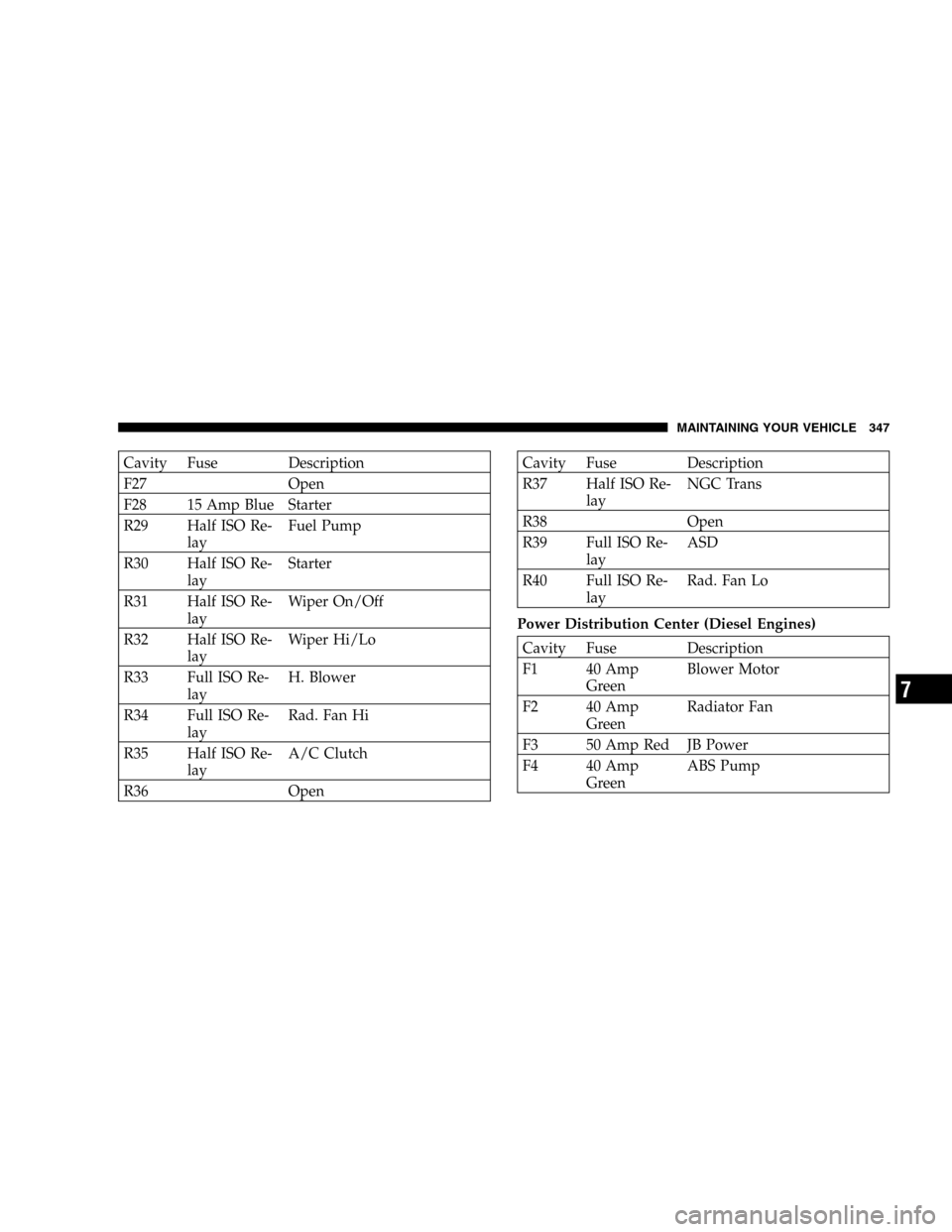
Cavity Fuse Description
F27 Open
F28 15 Amp Blue Starter
R29 Half ISO Re-
layFuel Pump
R30 Half ISO Re-
layStarter
R31 Half ISO Re-
layWiper On/Off
R32 Half ISO Re-
layWiper Hi/Lo
R33 Full ISO Re-
layH. Blower
R34 Full ISO Re-
layRad. Fan Hi
R35 Half ISO Re-
layA/C Clutch
R36 OpenCavity Fuse Description
R37 Half ISO Re-
layNGC Trans
R38 Open
R39 Full ISO Re-
layASD
R40 Full ISO Re-
layRad. Fan Lo
Power Distribution Center (Diesel Engines)
Cavity Fuse Description
F1 40 Amp
GreenBlower Motor
F2 40 Amp
GreenRadiator Fan
F3 50 Amp Red JB Power
F4 40 Amp
GreenABS Pump
MAINTAINING YOUR VEHICLE 347
7
Page 351 of 424
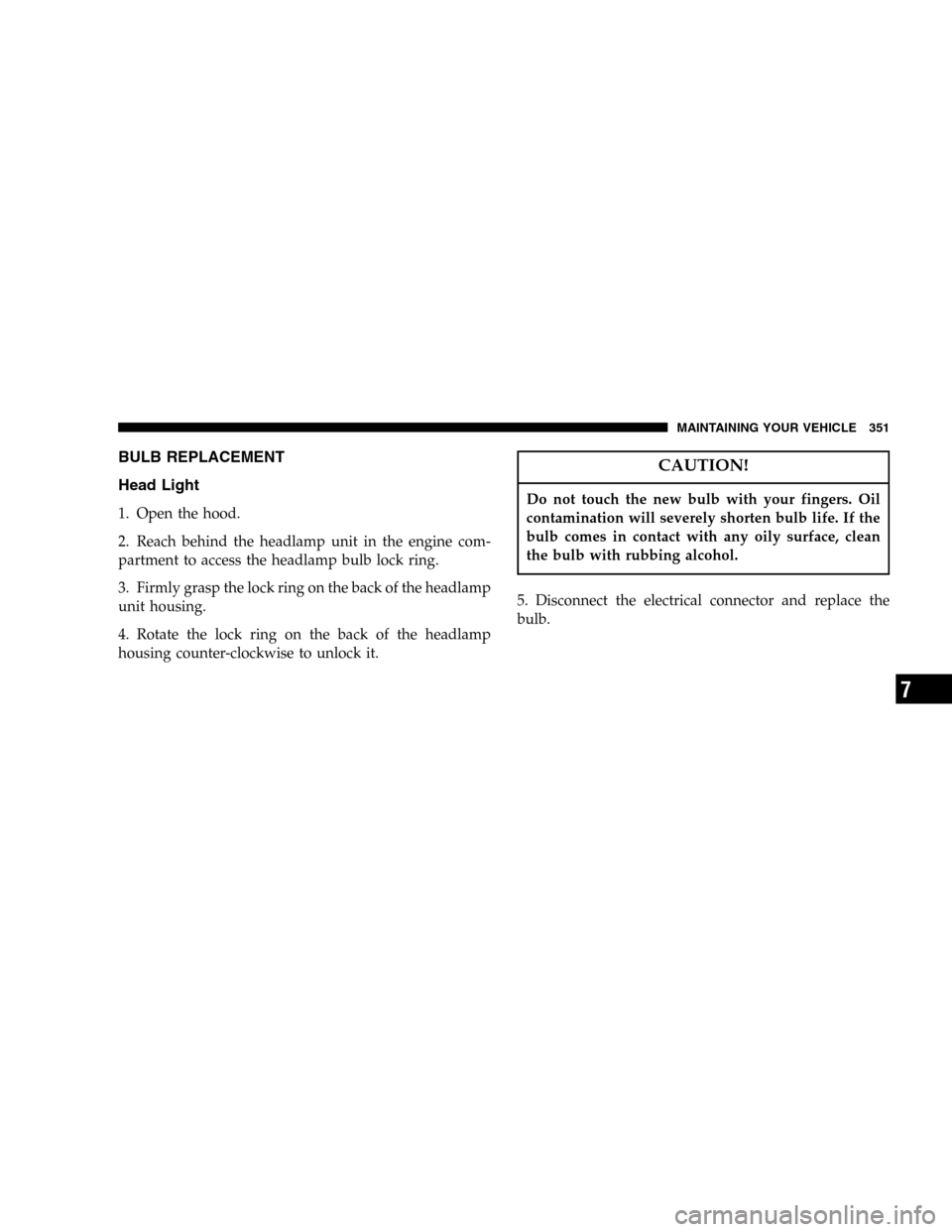
BULB REPLACEMENT
Head Light
1. Open the hood.
2. Reach behind the headlamp unit in the engine com-
partment to access the headlamp bulb lock ring.
3. Firmly grasp the lock ring on the back of the headlamp
unit housing.
4. Rotate the lock ring on the back of the headlamp
housing counter-clockwise to unlock it.
CAUTION!
Do not touch the new bulb with your fingers. Oil
contamination will severely shorten bulb life. If the
bulb comes in contact with any oily surface, clean
the bulb with rubbing alcohol.
5. Disconnect the electrical connector and replace the
bulb.
MAINTAINING YOUR VEHICLE 351
7
Page 356 of 424
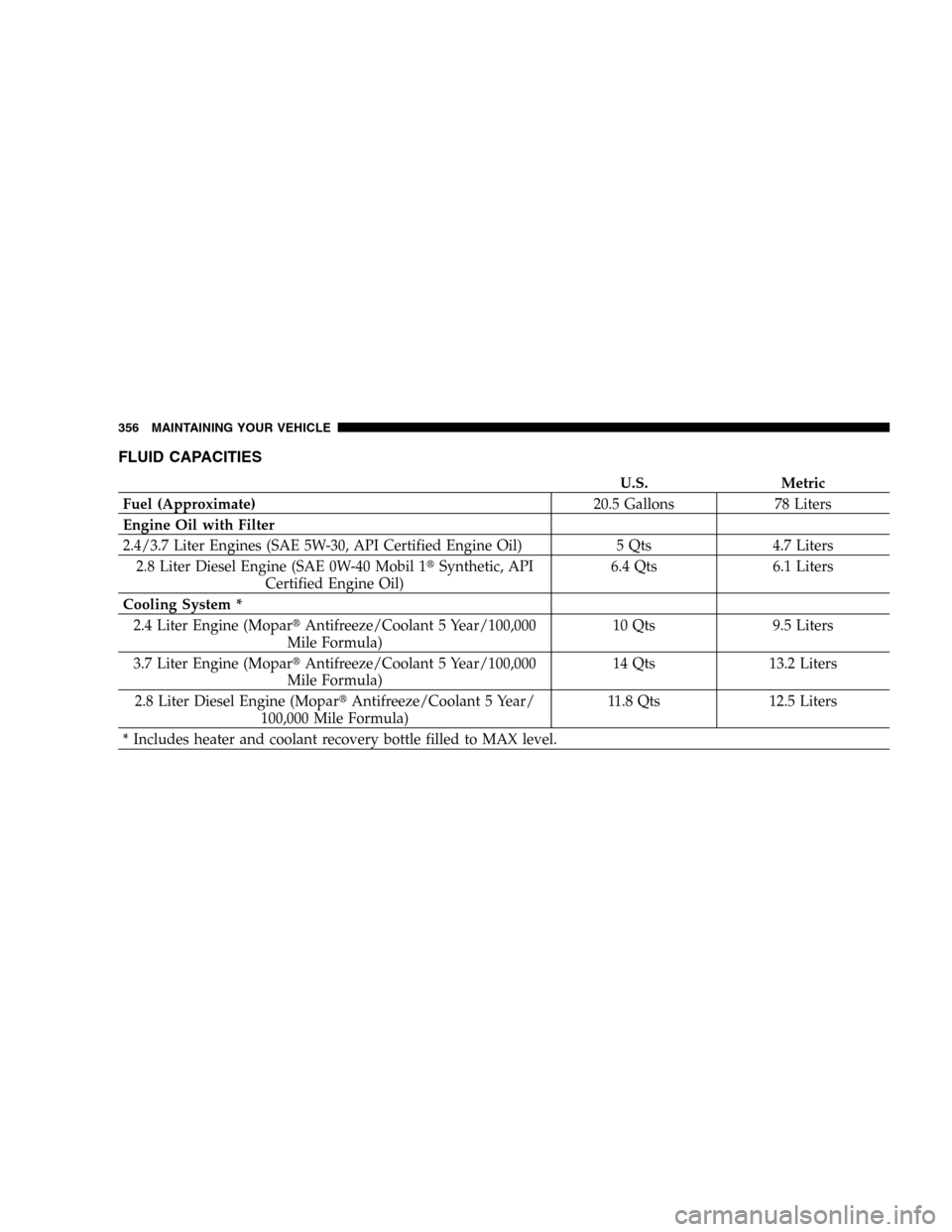
FLUID CAPACITIES
U.S. Metric
Fuel (Approximate)20.5 Gallons 78 Liters
Engine Oil with Filter
2.4/3.7 Liter Engines (SAE 5W-30, API Certified Engine Oil) 5 Qts 4.7 Liters
2.8 Liter Diesel Engine (SAE 0W-40 Mobil 1�Synthetic, API
Certified Engine Oil)6.4 Qts 6.1 Liters
Cooling System *
2.4 Liter Engine (Mopar�Antifreeze/Coolant 5 Year/100,000
Mile Formula)10 Qts 9.5 Liters
3.7 Liter Engine (Mopar�Antifreeze/Coolant 5 Year/100,000
Mile Formula)14 Qts 13.2 Liters
2.8 Liter Diesel Engine (Mopar�Antifreeze/Coolant 5 Year/
100,000 Mile Formula)11.8 Qts 12.5 Liters
* Includes heater and coolant recovery bottle filled to MAX level.
356 MAINTAINING YOUR VEHICLE