2005 HYUNDAI XG350 drain
[x] Cancel search: drainPage 156 of 247

34WHAT TO DO IN AN EMERGENCY
IF THE ENGINE OVERHEATS
WARNING:
While the engine is running, keep hair,
hands and clothing away from moving parts
such as the fan and drive belts to prevent
injury.
5. If the water pump drive belt is broken or
engine coolant is leaking out, stop the engine
immediately and call the nearest Hyundai
dealer for assistance.
WARNING:
Do not remove the radiator cap when the
engine is hot. This can allow coolant to be
blown out of the opening and cause seri-
ous burns.
6. If you cannot find the cause of the overheat-
ing, wait until the engine temperature has
returned to normal. Then, if coolant has been
lost, carefully add coolant to the reservoir to
bring the fluid level in the reservoir up to the
halfway mark.
7. Proceed with caution, keeping alert for fur-
ther signs of overheating. If overheating
happens again, call a Hyundai dealer for
assistance.
CAUTION:
Serious loss of coolant indicates there is a
leak in the cooling system and this should
be checked as soon as possible by a Hyundai
dealer.
!!
!
D030A01L-AATIf your temperature gauge indicates overheat-
ing, you experience a loss of power, or hear loud
pinging or knocking, the engine is probably too
hot. If this happens, you should:
1. Pull off the road and stop as soon as it is safe
to do so.
2. Place the gear selector lever in "P" and set
the parking brake. If the air conditioning is on,
turn it off.
3. If engine coolant is running out under the car
or steam is coming out from the hood, stop
the engine. Do not open the hood until the
coolant has stopped running or the steaming
has stopped. If there is no visible loss of
engine coolant and no steam, leave the
engine running and check to be sure the
engine cooling fan is operating. If the fan is
not running, turn the engine off.
4. Check to see if the water pump drive belt is
missing. If it is not missing, check to see that
it is tight. If the drive belt seems to be
satisfactory, check for coolant leaking from
the radiator, hoses or under the car. (If the
air conditioning had been in use, it is normal
for cold water to be draining from it when you
stop).
xgflhma-3.p656/16/04, 3:00 PM 4
Page 168 of 247
4
CORROSION PREVENTION AND APPEARANCE CARE
4
CORROSION PREVENTION AND APPEARANCE CARE
3
TO HELP PREVENT CORROSIONE020B01A-AATKeep Your Car CleanThe best way to prevent corrosion is to keep
your car clean and free of corrosive materials.
Attention to the underside of the car is particu-
larly important.
o If you live in a high-corrosion area — where
road salts are used, near the ocean, areas
with industrial pollution, acid rain, etc.—, you
should take extra care to prevent corrosion.
In winter, hose off the underside of your car
at least once a month and be sure to clean
the underside thoroughly when winter is
over.
o When cleaning underneath the car, give
particular attention to the components under
the fenders and other areas that are hidden
from view. Do a thorough job; just dampening
the accumulated mud rather than washing it
away will accelerate corrosion rather than
prevent it. Water under high pressure and
steam are particularly effective in removing
accumulated mud and corrosive materials.E020A01A-AATYou can help prevent corrosion from getting
started by observing the following:
E020C01A-AATKeep Your Garage DryDon't park your car in a damp, poorly ventilated
garage. This creates a favorable environment
for corrosion. This is particularly true if you
wash your car in the garage or drive it into the
garage when it is still wet or covered with snow,
ice or mud. Even a heated garage can contrib-
ute to corrosion unless it is well ventilated so
moisture is dispersed.
E020D02A-AATKeep Paint and Trim in Good ConditionScratches or chips in the finish should be
covered with "touch-up" paint as soon as pos-
sible to reduce the possibility of corrosion. If
bare metal is showing through, the attention of
a qualified body and paint shop is recommended.
Bird droppings : Bird droppings are highly cor-
rosive and may damage painted surfaces in just
a few hours. Always remove bird droppings as
soon as possible.E020E01A-AATDon't Neglect the InteriorMoisture can collect under the floor mats and
carpeting to cause corrosion. Check under the
mats periodically to be sure the carpeting is dry.
Use particular care if you carry fertilizers, clean-
ing materials or chemicals in the car.
These should be carried only in proper contain-
ers and any spills or leaks should be cleaned up,
flushed with clear water and thoroughly dried. o When cleaning lower door panels, rocker
panels and frame members, be sure that
drain holes are kept open so that moisture
can escape and not be trapped inside to ac-
celerate corrosion.
xgflhma-4.p656/16/04, 2:59 PM 3
Page 185 of 247

6
DO-IT-YOURSELF MAINTENANCE
5
!
CHANGING THE OIL AND FILTER
!
WARNING:
Be very careful when draining the engine oil
as it may be hot enough to burn you!
G040A01L-AATThe engine oil and filter should be changed at
those intervals specified in the maintenance
schedule in Section 5. If the car is being driven
in severe conditions, more frequent oil and filter
changes are required.
The procedure for changing the oil and filter is
as follows:
1. Park the car on level ground and set the
parking brake. Start the engine and let it
warm up until the needle on the coolant
temperature gauge moves above the lowest
mark. Turn the engine off and place the gear
selector lever in "P".
2. Open the hood and remove the engine oil
filler cap.
G040A02L
3. Slide underneath the car and loosen the
drain plug by turning it counterclockwise with
a wrench of the proper size. Be sure that a
drain pan is in position to catch the oil as it
drains out, then remove the drain plug.
4. When the oil has stopped draining, replace the
drain plug using a new washer and retighten by
turning it clockwise.
Oil pan drain plug tightening torque:
3.5 ~ 4.0 kgf.m
5. Remove the oil filter by turning it counterclock-
wise with a oil filter wrench of the proper size. A
certain amount of oil will come out when you
remove the filter. So be sure to have your drain
pan in place underneath it.
6. Install a new oil filter in accordance with the
instructions on the carton or on the filter itself. Do
not over-tighten.
Oil filter tightening torque:1.2 ~1.6 kgf.m
Be sure that the mounting surface on the engine
is clean and that the old gasket is removed
completely. Lubricate the new gasket on the
filter with clean engine oil before installation.
7. Remove the engine oil level dipstick.8. Refill the crankcase with the recommended
engine oil. Refer to the specification in chap-
ter 9 for engine oil capacity.
Oil filler cap
Oil fillerDrain plug9. Start the engine and check to be sure no oil
is leaking from the drain plug or oil filter.
10.Shut off the engine and recheck the oil level.
NOTE:Always dispose of used engine oil in an
environmentally acceptable manner. It is
suggested that it be placed in a sealed
container and taken to a service station for
reclamation. Do not pour the oil on the
ground or put it in with the household trash.
CAUTION
Slowly pour the recommended oil using by
a tunnel. Do not overfill not to damage
engine.
!
PROPOSITION 65 WARNING:
Used engine oil may cause irritation or can-
cer of the skin if left in contact with the skin
for prolonged periods of time. Used engine
oil contains chemicals that have caused
cancer in laboratory animals. Always protect
your skin by washing your hands thoroughly
with soap and warm water as soon as pos-
sible after handling used oil.
xgflhma-6.p656/16/04, 2:58 PM 5
Page 187 of 247
6
DO-IT-YOURSELF MAINTENANCE
7
G050D02A-AATTo Change the Engine CoolantThe engine coolant should be changed at those
intervals specified in the vehicle maintenance
schedule in Section 5.
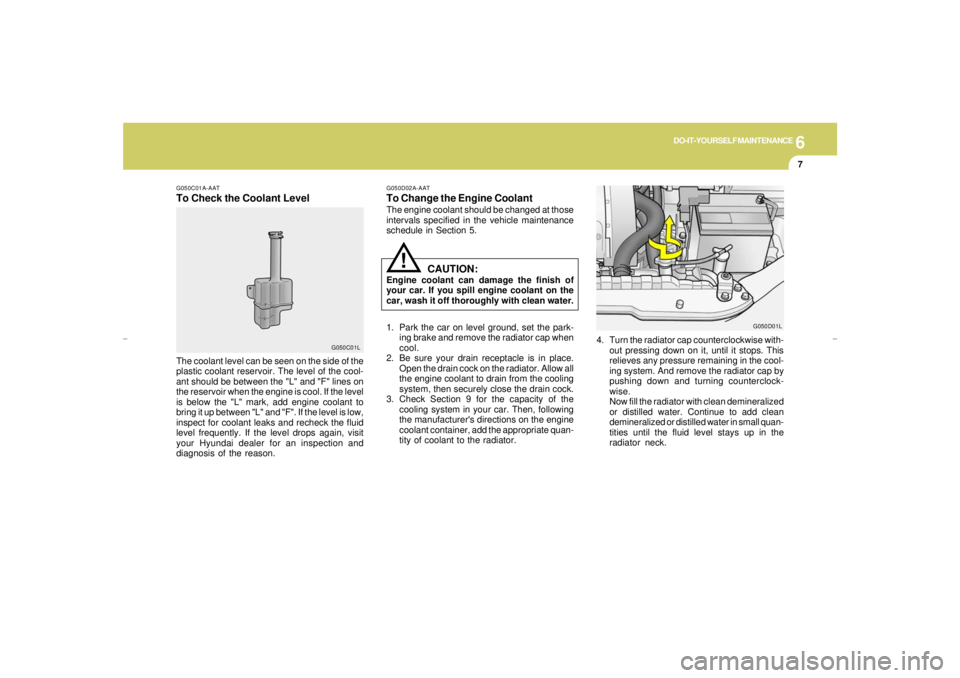
G050C01A-AATTo Check the Coolant LevelThe coolant level can be seen on the side of the
plastic coolant reservoir. The level of the cool-
ant should be between the "L" and "F" lines on
the reservoir when the engine is cool. If the level
is below the "L" mark, add engine coolant to
bring it up between "L" and "F". If the level is low,
inspect for coolant leaks and recheck the fluid
level frequently. If the level drops again, visit
your Hyundai dealer for an inspection and
diagnosis of the reason.
G050C01L
CAUTION:
Engine coolant can damage the finish of
your car. If you spill engine coolant on the
car, wash it off thoroughly with clean water.
1. Park the car on level ground, set the park-
ing brake and remove the radiator cap when
cool.
2. Be sure your drain receptacle is in place.
Open the drain cock on the radiator. Allow all
the engine coolant to drain from the cooling
system, then securely close the drain cock.
3. Check Section 9 for the capacity of the
cooling system in your car. Then, following
the manufacturer's directions on the engine
coolant container, add the appropriate quan-
tity of coolant to the radiator.
!
4. Turn the radiator cap counterclockwise with-
out pressing down on it, until it stops. This
relieves any pressure remaining in the cool-
ing system. And remove the radiator cap by
pushing down and turning counterclock-
wise.
Now fill the radiator with clean demineralized
or distilled water. Continue to add clean
demineralized or distilled water in small quan-
tities until the fluid level stays up in the
radiator neck.
G050D01L
xgflhma-6.p656/16/04, 2:58 PM 7
Page 188 of 247

6
DO-IT-YOURSELF MAINTENANCE
8
SPARK PLUGSG060A02Y-AATYour engine was originally equipped with plati-
num-tipped spark plugs.
Platinum-tipped spark plugs will last longer than
conventional type spark plugs and can be
identified by blue lines on the ceramic shell.NOTE:Do not clean or regap platinum-tipped spark
plugs.
G060A01LG060B04L-AAT
Replacing the Spark PlugsThe spark plugs should be changed at the
intervals specified in the vehicle maintenance
schedule in Section 5 or whenever engine
performance indicates they should be changed.
Symptoms that suggest poor spark plug perfor-
mance include engine misfiring under load, loss
of fuel economy, poor acceleration, etc. When
spark plugs are replaced, always use spark
plugs recommended by Hyundai. The use of
other spark plugs can result in loss of perfor-
mance, radio interference or engine damage.RC10PYP4 (CHAMPION)
RC10PYPB4 (CHAMPION)
PFR5N-II (NGK)
0.039~0.043 in. (1.0~1.1 mm)
Recommended Spark Plugs:
!
5. Start the engine, top off the radiator with
water and then add coolant to the reservoir
until the level is between "LOW" and "FULL".
6. Replace the radiator and reservoir caps and
check to be sure the drain cocks are fully
closed and not leaking.
G050D02L
WARNING:
The cooling fan is controlled by engine
coolant temperature and may sometimes
operate even when the engine is not run-
ning. Use extreme caution when working
near the blades of the coolant fan so that
you are not injured by a rotating fan blade.
As the engine coolant temperature de-
creases, the fan will automatically shut off.
This is a normal condition.(3.5V6)
xgflhma-6.p656/16/04, 2:58 PM 8
Page 240 of 247

9
VEHICLE SPECIFICATIONS4
J080A05L-AATLUBRICATION CHART
Oil & Coolant Standard
API SH, Hot Climate : SAE 20W-40, 20W-50 (ABOVE 32°F OR 0°C)
SG or Normal Climate : SAE 10W-30 10W-40, 10W-50 (ABOVE -10°F OR -23°C)
SG/CDCold Climate : SAE 5W-30 5W-40 (BELOW 100°F OR 38°C)
HYUNDAI GENUINE ATF SP III, DIAMOND ATF SP III, SK ATF SP III or other brands
approved by Hyundai Motor Co.,
Ethylene glycol base for aluminum radiator
PSF-3 type fluid
DOT 3, DOT 4 or Equivalent Item
Engine
Transaxle
Coolant
Power steering
Brakes and clutch fluid
Quantity (US.qts) (lmp.qts, liter)
Drain & refill;
Without oil filter : 4.23 (3.52, 4.0)
With oil filter : 4.54 (3.78,4.3)
8.98 (7.48, 8.5)
11.8 (9.8, 11.2)
1.06 (0.88, 1.0)
As required
xgflhma-9.p656/16/04, 2:56 PM 4