2005 HYUNDAI XG350 wheel
[x] Cancel search: wheelPage 57 of 247

1
FEATURES OF YOUR HYUNDAI
45
INSTRUMENT CLUSTER
B260C02L-AAT
TRACTION CONTROL
INDICATOR LIGHT
The traction control indicators change opera-
tions according to the ignition switch position
and whether the system is in operation or not.
They will also illuminate when the ignition key is
turned to the "ON" or "START" position, but
should go out after three seconds. If the TCS
indicator stays on, take your car to your autho-
rized Hyundai dealer and have the system
checked. See section 2 for more information
about the TCS system.NOTE:When the TCS is manually deactivated, the
indicator light remains illuminated until the
ignition switch is turned off.B260Q01Y-GAT
CRUISE INDICATOR Light
(If installed)
The cruise indicator light in the instrument clus-
ter is illuminated only when the vehicle cruising
speed has been set using the control switch on
the steering wheel.
The indicator light does not illuminate when the
main cruise control switch is activated.
Information about the use of cruise control is
beginning on page 1-75.
B280A01A-AATFUEL GAUGEThe needle on the gauge indicates the approxi-
mate fuel level in the fuel tank. The fuel capacity
is given in Section 9.
B270A01A-AATBRAKE PAD WEAR WARNING SOUNDThe front disc brake pads have wear indicators
that should make a high-pitched squealing or
scraping noise when new pads are needed. The
sound may come and go or be heard all the time
when the vehicle is moving. It may also be heard
when the brake pedal is pushed down firmly.
Excessive rotor damage will result if the worn
pads are not replaced. See your Hyundai dealer
immediately.B270B01L-AAT
STOP/TAIL LIGHT FAILURE
WARNING LIGHT
If the Stop/Tail Light Failure warning light comes
on when the parking brake is applied or the tail
light is turned on, check the brake lines or the
tail light bulb.
B280A01L
xgflhma-1.p656/16/04, 3:03 PM 45
Page 62 of 247
1FEATURES OF YOUR HYUNDAI50
WINDSHIELD WIPER AND WASHER
SWITCH
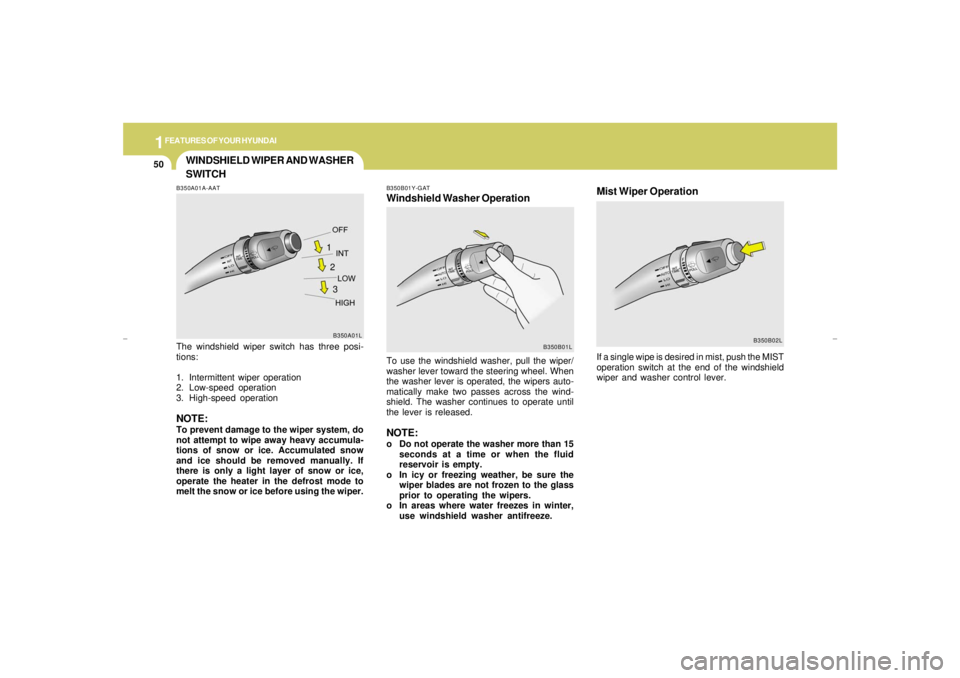
Mist Wiper OperationIf a single wipe is desired in mist, push the MIST
operation switch at the end of the windshield
wiper and washer control lever.
B350B01Y-GATWindshield Washer OperationTo use the windshield washer, pull the wiper/
washer lever toward the steering wheel. When
the washer lever is operated, the wipers auto-
matically make two passes across the wind-
shield. The washer continues to operate until
the lever is released.NOTE:o Do not operate the washer more than 15
seconds at a time or when the fluid
reservoir is empty.
o In icy or freezing weather, be sure the
wiper blades are not frozen to the glass
prior to operating the wipers.
o In areas where water freezes in winter,
use windshield washer antifreeze.
B350B01LB350B02L
B350A01A-AATThe windshield wiper switch has three posi-
tions:
1. Intermittent wiper operation
2. Low-speed operation
3. High-speed operationNOTE:To prevent damage to the wiper system, do
not attempt to wipe away heavy accumula-
tions of snow or ice. Accumulated snow
and ice should be removed manually. If
there is only a light layer of snow or ice,
operate the heater in the defrost mode to
melt the snow or ice before using the wiper.
B350A01L1
2
3
xgflhma-1.p656/16/04, 3:03 PM 50
Page 86 of 247
1FEATURES OF YOUR HYUNDAI74
DOOR COURTESY LIGHT
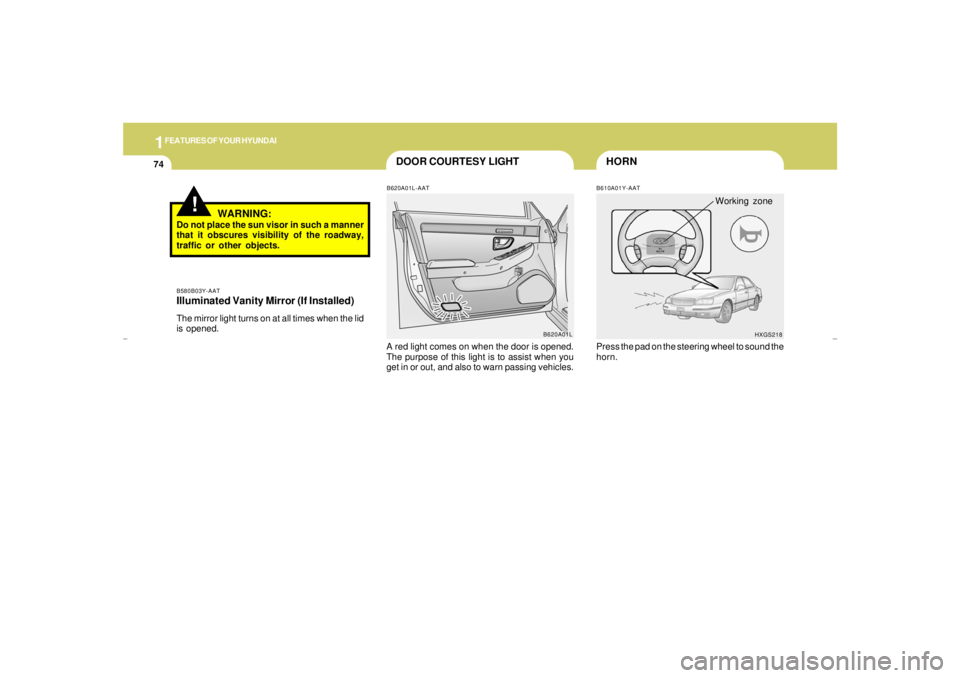
HORNB610A01Y-AAT
B620A01L B620A01L-AAT
A red light comes on when the door is opened.
The purpose of this light is to assist when you
get in or out, and also to warn passing vehicles.
HXGS218
Working zone
Press the pad on the steering wheel to sound the
horn.
!
WARNING:
Do not place the sun visor in such a manner
that it obscures visibility of the roadway,
traffic or other objects.B580B03Y-AATIlluminated Vanity Mirror (If Installed)The mirror light turns on at all times when the lid
is opened.
xgflhma-1.p656/16/04, 3:04 PM 74
Page 87 of 247
1
FEATURES OF YOUR HYUNDAI
75
CRUISE CONTROL STEERING WHEEL TILT LEVER
REAR SEAT ARM REST
!
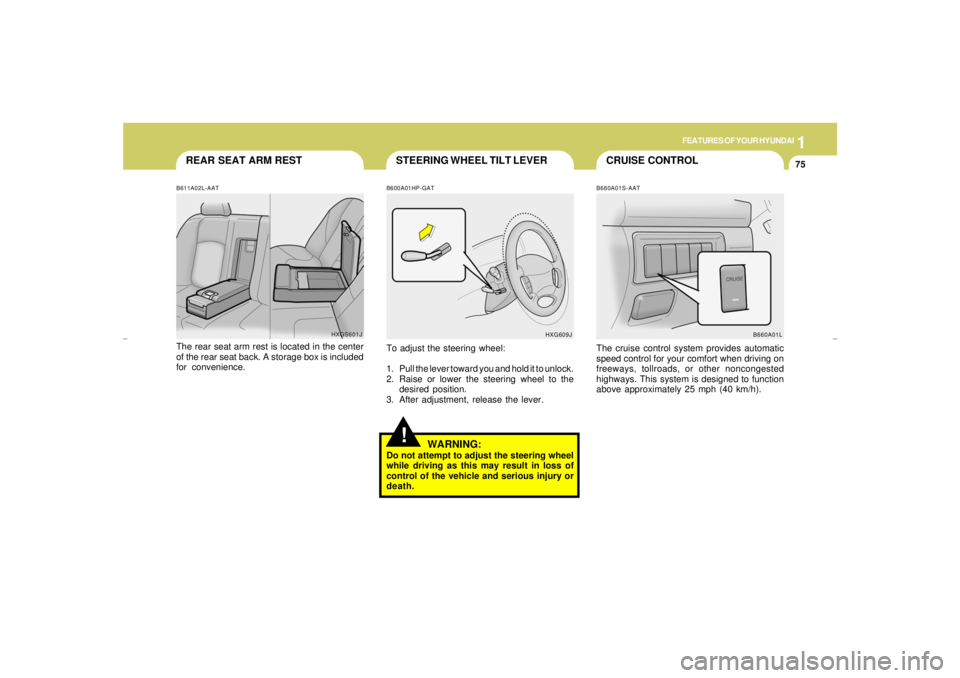
B660A01S-AATThe cruise control system provides automatic
speed control for your comfort when driving on
freeways, tollroads, or other noncongested
highways. This system is designed to function
above approximately 25 mph (40 km/h).
B600A01HP-GATTo adjust the steering wheel:
1. Pull the lever toward you and hold it to unlock.
2. Raise or lower the steering wheel to the
desired position.
3. After adjustment, release the lever.
WARNING:
Do not attempt to adjust the steering wheel
while driving as this may result in loss of
control of the vehicle and serious injury or
death.
HXG609J
B660A01L B611A02L-AAT
The rear seat arm rest is located in the center
of the rear seat back. A storage box is included
for convenience.
HXGS601J
xgflhma-1.p656/16/04, 3:04 PM 75
Page 133 of 247

DRIVING YOUR HYUNDAI
32
KEY POSITIONS COMBINATION IGNITION SWITCH
BEFORE STARTING THE ENGINE
!
C020A01A-AATBefore you start the engine, you should always:
1. Look around the vehicle to be sure there are
no flat tires, puddles of oil, water or other
indications of possible trouble.
2. After entering the car, check to be sure the
parking brake is engaged.
3. Check that all windows, and lights are clean.
4. Check that the interior and exterior mirrors
are clean and in position.
5. Check your seat, seatback and headrest to
be sure they are in their proper positions.
6. Lock all the doors.
7. Fasten your seat belt and be sure that all
other occupants have fastened theirs.
8. Turn off all lights and accessories that are
not needed.
9. When you turn the ignition switch to "ON",
check that all appropriate warning lights are
operating and that you have sufficient fuel.
10.Check the operation of warning lights and all
bulbs when key is in the "ON" position.
C030A01L-AATTo Start the Engineo Place the shift lever in "P" (park) and de-
press the brake pedal fully.
o To start the engine, insert the ignition key and
turn it to the "START" position. Release it as
soon as the engine starts. Do not hold the
key in the "START" position for more than 15
seconds.NOTE:o For safety, the engine will not start if the
shift lever is not in "P" or "N" Position.
o The ignition key cannot be turned from
"ACC" position to "LOCK" position un-
less the shift lever is in the "P" (Park)
position or the negative battery terminal
is disconnected from the battery. To
remove the key, always confirm that the
shift lever is securely positioned in "P"
(Park).
o For additional information about start-
ing, see page 2-4.
C040A01A-AAT
WARNING:
The engine should not be turned off or the
key removed from the ignition key cylinder
while the vehicle is in motion. The steering
wheel is locked by removing the key.o "START"The engine is started in this position. It will crank
until you release the key.NOTE:Do not hold the key in the "START" position
for more than 15 seconds.LOCKACC
ON
START
C040A01E-1
xgflhma-2.p656/16/04, 3:00 PM 3
Page 134 of 247

2
DRIVING YOUR HYUNDAI4
STARTING!
C070C02A-AATTo remove the ignition key
C050A01A-AAT
1. Turn the ignition key to the "ACC" position.
2. Turn the ignition key counterclockwise from
the "ACC" position to the "LOCK" position.
3. The key can be removed in the "LOCK"
position.
WARNING:
Never run the engine in a closed or poorly
ventilated area any longer than is needed to
move your car in or out of the area. The
carbon monoxide gas emitted is odorless
and can cause serious injury or death.
C070C01E-1C050A01E-1
o "ON"When the key is in the "ON" position, the ignition
is on and all accessories may be turned on. If
the engine is not running, the key should not be
left in the "ON" position. This will discharge the
battery and may also damage the ignition sys-
tem.o "ACC"With the key in the "ACC" position, some elec-
trical accessories (radio, etc.) may be oper-
ated.o "LOCK"The key can be removed or inserted in this
position.
To protect against theft, the steering wheel
locks by removing the key.NOTE:To unlock the steering wheel, insert the key,
and then turn the steering wheel and key
simultaneously.LOCKACC
ON
START
xgflhma-2.p656/16/04, 3:00 PM 4
Page 138 of 247

2
DRIVING YOUR HYUNDAI8
ANTI-LOCK BRAKE SYSTEM
GOOD DRIVING PRACTICES
!
C120A02A-AAT(If Installed)The Anti-Lock Brake System (ABS) is designed
to prevent wheel lock-up during sudden braking
or on hazardous road surfaces. The ABS con-
trol module monitors the wheel speed and con-
trols the pressure applied to each brake. Thus,
in emergency situations or on slick roads, ABS
will increase vehicle control during braking.NOTE:During ABS operation, a pulsation may be
felt in the brake pedal when the brakes are
applied. Also, a noise may be heard in the
engine compartment while braking. These
conditions are normal and indicate that the
anti-lock brake system is functioning prop-
erly.
C090N03Y-AATo Never move the gear selector lever from "P"
or "N" to any other position with the accelera-
tor pedal depressed.
o Never move the gear selector lever into "P"
when the vehicle is in motion.
o Be sure the car is completely stopped before
you attempt to shift into "R".
o Never take the car out of gear and coast
down a hill. This may be extremely hazard-
ous. Always leave the car in gear when
moving.
o Do not "ride" the brakes. This can cause
them to overheat and malfunction. Instead,
when you are driving down a long hill, slow
down and shift to a lower gear. When you do
this, engine braking will help slow the car.
o Slow down before shifting to a lower gear.
Otherwise, the lower gear may not be en-
gaged.
o Always use the parking brake. Do not de-
pend on placing the transaxle in "P" to keep
the car from moving.
o Exercise extreme caution when driving on a
slippery surface. Be especially careful when
braking, accelerating or shifting gears. On a
slippery surface, an abrupt change in ve-
hicle speed can cause the drive wheels to
lose traction and the vehicle to go out of
control.
WARNING:
o The risk of rollover is greatly increased if
you lose control of your vehicle at high-
way speeds.
o Loss of control often occurs if two or
more wheels drop off the roadway and
the driver oversteers to reenter the road-
way.
o In the event your vehicle leaves the road-
way, do not steer sharply. Instead, slow
down before pulling back into the travel
lanes.
o In a collision crash, an unbelted person
is significantly more likely to die than a
person wearing a seatbelt.
o Never exceed posted speed limits.
o Excessive depressing of the accelerater
pedal in slippery driving conditions such
as pulling out of deep snow or mud may
cause severe damage to the transaxle.
Rocking the vehicle is not recommended.
Rather, use an appropriate towing
method.
xgflhma-2.p656/16/04, 3:00 PM 8
Page 139 of 247

DRIVING YOUR HYUNDAI
92
TRACTION CONTROL SYSTEM
(TCS)
!
!
WARNING:
Your ABS will not prevent accidents due to
improper or dangerous driving maneuvers.
Even though vehicle control is improved
during emergency braking, always main-
tain a safe distance between you and ob-
jects ahead. Vehicle speeds should always
be reduced during extreme road condi-
tions.
The braking distance for cars equipped
with an anti-lock braking system may be
longer than for those without it in the
following road conditions.
During these conditions the vehicle should
be driven at reduced speeds.
o Rough, gravel or snow-covered roads.
o With tire chains installed.
o On roads where the road surface is pit-
ted or has different surface height.
The safety features of an ABS equipped
vehicle should not be tested by high speed
driving or cornering. This could endanger
the safety of yourself or others.
C300A02Y-GAT(If Installed)
!
On slippery road surfaces, the traction control
system (TCS) limits the drive wheels from
spinning excessively, thus helping the car to
accelerate. It also provides sufficient driving
force and steering performance as the car turns
at accelerated speeds.SLIP ControlLimits the drive wheels from spinning exces-
sively during starting or while making acceler-
ated turns on slippery roads to avoid losing the
driving force of the front wheels.
CAUTION:
When the TCS indicator blinks, SLIP control
has been activated. It also means that the
road is slippery or your car is accelerating
excessively. In this situation, gently release
foot pressure from the accelerator pedal
and maintain moderate speed.
WARNING:
Traction control is only a driving aid; all
normal precautions for driving in inclement
weather and on slippery driving surfaces
should be observed.
C300A02L-A
Driving hintsTCS does not actively apply brakes. Be sure to
decelerate the car sufficiently before entering
curves.
xgflhma-2.p656/16/04, 3:00 PM 9