2005 HYUNDAI TUCSON child seat
[x] Cancel search: child seatPage 12 of 273
1
Fuel Recommendations ................................................ 1-2
Breaking in Your New Hyundai ..................................... 1-3
Keys.............................................................................. 1-3
Door .............................................................................. 1-4
Power Windows..........................................................1-11
Seats...........................................................................1-12
Seat Belts....................................................................1-17
Child Restraint System ...............................................1-23
Supplemental Restraint (AIRBAG) system .................1-30
Instrument Cluster and Indicator Lights...................... 1-42
Warning and Indicator Lights......................................1-44
Multi-Function Light Switch .........................................1-52
Windshield Wiper/Washer Switch...............................1-54
Sunroof.......................................................................1-60
Mirror...........................................................................1-65
How to use Luggage Room ........................................1-71
Hood Release .............................................................1-77
Cruise Control.............................................................1-80
Heating and Cooling Control .......................................1-84
Stereo Sound System...............................................1-101
Audio System............................................................1-103
Antenna.....................................................................1-135
1
FEATURES OF YOUR HYUNDAI
Page 15 of 273
1FEATURES OF YOUR HYUNDAI4
B030C01E-1
DOOR LOCKS!
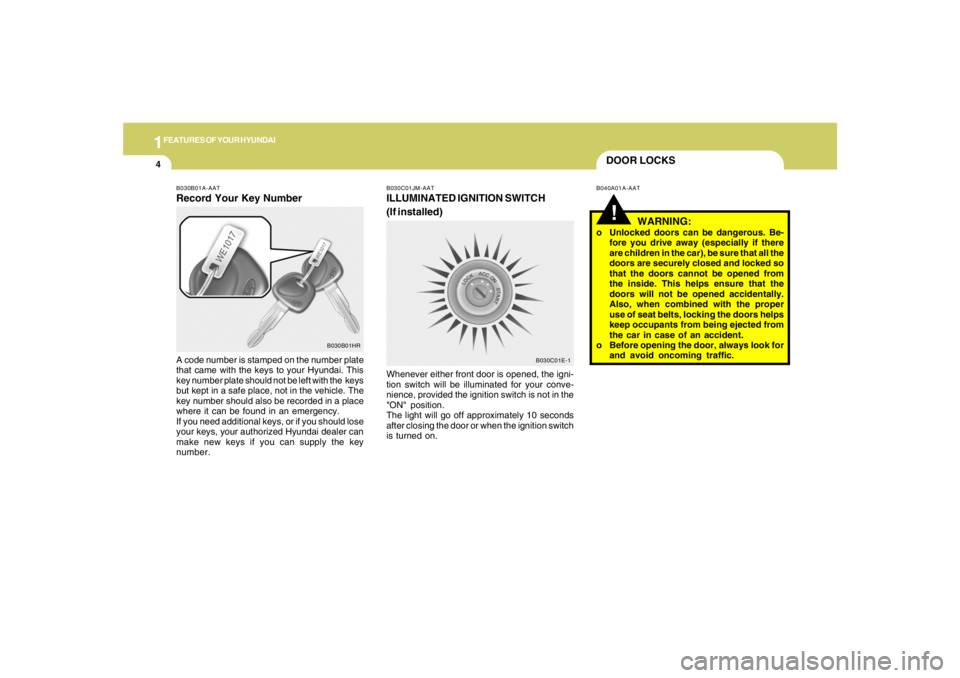
B040A01A-AAT B030C01JM-AAT
ILLUMINATED IGNITION SWITCH
(If installed)Whenever either front door is opened, the igni-
tion switch will be illuminated for your conve-
nience, provided the ignition switch is not in the
"ON" position.
The light will go off approximately 10 seconds
after closing the door or when the ignition switch
is turned on.
WARNING:
o Unlocked doors can be dangerous. Be-
fore you drive away (especially if there
are children in the car), be sure that all the
doors are securely closed and locked so
that the doors cannot be opened from
the inside. This helps ensure that the
doors will not be opened accidentally.
Also, when combined with the proper
use of seat belts, locking the doors helps
keep occupants from being ejected from
the car in case of an accident.
o Before opening the door, always look for
and avoid oncoming traffic.
B030B01A-AATRecord Your Key NumberA code number is stamped on the number plate
that came with the keys to your Hyundai. This
key number plate should not be left with the keys
but kept in a safe place, not in the vehicle. The
key number should also be recorded in a place
where it can be found in an emergency.
If you need additional keys, or if you should lose
your keys, your authorized Hyundai dealer can
make new keys if you can supply the key
number.
B030B01HR
Page 18 of 273
1
FEATURES OF YOUR HYUNDAI
7
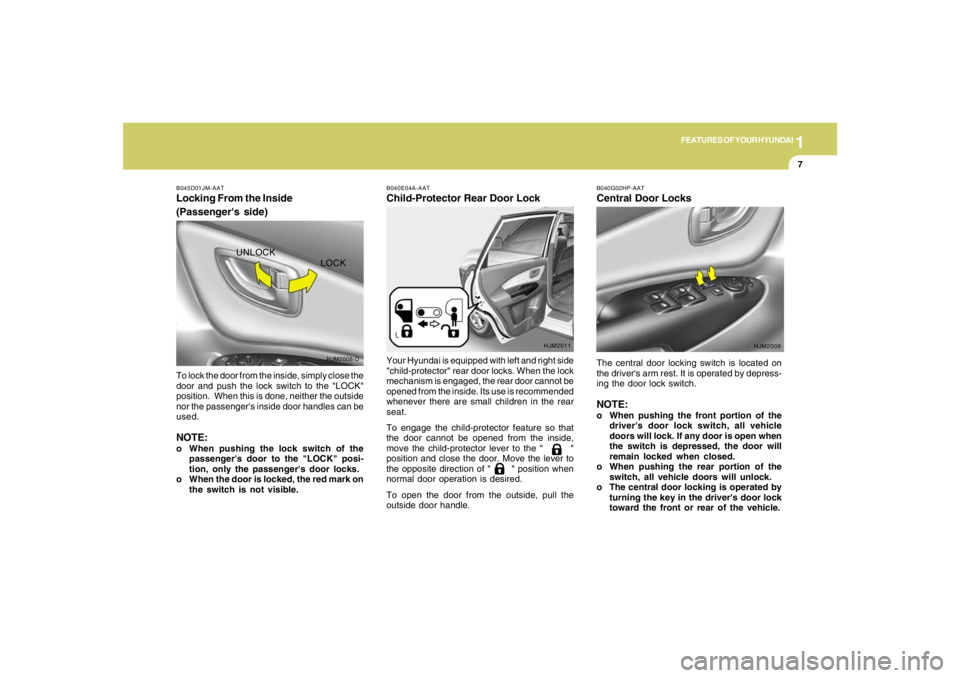
B045D01JM-AATLocking From the Inside
(Passenger's side)To lock the door from the inside, simply close the
door and push the lock switch to the "LOCK"
position. When this is done, neither the outside
nor the passenger's inside door handles can be
used.NOTE:o When pushing the lock switch of the
passenger's door to the "LOCK" posi-
tion, only the passenger's door locks.
o When the door is locked, the red mark on
the switch is not visible.
HJM2008-D
UNLOCK
LOCK
B040E04A-AATChild-Protector Rear Door LockYour Hyundai is equipped with left and right side
"child-protector" rear door locks. When the lock
mechanism is engaged, the rear door cannot be
opened from the inside. Its use is recommended
whenever there are small children in the rear
seat.
To engage the child-protector feature so that
the door cannot be opened from the inside,
move the child-protector lever to the " "
position and close the door. Move the lever to
the opposite direction of " " position when
normal door operation is desired.
To open the door from the outside, pull the
outside door handle.
HJM2011
B040G02HP-AATCentral Door LocksThe central door locking switch is located on
the driver's arm rest. It is operated by depress-
ing the door lock switch.NOTE:o When pushing the front portion of the
driver's door lock switch, all vehicle
doors will lock. If any door is open when
the switch is depressed, the door will
remain locked when closed.
o When pushing the rear portion of the
switch, all vehicle doors will unlock.
o The central door locking is operated by
turning the key in the driver's door lock
toward the front or rear of the vehicle.
HJM2009
Page 28 of 273
1
FEATURES OF YOUR HYUNDAI
17
!
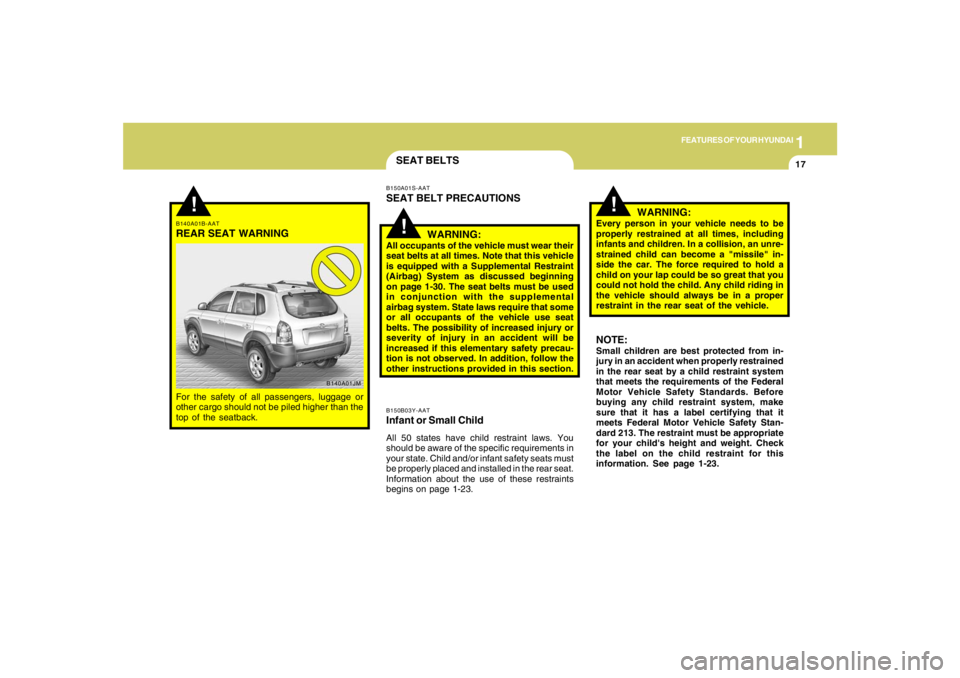
B140A01B-AATREAR SEAT WARNINGFor the safety of all passengers, luggage or
other cargo should not be piled higher than the
top of the seatback.
B140A01JM
SEAT BELTSB150B03Y-AATInfant or Small ChildAll 50 states have child restraint laws. You
should be aware of the specific requirements in
your state. Child and/or infant safety seats must
be properly placed and installed in the rear seat.
Information about the use of these restraints
begins on page 1-23.
!
B150A01S-AATSEAT BELT PRECAUTIONS
WARNING:All occupants of the vehicle must wear their
seat belts at all times. Note that this vehicle
is equipped with a Supplemental Restraint
(Airbag) System as discussed beginning
on page 1-30. The seat belts must be used
in conjunction with the supplemental
airbag system. State laws require that some
or all occupants of the vehicle use seat
belts. The possibility of increased injury or
severity of injury in an accident will be
increased if this elementary safety precau-
tion is not observed. In addition, follow the
other instructions provided in this section.
!
WARNING:
Every person in your vehicle needs to be
properly restrained at all times, including
infants and children. In a collision, an unre-
strained child can become a "missile" in-
side the car. The force required to hold a
child on your lap could be so great that you
could not hold the child. Any child riding in
the vehicle should always be in a proper
restraint in the rear seat of the vehicle.NOTE:Small children are best protected from in-
jury in an accident when properly restrained
in the rear seat by a child restraint system
that meets the requirements of the Federal
Motor Vehicle Safety Standards. Before
buying any child restraint system, make
sure that it has a label certifying that it
meets Federal Motor Vehicle Safety Stan-
dard 213. The restraint must be appropriate
for your child's height and weight. Check
the label on the child restraint for this
information. See page 1-23.
Page 29 of 273
1FEATURES OF YOUR HYUNDAI18
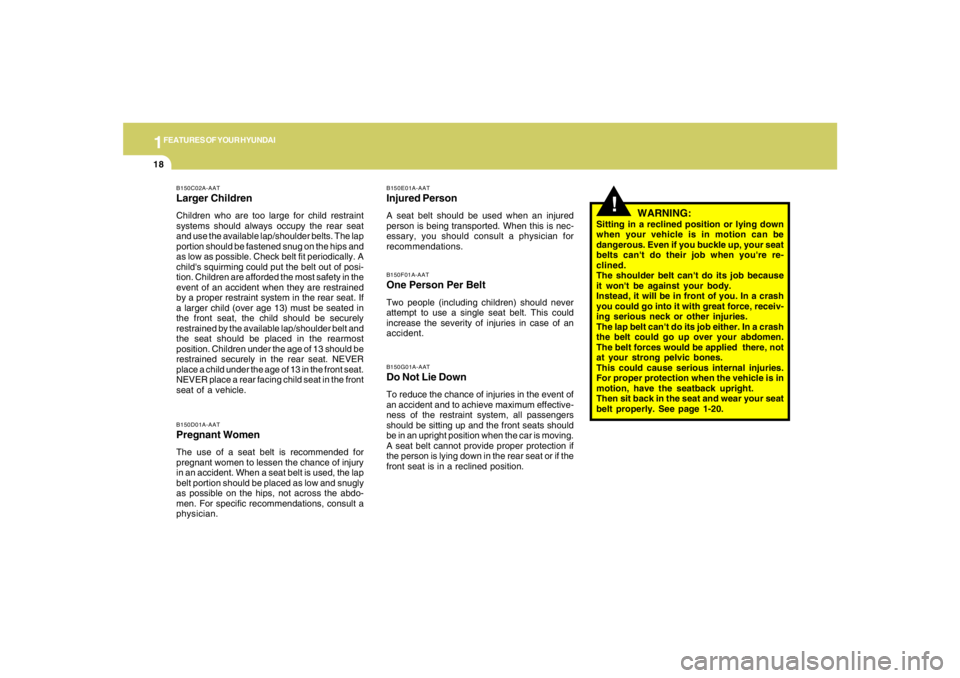
WARNING:
Sitting in a reclined position or lying down
when your vehicle is in motion can be
dangerous. Even if you buckle up, your seat
belts can't do their job when you're re-
clined.
The shoulder belt can't do its job because
it won't be against your body.
Instead, it will be in front of you. In a crash
you could go into it with great force, receiv-
ing serious neck or other injuries.
The lap belt can't do its job either. In a crash
the belt could go up over your abdomen.
The belt forces would be applied there, not
at your strong pelvic bones.
This could cause serious internal injuries.
For proper protection when the vehicle is in
motion, have the seatback upright.
Then sit back in the seat and wear your seat
belt properly. See page 1-20.
!
B150E01A-AATInjured PersonA seat belt should be used when an injured
person is being transported. When this is nec-
essary, you should consult a physician for
recommendations.B150F01A-AATOne Person Per BeltTwo people (including children) should never
attempt to use a single seat belt. This could
increase the severity of injuries in case of an
accident.B150G01A-AATDo Not Lie DownTo reduce the chance of injuries in the event of
an accident and to achieve maximum effective-
ness of the restraint system, all passengers
should be sitting up and the front seats should
be in an upright position when the car is moving.
A seat belt cannot provide proper protection if
the person is lying down in the rear seat or if the
front seat is in a reclined position.
B150C02A-AATLarger ChildrenChildren who are too large for child restraint
systems should always occupy the rear seat
and use the available lap/shoulder belts. The lap
portion should be fastened snug on the hips and
as low as possible. Check belt fit periodically. A
child's squirming could put the belt out of posi-
tion. Children are afforded the most safety in the
event of an accident when they are restrained
by a proper restraint system in the rear seat. If
a larger child (over age 13) must be seated in
the front seat, the child should be securely
restrained by the available lap/shoulder belt and
the seat should be placed in the rearmost
position. Children under the age of 13 should be
restrained securely in the rear seat. NEVER
place a child under the age of 13 in the front seat.
NEVER place a rear facing child seat in the front
seat of a vehicle.B150D01A-AATPregnant WomenThe use of a seat belt is recommended for
pregnant women to lessen the chance of injury
in an accident. When a seat belt is used, the lap
belt portion should be placed as low and snugly
as possible on the hips, not across the abdo-
men. For specific recommendations, consult a
physician.
Page 31 of 273
1FEATURES OF YOUR HYUNDAI20
B190A01Y-AATSEAT BELTS-Front Passenger and Rear
Seat 3-Point System with Combination
Locking RetractorCombination retractor type seat belts are in-
stalled in the rear seat positions to help accom-
modate the installation of child restraint systems.
Although a combination retractor is also installed
in the front passenger seat position, Hyundai
strongly recommends that children always be
seated in the rear seat. NEVER place any infant
restraint system in the front seat of the vehicle.
This type of seat belt combines the features of
both an emergency locking retractor seat belt
and an automatic locking retractor seat belt. To
fasten your seat belt, pull it out of the retractor
and insert the metal tab into the buckle. There
will be an audible "click" when the tab locks into
the buckle. When not securing a child restraint,
the seat belt operates in the same way as the
driver's seat belt (Emergency Locking Retrac-
tor Type). It automatically adjusts to the proper
length only after the lap belt portion of the seat
belt is adjusted manually so that it fits snugly
around your hips. When the seat belt is fully
extended from the retractor to allow the instal-
lation of a child restraint system, the seat belt
operation changes to allow the belt to retract, but
not to extend (Automatic Locking Retractor
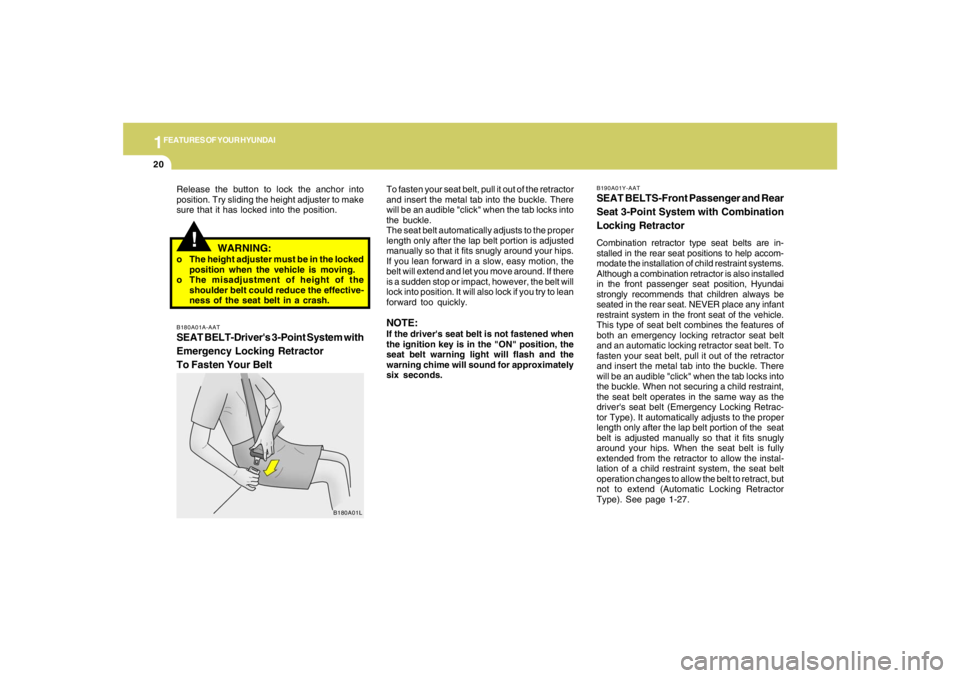
Type). See page 1-27. To fasten your seat belt, pull it out of the retractor
and insert the metal tab into the buckle. There
will be an audible "click" when the tab locks into
the buckle.
The seat belt automatically adjusts to the proper
length only after the lap belt portion is adjusted
manually so that it fits snugly around your hips.
If you lean forward in a slow, easy motion, the
belt will extend and let you move around. If there
is a sudden stop or impact, however, the belt will
lock into position. It will also lock if you try to lean
forward too quickly.
NOTE:If the driver's seat belt is not fastened when
the ignition key is in the "ON" position, the
seat belt warning light will flash and the
warning chime will sound for approximately
six seconds.
!
WARNING:
o The height adjuster must be in the locked
position when the vehicle is moving.
o The misadjustment of height of the
shoulder belt could reduce the effective-
ness of the seat belt in a crash. Release the button to lock the anchor into
position. Try sliding the height adjuster to make
sure that it has locked into the position.B180A01A-AATSEAT BELT-Driver's 3-Point System with
Emergency Locking Retractor
To Fasten Your Belt
B180A01L
Page 32 of 273
1
FEATURES OF YOUR HYUNDAI
21
!
NOTE:Although the combination retractor pro-
vides the same level of protection for seated
passengers in either emergency or auto-
matic locking modes, it is recommended
that seated passengers use the emergency
locking feature for improved convenience.
The automatic locking function is intended
to facilitate child restraint installation. To
convert from the automatic locking feature
to the emergency locking operation mode,
allow the unbuckled seat belt to fully re-
tract.
WARNING:
o For maximum restraint system protec-
tion, the seat belts must always be used
whenever the car is moving.
o Seat belts are most effective when
seatbacks are in the upright position.
o Children must always be seatbelted in
the rear seats. Never allow children to
ride in the front passanger seat.
o The shoulder belt should be positioned
midway over the shoulder nearest the
door for the most effective protection.
Never wear the seat belt under the arm
nearest the door. Wearing the belt under
the arm nearest the door could cause
serious or fatal injuries in an accident.
WARNING:
o Avoid wearing twisted seat belts. A
twisted belt can't do its job as well. In a
collision, it could even cut into you. Be
sure the belt webbing is straight and not
twisted.
o Be careful not to damage the belt web-
bing or hardware. If the belt webbing or
hardware is damaged, replace it.
!
WARNING:
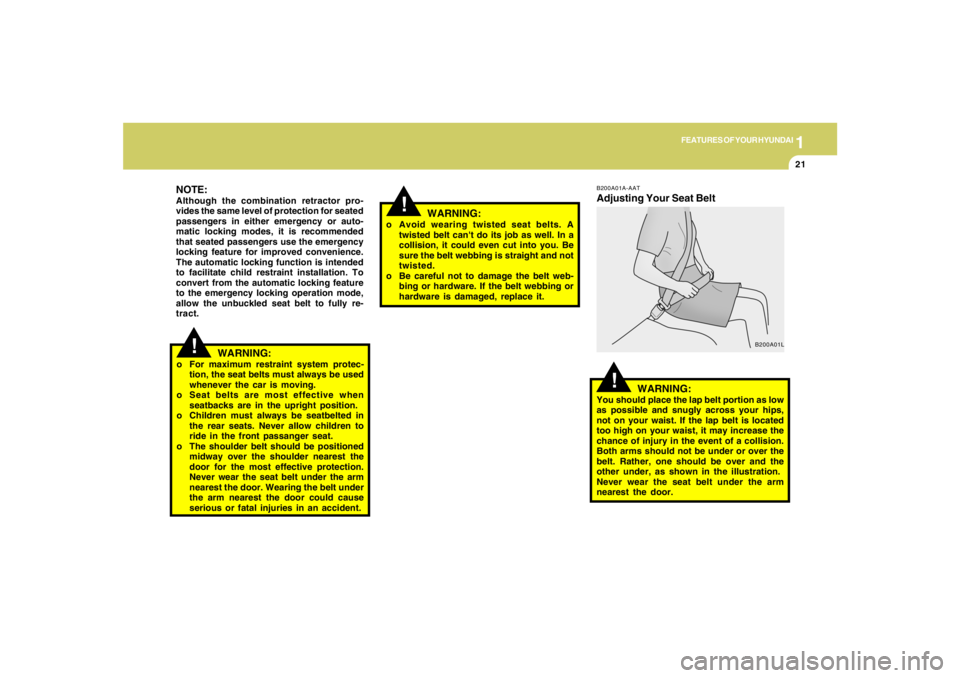
You should place the lap belt portion as low
as possible and snugly across your hips,
not on your waist. If the lap belt is located
too high on your waist, it may increase the
chance of injury in the event of a collision.
Both arms should not be under or over the
belt. Rather, one should be over and the
other under, as shown in the illustration.
Never wear the seat belt under the arm
nearest the door.
!
B200A01A-AATAdjusting Your Seat Belt
B200A01L
Page 34 of 273
1
FEATURES OF YOUR HYUNDAI
23
!(1) In case of folding rear seatbacks down.
(2) If transporting an object on the rear
seat may cause damage to the rear
seat center belt.
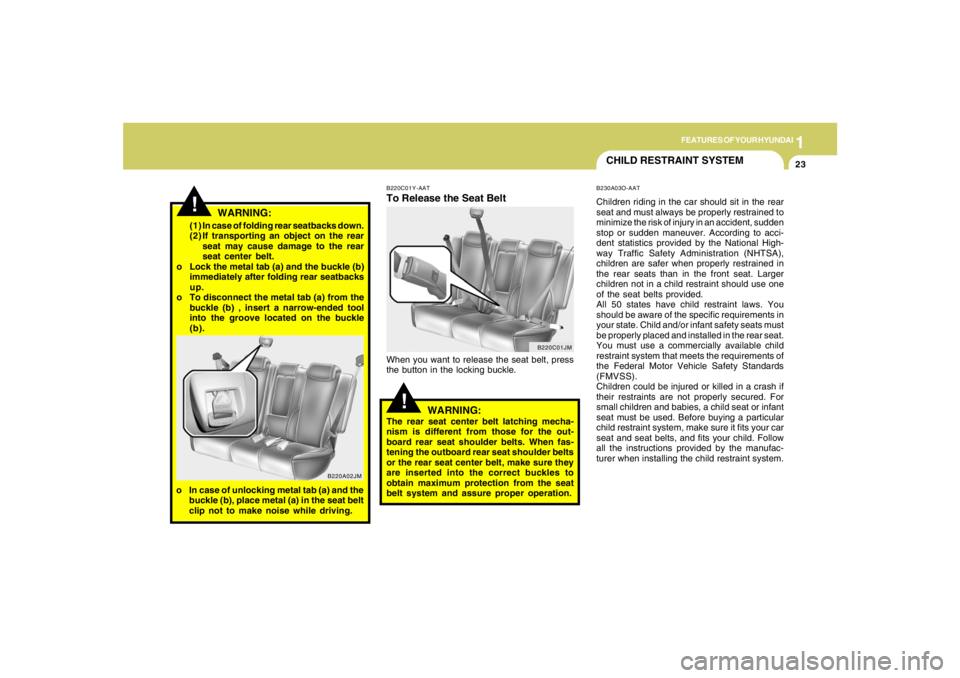
o Lock the metal tab (a) and the buckle (b)
immediately after folding rear seatbacks
up.
o To disconnect the metal tab (a) from the
buckle (b) , insert a narrow-ended tool
into the groove located on the buckle
(b).
WARNING:
CHILD RESTRAINT SYSTEMB230A03O-AATChildren riding in the car should sit in the rear
seat and must always be properly restrained to
minimize the risk of injury in an accident, sudden
stop or sudden maneuver. According to acci-
dent statistics provided by the National High-
way Traffic Safety Administration (NHTSA),
children are safer when properly restrained in
the rear seats than in the front seat. Larger
children not in a child restraint should use one
of the seat belts provided.
All 50 states have child restraint laws. You
should be aware of the specific requirements in
your state. Child and/or infant safety seats must
be properly placed and installed in the rear seat.
You must use a commercially available child
restraint system that meets the requirements of
the Federal Motor Vehicle Safety Standards
(FMVSS).
Children could be injured or killed in a crash if
their restraints are not properly secured. For
small children and babies, a child seat or infant
seat must be used. Before buying a particular
child restraint system, make sure it fits your car
seat and seat belts, and fits your child. Follow
all the instructions provided by the manufac-
turer when installing the child restraint system.
!
B220C01Y-AATTo Release the Seat BeltWhen you want to release the seat belt, press
the button in the locking buckle.
WARNING:
The rear seat center belt latching mecha-
nism is different from those for the out-
board rear seat shoulder belts. When fas-
tening the outboard rear seat shoulder belts
or the rear seat center belt, make sure they
are inserted into the correct buckles to
obtain maximum protection from the seat
belt system and assure proper operation.
B220C01JM
B220A02JM
o In case of unlocking metal tab (a) and the
buckle (b), place metal (a) in the seat belt
clip not to make noise while driving.