2005 HYUNDAI TUCSON child seat
[x] Cancel search: child seatPage 48 of 273

1
FEATURES OF YOUR HYUNDAI
37
The occupant classification system can func-
tion only when the ignition key is in the "ON"
position. If the "PASSENGER AIR BAG OFF"
indicator is illuminated when the front
passenger's seat is occupied by an adult who
is seated properly sitting upright and with the
seat in an upright position, centered on the seat
cushion, with their seat belt on and legs comfort-
ably extended feet on the floor, have your
vehicle immediately inspected by your Hyundai
dealer.
The "PASSENGER AIR BAG OFF" status indi-
cator light is on or off under the following
conditions;
!
"PASSENGER AIR
BAG OFF"
Status Indicator light
OFF
ON
ON Passenger status de-
tected by the occupant
classification system
1. Adult *
1
2. Child *
2 or
child restraint system
3. Unoccupied (Empty)
Right front
passenger
air bag
Enabled
Disabled
Disabled
WARNING:
o A child in a rear-facing child restraint can
be seriously injured or killed if the right
front passenger's air bag inflates. Don't
use a rear-facing child restraint in the
right front passenger's seat.
o If the indicator and the air bag readiness
light ever illuminate at the same time, it
means that something may be wrong
with the air bag system. If this ever
happens, have the vehicle serviced
promptly, because an adult-size person
sitting in the right front passenger seat
may not have the supplemental protec-
tion of the frontal air bag.
o If the occupant classification system is
not working properly, the SRS airbag
warning light on the instrument panel
will illuminate because the passenger's
airbag is connected with the occupant
classification system.
o If there is a malfunction of the occupant
classification system, the "PASSENGER
AIR BAG" indicator will illuminate and
the front passenger's airbag will not
deploy in frontal crashes.
!
WARNING:
o If the SRS airbag warning light does not
illuminate when the ignition key is turned
to "ON" position, if it remains illumi-
nated after coming on for approximately
6 seconds, have an authorized Hyundai
dealer inspect the occupant classifica-
tion system with the SRS airbag system
as soon as possible.
o Even though your vehicle is equipped
with the occupant classification sys-
tem, do not install a child restraint sys-
tem in the front passenger's seat. The
infant or child could be severely injured
or killed by an airbag deployment in case
of an accident. A child restraint system
must never be placed in the front seat.
Children who are too large for child
restraint systems should always occupy
the rear seat and use the available lap/
shoulder belts. Children are afforded the
most safety in the event of an accident
when they are restrained by a proper
restraint system in the rear seat. *1) The system judges a person of adult size as
an adult. When a smaller adult sits in the front
passenger seat, the system may detect him/
her as a child depending on his/her physique
and posture.*2) When a larger child who has outgrown a child
restraint system sits in the passenger seat,
the system may detect him/her as an adult
depending on his/her physique and posture.
Page 51 of 273

1FEATURES OF YOUR HYUNDAI40
!
o If you sell your vehicle, make certain that
this manual is transferred to the new
owner.
o If your car was flooded and has soaked
carpeting or water on the floor, don't try
to start the engine; have the car towed to
an authorized Hyundai dealer.
o Do not replace the bumper or the bumper
guard with the one other than the Hyundai
genuine parts. Otherwise, it can ad-
versely affect SRS performance and lead
to an increased risk of injury.
WARNING:
o For cleaning the airbag pad covers, use
only a soft, dry cloth or one which has
been moistened with plain water. Sol-
vents or cleaners could adversely affect
the airbag covers and proper deploy-
ment of the system.
o No objects should be placed over or near
the airbag modules on the steering
wheel, instrument panel, and the front
passenger's panel above the glove box,
because any such object could cause
harm if the vehicle is in a crash severe
enough to cause the airbags to inflate.
o If the airbags inflate, they must be re-
placed by an authorized Hyundai dealer.
o Do not tamper with or disconnect SRS
wiring, or other components of the SRS
system. Doing so could result in injury,
due to accidental inflation of the airbags
or by rendering the SRS inoperative.
o If components of the airbag system must
be discarded, or if the vehicle must be
scrapped, certain safety precautions
must be observed. Your Hyundai dealer
knows these precautions and can give
you the necessary information. Failure
to follow these precautions and proce-
dures could increase the risk of personal
injury.
!
WARNING:
!
WARNING:
o Do not install a child restraint system in
the front passenger seat position.
A child restraint system must never be
placed in the front seat. The infant or
child could be severely injured or killed
by an airbag deployment in case of an
accident.
o Modification to SRS components or wir-
ing, including the addition of any kind of
badges to the pad covers or modifica-
tions to the body structure, can ad-
versely affect SRS performance and lead
to possible injury.B240C01JM-AATSRS Careo The SRS is virtually maintenance free and
there are no parts you can safely service by
yourself. If the SRS SRI (Service Reminder
Indicator) does not illuminate, or continu-
ously remains on, have your vehicle imme-
diately inspected by your Hyundai dealer.
o Any work on the SRS system, such as
removing, installing, repairing, or any work
on the steering wheel must be performed by
a qualified Hyundai technician. Improper
handling of the airbag system may result in
serious personal injury.
Page 52 of 273

1
FEATURES OF YOUR HYUNDAI
41
B240D01JM-AATAdditional Safety PrecautionsoNever let passengers ride in the cargo
area (trunk) or on top of a folded-down
back seat. All occupants should sit upright,
fully back in their seats with their seat belts
on and their feet on the floor.
oPassengers should not move out of or
change seats while the vehicle is mov-
ing. A passenger who is not wearing a seat
belt during a crash or emergency stop can
be thrown against the inside of the vehicle,
against other occupants, or out of the ve-
hicle.
oEach seat belt is designed to restrain one
occupant. If more than one person uses the
same seat belt, they could be seriously
injured or killed in a collision.
oDo not use any accessories on seat
belts. Devices claiming to improve occu-
pant comfort or reposition the seat belt can
reduce the protection provided by the seat
belt and increase the chance of serious
injury in a crash.
oPassengers should not place hard or
sharp objects between themselves and
the airbags. Carrying hard or sharp objects
on your lap or in your mouth can result in
injuries if an airbag inflates.oKeep occupants away from the airbag
covers. All occupants should sit upright, fully
back in their seats with their seat belts on and
their feet on the floor. If occupants are too
close to the airbag covers, they could be
injured if the airbags inflate.
oDo not attach or place objects on or near
the airbag covers. Any object attached to
or placed on the front or side impact airbag
covers could interfere with the proper opera-
tion of the airbags.
oDo not modify the front seats. Modifica-
tion of the front seats could interfere with the
operation of the supplemental restraint sys-
tem sensing components or side impact
airbags.
oDo not place items under the front seats.
Placing items under the front seats could
interfere with the operation of the supple-
mental restraint system sensing compo-
nents and wiring harnesses.
oNever hold an infant or child on your lap.
The infant or child could be seriously injured
or killed in the event of a crash. All infants and
children should be properly restrained in
appropriate child safety seats or seat belts
in the rear seat.
!
WARNING:
o Sitting improperly or out of position can
result in serious injury or death in a
crash.
o Always sit upright, fully back in the seat,
with your seat belt on, and your feet on
the floor.Adding Equipment to or Modifying Your
Airbag-Equipped Vehicle.If you modify your vehicle by changing your
vehicle's frame, bumper system, front end or
side sheet metal or ride height, this may affect
the operation of your vehicle's airbag system.
Page 176 of 273
2
DRIVING YOUR HYUNDAI
30
NOTE:
o Overloading your vehicle may
cause damage. Repairs would not
be covered by your warranty. Do
not overload your vehicle.
o Using heavier suspension com-
ponents to get added durability
might not change your weight rat-
ings. Ask your dealer to help you
load your vehicle the right way.
The label will help you decide how much
cargo and installed equipment your
vehicle can carry.
If you carry items inside your vehicle –
like suitcases, tools, packages, or any-
thing else – they more as fast as the
vehicle goes. If you have to stop or turn
quickly, or if there is a crash, the items
will keep going and can cause an injury
if they strikes the driver or a passenger.
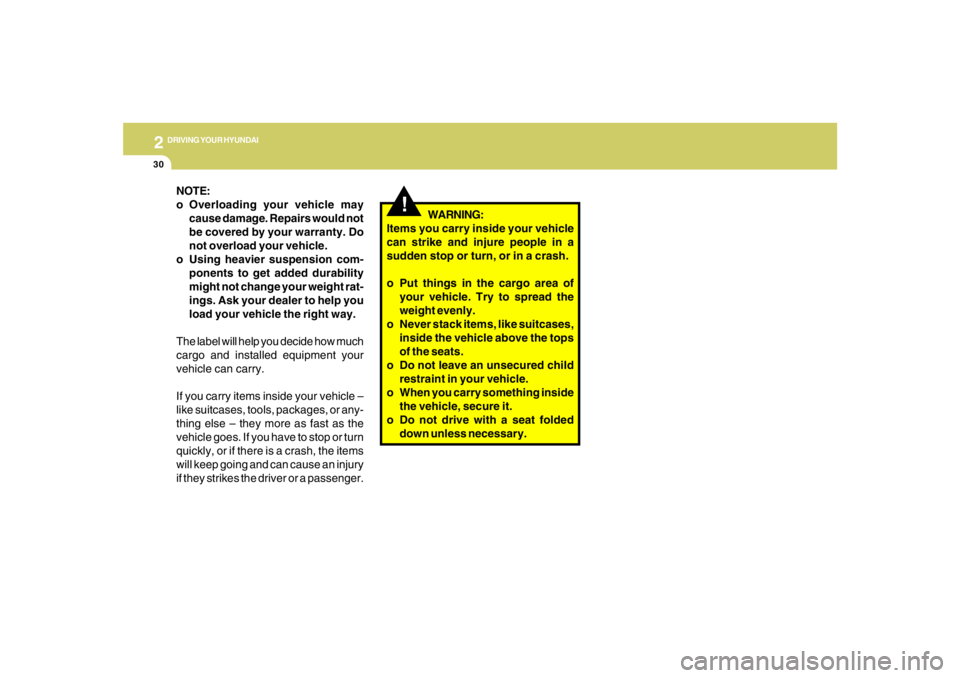
!
WARNING:
Items you carry inside your vehicle
can strike and injure people in a
sudden stop or turn, or in a crash.
o Put things in the cargo area of
your vehicle. Try to spread the
weight evenly.
o Never stack items, like suitcases,
inside the vehicle above the tops
of the seats.
o Do not leave an unsecured child
restraint in your vehicle.
o When you carry something inside
the vehicle, secure it.
o Do not drive with a seat folded
down unless necessary.
Page 267 of 273
10
INDEX
2
A
Air bag ...............................................................................................1-30
Air Cleaner Filter ...............................................................................6-11
Air Conditioning
Care..............................................................................................6-17
Operation............................................................................ 1-92, 6-17
Switch...........................................................................................1-92
Antenna..........................................................................................1-135
Ashtray..............................................................................................1-60
Audio System
Cassette Tape player operation (J290)...................................1-126
Cassete tape player operation (M280)....................................1-112
Compact disc player operation (K260)....................................1-106
Compact disc player operation (M280)....................................1-115
CD changer operation (M280) ..................................................1-119
Compact disc player / CD Auto changer operation (J290) .....1-128
Stereo radio operation (J290) ...................................................1-123
Stereo radio operation (K260)..................................................1-103
Stereo radio operation (M280) ..................................................1-109
B
Battery..................................................................................... 2-20, 6-23
Brake
Anti-lock brake system ................................................................2-12
Traction control system (TCS) ...................................................2-12
Checking the brakes ....................................................................6-15Electronic Stability Program (ESP) ...................................................2-14
Fluid ..............................................................................................6-13
Pedal clearance...........................................................................6-20
Pedal free-play.............................................................................6-20
Practices......................................................................................2-18
Breaking-In your New Hyundai .......................................................... 1-3
Bulb Replacement.............................................................................6-26
C
Care of Cassette Tapes ................................................................1-133
Care of Disc ...................................................................................1-133
Catalytic Converter............................................................................. 7-3
Child-Protector Rear Door Lock ......................................................... 1-7
Child Restraint System.....................................................................1-23
Installing a Child Restraint Seat with the
"Tether Anchorage" System .....................................................1-25
Securing the Child Restraint Seat with the "ISOFIX" System ....1-26
Cigarette Lighter................................................................................1-58
Clock.................................................................................................1-58
Clutch
Checking fluid...............................................................................6-16
Pedal free-play.............................................................................6-20
Combination Light
Auto light.......................................................................................1-54
Headlight flasher..........................................................................1-53
Headlight switch...........................................................................1-53
High-beam switch........................................................................1-53
Lane change signal ......................................................................1-53
Parking light auto off .....................................................................1-53
Turn signal operation...................................................................1-52