2005 HYUNDAI TUCSON key
[x] Cancel search: keyPage 22 of 273
1
FEATURES OF YOUR HYUNDAI
11
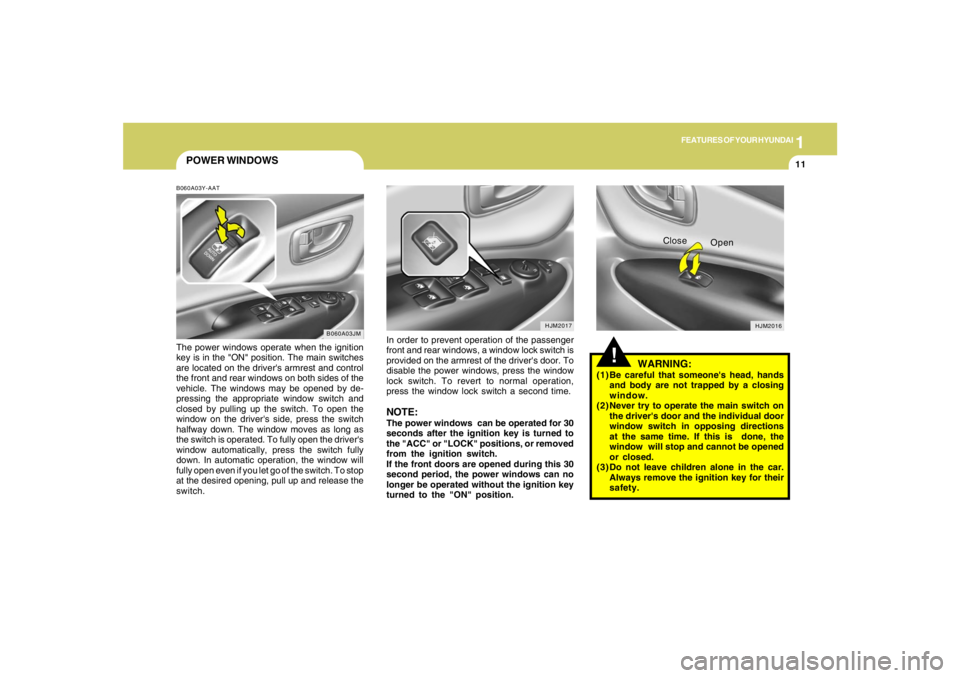
POWER WINDOWSB060A03Y-AATThe power windows operate when the ignition
key is in the "ON" position. The main switches
are located on the driver's armrest and control
the front and rear windows on both sides of the
vehicle. The windows may be opened by de-
pressing the appropriate window switch and
closed by pulling up the switch. To open the
window on the driver's side, press the switch
halfway down. The window moves as long as
the switch is operated. To fully open the driver's
window automatically, press the switch fully
down. In automatic operation, the window will
fully open even if you let go of the switch. To stop
at the desired opening, pull up and release the
switch.
B060A03JM
!
In order to prevent operation of the passenger
front and rear windows, a window lock switch is
provided on the armrest of the driver's door. To
disable the power windows, press the window
lock switch. To revert to normal operation,
press the window lock switch a second time.NOTE:The power windows can be operated for 30
seconds after the ignition key is turned to
the "ACC" or "LOCK" positions, or removed
from the ignition switch.
If the front doors are opened during this 30
second period, the power windows can no
longer be operated without the ignition key
turned to the "ON" position.
WARNING:
(1) Be careful that someone's head, hands
and body are not trapped by a closing
window.
(2) Never try to operate the main switch on
the driver's door and the individual door
window switch in opposing directions
at the same time. If this is done, the
window will stop and cannot be opened
or closed.
(3) Do not leave children alone in the car.
Always remove the ignition key for their
safety.
HJM2016
Close
Open
HJM2017
Page 26 of 273
1
FEATURES OF YOUR HYUNDAI
15
!
The seat warmer is provided to warm the front
seats during cold weather. With the ignition key
in the "ON" position, push either of the switches
to warm the driver's seat or the passenger's
seat.
During mild weather or under conditions where
the operation of the seat warmer is not needed,
keep the switches in the "OFF" position.NOTE:o The seat warmer will not operate if the
ambient temperature is higher than
82.4°F ± 3.5°F (28°C ± 3.5°C).
o If the seat warmer doesn't work when
ambient temperature is lower than 75.2°F
(24°C), it should be checked at an autho-
rized dealer.
WARNING:
It is recommended that the seat heater not
be used when elderly people or people who
are ill occupy the seat. Also, do not use the
seat warmer if the occupant is sleeping.
B085A01JM-GATREAR SEAT
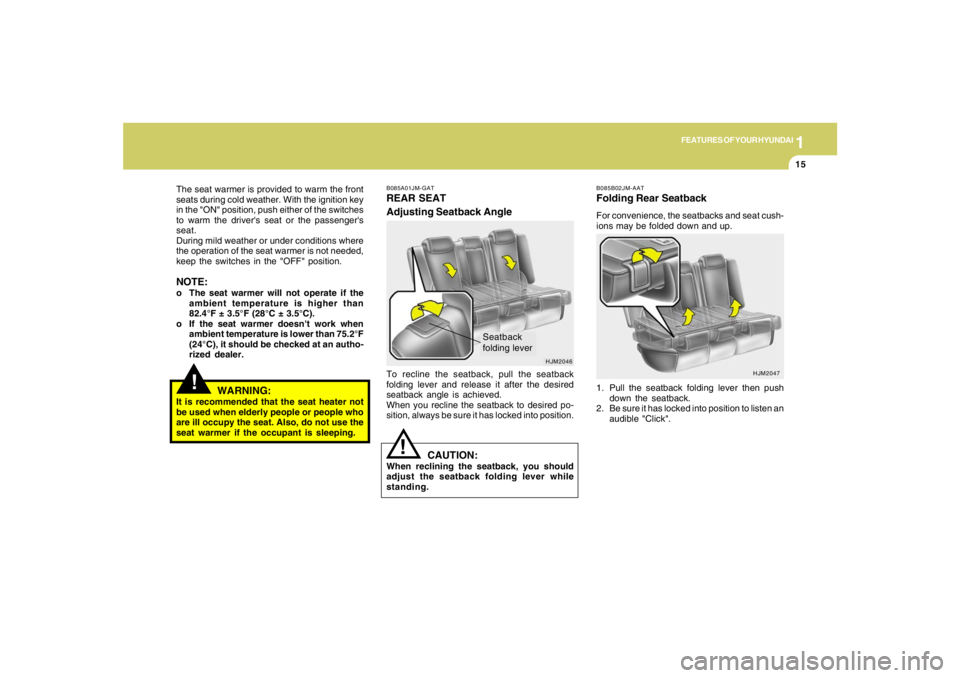
Adjusting Seatback AngleTo recline the seatback, pull the seatback
folding lever and release it after the desired
seatback angle is achieved.
When you recline the seatback to desired po-
sition, always be sure it has locked into position.
HJM2046
Seatback
folding lever
!
HJM2047 B085B02JM-AAT
Folding Rear SeatbackFor convenience, the seatbacks and seat cush-
ions may be folded down and up.
CAUTION:
When reclining the seatback, you should
adjust the seatback folding lever while
standing.1. Pull the seatback folding lever then push
down the seatback.
2. Be sure it has locked into position to listen an
audible "Click".
Page 31 of 273
1FEATURES OF YOUR HYUNDAI20
B190A01Y-AATSEAT BELTS-Front Passenger and Rear
Seat 3-Point System with Combination
Locking RetractorCombination retractor type seat belts are in-
stalled in the rear seat positions to help accom-
modate the installation of child restraint systems.
Although a combination retractor is also installed
in the front passenger seat position, Hyundai
strongly recommends that children always be
seated in the rear seat. NEVER place any infant
restraint system in the front seat of the vehicle.
This type of seat belt combines the features of
both an emergency locking retractor seat belt
and an automatic locking retractor seat belt. To
fasten your seat belt, pull it out of the retractor
and insert the metal tab into the buckle. There
will be an audible "click" when the tab locks into
the buckle. When not securing a child restraint,
the seat belt operates in the same way as the
driver's seat belt (Emergency Locking Retrac-
tor Type). It automatically adjusts to the proper
length only after the lap belt portion of the seat
belt is adjusted manually so that it fits snugly
around your hips. When the seat belt is fully
extended from the retractor to allow the instal-
lation of a child restraint system, the seat belt
operation changes to allow the belt to retract, but
not to extend (Automatic Locking Retractor
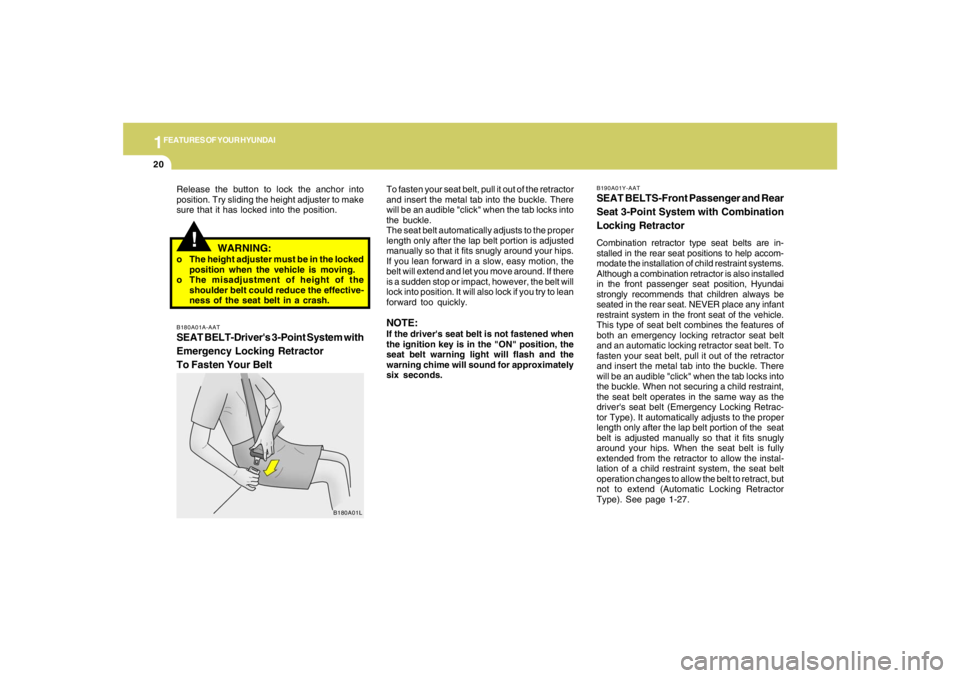
Type). See page 1-27. To fasten your seat belt, pull it out of the retractor
and insert the metal tab into the buckle. There
will be an audible "click" when the tab locks into
the buckle.
The seat belt automatically adjusts to the proper
length only after the lap belt portion is adjusted
manually so that it fits snugly around your hips.
If you lean forward in a slow, easy motion, the
belt will extend and let you move around. If there
is a sudden stop or impact, however, the belt will
lock into position. It will also lock if you try to lean
forward too quickly.
NOTE:If the driver's seat belt is not fastened when
the ignition key is in the "ON" position, the
seat belt warning light will flash and the
warning chime will sound for approximately
six seconds.
!
WARNING:
o The height adjuster must be in the locked
position when the vehicle is moving.
o The misadjustment of height of the
shoulder belt could reduce the effective-
ness of the seat belt in a crash. Release the button to lock the anchor into
position. Try sliding the height adjuster to make
sure that it has locked into the position.B180A01A-AATSEAT BELT-Driver's 3-Point System with
Emergency Locking Retractor
To Fasten Your Belt
B180A01L
Page 40 of 273
1
FEATURES OF YOUR HYUNDAI
29
!
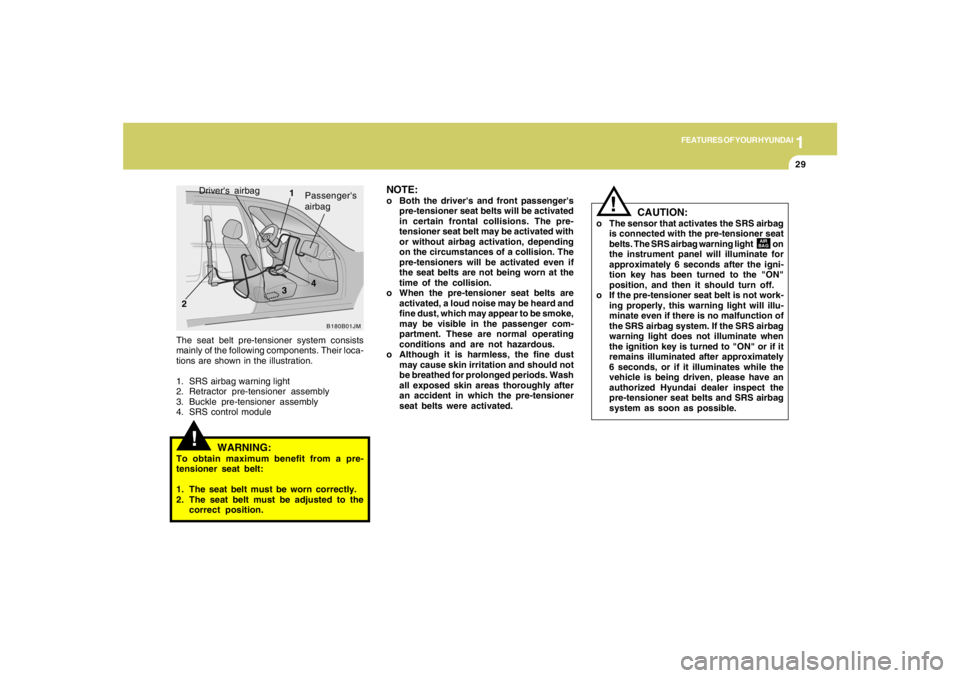
The seat belt pre-tensioner system consists
mainly of the following components. Their loca-
tions are shown in the illustration.
1. SRS airbag warning light
2. Retractor pre-tensioner assembly
3. Buckle pre-tensioner assembly
4. SRS control module
WARNING:
To obtain maximum benefit from a pre-
tensioner seat belt:
1. The seat belt must be worn correctly.
2. The seat belt must be adjusted to the
correct position.
NOTE:o Both the driver's and front passenger's
pre-tensioner seat belts will be activated
in certain frontal collisions. The pre-
tensioner seat belt may be activated with
or without airbag activation, depending
on the circumstances of a collision. The
pre-tensioners will be activated even if
the seat belts are not being worn at the
time of the collision.
o When the pre-tensioner seat belts are
activated, a loud noise may be heard and
fine dust, which may appear to be smoke,
may be visible in the passenger com-
partment. These are normal operating
conditions and are not hazardous.
o Although it is harmless, the fine dust
may cause skin irritation and should not
be breathed for prolonged periods. Wash
all exposed skin areas thoroughly after
an accident in which the pre-tensioner
seat belts were activated.
B180B01JM
Driver's airbag
1
24
Passenger's
airbag
3
CAUTION:
o The sensor that activates the SRS airbag
is connected with the pre-tensioner seat
belts. The SRS airbag warning light on
the instrument panel will illuminate for
approximately 6 seconds after the igni-
tion key has been turned to the "ON"
position, and then it should turn off.
o If the pre-tensioner seat belt is not work-
ing properly, this warning light will illu-
minate even if there is no malfunction of
the SRS airbag system. If the SRS airbag
warning light does not illuminate when
the ignition key is turned to "ON" or if it
remains illuminated after approximately
6 seconds, or if it illuminates while the
vehicle is being driven, please have an
authorized Hyundai dealer inspect the
pre-tensioner seat belts and SRS airbag
system as soon as possible.
AIR
BAG
!
Page 42 of 273
1
FEATURES OF YOUR HYUNDAI
31
!
CAUTION:
If the seat position sensor is not working
properly, the SRS airbag warning light on
the instrument panel will illuminate even if
there is no malfunction of the SRS airbag
system, because the SRS airbag warning
light is connected with the seat position
sensor. If the SRS airbag warning light does
not illuminate when the ignition key is
turned to the "ON" position, if it remains
illuminated after coming on for approxi-
mately 6 seconds, or if it illuminates while
the vehicle is being driven, have an autho-
rized Hyundai dealer inspect the seat posi-
tion sensor and the advanced SRS airbag
system as soon as possible.
!
WARNING:
o Modification to the seat structure can
adversely affect the seat position sensor
and cause the airbag to deploy at a
different level than should be provided.
o Do not place any objects underneath the
front seats which could damage the seat
position sensor or interfere with the
occupant classification system.
o Do not place any objects that may cause
magnetic fields near the front seats.
These may cause a malfunction of the
seat position sensor.NOTE:o Be sure to read information about the
SRS on the labels provided on the back-
side of the sun visor and in the glove box.
o Advanced airbags are combined with
pre-tensioner seat belts to help provide
enhanced occupant protection in fron-
tal crashes. Front airbags are not in-
tended to deploy in light collisions in
which protection can be provided by the
pre-tensioner seat belt.
o If you are considering modification of
your vehicle due to a disability, please
contact the Hyundai Customer Assis-
tance Center at 1-800-633-5151.
AIR
BAG
Additionally, your Hyundai is equipped with an
occupant classification system in the front
passenger's seat. The occupant classification
system detects the presence of a passenger in
the front passenger's seat and will turn off the
front passenger's airbag under certain condi-
tions. For more detail, see "Occupant Classifi-
cation System" later in this section.
!
WARNING:
o As its name implies, the SRS is designed
to work with, and be supplemental to,
the driver's and the passenger's three
point seat belt systems and is not a
substitute for them. Therefore, your seat
belts must be worn at all times. The
airbags deploy only in certain frontal
impact conditions severe enough to
cause significant injury to the vehicle
occupants.
o Sitting too close to a front airbag can
result in serious or fatal injury if the front
airbags inflate. Always sit as far back
from airbags as possible.
o Ignoring the SRS indicator light can re-
sult in serious or fatal injury if the airbags,
occupant classification system or pre-
tensioners do not work properly. Have
your car checked by a dealer as soon as
possible if the SRS warning light alerts
you to a potential problem.
o The SRS is designed to deploy the front
airbags only when an impact is suffi-
ciently severe and when the impact angle
is less than 30° from the forward longi-
tudinal axis of the vehicle. The front
airbags will not deploy in side, rear or
rollover impacts. Additionally, the
airbags will only deploy once. Seat belts
must be worn at all times.
Page 43 of 273
1FEATURES OF YOUR HYUNDAI32
B240A02JM
!
Rear impact
Side Impact
Rollover
o The driver should sit back as far as
possible while still maintaining control
of the vehicle. If you are sitting too close
to the airbag, it can cause death or seri-
ous injury when it inflates.
WARNING:
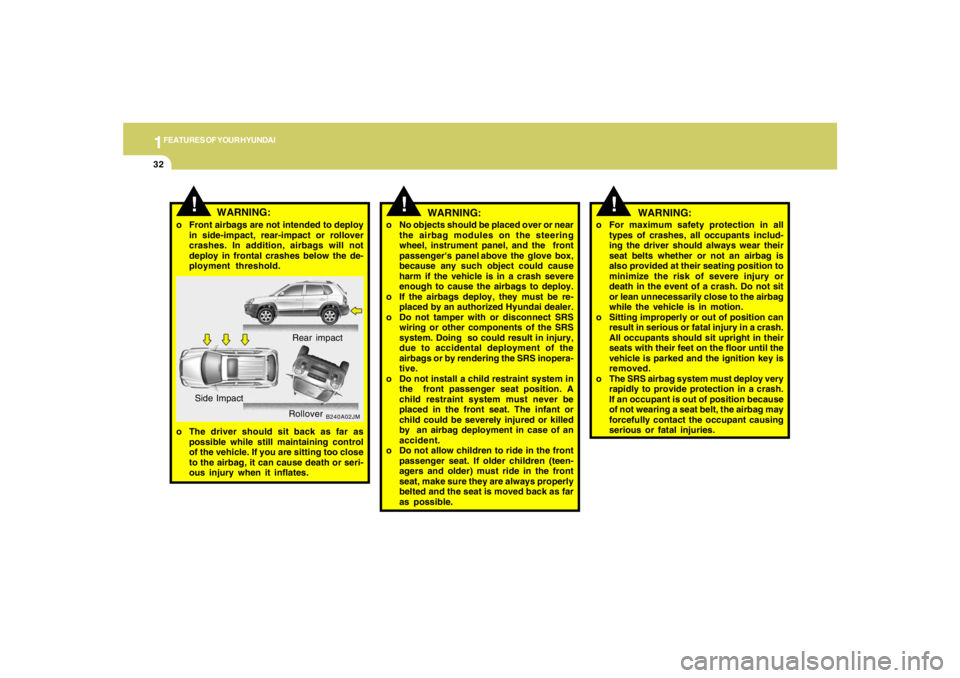
o Front airbags are not intended to deploy
in side-impact, rear-impact or rollover
crashes. In addition, airbags will not
deploy in frontal crashes below the de-
ployment threshold.
!
WARNING:
o No objects should be placed over or near
the airbag modules on the steering
wheel, instrument panel, and the front
passenger's panel above the glove box,
because any such object could cause
harm if the vehicle is in a crash severe
enough to cause the airbags to deploy.
o If the airbags deploy, they must be re-
placed by an authorized Hyundai dealer.
o Do not tamper with or disconnect SRS
wiring or other components of the SRS
system. Doing so could result in injury,
due to accidental deployment of the
airbags or by rendering the SRS inopera-
tive.
o Do not install a child restraint system in
the front passenger seat position. A
child restraint system must never be
placed in the front seat. The infant or
child could be severely injured or killed
by an airbag deployment in case of an
accident.
o Do not allow children to ride in the front
passenger seat. If older children (teen-
agers and older) must ride in the front
seat, make sure they are always properly
belted and the seat is moved back as far
as possible.o For maximum safety protection in all
types of crashes, all occupants includ-
ing the driver should always wear their
seat belts whether or not an airbag is
also provided at their seating position to
minimize the risk of severe injury or
death in the event of a crash. Do not sit
or lean unnecessarily close to the airbag
while the vehicle is in motion.
o Sitting improperly or out of position can
result in serious or fatal injury in a crash.
All occupants should sit upright in their
seats with their feet on the floor until the
vehicle is parked and the ignition key is
removed.
o The SRS airbag system must deploy very
rapidly to provide protection in a crash.
If an occupant is out of position because
of not wearing a seat belt, the airbag may
forcefully contact the occupant causing
serious or fatal injuries.
!
WARNING:
Page 44 of 273
1
FEATURES OF YOUR HYUNDAI
33
The SRSCM continually monitors all elements
while the ignition is "ON" to determine if a frontal
or near-frontal impact is severe enough to
require airbag deployment or pre-tensioner seat
belt deployment.
The SRS service reminder indicator (SRI) on
the instrument panel will illuminate for about 6
seconds after the ignition key is turned to the
"ON" position or after the engine is started, after
which the SRI should go out.
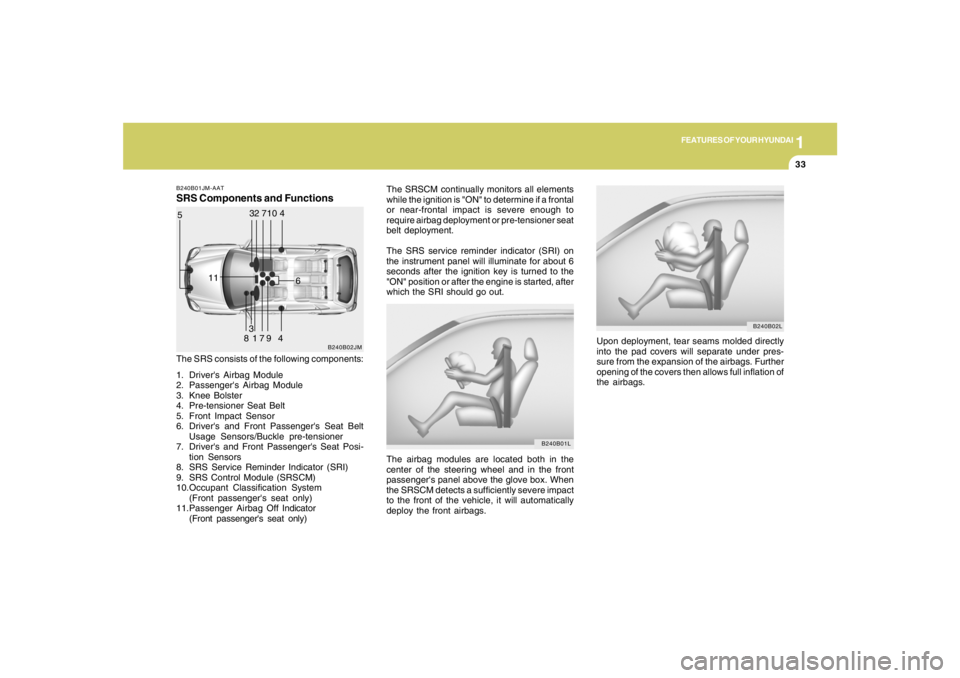
The airbag modules are located both in the
center of the steering wheel and in the front
passenger's panel above the glove box. When
the SRSCM detects a sufficiently severe impact
to the front of the vehicle, it will automatically
deploy the front airbags.
B240B01JM-AATSRS Components and FunctionsThe SRS consists of the following components:
1. Driver's Airbag Module
2. Passenger's Airbag Module
3. Knee Bolster
4. Pre-tensioner Seat Belt
5. Front Impact Sensor
6. Driver's and Front Passenger's Seat Belt
Usage Sensors/Buckle pre-tensioner
7. Driver's and Front Passenger's Seat Posi-
tion Sensors
8. SRS Service Reminder Indicator (SRI)
9. SRS Control Module (SRSCM)
10.Occupant Classification System
(Front passenger's seat only)
11.Passenger Airbag Off Indicator
(Front passenger's seat only)
B240B02JM
11
12710
79 5
6
4
3
4
83
B240B01L
Upon deployment, tear seams molded directly
into the pad covers will separate under pres-
sure from the expansion of the airbags. Further
opening of the covers then allows full inflation of
the airbags.
B240B02L
Page 46 of 273
1
FEATURES OF YOUR HYUNDAI
35
!
o The SRS can function only when the
ignition key is in the "ON" position. If the
SRS SRI does not illuminate or contin-
uously remains on after illuminating for
about 6 seconds when the ignition key
is turned to the "ON" position, or after
the engine is started, illuminates while
driving, the SRS is not working properly.
If this occurs, have your vehicle immedi-
ately inspected by your Hyundai dealer.
o Before you replace a fuse or disconnect
a battery terminal, turn the ignition key
to the "LOCK" position or remove the
ignition key. Never remove or replace the
air bag related fuse(s) when the ignition
key is in the "ON" position. Failure to
heed this warning will cause the SRS SRI
to illuminate.
WARNING:
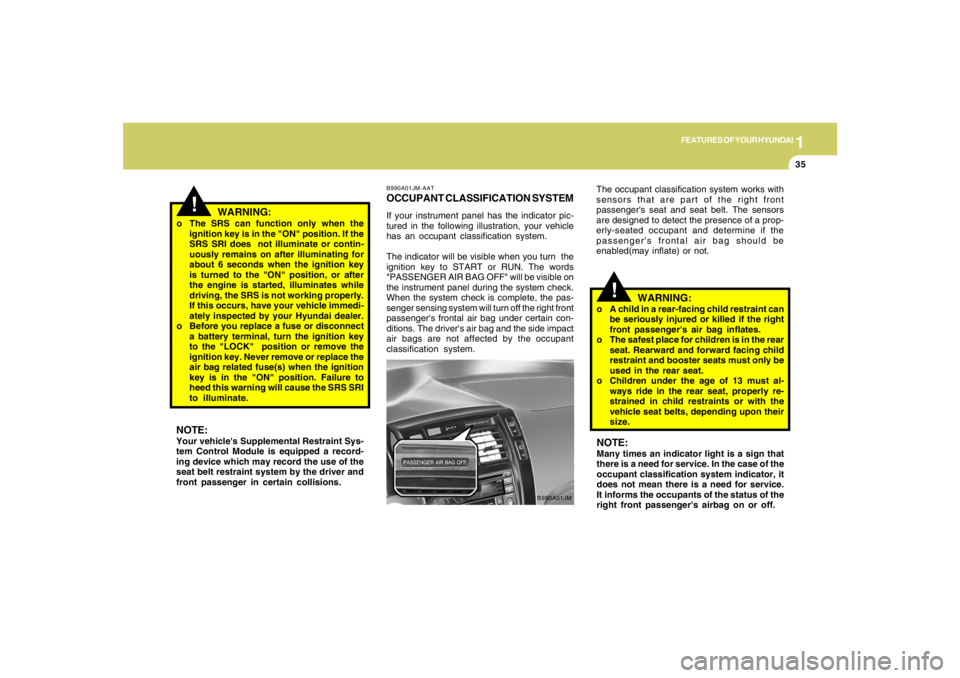
B990A01JM-AATOCCUPANT CLASSIFICATION SYSTEMIf your instrument panel has the indicator pic-
tured in the following illustration, your vehicle
has an occupant classification system.
The indicator will be visible when you turn the
ignition key to START or RUN. The words
"PASSENGER AIR BAG OFF" will be visible on
the instrument panel during the system check.
When the system check is complete, the pas-
senger sensing system will turn off the right front
passenger's frontal air bag under certain con-
ditions. The driver's air bag and the side impact
air bags are not affected by the occupant
classification system.
B990A01JM
NOTE:Your vehicle's Supplemental Restraint Sys-
tem Control Module is equipped a record-
ing device which may record the use of the
seat belt restraint system by the driver and
front passenger in certain collisions.The occupant classification system works with
sensors that are part of the right front
passenger's seat and seat belt. The sensors
are designed to detect the presence of a prop-
erly-seated occupant and determine if the
passenger's frontal air bag should be
enabled(may inflate) or not.
!
WARNING:
o A child in a rear-facing child restraint can
be seriously injured or killed if the right
front passenger's air bag inflates.
o The safest place for children is in the rear
seat. Rearward and forward facing child
restraint and booster seats must only be
used in the rear seat.
o Children under the age of 13 must al-
ways ride in the rear seat, properly re-
strained in child restraints or with the
vehicle seat belts, depending upon their
size.NOTE:Many times an indicator light is a sign that
there is a need for service. In the case of the
occupant classification system indicator, it
does not mean there is a need for service.
It informs the occupants of the status of the
right front passenger's airbag on or off.