2005 HYUNDAI TUCSON child restraint
[x] Cancel search: child restraintPage 37 of 273

1FEATURES OF YOUR HYUNDAI26
!
WARNING:
o Do not install a child restraint seat at the
center of the rear seat using the vehicle's
ISOFIX anchors. The ISOFIX anchors are
only provided for the left and right out-
board rear seating positions. Do not
misuse the ISOFIX anchors by attempt-
ing to attach a child safety seat in the
middle of the rear seat position to the
ISOFIX anchors. In a crash, the child seat
ISOFIX attachments may not be strong
enough to secure the child restraint seat
properly in the center of the rear seat and
may break, causing serious injury or
death.
o Do not mount more than one child re-
straint to a single tether or to a child
restraint lower anchorage point. The
improper increased load may cause the
anchorage points or tether anchor to
break, causing serious injury or death.
o Attach the ISOFIX or ISOFIX-compatible
child seat only to the appropriate loca-
tions shown.
o Always follow the installation and use
instructions provided by the manufac-
turer of the child restraint.
!
B230D03E-AATSecuring the Child Restraint Seat with
the "ISOFIX" systemSome child seat manufacturers make safety
seats that are labeled as ISOFIX or ISOFIX-
compatible child seats. These seats include two
rigid or webbing mounted attachments that
connect to two ISOFIX anchors at specific
seating positions in your vehicle. This type of
child seat eliminates the need to use seat belts
to attach the child seat for forward-facing child
seats.
ISOFIX anchors have been provided in your
vehicle. The ISOFIX anchors are located in the
left and right outboard rear seating positions.
Their locations are shown in the illustration.
There is no ISOFIX anchor provided for the
center rear seating position. For vehicles with adjustable headrests, route
the tether strap under the headrest and
between the headrest posts, otherwise route
the tether strap over the top of the seatback.
3. Connect the tether strap hook to the child
restraint hook holder and tighten to secure
the seat.
WARNING:
o Install the Child Restraint Seat fully rear-
ward against the seatback with the
seatback in a vertical position, not re-
clined.
o Do not mount more than one child re-
straint to a single tether or to a child
restraint lower anchorage point. The im-
proper increased load may cause the
anchorage points or tether anchor to
break, causing serious injury or death.
B230D01JM
Page 38 of 273
1
FEATURES OF YOUR HYUNDAI
27
!
WARNING:
If the child restraint seat is not anchored
properly, the risk of a child being seriously
injured or killed in a collision greatly in-
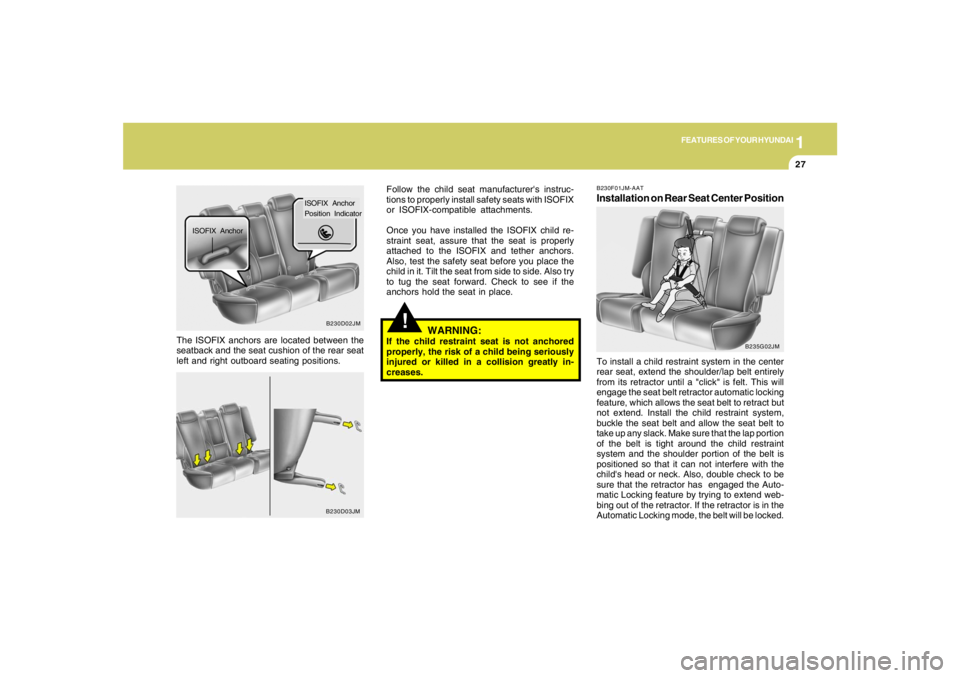
creases. The ISOFIX anchors are located between the
seatback and the seat cushion of the rear seat
left and right outboard seating positions.Follow the child seat manufacturer's instruc-
tions to properly install safety seats with ISOFIX
or ISOFIX-compatible attachments.
Once you have installed the ISOFIX child re-
straint seat, assure that the seat is properly
attached to the ISOFIX and tether anchors.
Also, test the safety seat before you place the
child in it. Tilt the seat from side to side. Also try
to tug the seat forward. Check to see if the
anchors hold the seat in place.
ISOFIX Anchor
Position Indicator
ISOFIX Anchor
B230D02JMB230D03JM
B230F01JM-AATInstallation on Rear Seat Center PositionTo install a child restraint system in the center
rear seat, extend the shoulder/lap belt entirely
from its retractor until a "click" is felt. This will
engage the seat belt retractor automatic locking
feature, which allows the seat belt to retract but
not extend. Install the child restraint system,
buckle the seat belt and allow the seat belt to
take up any slack. Make sure that the lap portion
of the belt is tight around the child restraint
system and the shoulder portion of the belt is
positioned so that it can not interfere with the
child's head or neck. Also, double check to be
sure that the retractor has engaged the Auto-
matic Locking feature by trying to extend web-
bing out of the retractor. If the retractor is in the
Automatic Locking mode, the belt will be locked.
B235G02JM
Page 39 of 273
1FEATURES OF YOUR HYUNDAI28
HXG229
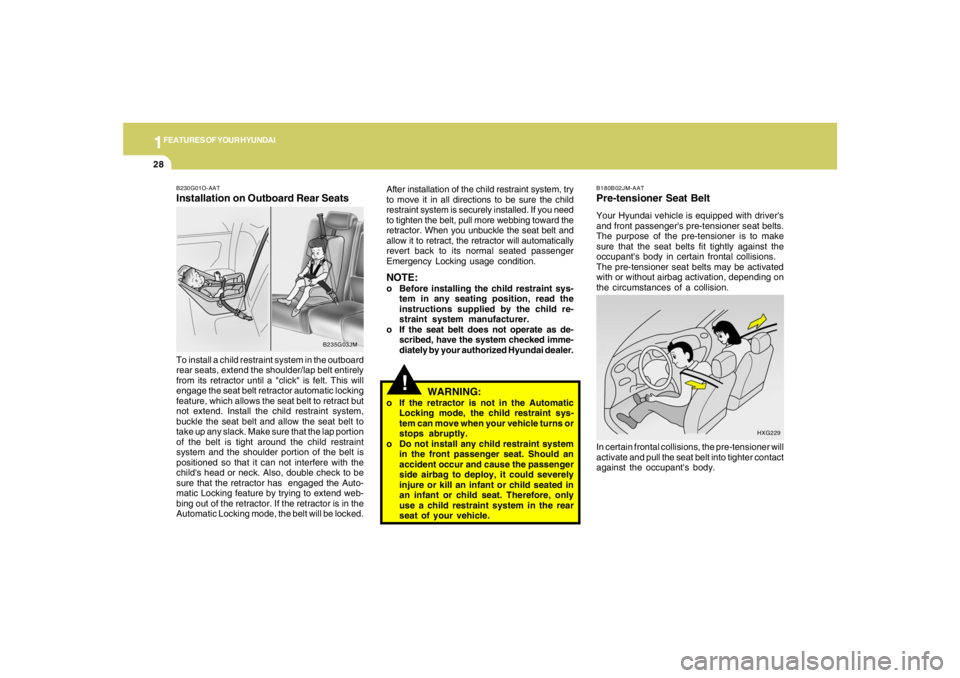
In certain frontal collisions, the pre-tensioner will
activate and pull the seat belt into tighter contact
against the occupant's body.B180B02JM-AATPre-tensioner Seat BeltYour Hyundai vehicle is equipped with driver's
and front passenger's pre-tensioner seat belts.
The purpose of the pre-tensioner is to make
sure that the seat belts fit tightly against the
occupant's body in certain frontal collisions.
The pre-tensioner seat belts may be activated
with or without airbag activation, depending on
the circumstances of a collision.
!
B230G01O-AATInstallation on Outboard Rear Seats
WARNING:
o If the retractor is not in the Automatic
Locking mode, the child restraint sys-
tem can move when your vehicle turns or
stops abruptly.
o Do not install any child restraint system
in the front passenger seat. Should an
accident occur and cause the passenger
side airbag to deploy, it could severely
injure or kill an infant or child seated in
an infant or child seat. Therefore, only
use a child restraint system in the rear
seat of your vehicle. To install a child restraint system in the outboard
rear seats, extend the shoulder/lap belt entirely
from its retractor until a "click" is felt. This will
engage the seat belt retractor automatic locking
feature, which allows the seat belt to retract but
not extend. Install the child restraint system,
buckle the seat belt and allow the seat belt to
take up any slack. Make sure that the lap portion
of the belt is tight around the child restraint
system and the shoulder portion of the belt is
positioned so that it can not interfere with the
child's head or neck. Also, double check to be
sure that the retractor has engaged the Auto-
matic Locking feature by trying to extend web-
bing out of the retractor. If the retractor is in the
Automatic Locking mode, the belt will be locked.After installation of the child restraint system, try
to move it in all directions to be sure the child
restraint system is securely installed. If you need
to tighten the belt, pull more webbing toward the
retractor. When you unbuckle the seat belt and
allow it to retract, the retractor will automatically
revert back to its normal seated passenger
Emergency Locking usage condition.NOTE:o Before installing the child restraint sys-
tem in any seating position, read the
instructions supplied by the child re-
straint system manufacturer.
o If the seat belt does not operate as de-
scribed, have the system checked imme-
diately by your authorized Hyundai dealer.
B235G03JM
Page 43 of 273
1FEATURES OF YOUR HYUNDAI32
B240A02JM
!
Rear impact
Side Impact
Rollover
o The driver should sit back as far as
possible while still maintaining control
of the vehicle. If you are sitting too close
to the airbag, it can cause death or seri-
ous injury when it inflates.
WARNING:
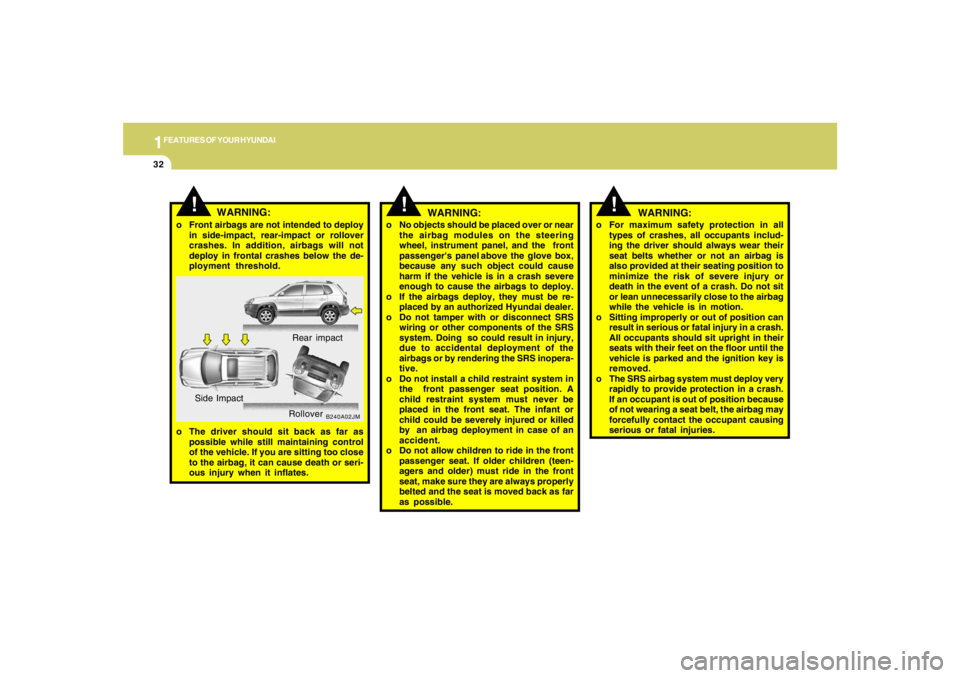
o Front airbags are not intended to deploy
in side-impact, rear-impact or rollover
crashes. In addition, airbags will not
deploy in frontal crashes below the de-
ployment threshold.
!
WARNING:
o No objects should be placed over or near
the airbag modules on the steering
wheel, instrument panel, and the front
passenger's panel above the glove box,
because any such object could cause
harm if the vehicle is in a crash severe
enough to cause the airbags to deploy.
o If the airbags deploy, they must be re-
placed by an authorized Hyundai dealer.
o Do not tamper with or disconnect SRS
wiring or other components of the SRS
system. Doing so could result in injury,
due to accidental deployment of the
airbags or by rendering the SRS inopera-
tive.
o Do not install a child restraint system in
the front passenger seat position. A
child restraint system must never be
placed in the front seat. The infant or
child could be severely injured or killed
by an airbag deployment in case of an
accident.
o Do not allow children to ride in the front
passenger seat. If older children (teen-
agers and older) must ride in the front
seat, make sure they are always properly
belted and the seat is moved back as far
as possible.o For maximum safety protection in all
types of crashes, all occupants includ-
ing the driver should always wear their
seat belts whether or not an airbag is
also provided at their seating position to
minimize the risk of severe injury or
death in the event of a crash. Do not sit
or lean unnecessarily close to the airbag
while the vehicle is in motion.
o Sitting improperly or out of position can
result in serious or fatal injury in a crash.
All occupants should sit upright in their
seats with their feet on the floor until the
vehicle is parked and the ignition key is
removed.
o The SRS airbag system must deploy very
rapidly to provide protection in a crash.
If an occupant is out of position because
of not wearing a seat belt, the airbag may
forcefully contact the occupant causing
serious or fatal injuries.
!
WARNING:
Page 46 of 273
1
FEATURES OF YOUR HYUNDAI
35
!
o The SRS can function only when the
ignition key is in the "ON" position. If the
SRS SRI does not illuminate or contin-
uously remains on after illuminating for
about 6 seconds when the ignition key
is turned to the "ON" position, or after
the engine is started, illuminates while
driving, the SRS is not working properly.
If this occurs, have your vehicle immedi-
ately inspected by your Hyundai dealer.
o Before you replace a fuse or disconnect
a battery terminal, turn the ignition key
to the "LOCK" position or remove the
ignition key. Never remove or replace the
air bag related fuse(s) when the ignition
key is in the "ON" position. Failure to
heed this warning will cause the SRS SRI
to illuminate.
WARNING:
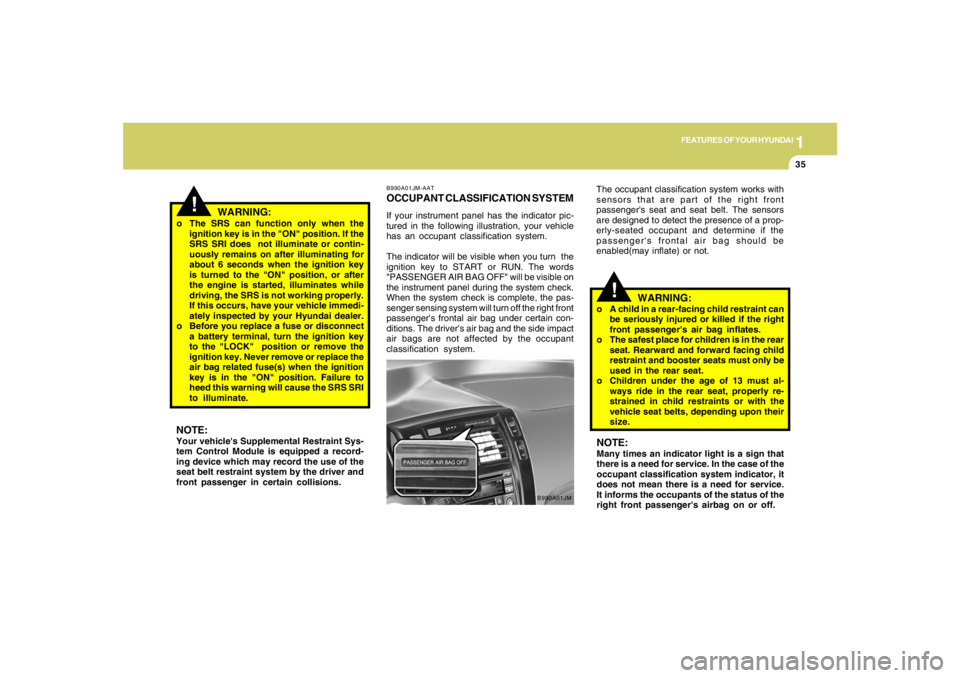
B990A01JM-AATOCCUPANT CLASSIFICATION SYSTEMIf your instrument panel has the indicator pic-
tured in the following illustration, your vehicle
has an occupant classification system.
The indicator will be visible when you turn the
ignition key to START or RUN. The words
"PASSENGER AIR BAG OFF" will be visible on
the instrument panel during the system check.
When the system check is complete, the pas-
senger sensing system will turn off the right front
passenger's frontal air bag under certain con-
ditions. The driver's air bag and the side impact
air bags are not affected by the occupant
classification system.
B990A01JM
NOTE:Your vehicle's Supplemental Restraint Sys-
tem Control Module is equipped a record-
ing device which may record the use of the
seat belt restraint system by the driver and
front passenger in certain collisions.The occupant classification system works with
sensors that are part of the right front
passenger's seat and seat belt. The sensors
are designed to detect the presence of a prop-
erly-seated occupant and determine if the
passenger's frontal air bag should be
enabled(may inflate) or not.
!
WARNING:
o A child in a rear-facing child restraint can
be seriously injured or killed if the right
front passenger's air bag inflates.
o The safest place for children is in the rear
seat. Rearward and forward facing child
restraint and booster seats must only be
used in the rear seat.
o Children under the age of 13 must al-
ways ride in the rear seat, properly re-
strained in child restraints or with the
vehicle seat belts, depending upon their
size.NOTE:Many times an indicator light is a sign that
there is a need for service. In the case of the
occupant classification system indicator, it
does not mean there is a need for service.
It informs the occupants of the status of the
right front passenger's airbag on or off.
Page 47 of 273

1FEATURES OF YOUR HYUNDAI36
!
The occupant classification system is designed
to enable(may inflate) the right front passenger's
frontal air bag anytime the system senses that
a person of adult size is sitting properly in the
right front passenger's seat. When the passen-
ger sensing system has allowed the air bag to
be enabled, the indicator will turn off and stay
turned off to remind you that the air bag is active.
For some children who have outgrown child
restraints and for very small adults, the occu-
pant classification system may or may not turn
off the right front passenger's frontal air bag,
depending upon the person's seating posture
and body build.
If a person of adult-size is sitting in the right front
passenger's seat, but the indicator is turned on,
it could be because that person isn't sitting
properly in the seat. The right front passenger
should sit upright, centered on the seat cushion,
with their seat belt on and legs comfortably
extended, feet on the floor, and with the seat in
an upright position.
Aftermarket equipment, such as seat covers,
can affect how the occupant classification sys-
tem operates. Do not use seat covers or other
aftermarket equipment if your vehicle has the
occupant classification system.
!
B990B02JM-AATPassenger Air Bag Status IndicatorIf your vehicle has the occupant classification
system, your instrument panel will have a pas-
senger air bag status indicator.
When the ignition key is turned to RUN or
START, the passenger air bag status indicator
will be turned on and off for several seconds as
a system check. Then, after several more
seconds, the status indicator will be turned on
or off to let you know the status of the right front
passenger's frontal air bag.
If the "PASSENGER AIR BAG OFF" indicator is
illuminated, it means that the right front
passenger's frontal air bag is disabled. If the
indicator is not illuminated, it means that the right
front passenger's frontal air bag is enabled.
B990A01JM
CAUTION:
Stowing of articles under the passenger's
seat or between the passenger's seat cush-
ion and seatback may interfere with the
proper operation of the occupant classifi-
cation system.
WARNING
Everyone in your vehicle should wear a
safety belt properly -- whether or not
there is an air bag for that person.
Page 48 of 273

1
FEATURES OF YOUR HYUNDAI
37
The occupant classification system can func-
tion only when the ignition key is in the "ON"
position. If the "PASSENGER AIR BAG OFF"
indicator is illuminated when the front
passenger's seat is occupied by an adult who
is seated properly sitting upright and with the
seat in an upright position, centered on the seat
cushion, with their seat belt on and legs comfort-
ably extended feet on the floor, have your
vehicle immediately inspected by your Hyundai
dealer.
The "PASSENGER AIR BAG OFF" status indi-
cator light is on or off under the following
conditions;
!
"PASSENGER AIR
BAG OFF"
Status Indicator light
OFF
ON
ON Passenger status de-
tected by the occupant
classification system
1. Adult *
1
2. Child *
2 or
child restraint system
3. Unoccupied (Empty)
Right front
passenger
air bag
Enabled
Disabled
Disabled
WARNING:
o A child in a rear-facing child restraint can
be seriously injured or killed if the right
front passenger's air bag inflates. Don't
use a rear-facing child restraint in the
right front passenger's seat.
o If the indicator and the air bag readiness
light ever illuminate at the same time, it
means that something may be wrong
with the air bag system. If this ever
happens, have the vehicle serviced
promptly, because an adult-size person
sitting in the right front passenger seat
may not have the supplemental protec-
tion of the frontal air bag.
o If the occupant classification system is
not working properly, the SRS airbag
warning light on the instrument panel
will illuminate because the passenger's
airbag is connected with the occupant
classification system.
o If there is a malfunction of the occupant
classification system, the "PASSENGER
AIR BAG" indicator will illuminate and
the front passenger's airbag will not
deploy in frontal crashes.
!
WARNING:
o If the SRS airbag warning light does not
illuminate when the ignition key is turned
to "ON" position, if it remains illumi-
nated after coming on for approximately
6 seconds, have an authorized Hyundai
dealer inspect the occupant classifica-
tion system with the SRS airbag system
as soon as possible.
o Even though your vehicle is equipped
with the occupant classification sys-
tem, do not install a child restraint sys-
tem in the front passenger's seat. The
infant or child could be severely injured
or killed by an airbag deployment in case
of an accident. A child restraint system
must never be placed in the front seat.
Children who are too large for child
restraint systems should always occupy
the rear seat and use the available lap/
shoulder belts. Children are afforded the
most safety in the event of an accident
when they are restrained by a proper
restraint system in the rear seat. *1) The system judges a person of adult size as
an adult. When a smaller adult sits in the front
passenger seat, the system may detect him/
her as a child depending on his/her physique
and posture.*2) When a larger child who has outgrown a child
restraint system sits in the passenger seat,
the system may detect him/her as an adult
depending on his/her physique and posture.
Page 51 of 273

1FEATURES OF YOUR HYUNDAI40
!
o If you sell your vehicle, make certain that
this manual is transferred to the new
owner.
o If your car was flooded and has soaked
carpeting or water on the floor, don't try
to start the engine; have the car towed to
an authorized Hyundai dealer.
o Do not replace the bumper or the bumper
guard with the one other than the Hyundai
genuine parts. Otherwise, it can ad-
versely affect SRS performance and lead
to an increased risk of injury.
WARNING:
o For cleaning the airbag pad covers, use
only a soft, dry cloth or one which has
been moistened with plain water. Sol-
vents or cleaners could adversely affect
the airbag covers and proper deploy-
ment of the system.
o No objects should be placed over or near
the airbag modules on the steering
wheel, instrument panel, and the front
passenger's panel above the glove box,
because any such object could cause
harm if the vehicle is in a crash severe
enough to cause the airbags to inflate.
o If the airbags inflate, they must be re-
placed by an authorized Hyundai dealer.
o Do not tamper with or disconnect SRS
wiring, or other components of the SRS
system. Doing so could result in injury,
due to accidental inflation of the airbags
or by rendering the SRS inoperative.
o If components of the airbag system must
be discarded, or if the vehicle must be
scrapped, certain safety precautions
must be observed. Your Hyundai dealer
knows these precautions and can give
you the necessary information. Failure
to follow these precautions and proce-
dures could increase the risk of personal
injury.
!
WARNING:
!
WARNING:
o Do not install a child restraint system in
the front passenger seat position.
A child restraint system must never be
placed in the front seat. The infant or
child could be severely injured or killed
by an airbag deployment in case of an
accident.
o Modification to SRS components or wir-
ing, including the addition of any kind of
badges to the pad covers or modifica-
tions to the body structure, can ad-
versely affect SRS performance and lead
to possible injury.B240C01JM-AATSRS Careo The SRS is virtually maintenance free and
there are no parts you can safely service by
yourself. If the SRS SRI (Service Reminder
Indicator) does not illuminate, or continu-
ously remains on, have your vehicle imme-
diately inspected by your Hyundai dealer.
o Any work on the SRS system, such as
removing, installing, repairing, or any work
on the steering wheel must be performed by
a qualified Hyundai technician. Improper
handling of the airbag system may result in
serious personal injury.