2005 Hyundai Matrix radiator
[x] Cancel search: radiatorPage 43 of 407

1- 35
CONTROLS AND EQUIPMENT
The fuel gauge indicates the quantity of fuel remaining in the fuel tank. NOTE: The fuel gauge is not intended to giveother than an approximate indication ofthe fuel level and is unsuitable for thepurposes of calculating fuel consumptionfigures.SB215B1-E ENGINE COOLANT TEMPERATURE GAUGE The engine coolant temperature gauge indi- cates the engine coolant temperature and will, under normal circumstances, give an indica-tion in the "Normal" or centre portion of thescale. Should the indication move into theupper or "Hot" portion of the scale, engineoverheating is indicated. Under these circum-stances, the vehicle should be brought to restas soon as is safe to do so and the engineturned off. Once the engine has cooled some-what, the coolant level and the condition ofthe generator/water pump drive belt should bechecked. If the cause of the overheating can-not be readily established, the assistance ofa Hyundai authorised repairer should besought.
SB215A1-E
FUEL GAUGE
B950A01E-DAT REAR FOG AUDIBLE WARNING SOUND The rear fog audible warning chime sounds when the rear fog lights are on and the doorin driver side is open.
HFC2101
HFC2045
WARNING: The engine cooling system is pressurized and removal of the radiator cap when theengine is hot may cause hot water andsteam to be ejected from the radiator re-sulting in burns and scalding. The radiatorcap must only be removed when the en-gine has cooled. Do not add cold water toa hot engine to avoid the possibility ofengine damage. The use of plain water inthe cooling system is not recommendedsince the aluminium components of thecooling system require the use of a corro-sion inhibitor found in the recommendedEthylene Glycol type anti freeze solutions.
B300A01FC
SB215C1-E SPEEDOMETER The speedometer indicates the vehicle speed in both miles and kilometres per hour.
Page 59 of 407

1- 51
CONTROLS AND EQUIPMENT
B570A01FC-EAT
BONNET RELEASE
Pull the release lever inside the vehicle to
unlatch the bonnet. At the front of the vehicle, push the safety catch lever sidewards asshown and raise the bonnet by hand. Supportthe bonnet by means of the bonnet prop. Before closing the bonnet, ensure that the
prop is correctly stowed. Lower the bonnet byhand to a position of approximately 30cm fromthe closed position and allow the bonnet todrop. Do not attempt to close the bonnet bylowering the panel to the closed position andpressing upon the panel work since this mayresult in damage to the panel. CAUTION:Ensure that the bonnet prop has beenremoved prior to closing the bonnet. Al-ways check to ensure that the bonnet haslatched prior to setting the vehicle in mo-tion. WARNING: The bonnet prop must be correctly in- serted into the panel to prevent the possi-bility of injury arising from the bonnetfalling.
HFC2019
HFC2018-D
SB440A1-E
REMOTE FUEL FILLER FLAP
RELEASE (Not all models) The fuel filler flap may be opened from inside
the vehicle by pulling up on the fuel filler flap release.
NOTE: If the fuel filler flap will not open because
ice has formed around it, tap lightly or push on it to break the ice and release it.Do not lever the flap. If necessary, sprayaround the flap with an approved deicerfluid (do not use radiator anti-freeze) ormove the vehicle to a warm place andallow the ice to melt.
HFC2015-D
Page 90 of 407
3-3
IN CASE OF EMERGENCY
If the drive belt seems to be satisfactory, check for coolant leaking from the radiator, hoses or under the car. (If the air condi- tioning had been in use, it is normal for cold water to be draining from it).
WARNING: Whilst the engine is running, keep hands and clothing away from moving parts such as the fan and drive belts to prevent injury. WARNING (Diesel only): Never work on injection system with en-gine running or within 30 seconds after shutting off engine. High pressure pump, rail, injectors and high pressure pipes are subject to high pressure even after the engine stopped. The fuel jet produced by fuel leaks may cause serious injury, if it touch the body. People using pacemak- ers should ensure that they keep a dis- tance of 30cm from the ECU or wiring harness within the engine room whilst engine is running, since the high currents in the Common Rail system produce con- siderable magnetic fields.
5. If the water pump drive belt is broken or coolant is leaking out, stop the engine immediately and call the nearest Hyundai authorised repairer for assistance. WARNING:Do not remove the radiator cap when theengine is hot since steam and boiling water may be ejected from the radiator resulting in burns or scalding.
6. If the cause of the overheating cannot be found, wait until the engine temperature has returned to normal. Then, if coolant has been lost, carefully remove the radia- tor cap and add water to bring the fluid level in the reservoir up to the base of the radiator fill opening. Fill the coolant expan- sion tank to the halfway mark.
7. Proceed with caution until it is established that the engine is operating normally. If theengine overheats repeatedly, the advice of a Hyundai authorised repairer should be sought.
CAUTION:Serious loss of coolant indicates there is a leak in the cooling system and this should be checked as soon as possible by a Hyundai authorised repairer. D040A01FC-EAT
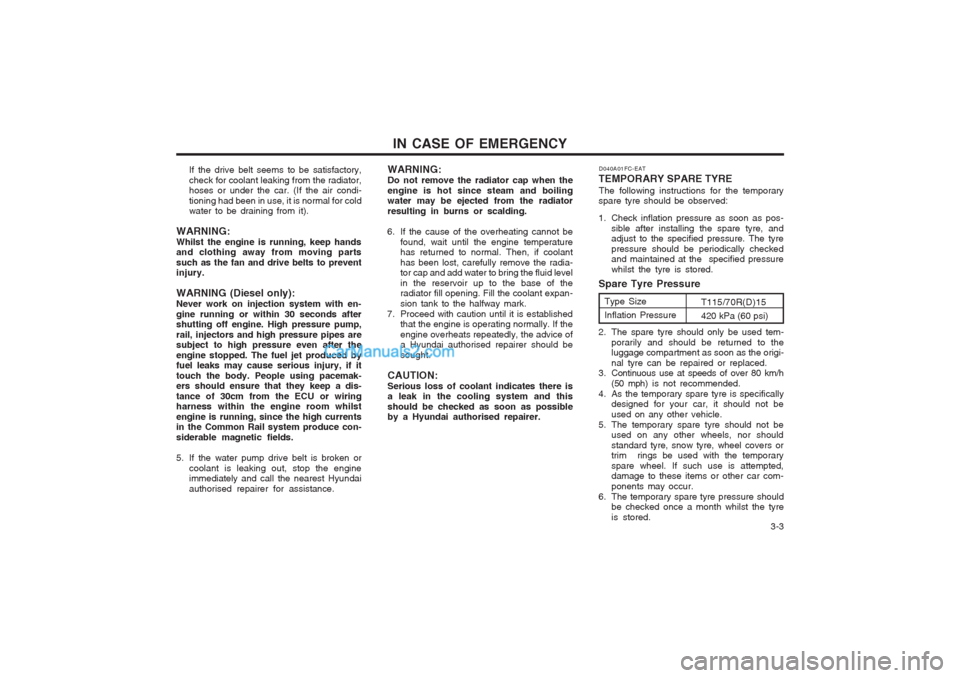
TEMPORARY SPARE TYRE The following instructions for the temporary
spare tyre should be observed:
1. Check inflation pressure as soon as pos-
sible after installing the spare tyre, and adjust to the specified pressure. The tyre pressure should be periodically checked and maintained at the specified pressure whilst the tyre is stored.
2. The spare tyre should only be used tem- porarily and should be returned to the luggage compartment as soon as the origi- nal tyre can be repaired or replaced.
3. Continuous use at speeds of over 80 km/h
(50 mph) is not recommended.
4. As the temporary spare tyre is specifically designed for your car, it should not beused on any other vehicle.
5. The temporary spare tyre should not be used on any other wheels, nor shouldstandard tyre, snow tyre, wheel covers or trim rings be used with the temporary spare wheel. If such use is attempted, damage to these items or other car com- ponents may occur.
6. The temporary spare tyre pressure should be checked once a month whilst the tyreis stored.
Spare Tyre Pressure
Type Size Inflation Pressure T115/70R(D)15420 kPa (60 psi)
Page 106 of 407

VEHICLE MAINTENANCE REQUIREMENTS 5-7
6ZF070D1-A
o Manual Transaxle Oil Inspect the manual transaxle oil according to
the maintenance schedule. NOTE: If the oil level is low, check for possible
leaks before adding oil. Do not overfill.
6ZF070H1-A
o Rear Brake Drums And Linings/ Parking Brake
Check the rear brake drums and linings for
scoring, burning, leaking fluid, broken parts, and excessive wear. Inspect the parkingbrake system including the parking brakelever and cables. For detailed service proce-dures, refer to the Shop Manual.
6ZF070J1-A
o Brake Pads, Calipers and Rotors Check the pads for excessive wear, discs for
run out and wear, and calipers for fluid leak-age.
6ZF070K1-A
o Exhaust Pipe and Muffler Visually inspect the exhaust pipes, silencerand hangers for cracks, deterioration, or dam-age. Start the engine and listen carefully forany exhaust gas leakage. Tighten connec-tions or replace parts as necessary.
F070E05A-AAT
o Automatic Transaxle Fluid The fluid level should be in the "HOT" range
of the dipstick, after the engine and transaxleare at normal operating temperature. Checkthe automatic transaxle fluid level with theengine running and the transaxle in neutral,with the parking brake properly applied. UseHyundai Genuine ATF SP-III, DIAMOND ATFSP-III, SK ATF SP-III or other brands ap-proved by Hyundai Motor Co., when adding orchanging fluid. 6ZF070F1-A
o Brake Hoses and Lines Visually check for proper installation, chafing, cracks, deterioration and any leakage. Replaceany deteriorated or damaged parts immediately.
6ZF060H1-A
o Air Cleaner Filter A Genuine Hyundai air cleaner filter is recom-
mended when filter is replaced.
6ZF060J1-A
o Spark Plugs Make sure to install new spark plugs of the
correct heat range.
6ZF070B1-A
o Cooling System Check the cooling system part, such asradiator, coolant reservoir, hoses and con-nections for leakage and damage. Replaceany damaged parts. 6ZF070G2-A
o Brake Fluid Check brake fluid level in the brake fluidreservoir. The level should be between "MIN"and "MAX" marks on the side of the reservoir.Use only hydraulic brake fluid conforming toDOT 3 or DOT 4.
6ZF070C1-A
o Engine Coolant The coolant should be changed at theintervals specified in the maintenance sched-ule.
F060N02E-AAT
o Valve Clearance Inspect excessive valve noise and/or enginevibration and adjust if necessary. A qualifiedtechnician should perform the operation.
Page 108 of 407

OWNER MAINTENANCE 6-1
SG000A1-E
6. OWNER MAINTENANCE
6
HFC5001
1. Air filter element
2. Engine oil filler cap
3. Brake fluid and clutch fluid reservoir
4. Auto fuel cut switch 5. Relay box
6. Power steering fluid reservoir
7. Engine oil level dipstick
8. Engine cover
9. Engine coolant reservoir10.Radiator cap
11.Automatic transaxle fluid level dipstick
(Not all models)
12.Battery
13.Windscreen washer fluid reservoir cap CAUTION:When inspecting or servicing the engine, you should handle toolsand other heavy objects carefullyso that the plastic cover of theengine is not damaged.
G010B01FC-EAT ENGINE COMPARTMENT (1.6 DOHC)
12
34 5
6 7 8 9 10 11 12 13
Page 109 of 407

OWNER MAINTENANCE
6-2 HFC003
CAUTION: When inspecting or servicing the engine, you should handle toolsand other heavy objects carefullyso that the plastic cover of theengine is not damaged.
G010C01FC-EAT ENGINE COMPARTMENT (1.8 DOHC)
1. Air filter element
2. Engine oil filler cap
3. Brake fluid and clutch fluid reservoir
4. Auto fuel cut switch
5. Relay box
6. Power steering fluid reservoir
7. Engine oil level dipstick
8. Engine cover
9. Engine coolant reservoir10.Radiator cap
11.Automatic transaxle fluid level dipstick
(Not all models)
12.Battery
13.Windscreen washer fluid reservoir cap
1 2 345
6 7 8 9 10 11 12 13
Page 110 of 407

OWNER MAINTENANCE 6-3
G010E02FC
G010E02FC-EAT
ENGINE COMPARTMENT Diesel (1.5 CRDi)
1. Air filter element
2. Engine oil filler cap
3. Brake fluid and clutch fluid reservoir
4. Fuel filter 5. Relay box
6. Power steering fluid reservoir
7. Engine oil level dipstick
8. Engine coolant reservoir
9. Radiator cap
10.Battery
11.Windscreen washer fluid reservoir capCAUTION:When inspecting or servicing the
engine, you should handle tools and other heavy objects care-fully so that the plastic cover ofthe engine is not damaged.
Page 113 of 407

OWNER MAINTENANCE
6-6 ZG030E1-A
ENGINE OIL CONSUMPTION Function of engine oil
Engine oil has the primary function of lubricat- ing and cooling the inside of the engine.
Engine oil consumption It is normal that an engine should consumesome engine oil in the course of normaldriving. The cause of oil consumption in anormal engine are as follows;
o Engine oil is used to lubricate pistons, piston rings and cylinders. A thin film of oil is left on the cylinder wall when a piston moves downwards in thecylinder. High negative pressure generatedduring engine operation sucks some of theoil into the combustion chamber.This oil with some oil of the cylinder wall isburned by the high temperature combustiongases during the combustion process.
o The engine oil consumption is strongly effected by the viscosity and quality of oil,engine rpm and driving condition etc. More engine oil may be consumed under severe driving conditions such as highspeeds, frequent acceleration and decel-eration, compared to normal driving.
If the indicated oil level is at or below the lower
mark of the dipstick, oil should be added untilthe level is at or below the upper mark. To add oil to the engine, remove the filler cap
by rotating in an counterclockwise directionand pour engine oil into the engine. Beforechecking the level again, allow several min-utes for the oil to drain into the sump. Replacethe oil filler cap rotating it in a clockwisedirection until tight.
The quantity of oil required to raise the level
from the minimum to maximum level is approx-imately 1 litre.
The distance between the "F" and "L" marks
is equal to about 1 liter(Petrol Engine)/1.2liter(Diesel Engine) of oil.
WARNING: Be very careful not to touch the radiator
hose when checking the engine oil as it may be hot enough to burn you.
G030D02FC
Diesel engine
SG030D3-E
ENGINE OIL REPLENISHMENT
HFC5009
Petrol engine
Withdraw the dipstick and wipe it with a clean rag. Replace the dipstick fully and withdrawagain when the oil level may be read from thestick. Normal oil level is indicated when the oilis present between the two marks on thestick. It is not necessary to add oil if the levelis above the lower mark and in any case, oilmust not be added to the degree that the levelexceeds the upper mark. Replace the dip-stick fully after checking the level. WARNING: Be very careful not to touch the radiator hose when checking the engine oil as itmay be hot enough to burn you.