2005 Hyundai Matrix coolant temperature
[x] Cancel search: coolant temperaturePage 355 of 407

6 DO-IT-YOURSELF MAINTENANCE
10
CAUTION:
Slowly pour the recommended oil using by a funnel. Do not overfillnot to damage engine.
!
NOTE: Always dispose of used engine oil in an environmentally acceptablemanner. It is suggested that it be placed in a sealed container and taken to a service station for maybereclaimation. Do not pour the oil on the ground or put it in with the household trash.
Be sure that the mounting surfaceon the engine is clean and that theold gasket is removed completely. Lubricate the new gasket on the filter with clean engine oil beforeinstallation.
7. Remove the engine oil level dip- stick.
8. Refill the crankcase with the rec-
ommended engine oil. Refer tothe specification in chapter 9 for engine oil capacity.
!
9. Start the engine and check to be sure no oil is leaking from the drain plug or oil filter.
10.Shut off the engine and recheck the oil level. WARNING:
Used motor oil may cause irrita-
tion or cancer of the skin if left in contact with the skin for prolongedperiods of time. Wash your hands thoroughly with soap and warm water as soon as possible afterhandling used oil. G040B04FC-GAT
Diesel Engine
Oil filter
G040B01FC
Oil filler cap
The engine oil and filter should be
changed at those intervals specified in the maintenance schedule in Sec- tion 5. If the car is being driven in severe conditions, more frequent oiland filter changes are required.
The procedure for changing the oil
and filter is as follows:
1. Park the car on level ground and
set the parking brake. Start the engine and let it warm up until the needle on the coolant temperature gauge moves above the lowestmark.
Page 358 of 407
6
DO-IT-YOURSELF MAINTENANCE
13
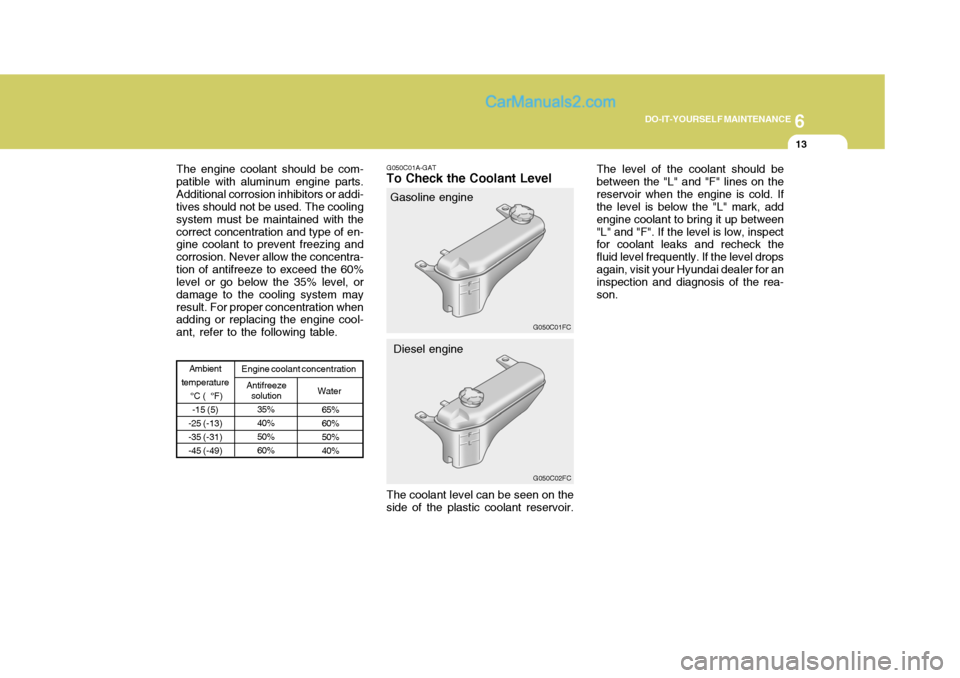
Water
65% 60%50%40%
35%40%50%60%
The engine coolant should be com- patible with aluminum engine parts.Additional corrosion inhibitors or addi- tives should not be used. The cooling system must be maintained with thecorrect concentration and type of en- gine coolant to prevent freezing and corrosion. Never allow the concentra-tion of antifreeze to exceed the 60% level or go below the 35% level, or damage to the cooling system mayresult. For proper concentration when adding or replacing the engine cool- ant, refer to the following table. G050C01A-GAT
To Check the Coolant Level The level of the coolant should bebetween the "L" and "F" lines on thereservoir when the engine is cold. If the level is below the "L" mark, add engine coolant to bring it up between"L" and "F". If the level is low, inspect for coolant leaks and recheck the fluid level frequently. If the level dropsagain, visit your Hyundai dealer for an inspection and diagnosis of the rea- son.
G050C01FC
G050C02FC
Gasoline engine
Diesel engine
Ambient
temperature °C ( °F)-15 (5)
-25 (-13) -35 (-31)-45 (-49) Engine coolant concentration
Antifreezesolution
The coolant level can be seen on the
side of the plastic coolant reservoir.
Page 360 of 407

6
DO-IT-YOURSELF MAINTENANCE
15
!
SPARK PLUGS
WARNING:
The cooling fan is controlled by engine coolant temperature and may sometimes operate even when the engine is not running. Useextreme caution when working near the blades of the cooling fan so that you are not injured by arotating fan blade. As the engine coolant temperature decreases, the fan will automatically shut off. Thisis a normal condition. G060A01L
G060B02S-GAT
REPLACING THE SPARK PLUGS (Gasoline Engine)
The spark plugs should be changed
at the intervals specified in the ve- hicle maintenances schedule in Sec- tion 5 or whenever engine perfor-mance indicates they should be changed. Symptoms that suggest poor spark plug performance include en-gine misfiring under load, loss of fuel economy, poor acceleration, etc. When spark plugs are replaced, al-ways use spark plugs recommended by Hyundai. The use of other spark plugs can result in loss of perfor-mance, radio interference or engine damage.
Unleaded: 1.0 ~ 1.1 mm (0.039 ~ 0.043 in.) Leaded: 0.7 ~ 0.8 mm (0.028 ~ 0.032 in.)
NOTE: When replacing the spark plugs, genuine Hyundai replacement partsare recommended.
Recommended Spark Plugs:
CHAMPION NGK Leaded
engine
RC10YCBKR5ES
Unleaded
engine
RC10YC4BKR5ES-11
Page 367 of 407
6 DO-IT-YOURSELF MAINTENANCE
22
!
!
CHECKING THE BRAKES
G120A01A-AAT
! CAUTION:
Because brakes are essential to
the safe operation of the car, it is suggested that they be checked and inspected by your Hyundai dealer. The brakes should bechecked and inspected for wear at those intervals specified in the vehicle maintenance schedule inSection 5.
WARNING (Diesel only):
Never work on injection system
with engine running or within 30 seconds after shutting off engine. High pressure pump, rail, injec-tors and high pressure pipes are subject to high pressure even af- ter the engine stopped. The fuel jetproduced by fuel leaks may cause serious injury, if it touch the body. People using pacemakers shouldnot move than 30cm closer to the ECU or wiring harness within the engine room while engine is run-ning, since the high currents in the Common Rail system produce considerable magnetic fields.
WARNING:
The cooling fan is controlled byengine coolant temperature andmay sometimes operate even when the engine is not running. Use extreme caution when workingnear the blades of the cooling fan, so that you are not injured by a rotating fan blade. As the enginecoolant temperature decreases, the fan will automatically shut off. This is a normal condition.Fluid level should be within this range
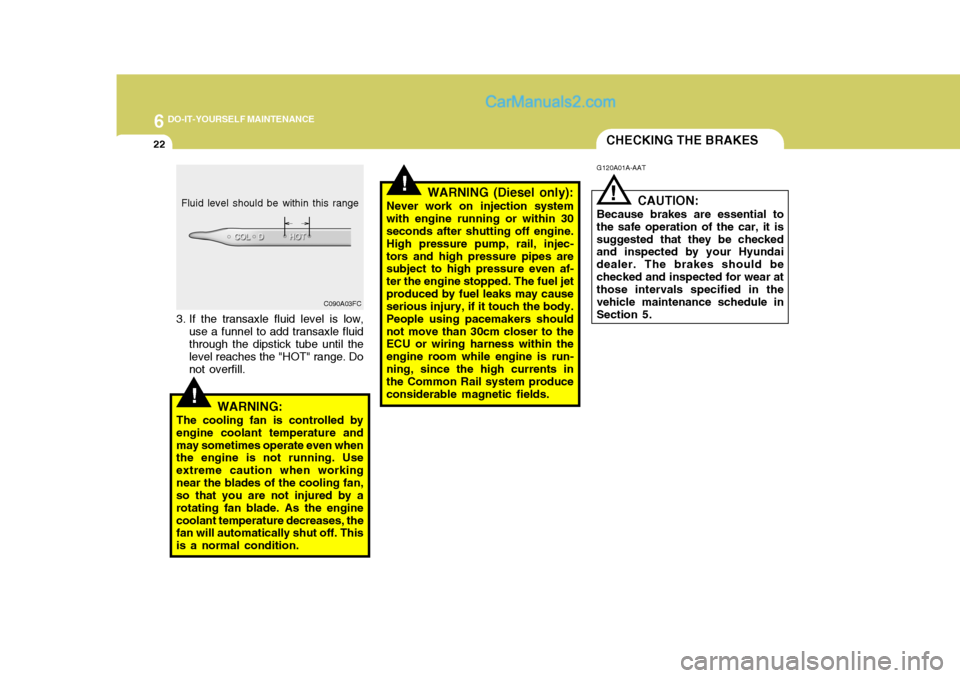
3. If the transaxle fluid level is low, use a funnel to add transaxle fluid through the dipstick tube until the level reaches the "HOT" range. Do not overfill. C090A03FC
Page 377 of 407

6 DO-IT-YOURSELF MAINTENANCE
32
To check the power steering fluid level, be sure the ignition is "OFF",then check to make certain that the power steering fluid level is between the "MAX" and "MIN" level markingson the fluid reservoir. NOTE: Grinding noise from the power steering pump may be heard im- mediately after the engine is startedin extremely cold conditions (be- low - 20°C). If the noise stops dur- ing warm up, there is no abnormalfunction in the system. It is due to a power steering fluid characteris- tic in extremely cold conditions. Recommended Fluid Use PSF-3 type fluid NOTE: Do not start the engine when the power steering oil reservoir is empty.
!
CHECKING ELECTRIC COOLING FANS
G220A01A-AAT
WARNING:
The cooling fan is controlled by engine coolant temperature and may sometimes operate even whenthe engine is not running. Use extreme caution when working near the blades of the cooling fan,so that you are not injured by a rotating fan blade. As the engine coolant temperature decreases thefan will automatically shut off. This is a normal condition.POWER STEERING FLUID LEVEL
G220B01A-AAT
Checking Engine Cooling Fan
The engine cooling fan should come on automatically if the engine coolant temperature is high. G220C01A-AAT
Checking Condenser Cooling Fan
The condenser cooling fan should come on automatically whenever the air conditioning is in operation. G230A03A-GAT
HFC5004
G230A02FC
Gasoline engine
Diesel engine
The power steering fluid level should be checked regularly.
Page 389 of 407

7EMISSION CONTROL SYSTEMS
2EMISSION CONTROL SYSTEMS
H010A01A-GAT
(If Installed)
Your Hyundai is equipped with an
emission control system to meet all requirements of the Emission prohibi- tion rules of your province.
There are three emission control sys-
tems which are as follows.
(1) Crankcase emission control sys- tem
(2) Evaporative emission control sys- tem
(3) Exhaust emission control system
In order to assure the proper function
of the emission control systems, it is recommended that you have your carinspected and maintained by an au- thorized Hyundai dealer in accordance with the maintenance schedule in thismanual. H010B01A-AAT
1. Crankcase Emission Control
System
The positive crankcase ventilation
system is employed to prevent airpollution caused by blow-by gasesbeing emitted from the crankcase. This system supplies fresh filtered air to the crankcase through the air in-take hose. Inside the crankcase, the fresh air mixes with blow-by gases, then passes through the PCV valveinto the induction system.
H010C01E-GAT
2. Evaporative Emission Control
System
The Evaporative Emission Control
System is designed to prevent fuel vapors from escaping into the atmo- sphere. Canister
While the engine is inoperative, fuel
vapors generated inside the fuel tank are absorbed and stored in the canis- ter. When the engine is running, thefuel vapors absorbed in the canister are drawn into the induction system through the purge control solenoidvalve. Purge Control Solenoid Valve (PCSV)
The purge control solenoid valve is
controlled by the Engine Control Mod- ule (ECM); when the engine coolant temperature is low during idling, the PCSV closes so that evaporated fuelis not taken into the engine. After the engine warms-up during ordinary driv- ing, the PCSV opens so as to intro-duce evaporated fuel to the engine.
H010D01A-AAT
3. Exhaust Emission Control
System
The Exhaust Emission Control Sys-
tem is a highly effective system which controls exhaust emissions while maintaining good vehicle performance.