2005 Hyundai Matrix wheel
[x] Cancel search: wheelPage 77 of 407

DRIVING YOUR HYUNDAI 2- 5
SC090A03-E MANUAL TRANSAXLE
HFC3029
The five speed fully synchronized transaxle is controlled by a floor mounted shift lever upon which the shift pattern is indicated. It is impor- tant that when changing gear, the clutch pedal is fully depressed to avoid transaxle damage. CAUTION:
o Do not attempt to engage reverse gear
when the car is in motion.
o To avoid damaging the selector mecha- nism, do not use the gear shift lever as a hand rest. Release the lever immedi- ately the shift is completed.
o To avoid premature clutch wear, do not use the clutch pedal as a foot rest, anddo not hold the vehicle on a gradient using the clutch.
o Ensure that the engine is not over-revved by upshifting before the tachometerneedle enters the red zone.
o Do not coast with the shift lever at the neutral position.
o When descending long gradients, make use of the engine braking to assist thefootbrake to avoid brake fade or over- heating.
o When slippery conditions are encoun- tered, increased caution should be ex-ercised when gear changing, braking or accelerating. Abrupt changes in speed may cause a loss of traction or control of the vehicle.
o During cold weather, shifting may be difficult until the transaxle lubricant haswarmed up. This is normal and not harmful to the transaxle.
o Anticipate the road and conditions ahead
to enable adjustments in speed to be madesmoothly. Avoid heavy acceleration and sharp braking.
o Avoid cruising at unnecessary high speeds.
o Always ensure that the periodic mainte- nance services are performed by aHyundai authorised repairer at the time and/or mileage intervals specified.
o Use the air conditioning only when neces- sary.
o If you 've come to a complete stop and
it's hard to shift into 1 st
or R(Reverse),
put the shift lever in N(Neutral) posi- tion and release the clutch. Press the clutch pedal back down, and then shift into 1 st
or R(Reverse) gear position.
o Do not use the shift lever as a handrest during driving, as this can result inpremature wear of the transaxle shift forks.
WARNING:
o Avoid high cornering speeds.
o Do not make quick steering wheel movements, such as sharp lanechanges or fast, sharp turns.
o Always wear your seat belts. In a collision crash, an unbelted per- son is significantly more likely to die than a person wearing a seatbelt.
o The risk of rollover is greatly increased
if you lose control of your vehicle at highway speeds.
o Loss of control often occurs if two or
more wheels drop off the roadway andthe driver oversteers to reenter the roadway.
o In the event your vehicle leaves the roadway, do not steer sharply. Instead,slow down before pulling back into the travel lanes.
o Never exceed posted speed limits.
Page 79 of 407

DRIVING YOUR HYUNDAI 2- 7
DC110C1-E o R (Reverse):With the selector in this position, reverse gear will be engaged. The engine may not be started with the selector in this position. CAUTION: The selector must NEVER be shifted to the"R" position whilst the vehicle is in mo- tion.
YC090A1-E SELECTOR POSITIONS o P (Park): With the selector in this position, no drive is transmitted from the engine and the transaxle output and therefore the front wheels locked. The engine may be started with the selector in this position. CAUTION: The selector must NEVER be shifted to the "P" position whilst the vehicle is in motion, otherwise serious transaxle dam- age will result.
DC110F1-E
o 2 (Second Gear):
With the selector in this position, first gear will be engaged from rest. The transmission will upshift to second gear depending upon the vehicle speed and throttle position. No upshift to third or fourth will occur. The engine may not be started with the selector in this position. CAUTION: Do not move the selector to the 2 position when the vehicle speed is in excess of 60 m.p.h. DC110G2-E o L (Low Gear):With the selector in this position, first gear will be engaged from rest. No upshift will occur regardless of vehicle speed and throttle open- ing. The engine may not be started with the selector in this position. CAUTION: Do not move the selector to the "L" posi- tion when the vehicle speed is in excess of 50 m.p.h.
DC110E1-E
o D (Drive): With the selector in this position, first gear willbe engaged from rest and the transmission will automatically upshift to second, third and fourth depending upon the vehicle speed, throttle position and the position of the over- drive switch. The engine may not be started with the selector in this position.
DC110D1-E
o N (Neutral): With the selector in this position, no gear isselected and no drive is transmitted from the engine. The engine may be started with the selector in this position. CAUTION: Do not coast with the selector at the "N"position.
C090H01A-EAT NOTE:
o The brake pedal should be depressedwhen shifting from NEUTRAL to a for- ward or reverse gear.
o The brake pedal fully depressed in or- der to move the shift lever from the "P"(Park) position to any of the other posi- tions.
o It is always possible to shift from "R", "N", "D", "2", "L" position.
For optimum fuel economy, accelerate grad-ually. The transaxle will automatically shift to the second, third and overdrive gears.
Page 81 of 407

DRIVING YOUR HYUNDAI 2- 9
SC130A1-E OVERDRIVE SWITCH
The overdrive switch prevents the transaxle upshifting higher than third gear when the switch is turned "OFF". The transaxle will start from rest in first gear and upshift to second and third gear depending upon the roadspeed and throttle opening but will not upshift to fourth gear. When the overdrive switch is turned "ON", the transaxle will start from rest in first gear and will upshift, depending upon roadspeed and throttle opening to second, third and fourth gear. Therefore, when the overdrive switch is turned "OFF", the transaxle performs as a three speed unit and the over- drive warning light located in the instrument cluster will be illuminated. When the overdrive switch is turned "ON", the transaxle functions as a fully automatic four speed unit with the maximum fuel economy potential of the ve- hicle being realized.
SC140A1-E EFFECTIVE BRAKINGBraking system performance and friction ma- terial life are greatly affected by the driving style adopted. The following suggestions are made to assist in achieving the best results from the braking system.
o Anticipate the road and conditions ahead
in order that heavy braking may be avoided.
o When descending long gradients, use the engine to assist in retarding the vehicle to minimize the possibility of brake fade oc- curring.
o When trailer towing, ensure that the trailer brakes function correctly and use enginebraking to assist the vehicle braking system.
o Use only genuine Hyundai replacement brake pads and shoes to ensure consis-tent friction characteristics and wear rates.
o After driving through deep water (e.g. fording), the brakes may become wet and perfor-mance reduced. Always check brake effi- ciency after emerging from the water and dry the brakes by lightly depressing the brake pedal several times whilst driving slowly.
o Apply the parking brake only when the
vehicle is at rest.
o Since the power assistance provided by
the brake servo is derived from the engine,coasting with the engine turned off or tow- ing of the vehicle with the engine turned off will result in greatly increased pedal pres- sures being required to stop the vehicle.
HFC3023-D
WARNING:
o Avoid high cornering speeds.
o Do not make quick steering wheel move-ments, such as sharp lane changes orfast, sharp turns.
o Always wear your seat belts. In a collision crash, an unbelted per- son is significantly more likely to die than a person wearing a seatbelt.
o The risk of rollover is greatly increased if you lose control of your vehicle athighway speeds.
o Loss of control often occurs if two or more wheels drop off the roadway andthe driver oversteers to reenter the roadway.
o In the event your vehicle leaves the roadway, do not steer sharply. Instead,slow down before pulling back into the travel lanes.
o Never exceed posted speed limits.
o Excessive depressing of the accelerater
pedal under the tyres slip condition such as moving out of the mud or fresh snow etc, may cause severe dam- age to the transmission. If this condi- tion exists, it may be adviseable to have the vehicle towed.
Page 82 of 407
DRIVING YOUR HYUNDAI
2- 10 C300B01O-GAT TCS ON ModeIn the TCS ON mode, the indicator in the instrument cluster will not be illuminated. NOTE:
1) Turn off the engine. Then restart the
engine, and the TCS mode will auto- matically turn "ON".
2) When the traction control is operating properly, you can feel a slight pulsationin the vehicle. This is only the effect of brake control and indicates nothing unusual.
Driving hints TCS does not actively apply brakes. Be sure to decelerate the car sufficiently before enter- ing curves. CAUTION: When the TCS indicator blinks, SLIP con-trol has been activated. It also means that the road is slippery or your car is acceler- ating excessively. In this situation, release foot pressure from the accelerator pedal and maintain moderate speed. WARNING: Traction control is only a driving aid; all normal precautions for driving in inclem- ent weather and on slippery driving sur- faces should be observed.
The braking distance for cars equipped
with an anti-lock braking system may belonger than for those without it, in the following road conditions.
o Driving on rough, gravel or snow-cov-
ered roads.
o Driving with tyre chains installed.
o Driving on roads where the road sur- face is pitted or has different surfaceheight.
These roads should be driven at reduced
speeds. The safety features of an ABSequipped vehicle should not be tested by high speed driving or cornering. This could endanger the safety of yourself or others. C300A01O-EAT
BRAKE TRACTION CONTROL SYSTEM (BTCS) (Not all models)
On slippery road surfaces, the traction control system (TCS) limits the drive wheels from spinning excessively, thus helping the car to accelerate. It also provides sufficient driving force and steering performance as the car turns at accelerated speeds.
SLIP Control Limits the drive wheels from spinning exces-sively during starting or whilst making accel- erated turns on slippery roads to avoid losing the driving force of the front wheels.
o Do not hold the vehicle on the upgrade with
the accelerator pedal. This can cause the transmission to overheat. Always use the brake pedal or parking brake.
SC140B1-E ANTI-LOCK BRAKE SYSTEM (Not all models) The Anti-Lock Brake System (ABS) is de- signed to prevent wheel lock-up during sud- den braking or on hazardous road surfaces. The ABS control module monitors the wheel speed and controls the pressure applied to each brake. Thus, in emergency situations or on slick roads, ABS will increase vehicle con- trol during braking. NOTE: During ABS operation, a slight pulsation may be felt in the brake pedal when the brakes are applied. Also, a noise may be heard in the engine compartment whilst braking. These conditions are normal and indicate that the anti-lock brake system is functioning properly. WARNING: ABS will not prevent accidents due to im-proper or dangerous driving maneuvers. Even though vehicle control is improved during emergency braking, always maintain a safe distance between you and objects ahead. Vehicle speeds should always be reduced during extreme road conditions.
Page 83 of 407

DRIVING YOUR HYUNDAI 2- 11
SC150A1-F
DRIVING FOR ECONOMY You can save fuel and get more miles from
your car if you follow these suggestions:
o Drive smoothly. Accelerate at a moderate
rate. Don't make "jack-rabbit" starts or full- throttle shifts and maintain a steady cruis- ing speed. Don't race between stoplights. Try to adjust your speed to that of the other traffic so you don't have to change speeds unnecessarily.Avoid heavy traffic whenever possible. Al- ways maintain a safe distance from other vehicles so you can avoid unnecessary braking. This also reduces brake wear.
o Drive at a moderate speed. The faster you drive, the more fuel your car uses. Drivingat a moderate speed, especially on the highway, is one of the most effective ways to reduce fuel consumption.
o Don't "ride" the brake or clutch pedal. This can increase fuel consumption and alsoincrease wear on these components. In addition, driving with your foot resting on the brake pedal may cause the brakes to overheat, which reduces their effective- ness and may lead to more serious con-
sequences.
o Take care of your tyres. Keep them inflated to the recommended pressure. Incorrectinfla-tion, either too much or too little, re- sults in unnecessary tyre wear. Check the tyre pres-sures at least once a month.
C300D02O-GAT Indicator and WarningThe indicator should illuminate when the igni-
tion key is turned to "ON" or "START", but should go out after three seconds.If the indicator does not illuminate, have it checked by an Hyundai authorised repairer. Should there be any unusual conditions in the device, TCS illuminates as a warning.If TCS illuminates, pull your car to a safe place and stop the engine. Then, start the engine again to check if theTCS indicator goes out.If the indicator remains lit even after the engine has been started, have your car checked by an Hyundai authorised repairer. NOTE: When TCS illuminates, traction control isautomatically deactivated for safety. o Be sure that the wheels are aligned cor-
rectly. Improper alignment can result from hitting curbs or driving too fast over irregu- lar surfaces. Poor alignment causes faster tyre wear and may also result in other problems as well as greater fuel consump- tion.
o Keep your car in good condition. For better fuel economy and reduced maintenancecosts, maintain your car in accordance with the maintenance schedule in Section 5. If you drive your car in severe condi- tions, more frequent maintenance is re- quired (see Section 5 for details).
o Keep your car clean. For maximum ser- vice, your car should be kept clean and free of corrosive materials. It is especially important that mud, dirt, ice, etc. not be allowed to accumulate on the underside of the car. This extra weight can result in increased fuel consumption and also con- tribute to corrosion.
o Travel lightly. Don't carry unnecessary
weight in your car. Weight is an enemy ofgood fuel economy.
o Don't let the engine idle longer than neces- sary. If you are waiting (and not in traffic),turn off your engine and restart only when you're ready to go.
o Remember, your car does not require extended warm-up. As soon as the engineis running smoothly, you can drive away. In very cold weather, however, give your engine a slightly longer warm-up period.
3) When the engine starts, a click is heard
from the engine compartment; however, this is only the sound of traction control being checked.
4) When moving out of the mud or fresh snow, pressing the accelerator pedalmay not cause the engine speed to increase.
Page 85 of 407

DRIVING YOUR HYUNDAI 2- 13
NOTE: Never allow undiluted screen washer fluidadditive to spill upon the paintwork or use engine coolant anti-freeze since damage to the paintwork may result.
o When driving in extreme conditions, the
windscreen wiper blades may fail to clear the screen properly due to the formation of ice upon the blade edge. It will therefore be necessary to periodically remove such ice to restore their efficiency.
o If the power operated door mirrors become frozen, attempts to adjust these may dam-age the mechanism.
o The formation of snow or ice built up inside the wheel arches may interfere with theroad wheels or steering mechanism. In such instances, unusual noises or an in- crease in steering effort may result. There- fore, ensure that the wheel arches are checked periodically and any accumulated snow or ice removed.
o It is advisable to carry emergency equip- ment including, torch, shovel, tow rope,blankets etc., if a journey is to be under- taken into areas of severe road conditions. SC200B3-E
TOWING ATTACHMENTS It is strongly recommended that only an
Hyundai Approved towing attachment is usedto ensure that the loads placed upon the body structure are correctly distributed. The use of a non approved attachment will result in the invalidation of the vehicle warranty. Hyundai towing attachments are designed and con- structed to ensure maximum towing perfor- mance and ease of fitment. A range of acces- sories including electrical kits are available through the Hyundai authorised repairer net- work.
It is of the utmost importance that those areas
of the vehicle which are subjected to greaterstress during towing are maintained in accor- dance with the recommendations given at the end of this book. In addition, the daily operating checks relating to engine oil, transmission oil and tyres must be performed at each refuelling to ensure maximum reliability and safety. The use of a proprietary stabiliser will assist in
achieving an inherently stable outfit but whilstthe use of such equipment will improve the characteristics of a balanced outfit, it will not compensate for a badly loaded and therefore unstable outfit.
The tyres and braking equipment fitted to the
trailer or caravan must be maintained in ac- cordance with the recommendations of the manufacturer. Special attention should be paid
WARNING: It is not recommended that the vehicle be used for towing until the first 1,000 miles of Running in has been completed. All Hyundai MATRIX models are suited to tow- ing trailers and caravans up to the limits indicated on page 2-14. MATRIX models fitted with automatic transaxle have a transaxle oil cooler and further transaxle cooling should not be required.
C190E01FC-EAT TRAILER AND CARAVAN TOWING
Nose weightSSA2200B
Total trailer weight
Page 86 of 407
DRIVING YOUR HYUNDAI
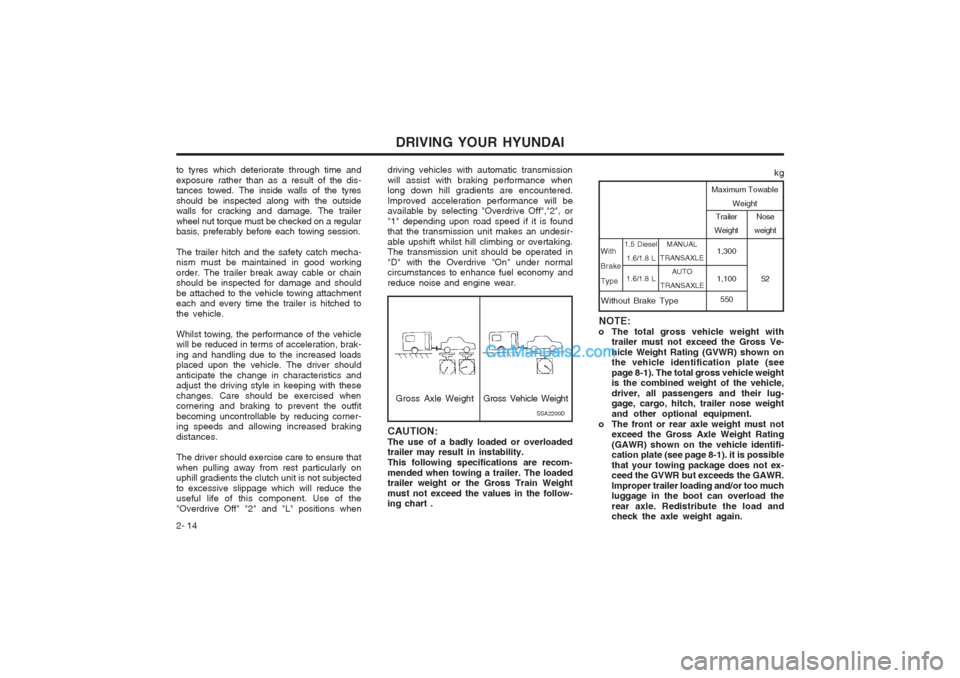
2- 14 NOTE:
o The total gross vehicle weight with trailer must not exceed the Gross Ve- hicle Weight Rating (GVWR) shown on the vehicle identification plate (see page 8-1). The total gross vehicle weight is the combined weight of the vehicle, driver, all passengers and their lug- gage, cargo, hitch, trailer nose weight and other optional equipment.
o The front or rear axle weight must not exceed the Gross Axle Weight Rating(GAWR) shown on the vehicle identifi- cation plate (see page 8-1). it is possible that your towing package does not ex- ceed the GVWR but exceeds the GAWR. Improper trailer loading and/or too much luggage in the boot can overload the rear axle. Redistribute the load and check the axle weight again. MANUAL
TRANSAXLE AUTO
TRANSAXLE Trailer
Weight
1,300 1,100 550 Nose
weight
52
kg
Maximum Towable Weight
With Brake Type
1.5 Diesel 1.6/1.8 L
1.6/1.8 L
Without Brake Type
driving vehicles with automatic transmission will assist with braking performance when long down hill gradients are encountered. Improved acceleration performance will be available by selecting "Overdrive Off","2", or "1" depending upon road speed if it is found that the transmission unit makes an undesir- able upshift whilst hill climbing or overtaking. The transmission unit should be operated in "D" with the Overdrive "On" under normal circumstances to enhance fuel economy and reduce noise and engine wear.
Gross Axle Weight
CAUTION: The use of a badly loaded or overloaded trailer may result in instability. This following specifications are recom-mended when towing a trailer. The loaded trailer weight or the Gross Train Weight must not exceed the values in the follow- ing chart . SSA2200DGross Vehicle Weight
to tyres which deteriorate through time and exposure rather than as a result of the dis- tances towed. The inside walls of the tyres should be inspected along with the outside walls for cracking and damage. The trailer wheel nut torque must be checked on a regular basis, preferably before each towing session. The trailer hitch and the safety catch mecha- nism must be maintained in good working order. The trailer break away cable or chain should be inspected for damage and should be attached to the vehicle towing attachment each and every time the trailer is hitched to the vehicle. Whilst towing, the performance of the vehicle will be reduced in terms of acceleration, brak- ing and handling due to the increased loads placed upon the vehicle. The driver should anticipate the change in characteristics and adjust the driving style in keeping with these changes. Care should be exercised when cornering and braking to prevent the outfit becoming uncontrollable by reducing corner- ing speeds and allowing increased braking distances. The driver should exercise care to ensure that when pulling away from rest particularly on uphill gradients the clutch unit is not subjected to excessive slippage which will reduce the useful life of this component. Use of the "Overdrive Off" "2" and "L" positions when
Page 87 of 407

DRIVING YOUR HYUNDAI 2- 15
YC200E2-E
Trailer or Vehicle Towing Tips
1. Before towing, check towbar ball and safe- ty cable connections as well as proper operation of the trailer running lights, brake lights, and turn signals.
2. Always drive your vehicle at a moderate speed (Less than 60 MPH)
3. Trailer towing requires more fuel than nor- mal conditions.
4. To maintain engine braking efficiency and electrical charging performance, do not usefifth gear (manual transaxle) or overdrive (automatic transaxle). 5. Always secure items in the trailer to pre-
vent load shift whilst driving.
6. Check the condition and air pressure of all tyres on the trailer and your car. Low tyrepressure can seriously affect the handling. Also check the spare tyre.
7. The vehicle/trailer combination is more af- fected by crosswind and buffeting. When being passed by a large vehicle,keep a constant speed and steer straight ahead. If there is too much wind buffeting slow down to get out of the other vehicle's air turbulence.
8. When parking your car and trailer, espe- cially on a hill, be sure to follow all thenormal precautions. Turn your front wheels into the curb, set the parking brake firmly, and put the transaxle in 1st or Reverse (manual) or Park (automatic). In addition, place wheel chocks at each of the trailer's tyres.
9. If the trailer has electric brakes, start your vehicle and trailer moving, and then applythe trailer brake controller by hand to be sure the brakes are working. This lets you check your electrical connection at the same time.
10.During your trip, check occasionally to be sure that the load is secure, and that thelights and any trailer brakes are still work- ing. 11.Avoid jerky starts, sudden acceleration or
sudden stops.
12.Avoid sharp turns and rapid lane changes.
13.Avoid holding the brake pedal down too long or too frequently. This could causethe brakes to overheat, resulting in re- duced braking efficiency.
14.When going down a hill, shift into a lower gear and use the engine braking effect. When ascending a long grade, downshiftthe transaxle to a lower gear and reduce speed to reduce chances of engine over- loading and/or overheating.
15.If you have to stop whilst going uphill, do not hold the vehicle in place by pressing onthe accelerator. This can cause the auto- matic transaxle to overheat. Use the park- ing brake or footbrake.
NOTE:When towing check transaxle fluid more
frequently.
CAUTION:If overheating should occur when towing,
(temperature gauge reads near red zone), taking the following action may reduce or eliminate the problem.
1. Turn off the air conditioner.
2. Reduce highway speed.
3. Select a lower gear when going uphill.
4. While in stop and go traffic, place the gear selection in park or neutral andidle the engine at a higher speed.
Towing BracketAttachment Location
o The maximum permissible static verti-
cal load on the coupling device : 52kg
o The maximum permissible overhang of the coupling point : 760 mm.
C190E01FC