2005 Hyundai Matrix fuel cap
[x] Cancel search: fuel capPage 130 of 407

OWNER MAINTENANCE 6-23
To check the power steering fluid level, be
sure the ignition is "OFF", then check to make certain that the power steering fluid level isbetween the "MAX" and "MIN" level markingson the fluid reservoir.
NOTE: Grinding noise from power steering pump
may be heard immediately after the engine is started in extremely cold condition(below -4°F). If the noise stops during warmup, there is no abnormal function in thesystem. This is due to a power steeringfluid characteristic in extremely cold con-ditions. FLUID RECOMMENDATION
Only automatic transmission fluid meeting the
specification of PSF-3 or Dexron 2 should be used in the power steering system. SG230B1-E POWER STEERING HOSES Power steering hoses should be checked for damage, deterioration and leakage at each ser-vice.
G350B01FC-GAT
BLEEDING THE FUEL SYSTEM (Diesel engine)
The fuel system should be bled to remove air
as described in the illustration if the fuel supply is exhausted during travel, when the fuel filteris replaced, or if the vehicle is not used for along time.
1. Remove the air cap with pushing the but- ton.
G350A01FC
G350B01FC
2. Pump the hand pump until there are no more bubbles in the fuel coming out of the air pipe. When doing this, place a clotharound the air pipe to prevent the escapingfuel from spewing about.
3. Replace the air cap when there are no more bubbles in the fuel.
4. Continue pumping until the hand pump becomes stiff.
5. Finally, check to be sure that there is no leakage of fuel. If in doubt, consult your nearest Hyundai authorised repairer.
WARNING:
o Do not smoke or have any other open flame near the vehicle while bleedingthe fuel system.
o Be sure to carefully wipe away any water drained out in this manner, be-cause the fuel mixed in the water mightbe ignited and result in a fire.
Air pipe
Page 131 of 407

OWNER MAINTENANCE
6-24 G270A02A-GAT HEADLIGHT BULB Replacement instructions:
G270A01FC
1. Allow the bulb to cool. Wear eye protection.
2. Always grasp the bulb by its plastic base, avoid touching the glass.
SG250A1-E
REPLACING LIGHT BULBS
In the event of bulb failure being experienced, ensure that the relative lighting circuit is turnedoff prior to attempting to replace the bulb. Theillustrations on the following page will assist inlocating and removing the various bulbs. En-sure that the replacement bulb has the samecap configuration and wattage as the original. CAUTION: Keep the lamps out of contact with petro- leum products, such as oil, petrol, etc.
1. Loosen the drain plug at the bottom of the
fuel filter.
2. Tighten the drain plug when water no longer comes out.
3. Check to be sure that the warning lamp illuminates when the ignition key is turnedto "ON", and that it goes off when theengine is started. If in doubt, consult your nearest Hyundai authorised repairer.
NOTE: It is recommended that water accumu- lated in the fuel filter should be removedby an authorized Hyundai authorised re-pairer. WARNING:
o Do not smoke or have any other open flame near the vehicle while bleeding the fuel system.
o Be sure to carefully wipe away any water drained out in this manner, be-cause the fuel mixed in the water mightbe ignited and result in a fire.
G300B02FC
If the fuel filter warning lamp illuminates during driving, it indicates that water has accumu-lated in the fuel filter. If this occurs, remove thewater as described.
G300A01B-GAT REMOVAL OF WATER FROM THE FUEL FILTER (Diesel engine)
G300A02FC
Page 132 of 407
OWNER MAINTENANCE 6-25
5. Push the bulb spring for removing the
headlight bulb.
6. Remove the protective cap from the re- placement bulb and install the new bulb by matching the plastic base with the headlighthole. Install the dust cover after retighteningthe bulb spring and reconnect the powercord.
7. Use the protective cap and carton to dis- pose of the old bulb.
8. Check for proper headlight aim.
WARNING The halogen bulb contains gas under
pressure and if impacted could shatter, resulting in flying fragments. Always weareye protection when servicing the bulb.
G270A02FC
3. Disconnect the power cord from the bulb base in the back of the headlight.
4. Remove the dust cover.
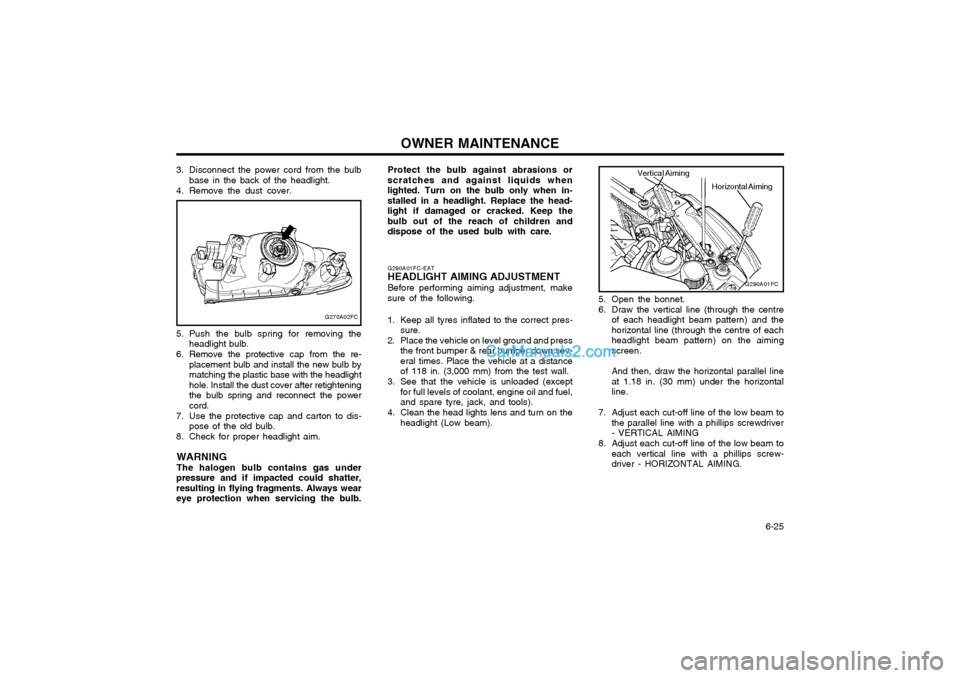
5. Open the bonnet.
6. Draw the vertical line (through the centreof each headlight beam pattern) and the horizontal line (through the centre of eachheadlight beam pattern) on the aimingscreen. And then, draw the horizontal parallel line at 1.18 in. (30 mm) under the horizontalline.
7. Adjust each cut-off line of the low beam to the parallel line with a phillips screwdriver- VERTICAL AIMING
8. Adjust each cut-off line of the low beam to each vertical line with a phillips screw-driver - HORIZONTAL AIMING.
G290A01FC-EAT
HEADLIGHT AIMING ADJUSTMENT
Before performing aiming adjustment, makesure of the following.
1. Keep all tyres inflated to the correct pres- sure.
2. Place the vehicle on level ground and press the front bumper & rear bumper down sev-eral times. Place the vehicle at a distanceof 118 in. (3,000 mm) from the test wall.
3. See that the vehicle is unloaded (except for full levels of coolant, engine oil and fuel,and spare tyre, jack, and tools).
4. Clean the head lights lens and turn on the headlight (Low beam).
G290A01FC
Horizontal Aiming
Vertical Aiming
Protect the bulb against abrasions or scratches and against liquids whenlighted. Turn on the bulb only when in-stalled in a headlight. Replace the head-light if damaged or cracked. Keep thebulb out of the reach of children anddispose of the used bulb with care.
Page 139 of 407

EMISSION CONTROL SYSTEM 7-1
SH000A1-E
7. EMISSION
CONTROL SYSTEM
SH010A1-E EMISSION CONTROL SYSTEMS (Not all models) Depending upon the market for which the ve-hicle is destined, the emission control systemwill comprise one or more of the followingemission control devices. (1) Crankcase emission control system (2) Evaporative emission control system (3) Exhaust emission control system In order that the proper functioning of the emis- sion control systems may be ensured, it isrecommended that the vehicle is inspected andmaintained by an Hyundai authorised repairerin accordance with the maintenance schedulein this manual. SH010B1-E 1. CRANKCASE EMISSION CONTROL SYSTEM
The positive crankcase ventilation system is employed to prevent air pollution caused byblow-by gases being emitted from the crank-case by introducing fresh air to the crankcase through the air cleaner where this mixes withblow-by gases and then passes through thePCV valve into the intake manifold from whereit subsequently enters the combustion cham-ber and is burned.
SH010D1-E 3. EXHAUST EMISSION CONTROL SYSTEM The exhaust emission control system is a highlyeffective system which controls exhaust emis-sion whilst maintaining good vehicle perfor-mance.
SH010C1-E
2. EVAPORATIVE EMISSION
CONTROL SYSTEM
The Evaporative Emission Control System is designed to prevent fuel vapours from escap-ing into the atmosphere through the fuel tankventilation system.Whilst the engine is not running, fuel vapoursgenerated inside the fuel tank are absorbedand stored in a charcoal canister. When theengine is started, the vapours stored in thecanister are drawn into the induction systemthrough the purge control solenoid valve andare subsequently burned.The purge control solenoid valve is controlledby the ECU; when the engine coolant tempera-ture is low or the engine is idling, the purgecontrol valve is closed and fuel vapours remainstored in the canister. Under normal runningconditions when the engine is warm, the valveopens and the vapours are drawn into the inlettract and subsequently burned in the combus-tion chamber. SH020A1-E
Catalytic Convertor Operation Precautions; For a petrol engine Hyundai Matrix models are fitted with catalytic convertors which require special operatingconsiderations. The catalytic convertor servesto oxidize certain noxious elements of theexhaust gases leaving the engine to reduce thelevel of pollutants emitted from the vehicle and,provided that care is exercised to prevent dam-age, the catalyst will operate efficiently for thelife of the vehicle.
7HFC5013
Catalytic Converter
Page 144 of 407

VEHICLE SPECIFICATIONS 9-1
Litre
55 Imp.gal
12
SJ000A1-F
9. VEHICLE SPECIFICATIONS
Fuel tank capacity
Type Wheel free playRack strokeOil pump type
J010A01FC-EAT MEASUREMENT
in. (mm)
Item BatteryGeneratorDiesel
CMF 68 AH 120A (12V)
Petrol
MF45AH
90A (13.5V)
9
J040A02FC-EAT ELECTRICAL
SJ030A1-FFUEL SYSTEM
J020A01FC-EAT POWER STEERING
US.gal14.5
Rack and pinion 0 ~ 1.18 in. (0 ~ 30 mm)5.7±0.04 in. (146±1mm)Vane type J030A01FC-DAT
TYRE
185/65 R14 195/55 R15205/55 R15 (1.8 DOHC only)
StandardOption
Type Front brake typeRear brake typeParking brake Dual hydraulic with brake boosterVentilated discDrum Cable
J050A01FC-GAT BRAKE
Front Rear
Overall lengthOverall widthOverall height (unladen) Wheel base Wheel tread
158.4 (4,025)
68.5 (1,740)64.3 (1,635)
*66.3 (1,685)
102.3 (2,600) 58.5 (1,485)58.5 (1,485)
*If installed roof rack
Standard Option
J030B01FC-EAT SPARE TYRE Space-saver Full size
Page 217 of 407

1
FEATURES OF YOUR HYUNDAI
53
!
B280A01A-AAT FUEL GAUGE The needle on the gauge indicates the approximate fuel level in the fuel tank. B290A02E-AAT ENGINE COOLANT TEMPERA- TURE GAUGE
HFC2045 HFC2101
WARNING:
Never remove the radiator cap when the engine is hot. The engine cool- ant is under pressure and coulderupt and cause severe burns. Wait until the engine is cool before re- moving the radiator cap. The needle on the engine coolant tem-perature gauge should stay in themiddle between "H" and "C". If it moves across the dial to "H" (Hot), pull over and stop as soon as possible and turnoff the engine. Then open the hood and after the engine has cooled, check the coolant level and the water pumpdrive belt. If you suspect cooling sys- tem trouble, have your cooling system checked by a Hyundai dealer as soonas possible.
INSTRUMENT CLUSTER
Page 240 of 407
1FEATURES OF YOUR HYUNDAI
76
!WARNING:
Fuel vapors are dangerous. Before refueling, always stop the engineand never allow sparks or open flames near the filler area. If you need to replace the filler cap, use agenuine Hyundai replacement part. If you open the fuel filler cap during high ambient temperatures, a slight"pressure sound" may be heard. This is normal and not a cause for concern.Whenever you open the fuel filler
cap, turn it slowly. HFC2016
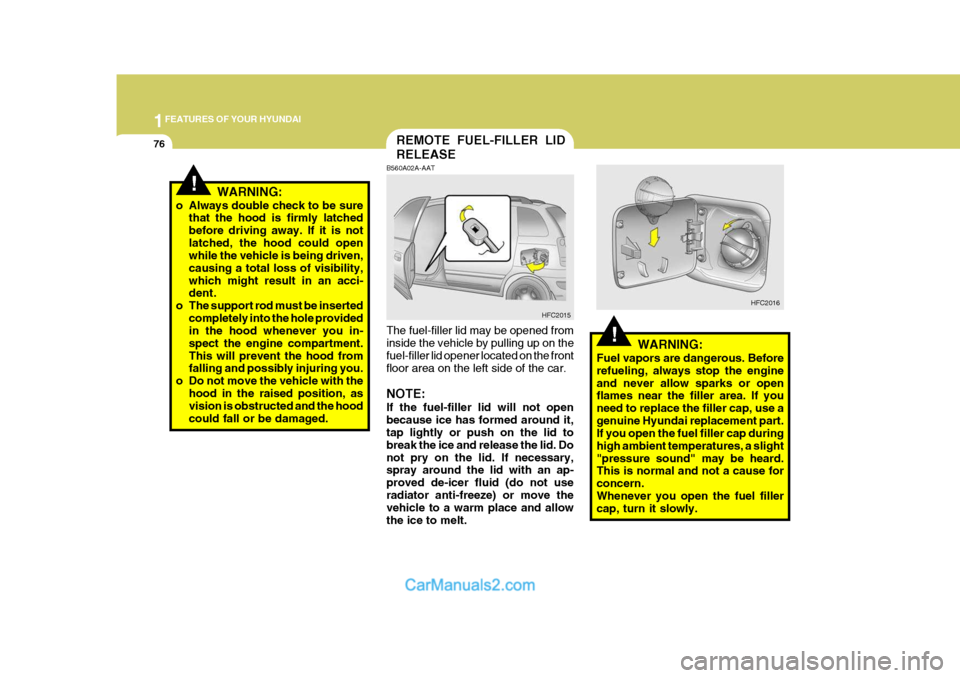
REMOTE FUEL-FILLER LID RELEASE
B560A02A-AAT The fuel-filler lid may be opened from inside the vehicle by pulling up on the fuel-filler lid opener located on the frontfloor area on the left side of the car. NOTE: If the fuel-filler lid will not open because ice has formed around it, tap lightly or push on the lid to break the ice and release the lid. Donot pry on the lid. If necessary, spray around the lid with an ap- proved de-icer fluid (do not useradiator anti-freeze) or move the vehicle to a warm place and allow the ice to melt. HFC2015
!WARNING:
o Always double check to be sure that the hood is firmly latched before driving away. If it is notlatched, the hood could open while the vehicle is being driven, causing a total loss of visibility,which might result in an acci- dent.
o The support rod must be inserted completely into the hole providedin the hood whenever you in- spect the engine compartment.This will prevent the hood from falling and possibly injuring you.
o Do not move the vehicle with the hood in the raised position, asvision is obstructed and the hood could fall or be damaged.
Page 318 of 407

3
WHAT TO DO IN AN EMERGENCY
5
!
!
!
check for coolant leaking from the radiator, hoses or under the car. (Ifthe air conditioning had been in use, it is normal for cold water to be draining from it when you stop).
WARNING (Diesel only):
Never work on injection system with engine running or within 30 sec- onds after shutting off engine. Highpressure pump, rail, injectors and high pressure pipes are subject to high pressure even after the enginestopped. The fuel jet produced by fuel leaks may cause serious in- jury, if it touch the body. Peopleusing pacemakers should not move than 30cm closer to the ECU or wiring harness within the engine 5. If the water pump drive belt is bro-
ken or coolant is leaking out, stopthe engine immediately and call the nearest Hyundai dealer for assis- tance. CAUTION:
Serious loss of engine coolant indi- cates there is a leak in the cooling system and this should be checkedas soon as possible by a Hyundai dealer.
room while engine is running, since the high currents in the CommonRail system produce considerable magnetic fields.
6. If you cannot find the cause of the
overheating, wait until the engine temperature has returned to nor- mal. Then, if the engine coolant hasbeen lost, carefully add coolant to the reservoir (page 6-14) to bring the fluid level in the reservoir up tothe halfway mark.
WARNING:
While the engine is running, keephair, hands, and clothing away from moving parts such as the fan and drive belts to prevent injury.
WARNING:
Do not remove the radiator cap whenthe engine is hot. This can allowcoolant to be blown out of the open- ing and cause serious burns. 7. Proceed with caution, keeping alert
for further signs of overheating. If overheating happens again, call a Hyundai dealer for assistance.
!