Page 175 of 273
Your vehicle has been designed to
tow a trailer, as well as f or carrying
passengers and their cargo.
To saf ely tow a trailer, you should
observe the load limits, use the
proper equipment, and f ollow the
guidelines in this section.
Be sure to read the Of f -Highway
Driving Guidelines section on pageif you plan to tow of f paved
surf aces.
The maximum
weight of the trailer and everything
in or on it depends on the number of
occupants in your vehicle and the
type of trailer being towed (see page ).
Towing a load that is too heavy can
seriously af f ect your vehicle’s
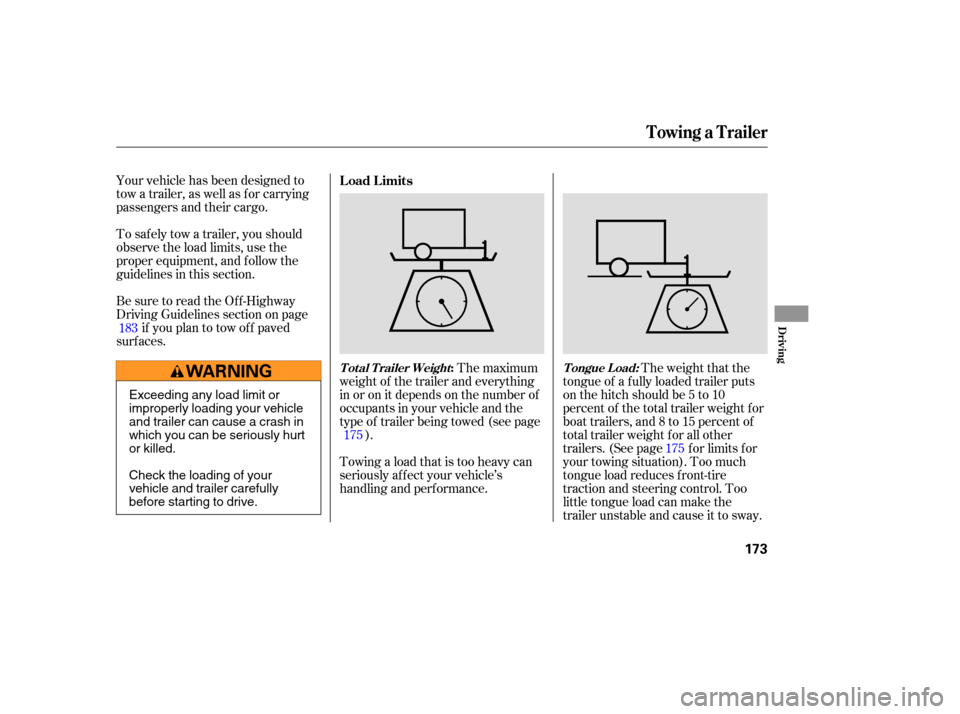
handling and perf ormance. Theweightthatthe
tongue of a f ully loaded trailer puts
on the hitch should be 5 to 10
percent of the total trailer weight for
boat trailers, and 8 to 15 percent of
total trailer weight for all other
trailers. (See page f or limits f or
your towing situation). Too much
tongue load reduces f ront-tire
traction and steering control. Too
little tongue load can make the
trailer unstable and cause it to sway.
183
175 175
Load Limits
Towing a Trailer
T ot al T railer Weight:Tongue Load:
Driving
173
Exceeding any load limit or
improperly loading your vehicle
and trailer can cause a crash in
which you can be seriously hurt
or killed.
Check the loading of your
vehicle and trailer carefully
beforestartingtodrive.
Page 176 of 273

�µ�µ
�µ Thebestwaytoconfirmthatall
loads are within limits is to check
them at a public scale.
The maximum
allowable weight of the vehicle, all
occupants, all cargo and the tongue
load is 5,950 lbs (2,700 kg).
The maximum
allowable weight on the vehicle axles
is 2,865 lbs (1,300 kg) on the f ront
axle, and 3,155 lbs (1,430 kg) on the
rear axle.
The maximum
allowable weight of the f ully loaded
vehicle and trailer is 9,700 lbs (4,410
kg) with the proper hitch and f luid
coolers (see page ).
The GCWR must be reduced 2
percent f or every 1,000 f eet (305
meters) of elevation. To help ensure a saf e drive to a scale,
or if you cannot get to a public scale,
we recommend that you estimate
your total trailer weight and tongue
load as described.
Add the weight of your trailer (as
quoted by the manuf acturer) with
everything in or on the trailer. Then
check the tables on page that
you do not exceed the limit f or your
conditions.
Park the vehicle on level ground.
Measure f rom the ground to the
bottom of the trailer hitch. Connect the f ully loaded trailer to
the hitch.
Measure again f rom the ground to
the same spot on the bottom of the
hitch.
Subtract the second measurement
from the first measurement, then
refer to the following table.
If thedifferenceismorethan3¾’’
inch, you have too much load on the
tongue. Redistribute the load or
remove cargo as needed. 1½’’
2¼’’ 3’’
3¾’’ 150 lbs (68 kg)
250 lbs (114 kg)
350 lbs (160 kg)
450 lbs (205 kg)
150
1.
2. 3.
4.
5.
175 Estimating Loads
Gross Vehicle Weight Rating
(GVWR)
Gross Axle Weight Ratings
(GA WR)
Gross Combined Weight Rating
(GCWR) If the
difference is: Estimated
tongue load is:
Towing a Trailer
To Estimate the Total Trailer Weight
To Estimate the Tongue Load
174
Page 177 of 273

Number ofOccupants 2
3
4
5
6
7
8 Max. T railer Weight
Max. T ongue Load
Number of Occupants 2
3
4
5
6
7
8 Max. T railer Weight
Max. T ongue Load
Equipped with transmission cooler and power steering f luid cooler.
T owing is Not Recommended
Equipped with transmission cooler and power steering f luid cooler.
T owing is Not Recommended
Towing a Trailer
Driving
175
Total Trailer Weight and Tongue Load Limits: BOAT TRAILERS
OTHER TYPES OF TRAILERS
The corresponding weight limits assume occupants fill seats from the front of the vehicle to the back, each occupant weighs 150 lbs (70 kg) and each has 1 5 lbs (7 kg)
of luggage in the cargo area.
4,500 lbs (2,045 kg)
4,500 lbs (2,045 kg)
4,500 lbs (2,045 kg)
4,300 lbs (1,945 kg)
4,100 lbs (1,855 kg) 2,000 lbs (905 kg) 450 lbs (205 kg)
450 lbs (205 kg)
450 lbs (205 kg)
350 lbs (160 kg)
220 lbs (100 kg)
100 lbs (45 kg)
3,500 lbs (1,590 kg)
3,500 lbs (1,590 kg)
3,300 lbs (1,490 kg)
3,100 lbs (1,400 kg)
2,700 lbs (1,220 kg) 1,200 lbs (540 kg) 450 lbs (205 kg)
450 lbs (205 kg)
450 lbs (205 kg)
350 lbs (160 kg)
220 lbs (100 kg)
100 lbs (45 kg)
Page 178 of 273
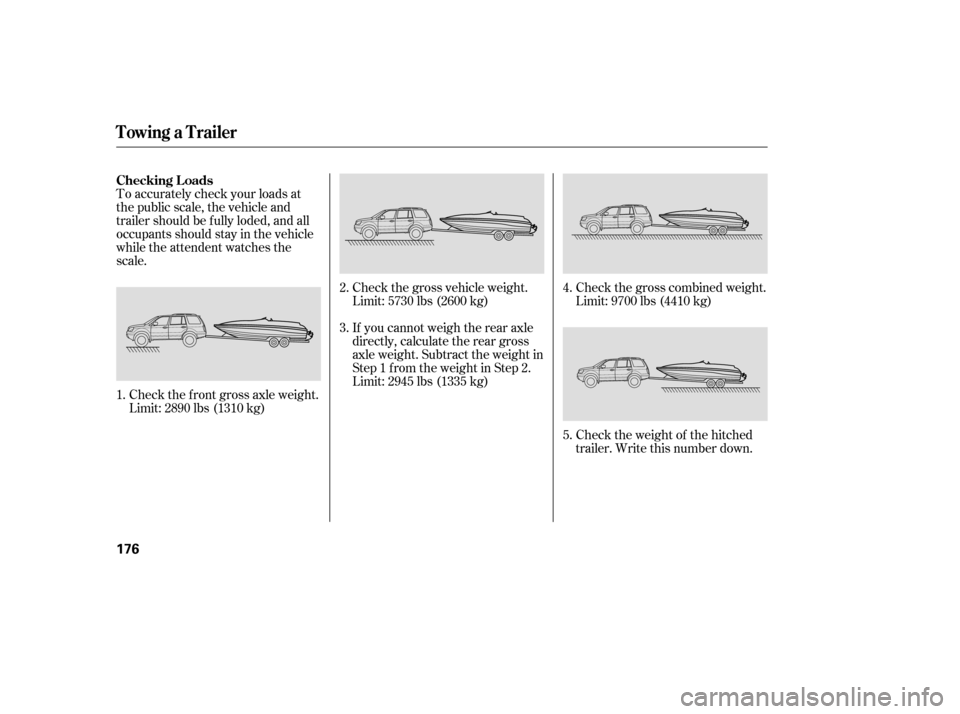
To accurately check your loads at
the public scale, the vehicle and
trailer should be f ully loded, and all
occupants should stay in the vehicle
while the attendent watches the
scale.Check the f ront gross axle weight.
Limit: 2890 lbs (1310 kg) Check the gross vehicle weight.
Limit: 5730 lbs (2600 kg)
If you cannot weigh the rear axle
directly, calculate the rear gross
axle weight. Subtract the weight in
Step 1 f rom the weight in Step 2.
Limit: 2945 lbs (1335 kg)
Check the gross combined weight.
Limit: 9700 lbs (4410 kg)
Check the weight of the hitched
trailer. Write this number down.
1. 2.
3.
4.
5.
Towing a Trailer
Checking L oads
176
Page 179 of 273
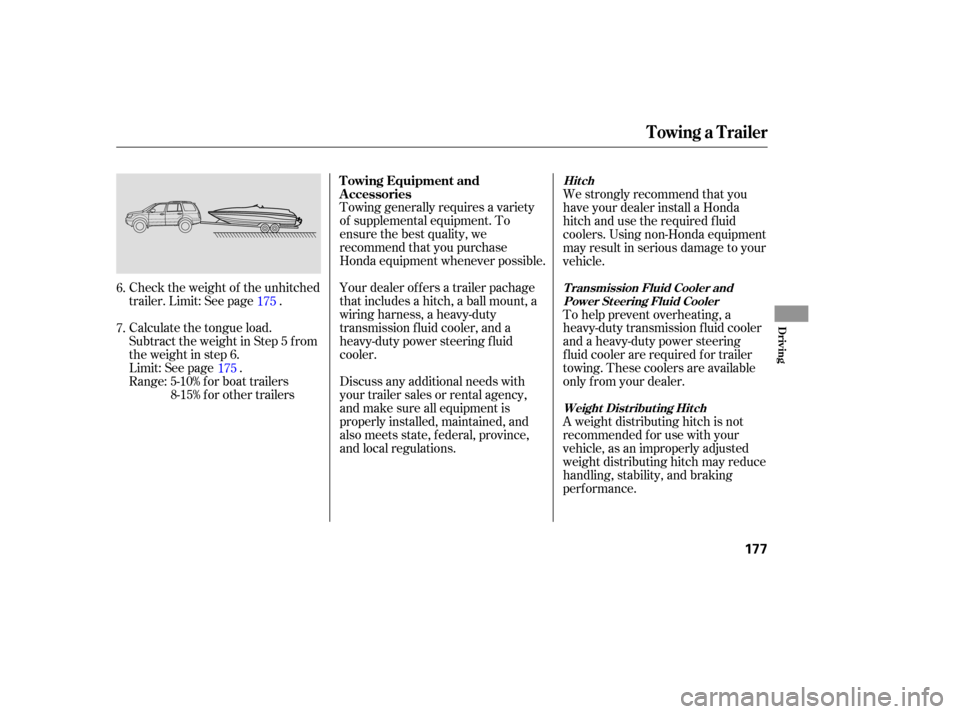
Check the weight of the unhitched
trailer. Limit: See page .
Calculate the tongue load.
Subtract the weight in Step5f rom
the weight in step 6.
Limit: See page .
Range: 5-10% f or boat trailers 8-15% f or other trailers Towing generally requires a variety
of supplemental equipment. To
ensure the best quality, we
recommend that you purchase
Honda equipment whenever possible.
Your dealer of f ers a trailer pachage
that includes a hitch, a ball mount, a
wiring harness, a heavy-duty
transmission f luid cooler, and a
heavy-duty power steering f luid
cooler.
Discuss any additional needs with
your trailer sales or rental agency,
and make sure all equipment is
properly installed, maintained, and
also meets state, f ederal, province,
and local regulations. We strongly recommend that you
have your dealer install a Honda
hitch and use the required f luid
coolers. Using non-Honda equipment
may result in serious damage to your
vehicle.
To help prevent overheating, a
heavy-duty transmission f luid cooler
and a heavy-duty power steering
f luid cooler are required f or trailer
towing. These coolers are available
only f rom your dealer.
A weight distributing hitch is not
recommended f or use with your
vehicle, as an improperly adjusted
weight distributing hitch may reduce
handling, stability, and braking
perf ormance.
6.
7.
175
175 T owing Equipment and
A ccessoriesT ransmission Fluid Cooler and
Power St eering Fluid Cooler
Weight Distributing Hitch
Hitch
Towing a Trailer
Driving
177
Page 180 of 273

Honda requires that any trailer with
a total trailer weight of 1,000 lbs (455
kg) or more has its own brakes.
There are two common types of
trailer brakes: surge and electric.
Surge brakes are common f or boat
trailers, since the brakes will get wet.
If you choose electric brakes, be
sure they are electronically actuated.
Do not attempt to tap into your
vehicle’s hydraulic system. No
matter how successf ul it may seem,
any attempt to attach trailer brakes
to your vehicles hydraulic system
will lower braking ef f ectiveness and
create a potential hazard.
See your brake manuf acturer f or
more inf ormation on installing
electric brakes.Always use saf ety chains when you
tow a trailer. Make sure the chains
are secured to the trailer and hitch,
and that they cross under the tongue
and can catch the trailer if it
becomes unhitched. Leave enough
slack to allow the trailer to turn
corners easily, but do not let the
chains drag on the ground.
This device is recommended if your
trailer tends to sway. Your trailer
maker can tell you what kind of sway
control you need and how to install it.
Many states and provinces require
special exterior mirrors when towing
a trailer. Even if they don’t, you
should install special mirrors if you
cannot clearly see behind you, or if
the trailer creates a blind spot.When towing a trailer, we
recommend that you carry a f ull-size
spare wheel and tire for your vehicle
and trailer. See page f or proper
tire size, page f or how to store a
full size wheel and tire, and page
f or inf ormation on changing a
flat tire.
Remember to unhitch the trailer
bef ore changing a f lat. Ask your
trailer sales or rental agency where
and how to store the trailer’s spare
tire. 217
228
225
Towing a Trailer
Trailer Brakes Saf ety Chains
Sway Cont rolTrailer Mirrors Spare Tires
178
Page 182 of 273

Your vehicle tires and spare are in
good condition and properly
inf lated.
The trailer tires and spare are in
good condition and inf lated as
recommended by the trailer
maker.Foryoursafetyandthesafetyof
others, take time to practice driving
maneuvers bef ore heading f or the
open road, and f ollow the guidelines
below.
Avoid towing a trailer during your
vehicle’s f irst 600 miles (1,000 km)
(see page ).
Drive slower than normal in all
driving situations, and obey posted
speed limits f or vehicles with trailers.
When towing a f ixed-sided trailer (e.
g., camper), do not exceed 55 mph
(88 km/h). At higher speeds, the
trailer may sway or affect vehicle
handling.
To prevent the transmission f rom
shif ting f requently, drive in the D
position.
The added weight, length, and
height of a trailer will af f ect your
vehicle’s handling and perf ormance,
so driving with a trailer requires
some special driving skills and
techniques. Towing perf ormance can be
af f ected by high altitude, high
temperature, or when climbing
steep grades. Theref ore, premium
fuelisrecommendedwhentowing
more than 3,500 lbs (1,590 kg).
When preparing to tow, and bef ore
driving away, be sure to check the
f ollowing:
The vehicle has been properly
serviced, and the tires, brakes,
suspension, cooling system, and
lights are in good operating
condition.
If you tow f requently, f ollow the
Severe Conditions maintenance
schedule.
The trailer has been properly
serviced and is in good condition.
All weights and loads are within
limits.
Thehitch,safetychains,andany
other attachments are secure.
All items in or on the trailer are
properly secured and cannot shif t
while you drive. 146
Trailer Driving Tips
Break-In Period
T owing Speeds and Gears
Driving Saf ely With a T railer
180
Page 188 of 273
You should never use a jack to try to
get unstuck. Your vehicle could
easily slip of f the jack and hurt you
or someone else.You may be able to safely tow a
lightweight trailer (such as a
motorcycle or small tent trailer) of f -
road if you f ollow these guidelines.
Do not exceed 1,000 lbs (450 kg)
or a tongue weight of 100 lbs (45
kg).
Trytostayonsmooth,leveldirt
roads, and avoid driving in hilly
terrain.
Allow extra room f or starting,
stopping, and turning.
Slow down if you encounter bumps
or other obstacles.
Of f -Highway Driving Guidelines
Towing a Trailer Off-Road
186