Page 42 of 273
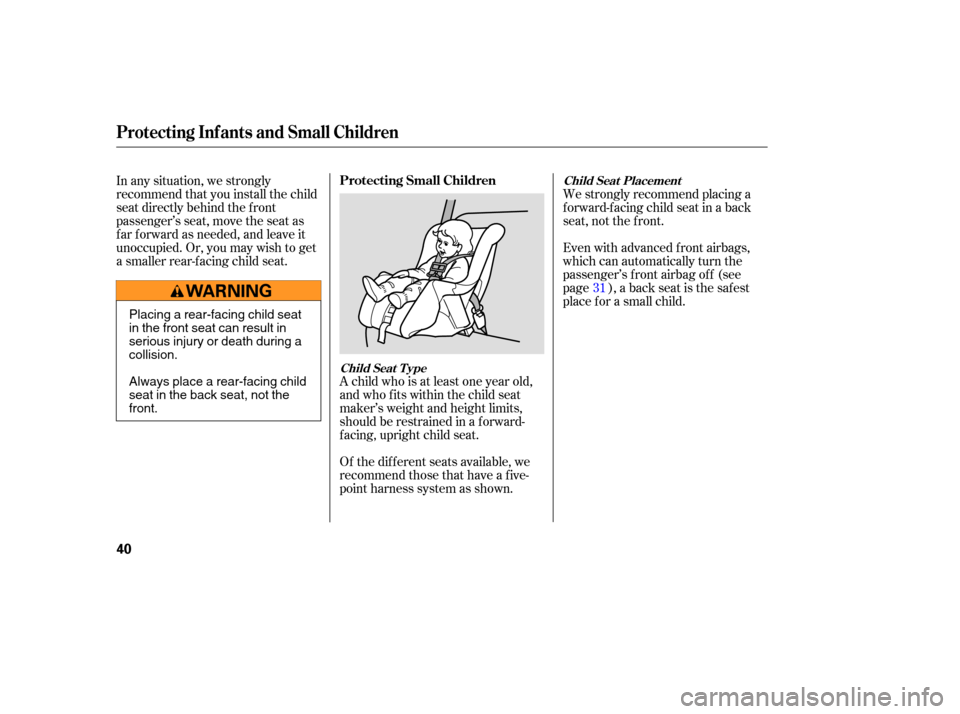
A child who is at least one year old,
and who fits within the child seat
maker’s weight and height limits,
should be restrained in a f orward-
f acing, upright child seat.
Of the different seats available, we
recommend those that have a f ive-
point harness system as shown.We strongly recommend placing a
forward-facing child seat in a back
seat, not the f ront.
In any situation, we strongly
recommend that you install the child
seat directly behind the f ront
passenger’s seat, move the seat as
f ar f orward as needed, and leave it
unoccupied. Or, you may wish to get
a smaller rear-f acing child seat.
Even with advanced front airbags,
which can automatically turn the
passenger’s f ront airbag of f (see
page ), a back seat is the saf est
place f or a small child.31
Protecting Inf ants and Small Children
Protecting Small Children
Child Seat T ype Child Seat Placement
40
Placing a rear-facing child seat
in the front seat can result in
serious injury or death during a
collision.
Always place a rear-facing child
seat in the back seat, not the
front.
Page 48 of 273
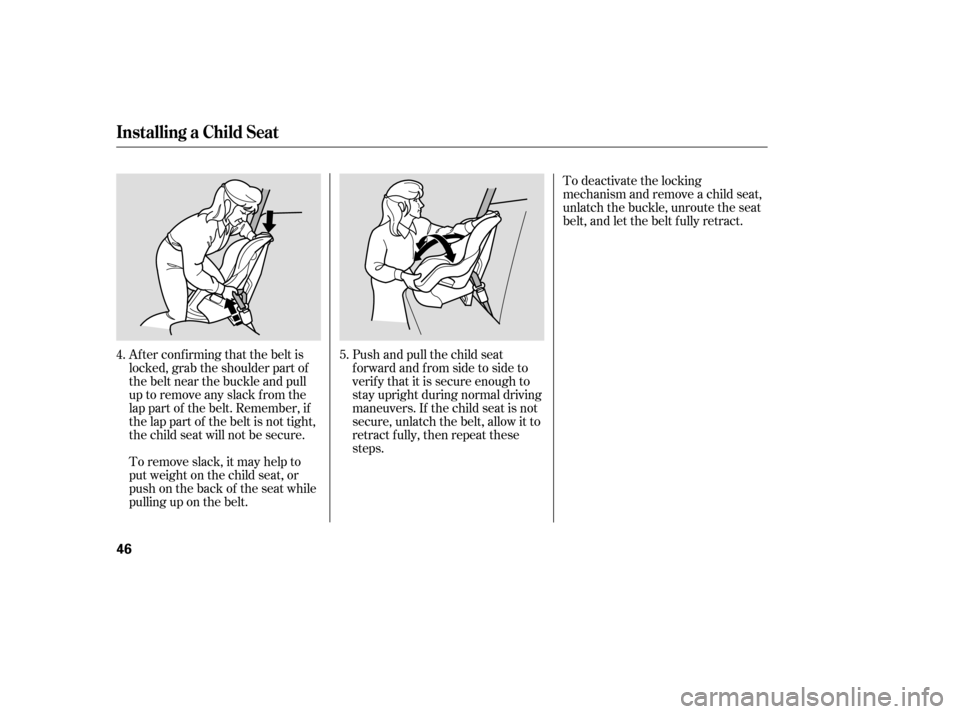
Af ter conf irming that the belt is
locked, grab the shoulder part of
the belt near the buckle and pull
up to remove any slack from the
lap part of the belt. Remember, if
the lap part of the belt is not tight,
the child seat will not be secure.To deactivate the locking
mechanism and remove a child seat,
unlatch the buckle, unroute the seat
belt, and let the belt f ully retract.
Push and pull the child seat
f orward and f rom side to side to
verif y that it is secure enough to
stay upright during normal driving
maneuvers. If the child seat is not
secure, unlatch the belt, allow it to
retract f ully, then repeat these
steps.
To remove slack, it may help to
putweightonthechildseat,or
push on the back of the seat while
pulling up on the belt.
4.
5.
Installing a Child Seat
46
Page 51 of 273
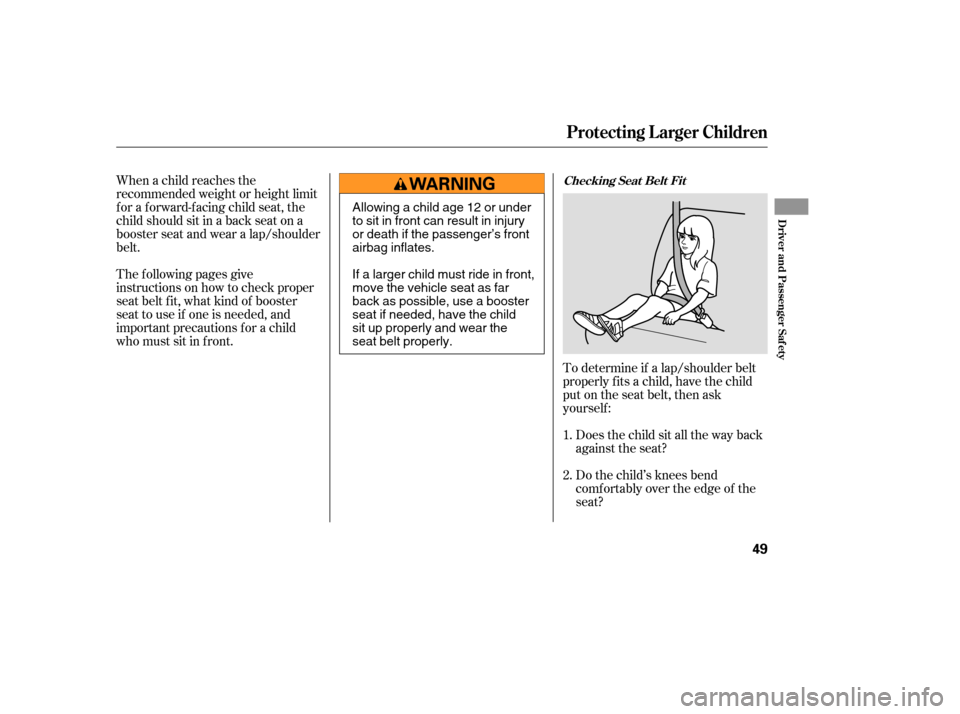
To determine if a lap/shoulder belt
properly f its a child, have the child
put on the seat belt, then ask
yourself :
When a child reaches the
recommended weight or height limit
for a forward-facing child seat, the
child should sit in a back seat on a
booster seat and wear a lap/shoulder
belt.
Does the child sit all the way back
against the seat?
Do the child’s knees bend
comf ortably over the edge of the
seat?
The f ollowing pages give
instructions on how to check proper
seat belt f it, what kind of booster
seat to use if one is needed, and
important precautions f or a child
who must sit in f ront.
1.
2.
Checking Seat Belt Fit
Protecting L arger Children
Driver and Passenger Saf ety
49
Allowing a child age 12 or under
to sit in front can result in injury
or death if the passenger’s front
airbag inflates.
If a larger child must ride in front,
move the vehicle seat as far
back as possible, use a booster
seat if needed, have the child
sit up properly and wear the
seat belt properly.
Page 52 of 273
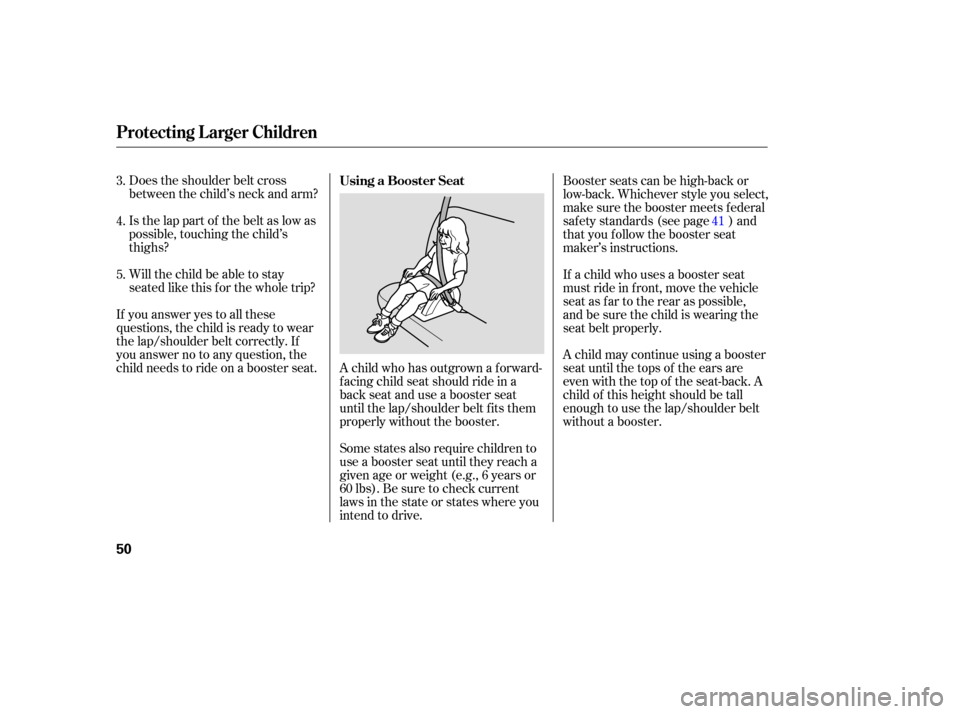
Does the shoulder belt cross
between the child’s neck and arm?
Is the lap part of the belt as low as
possible, touching the child’s
thighs?
Will the child be able to stay
seated like this f or the whole trip?
If you answer yes to all these
questions, the child is ready to wear
the lap/shoulder belt correctly. If
you answer no to any question, the
child needs to ride on a booster seat. A child who has outgrown a f orward- f acing child seat should ride in a
back seat and use a booster seat
until the lap/shoulder belt f its them
properly without the booster.
Some states also require children to
use a booster seat until they reach a
given age or weight (e.g., 6 years or
60 lbs). Be sure to check current
laws in the state or states where you
intend to drive.Booster seats can be high-back or
low-back. Whichever style you select,
make sure the booster meets f ederal
saf ety standards (see page ) and
that you f ollow the booster seat
maker’s instructions.
If a child who uses a booster seat
must ride in f ront, move the vehicle
seat as far to the rear as possible,
and be sure the child is wearing the
seat belt properly.
A child may continue using a booster
seat until the tops of the ears are
even with the top of the seat-back. A
child of this height should be tall
enough to use the lap/shoulder belt
without a booster.
4.
5. 3.
41
Using a Booster Seat
Protecting L arger Children
50
Page 60 of 273

See page .
If this indicator comes on when the
engine is running, the battery is not
being charged. For more inf ormation,
see page . The engine can be severely damaged
if this indicator f lashes or stays on
when the engine is running. For
more inf ormation, see page .
The instrument panel has many
indicators to give you important
inf ormation about your vehicle.
This indicator comes on when you
turn the ignition switch to ON (II). It
reminds you and your passengers to
f asten your seat belts. A beeper also
sounds if you have not f astened your
seat belt.
If you continue driving without
f astening your seat belt, the beeper
sounds and the indicator f lashes
again at regular intervals. If you turn the ignition switch to ON
(II) bef ore f astening your seat belt,
the beeper sounds and the indicator
f lashes. If you do not f asten your
seat belt bef ore the beeper stops, the
indicator stops f lashing but remains
on. This indicator comes on brief ly when
you turn the ignition switch to ON
(II). If it comes on at any other time,
it indicates a potential problem with
your f ront airbags. This indicator will
also alert you to a potential problem
with your side airbags, passenger’s
side airbag automatic cutoff system,
side curtain airbags, automatic seat
belt tensioners, driver’s seat position
sensor, or the f ront passenger’s
weight sensors. For more
inf ormation, see page .
This indicator comes on when you
turn the ignition switch to ON (II). If
it comes on at any other time, it
indicates that the passenger’s side
airbag has automatically shut off.
For more inf ormation, see page .
30
235
234
234
30
Malf unction Indicator
Lamp
L ow Oil Pressure
Indicator
Charging System
Indicator
Supplemental Restraint
System Indicator
Seat Belt Reminder
Indicator
Side A irbag Of f
Indicator
Instrument Panel
58
U.S. Canada
Page 152 of 273
Try to maintain a constant speed.
Everytimeyouslowdownand
speed up, your vehicle uses extra
fuel.Usethecruisecontrolwhen
appropriate.
Combine several short trips into
one.
The air conditioning puts an extra
load on the engine which makes it
usemorefuel.Usethefresh-air
ventilation when possible.
Always maintain your vehicle
according to the maintenance
schedule. See
(see page
).
an underinf lated tire
causes more ‘‘rolling resistance,’’
which uses more f uel.
The build-up of snow or mud on
your vehicle’s underside adds
weight and rolling resistance.
Frequent cleaning helps your f uel
mileage and reduces the chance of
corrosion.
Drive moderately. Rapid
acceleration, abrupt cornering and
hard braking use more f uel.
Always drive in the highest gear
possible. 191
For example,
Fuel Economy
Improving Fuel Economy
Owner’s
Maintenance Checks
150
Page 156 of 273
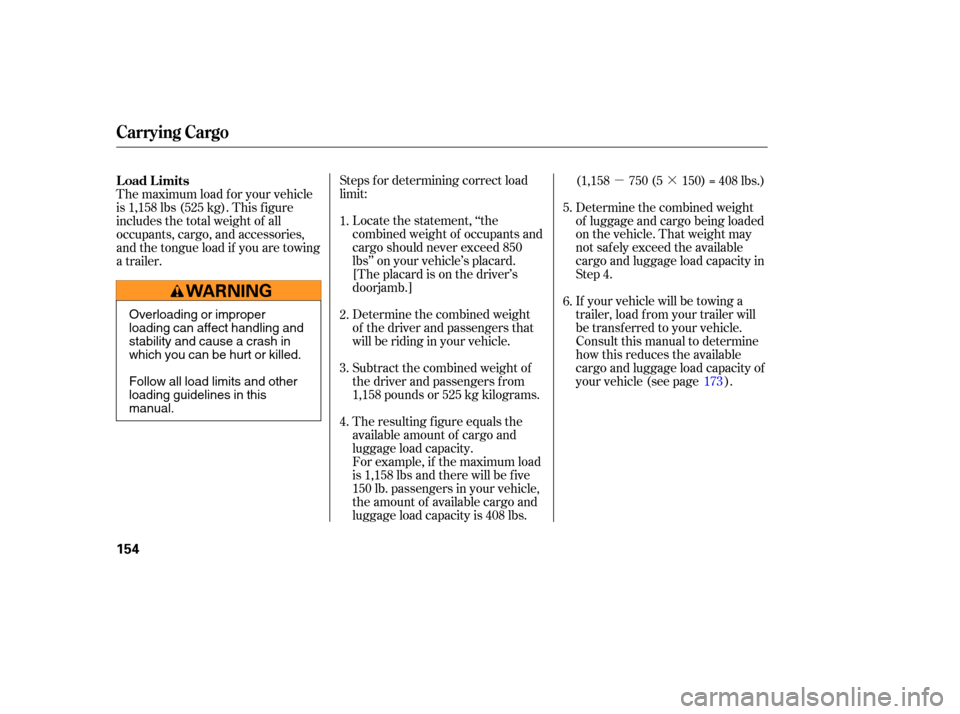
�µ�·
Steps f or determining correct load
limit:
Locate the statement, ‘‘the
combined weight of occupants and
cargo should never exceed 850
lbs’’ on your vehicle’s placard.
[The placard is on the driver’s
doorjamb.]
Determine the combined weight
of the driver and passengers that
will be riding in your vehicle.
The resulting f igure equals the
available amount of cargo and
luggage load capacity. Determine the combined weight
of luggage and cargo being loaded
on the vehicle. That weight may
not saf ely exceed the available
cargo and luggage load capacity in
Step 4.
If your vehicle will be towing a
trailer, load f rom your trailer will
be transf erred to your vehicle.
Consult this manual to determine
how this reduces the available
cargo and luggage load capacity of
yourvehicle(seepage ).
The maximum load f or your vehicle
is 1,158 lbs (525 kg). This f igure
includes the total weight of all
occupants, cargo, and accessories,
and the tongue load if you are towing
a trailer.
Subtract the combined weight of
the driver and passengers f rom
1,158 pounds or 525 kg kilograms.
For example, if the maximum load
is 1,158 lbs and there will be f ive
150 lb. passengers in your vehicle,
the amount of available cargo and
luggage load capacity is 408 lbs.(1,158 750 (5 150) = 408 lbs.)
1.
2. 5.
6.
3.
4. 173
Load Limits
Carrying Cargo
154
Overloading or improper
loading can affect handling and
stability and cause a crash in
which you can be hurt or killed.
Follow all load limits and other
loading guidelines in this
manual.
Page 157 of 273

Store or secure all items that could
be thrown around and hurt
someone during a crash.
Keep the glove box closed while
driving. If it is open, a passenger
could injure their knees during a
crash or sudden stop.Distribute cargo evenly on the
f loor of the cargo area, placing the
heaviest items on the bottom and
as far forward as possible. Tie
down items that could be thrown
about the vehicle during a crash or
sudden stop.
If you carry large items that
prevent you f rom closing the
tailgate, exhaust gas can enter the
passenger area. To avoid the
possibility of
, f ollow the instructions
on page .
If you carry any items on a roof
rack,besurethetotalweightof
the rack and the items does not
exceed 165 lbs (75 kg). If you use an accessory roof rack,
the roof rack weight limit may be
lower. Ref er to the inf ormation that
came with your roof rack.
Theseparationnetcanbeusedto
hold back sof t, lightweight items
stored in the cargo area. Heavy
items should be properly secured on
the f loor of the cargo area. The net
may not prevent heavy items f rom
being thrown f orward in a crash or a
sudden stop.
The cargo cover can be used over
the cargo area behind the third row
seats. When the third row seats are
f olded down, the cargo cover can be
installed in a f orward position and
extended over the larger cargo area.
Be sure items placed on the f loor
behind the f ront seats cannot roll
under the seats and interf ere with
the pedals or seat operation.
53
Carrying Cargo
Carrying Items in the Passenger
CompartmentCarrying Cargo in the Cargo A rea
or on a Roof Rack
carbon monoxide
poisoning Optional Separation Net
Optional Cargo Cover
Bef ore Driving
155