Page 19 of 273

This could cause
very serious injuries in a crash.
If a seat belt does not seem to work
as it should, it may not protect the
occupant in a crash.
Using a seat
belt that is not working properly can
result in serious injury or death.
Have your dealer check the belt as
soon as possible.
See page f or additional
inf ormation about your seat belts
and how to take care of them. After all occupants have adjusted
their seats and put on seat belts, it is
very important that they continue to
sit upright, well back in their seats,
with their feet on the floor, until the
vehicle is parked and the engine is
off.
Sitting improperly can increase the
chance of injury during a crash. For
example, if an occupant slouches,
lies down, turns sideways, sits
forward, leans forward or sideways,
or puts one or both f eet up, the
chance of injury during a crash is
greatly increased.
20
Never place t he shoulder port ion of a lap/shoulder belt under your arm orbehind your back.
No one should sit in a seat wit h aninoperat ive seat belt .Maintain a Proper Sitting
Position
6.
Protecting A dults and Teens
Driver and Passenger Saf ety
17
Page 22 of 273

The seat belts in all positions except
the driver’s have an additional
locking mechanism that must be
activated to secure a child seat (see
page ). All seat belts have an emergency
locking retractor. In normal driving,
the retractor lets you move f reely in
your seat while it keeps some
tension on the belt. During a collision
or sudden stop, the retractor
automatically locks the belt to help
restrain your body. To unlock the belt, push the red
PRESSbuttononthebuckle.Guide
the belt across your body so that it
retracts completely. Af ter exiting the
vehicle, be sure the belt is out of the
way and will not get closed in the
door.
Your seat belt system includes lap/
shoulder belts in all eight seating
positions. The f ront seat belts are
also equipped with automatic seat
belt tensioners.
The lap/shoulder belt in the center
seat of the second and third row
seats is equipped with a detachable
anchor that has two parts: a small
latch plate and a buckle.
The seat belt system
includes an indicator on the
instrument panel and a beeper to
remind you and your passengers to
f asten your seat belts.
If you continue driving without
f astening your seat belt, the beeper
sounds and the indicator f lashes
again at regular intervals. The detachable anchor should
normally be latched whenever the
seats-backs are in an upright position.
For more inf ormation about the
detachable anchor (see page ).
The lap and shoulder belt goes over
your shoulder, across your chest,
and across your hips.
To fasten the belt, insert the latch
plate into the buckle, then tug on the
belt to make sure the buckle is
latched (see page f or how to
properly position the belt).
If you turn the ignition switch to ON
(II) bef ore f astening your seat belt,
the beeper sounds and the indicator
f lashes. If you do not f asten your
seat belt bef ore the beeper stops, the
indicator stops f lashing but remains
on. 88
15 45
L ap/Shoulder Belt
Seat Belt System Components
Additional Inf ormation About Your Seat Belts
20
Page 24 of 273
The dealer should also inspect the
anchors f or damage and replace
them if needed. If the automatic seat
belt tensioners activate during a
crash, they must be replaced.
For inf ormation on how to clean your
seat belts, see page .
For saf ety, you should check the
condition of your seat belts regularly.
Pull each belt out f ully and look f or
f rays, cuts, burns, and wear. Check
that the latches work smoothly and
the belts retract easily. Any belt that
is not in good condition or not
working properly will not provide
good protection and should be
replaced as soon as possible.
Honda provides a lif etime warranty
on seat belts f or U.S. models. See
your
booklet f or details.
If a seat belt is worn during a crash,
it must be replaced by the dealer. A
belt that has been worn during a
crash may not provide the same level
of protection in a subsequent crash. 213
Honda Warranty Inf ormation
Seat Belt Maintenance
Additional Inf ormation About Your Seat Belts
22
Not checking or maintaining
seat belts can result in serious
injury or death if the seat belts
do not work properly when
needed.
Check your seat belts regularly
and have any problem
corrected as soon as possible.
Page 25 of 273
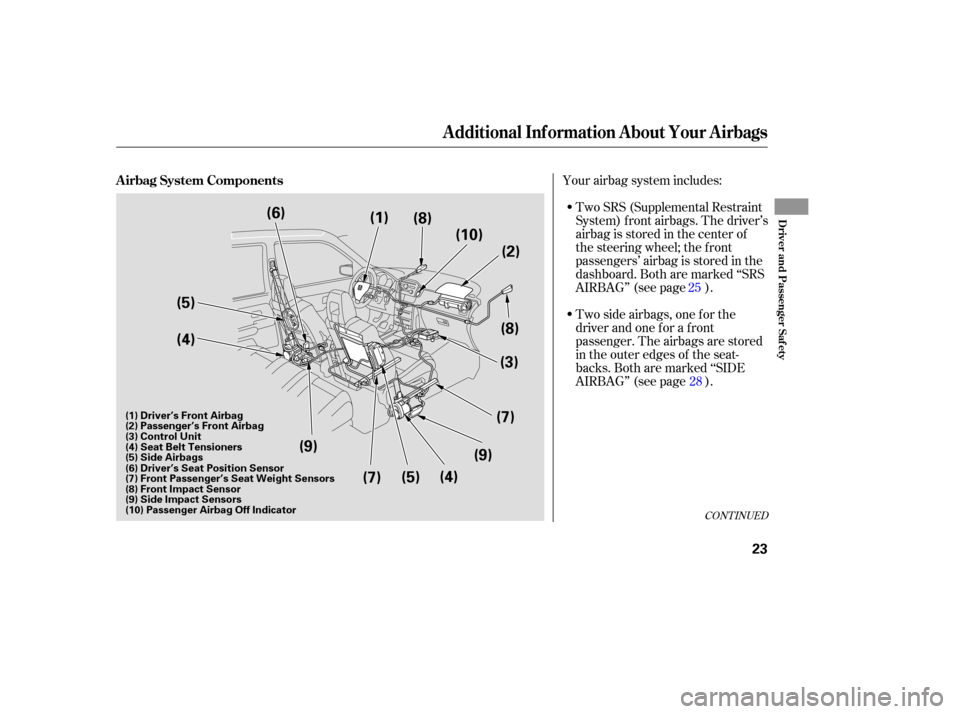
Your airbag system includes:Two SRS (Supplemental Restraint
System) f ront airbags. The driver’s
airbag is stored in the center of
the steering wheel; the f ront
passengers’airbagisstoredinthe
dashboard. Both are marked ‘‘SRS
AIRBAG’’ (see page ).
Two side airbags, one f or the
driver and one f or a f ront
passenger. The airbags are stored
in the outer edges of the seat-
backs. Both are marked ‘‘SIDE
AIRBAG’’ (see page ). 25
28
CONT INUED
Additional Inf ormation About Your Airbags
A irbag System Components
Driver and Passenger Saf ety
23
(1) (2)
(3)
(4)
(5)
(4) (5)
(6)
(8)
(10)
(8)
(7)
(9)
(9)
(7)
(1) Driver’s Front Airbag
(2) Passenger’s Front Airbag
(3) Control Unit
(4) Seat Belt Tensioners
(5) Side Airbags
(6) Driver’s Seat Position Sensor
(7) Front Passenger’s Seat Weight Sensors
(8) Front Impact Sensor
(9) Side Impact Sensors
(10) Passenger Airbag Off Indicator
Page 26 of 273

Automatic front seat belt
tensioners (see page ).
Sensors that can detect a
moderate to severe front impact or
side impact.
Sensors that can detect whether a
child is in the passenger’s side
airbag path and automatically turn
the airbag of f (see page ).
A driver’s seat position sensor that
monitors the distance of the seat
from the front airbag. If the seat is
too f ar f orward, the airbag will
inf late with less f orce (see page). An indicator on the instrument
panel that alerts you that the
passenger’s side airbag has been
turned of f (see page ).
Emergency backup power in case
your vehicle’s electrical system is
disconnected in a crash.
Weight sensors that monitor the
weight on the f ront passenger’s
seat. These automatically turn off
the passenger’s f ront airbag if
they detect an inf ant or small child
maybeintheseat(seepage ).
A sophisticated electronic system
that continually monitors and
records inf ormation about the
sensors, the control unit, the
airbag activators, the seat belt
tensioners, and driver and f ront
passenger seat belt use when the
ignition is in the ON (II) position.
An indicator on the instrument
panel that alerts you to a possible
problem with your airbags,
sensors, or seat belt tensioners
(see page ). An indicator on the dashboard that
alerts you that the f ront
passenger’s side airbag has been
turned of f (see page ).
21
27
30 31
31
27 27
Additional Inf ormation About Your Airbags
24
Page 27 of 273
CONT INUED
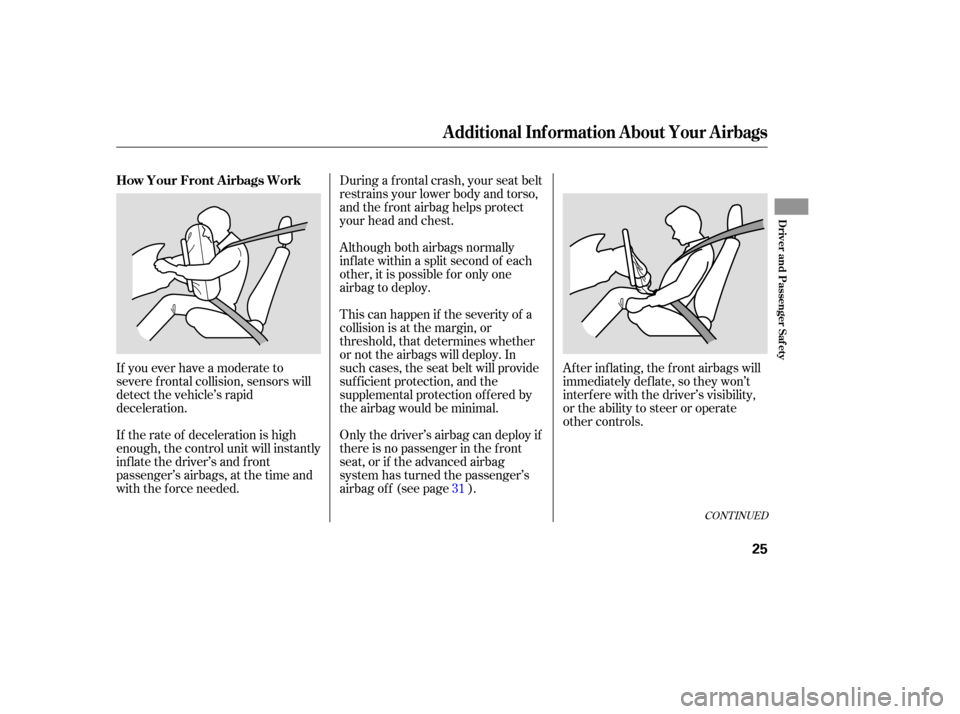
Af ter inf lating, the f ront airbags will
immediately def late, so they won’t
interf ere with the driver’s visibility,
or the ability to steer or operate
other controls.
During a f rontal crash, your seat belt
restrains your lower body and torso,
and the f ront airbag helps protect
your head and chest.
Although both airbags normally
inf late within a split second of each
other, it is possible f or only one
airbag to deploy.
This can happen if the severity of a
collision is at the margin, or
threshold, that determines whether
or not the airbags will deploy. In
such cases, the seat belt will provide
suf f icient protection, and the
supplemental protection of f ered by
the airbag would be minimal.
Only the driver’s airbag can deploy if
there is no passenger in the f ront
seat, or if the advanced airbag
system has turned the passenger’s
airbag off (see page ).
If you ever have a moderate to
severe f rontal collision, sensors will
detect the vehicle’s rapid
deceleration.
If the rate of deceleration is high
enough, the control unit will instantly
inf late the driver’s and f ront
passenger’s airbags, at the time and
with the f orce needed.
31
Additional Inf ormation About Your Airbags
How Your Front Airbags Work
Driver and Passenger Saf ety
25
Page 30 of 273
Moving the f ront seat f orcibly
back against cargo on the seat or
f loor behind it.
Hanging heavy items on the f ront
passenger seat, or placing heavy
items in the seat-back pocket.
When the airbag is turned of f , an
indicator in the center of the
dashboard will come on indicating
passenger airbag ‘‘OFF’’ (see page
).
To ensure that the passenger’s
advanced front airbag system will
work properly,
This includes: A rear passenger pushing or
pulling on the back of the
passenger’s seat.
If there is no passenger in the f ront
seat, the airbag will be off. However,
the Passenger Airbag Of f indicator
will not come on.
Also,makesurethefloormatbehind
the f ront passenger’s seat is hooked
to the floor mat anchor (see page
). If it is not, the mat may
interf ere with the proper operation
of the sensors and operation of the
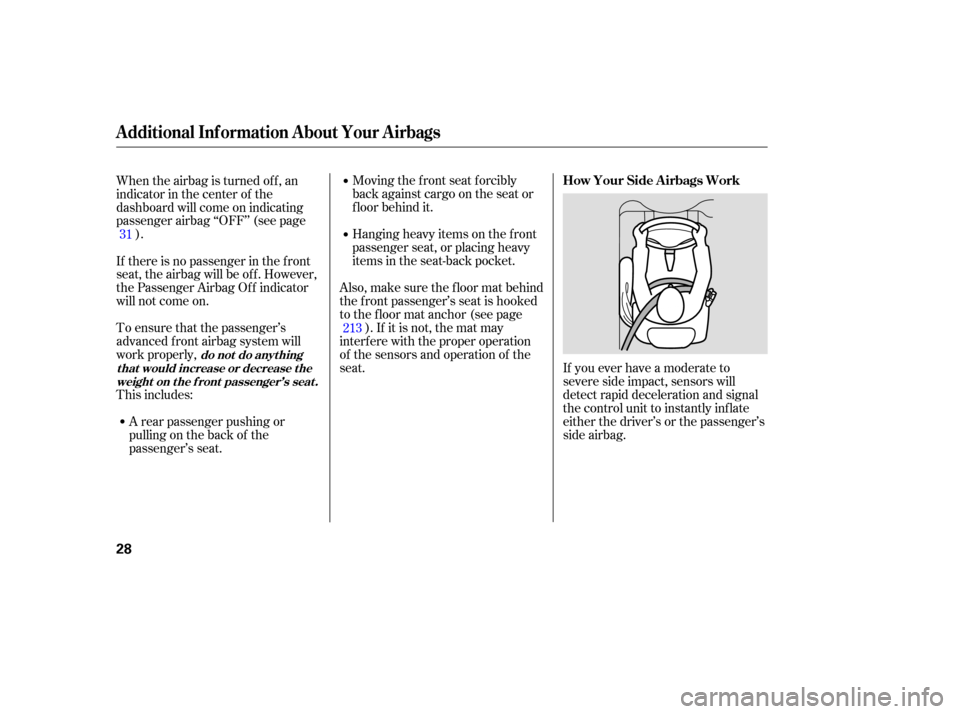
seat. If you ever have a moderate to
severe side impact, sensors will
detect rapid deceleration and signal
the control unit to instantly inf late
either the driver’s or the passenger’s
side airbag.
31
213
Additional Inf ormation About Your Airbags
How Your Side A irbags Work
do not do anyt hing
t hat would increase or decrease t he weight on t he f ront passenger’s seat .
28
Page 31 of 273

There will be some delay between
the moment the passenger moves
into or out of the airbag deployment
pathandwhentheindicatorcomes
on or goes of f .
A f ront seat passenger should not
use a cushion or other object as a
backrest. It may prevent the cutof f
system f rom working properly.
Only one airbag will deploy during a
side impact. If the impact is on the
passenger’s side, the passenger’s
side airbag will deploy even if there
is no passenger.
To get the best protection f rom the
side airbags, front seat occupants
should wear their seat belts and sit
upright and well back in their seats.
To reduce the risk of injury f rom an
inf lating side airbag, your vehicle has
an automatic cutoff system for the
passenger’s side airbag.
If the Side Airbag Of f Indicator
comes on (see page ), have the
passenger sit upright. Once the
passenger is out of the airbag’s
deployment path, the system will
turn the airbag back on, and the
indicator will go out.
Objects placed on the f ront
passenger seat can also cause the
side airbag to be shut of f . Thesideairbagmayalsoshutoff if a
short adult leans sideways, or a
larger adult slouches and leans
sideways into the airbag’s
deployment path. Although we do not encourage
children to ride in f ront, this system
is designed to shut of f the side
airbag if a child leans sideways and
the child’s head is in the side airbag
deployment path. 31
Additional Inf ormation About Your Airbags
Side A irbag Cut of f Syst em
Driver and Passenger Saf ety
29