2005 HONDA ODYSSEY gauge
[x] Cancel search: gaugePage 192 of 414

CONT INUED
Air conditioning places an extra load
on the engine. Watch the engine
coolant temperature gauge (see page). If it moves near the red mark,
turn of f the A/C until the gauge
reads normally.
Press the A/C button. The
indicator in the button comes on
(LX model) or ‘‘A/C ON’’ is shown
in the display (EX and Touring
models)whenafanspeedis
selected.
Make sure the temperature is set
to the lower limit.
Select .
If the outside air is humid, select
recirculation mode. If the outside
air is dry, select f resh air mode. you can
cool it down more rapidly by partially
opening the windows, turning on the
A/C, and setting the fan to
maximum speed in f resh air mode.
The f low-through ventilation system
draws in outside air, circulates it
through the interior, then exhausts it
through vents near the rear side
panels.
The heater uses engine coolant to
warm the air. If the engine is cold, it
will be several minutes bef ore you
f eel warm air coming f rom the
system.
Select and fresh air mode.
Set the f an to the desired speed.
Adjust the warmth of the air with
the temperature control dial or
buttons. Set the temperature control dial or
button to the lower limit.
Make sure the A/C is of f .
Select and fresh air mode.
Set the f an to the desired speed.
Set the f an to the desired speed.
1.
2.
3.
4.
5.
1.
2.
3. 1.
2.
3.
4. 71
If the interior is very warm,
Vents, Heating, and A/C
Using the A /C
Ventilation
Using the Heater
Features
191
Page 293 of 414

Youshoulddothefollowingchecks
and adjustments bef ore you drive
your vehicle.Make sure all windows, mirrors,
and outside lights are clean and
unobstructed. Remove f rost, snow,
or ice.
Check that the hood is f ully closed.
Visually check the tires. If a tire
looks low, use a gauge to check its
pressure.
Check that any items you may be
carrying are stored properly or
f astened down securely. Check the seat adjustment (see
page ).
Check the adjustment of the
inside and outside mirrors (see
page ).
Check the steering wheel
adjustment (see page ).
Make sure the doors and the
tailgate are securely closed and
locked.
Fasten your seat belt. Check that
your passengers have f astened
their seat belts (see page ).
When you start the engine, check
the gauges and indicators in the
instrument panel (see page ).
3.
2.
1.
4. 5.
6.
7.
8.
9.
10. 16
61
167
149
127
Preparing to Drive
292
Page 309 of 414

The best way to conf irm that vehicle
and trailer weights are within limits
is to have them checked at a public
scale.
Using a suitable scale or a special
tongue load gauge, check the tongue
load the f irst time you set up a
towing combination (a f ully-loaded
vehicle and trailer), then recheck the
tongue load whenever the conditions
change.If the total trailer weight is more
than 1,850 lbs (840 kg), you must
also use a weight distributing hitch.
This device transf ers weight f rom
the vehicle’s rear wheels to the f ront
wheels, and to the trailer’s wheels.
Caref ully f ollow the hitch maker’s
instructions f or proper installation
and adjustment.
Always use saf ety chains when you
tow a trailer. Make sure the chains
are secured to the trailer and hitch,
and that they cross under the tongue
and can catch the trailer if it
becomes unhitched. Leave enough
slack to allow the trailer to turn
corners easily, but do not let the
chains drag on the ground.
Towing generally requires a variety
of supplemental equipment,
depending on the size of your trailer,
how much load you are towing, and
where you tow. To ensure the best
quality, we recommend that you
purchase Honda equipment
whenever possible.
Discuss your needs with your trailer
sales or rental agency, and f ollow the
guidelines in this section. Also make
sure that all equipment is properly
installed and meets f ederal, state,
province, and local regulations.
Any hitch used on your vehicle must
be properly bolted to the underbody,
using the six threaded holes
provided. A hitch and the required
f luid coolers designed especially f or
your Odyssey can be obtained f rom
your Honda dealer.
Towing a Trailer
Checking L oads
T owing Equipment and
A ccessoriesWeight Distributing Hitch
Saf et y Chains
Hitches
308
Page 313 of 414

Maketurnsmoreslowlyandwider
than normal. The trailer tracks a
smaller arc than your vehicle, and it
canhitorrunoversomethingthe
vehicle misses. Allow more time and
distance f or braking. Do not brake or
turn suddenly as this could cause the
trailer to jackknif e or turn over.
When climbing hills, closely watch
your temperature gauge. If it nears
the red mark, turn the air
conditioning of f , reduce speed and, if
necessary, pull to the side of the
road to let the engine cool.
If the automatic transmission shif ts
f requently while going up a hill, shif t
to D .Always drive slowly and have
someone guide you when backing up.
Grip the of the steering
wheel; then turn the wheel to the lef t
to get the trailer to move to the lef t,
andturnthewheelrighttomovethe
trailer to the right.
Follow all normal precautions when
parking, including putting the
transmission in Park and f irmly
setting the parking brake. Also, place
wheel chocks at each of the trailer’s
tires.
If you must stop when f acing uphill,
use the f oot brake or parking brake.
Do not try to hold the vehicle in
placebypressingontheaccelerator,
as this can cause the automatic
transmission to overheat.
When driving down hills, reduce
your speed, and shif t down to 2nd
gear. Do not ‘‘ride’’ the brakes, and
remember, it will take longer to slow
downandstopwhentowingatrailer.
Crosswinds and air turbulence
caused by passing trucks can disrupt
your steering and cause trailer
swaying. When being passed by a
large vehicle, keep a constant speed,
and steer straight ahead. Do not try
to make quick steering or braking
corrections.
3
bottom
Towing a Trailer
Making T urns and Braking
Driving on Hills Backing Up
Parking
Handling Crosswinds and Buf f et ing
312
Page 334 of 414
On Canadian models:On the Touring model:The low washer
level indicator comes on when the
level is low (see page ).
You will see a
‘‘WASHER FLUID LOW’’ message
on the multi-information display
when the level is low.
Fill the reservoir with a good-quality
windshield washer f luid. This
increases the cleaning capability and
prevents f reezing in cold weather.
When you ref ill the reservoir, clean
the edges of the windshield wiper
blades with windshield washer f luid
on a clean cloth. This will help to
condition them.
Check the f luid level in the
windshield washer reservoir at least
monthly during normal use. This
reservoir supplies the windshield and
rear window washers.
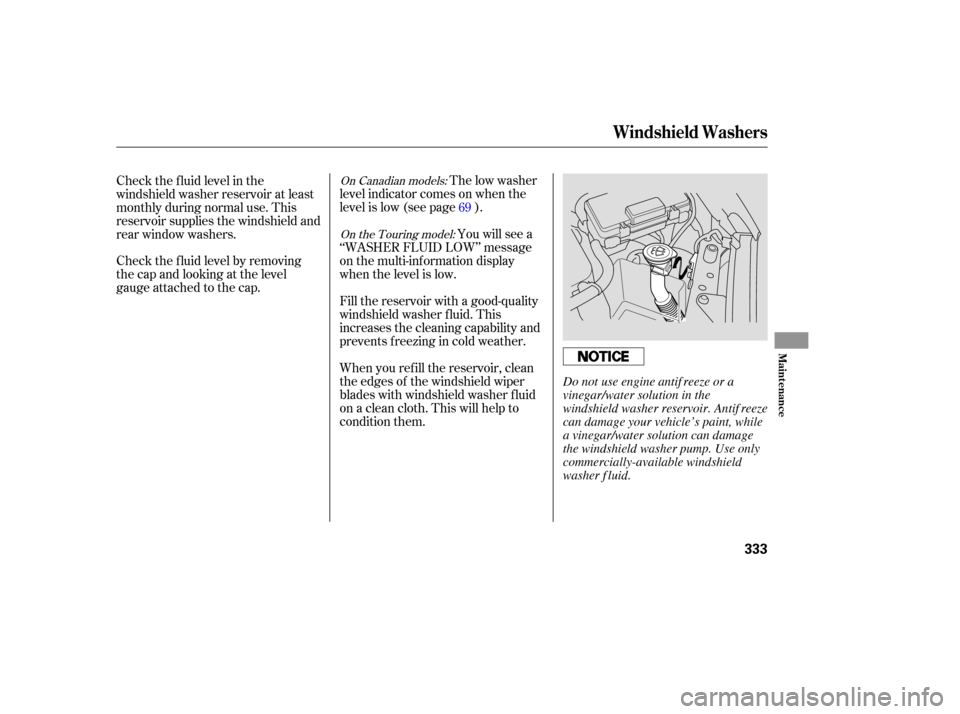
Check the f luid level by removing
the cap and looking at the level
gauge attached to the cap.
69
Windshield Washers
Maint enance
333
Do not use engine antif reeze or a
vinegar/water solution in the
windshield washer reservoir. Antif reeze
can damage your vehicle’s paint, while
a vinegar/water solution can damage
the windshield washer pump. Use only
commercially-available windshield
washer f luid.
Page 347 of 414
To saf ely operate your vehicle, your
tires must be the proper type and
size, in good condition with adequate
tread, and correctly inf lated.
The f ollowing pages give more
detailed inf ormation on how to take
care of your tires and what to do
when they need to be replaced.Keeping the tires properly inf lated
provides the best combination of
handling, tread lif e, and riding
comf ort.
Underinf lated tires wear unevenly,
adversely affect handling and fuel
economy, and are more likely to
fail from being overheated.
Overinf lated tires can make your
vehicleridemoreharshly,are
more prone to damage f rom road
hazards, and wear unevenly.
The tire pressure monitoring system
(TPMS) warns you when a tire
pressure is low. See page f or
more inf ormation.
We recommend that you visually
check your tires every day. If you
think a tire might be low, check it
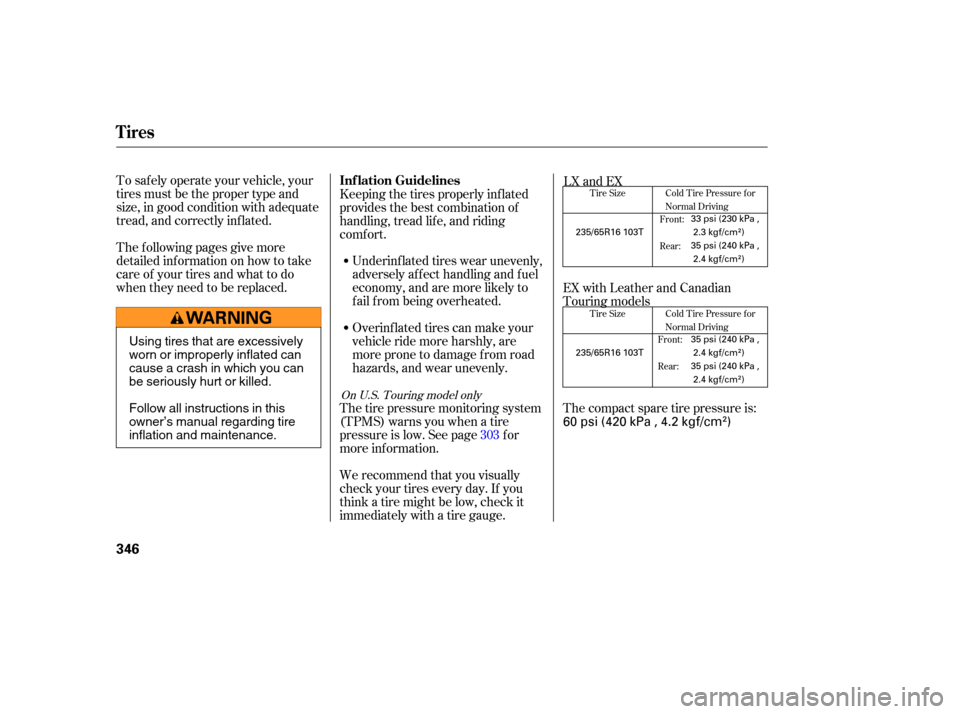
immediately with a tire gauge. Thecompactsparetirepressureis:
303 LX and EX
EX with Leather and Canadian
Touring modelsTire Size
Tire Size Cold Tire Pressure for
Normal Driving
Front:
Rear:
Cold Tire Pressure for
Normal Driving
Front:
Rear:
On U.S. Touring model only
Tires
Inf lation Guidelines
346
235/65R16 103T 33 psi (230 kPa ,
2.3 kgf/cm)
35 psi (240 kPa , 2.4 kgf/cm
)
235/65R16 103T 35 psi (240 kPa ,
2.4 kgf/cm
)
35 psi (240 kPa , 2.4 kgf/cm
)
60 psi (420 kPa , 4.2 kgf/cm)
Using tires that are excessively
worn or improperly inflated can
cause a crash in which you can
be seriously hurt or killed.
Follow all instructions in this
owner’s manual regarding tire
inflation and maintenance.
Page 348 of 414

CONT INUED
Excessive tread wear. Cuts, splits, or cracks in the side
of the tire. Replace the tire if you
can see f abric or cord.
Youshouldgetyourowntire
pressure gauge and use it whenever
you check your tire pressures. This
will make it easier f or you to tell if a
pressure loss is due to a tire problem
and not due to a variation between
gauges.
Bumps or bulges in the tread or
side of the tire. Replace the tire if
youfindeitherof theseconditions.
Every time you check inf lation, you
should also examine the tires for
damage, f oreign objects, and wear.
Youshouldlookfor:
If you check the pressure when the
tires are hot [driven f or several miles
(kilometers)], you will see readings 4
to6psi(30to40kPa,0.3to
0.4 kgf /cm ) higher than the cold
reading. This is normal; do not
release air to match the cold
pressure. The tires will be
underinf lated.
Tubeless tires have some ability to
self -seal if they are punctured. You
should look closely f or punctures if a
tire starts losing pressure.
For convenience, the recommended
tire sizes and cold air pressures are
on a label on the driver’s doorjamb.
Tire pressure f or high speed driving
is the same as f or normal driving.
For additional technical inf ormation,
see page .
Use a gauge to measure the air
pressure at least once a month. Even
tires that are in good condition may
lose one to two psi (10 to 20 kPa, 0.1
to 0.2 kgf /cm ) per month.
Remember to check the spare tire at
thesametime. Check the air pressures when the
tires are cold. This means the
vehicle has been parked f or at least
three hours, or driven less than 1
mile (1.6 km). Add or release air, if
needed, to match the recommended
cold tire pressures.
390
U.S. Touring model
Tire Size Cold Tire Pressure for
Normal Driving
Front:
Rear:
Tires
Tire Inspection
Maint enance
347
235-710R460A
104T 33 psi (230 kPa ,
2.3 kgf/cm)
35 psi (240 kPa , 2.4 kgf/cm
)
Page 368 of 414
Are you using a properly coded
key? An improperly coded key will
cause the immobilizer system
indicator in the instrument panel
to blink rapidly (see page ).
Do you have f uel? Check the f uel
gauge; the low f uel indicator may
not be working.
There may be an electrical
problem, such as no power to the
f uel pump. Check all the f uses
(see page ).
If youfindnothingwrong,youwill
need a qualif ied technician to f ind
the problem. See on page . Although this seems like a simple
procedure, you should take several
precautions.
Open the hood, and check the
physical condition of the battery.
In very cold weather, check the
condition of the electrolyte. If it
seems slushy or f rozen, do not try
jump starting until it thaws.
You cannot start your vehicle by
pushing or pulling it. Turn of f all the electrical acces-
sories: heater, A/C, climate
control, audio system, lights, etc.
Put the transmission in Neutral or
Park, and set the parking brake.
1.
2.
376
381 129
CONT INUED
Emergency
Towing Jump Starting
To Jump Start Your Vehicle:
If the Engine Won’t Start, Jump Starting
T aking Care of t he Unexpect ed
367
A battery can explode if you do
not follow the correct procedure,
seriously injuring anyone
nearby.
Keep all sparks, open flames,
and smoking materials away
from the battery.
If a battery sits in extreme cold, the
electrolyte inside can f reeze.
Attempting to jump start with a f rozen
battery can cause it to rupture.